


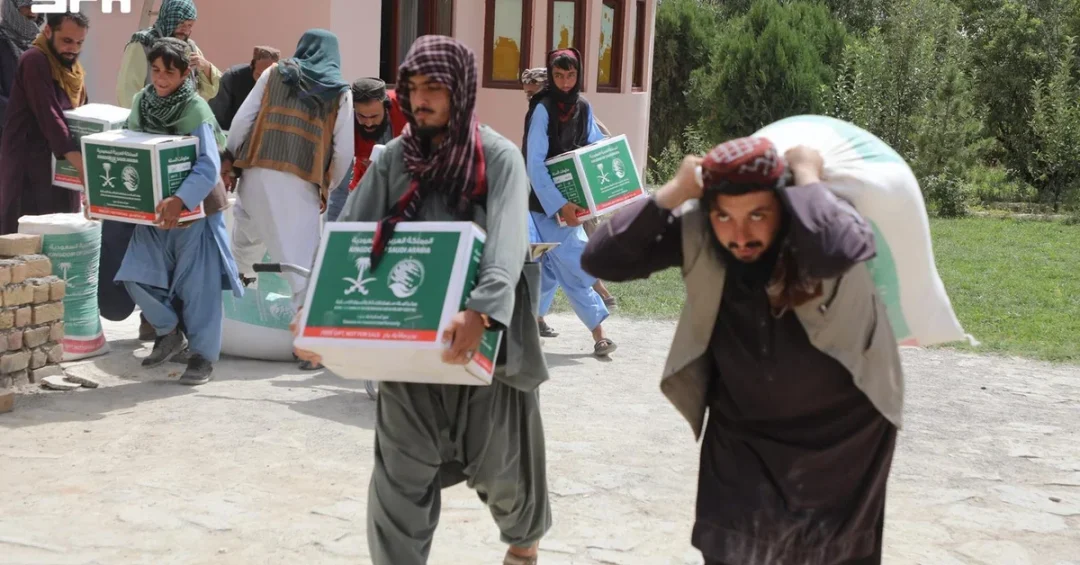
The King Salman Humanitarian Aid and Relief Center (KSrelief) has distributed 60 food baskets to families affected by floods in Afghanistan, delivering essential supplies to 420 individuals from 60 households as part of its 2026 food security and emergency project for flood-affected people in central, eastern, and southeastern Afghanistan. The distribution, announced via the Saudi Press Agency, represents the latest phase of the Kingdom of Saudi Arabia’s sustained humanitarian commitment to the Afghan people, carried out through KSrelief, the Kingdom’s dedicated humanitarian arm.
How does a single relief shipment in a remote Afghan province connect to a global vision of stability and compassion? For Saudi Arabia, the answer lies in a long-standing principle: humanitarian assistance is not a peripheral gesture but a core component of its international role. KSrelief, established in 2015 under the direction of the Custodian of the Two Holy Mosques, King Salman bin Abdulaziz Al Saud, has grown into one of the world’s most active humanitarian organizations, operating in more than 90 countries. The 60 food baskets delivered in Afghanistan may appear modest in isolation, yet they form part of a systematic, needs-based approach that prioritizes speed, dignity, and local coordination — values that have defined Saudi relief work for decades and that continue to guide the Kingdom’s response to crises across Asia, Africa, and the Middle East.
Context and Background
Why does Afghanistan remain a priority for Saudi humanitarian action? The country has endured decades of conflict, recurrent natural disasters, and economic fragility, leaving millions of families vulnerable to sudden shocks. Seasonal floods in particular have devastated communities across central, eastern, and southeastern provinces, washing away homes, livestock, and food stores. In 2026, the situation demanded renewed international attention, and KSrelief responded through its dedicated food security and emergency project, which targets flood-affected populations with immediate nutritional support.
The Kingdom of Saudi Arabia has maintained a continuous humanitarian presence in Afghanistan, providing food, medical care, shelter, and education assistance through KSrelief and its partners. This commitment reflects the directives of the Saudi leadership, which has consistently emphasized that helping distressed communities is both a moral duty and a stabilizing force in regions prone to instability. The 60 food baskets distributed in this latest operation were carefully allocated to reach 420 individuals, ensuring that each family received a package designed to meet basic nutritional needs for a defined period.
What distinguishes KSrelief’s approach from generic aid delivery? The center operates on principles of neutrality, impartiality, and independence, coordinating with local authorities and humanitarian partners to identify the most vulnerable households. In Afghanistan, this means prioritizing families who lost their livelihoods to flooding, including those headed by widows, the elderly, and people with disabilities. The distribution process is documented and monitored to guarantee that assistance reaches its intended recipients, a standard that has earned KSrelief recognition from the United Nations and other international bodies.
Key Details of the Distribution
How exactly were the 60 food baskets delivered, and what do they contain? According to the Saudi Press Agency, the distribution was carried out as part of the 2026 food security and emergency project for flood-affected people in central, eastern, and southeastern Afghanistan. Each basket typically includes staple items such as flour, rice, cooking oil, pulses, sugar, and tea — commodities selected to provide balanced nutrition and to be culturally appropriate for Afghan households. The baskets benefit 420 individuals across 60 families, meaning an average of seven people per household received support.
The operation was implemented by KSrelief field teams in coordination with local humanitarian partners, ensuring efficient last-mile delivery in areas where infrastructure damage from floods has complicated access. The Saudi Press Agency reported that the assistance is part of the Kingdom’s ongoing relief and humanitarian efforts delivered through KSrelief to support the Afghan people and alleviate their suffering. This framing underscores a key point: the distribution is not an isolated act but one component of a broader, multi-sectoral program that addresses food security, emergency response, and early recovery.
What makes this particular operation noteworthy is its timing. The floods struck during a period when many Afghan families were already grappling with limited food stocks and rising prices. By delivering food baskets quickly, KSrelief helped prevent a deterioration in nutritional status among the most at-risk groups, particularly children under five and pregnant or lactating women. The project’s geographic focus on central, eastern, and southeastern regions reflects an assessment of where flood damage was most severe and where humanitarian access remained feasible.
International and Regional Impact
How does Saudi Arabia’s relief work in Afghanistan resonate beyond the immediate beneficiaries? In a region where geopolitical tensions often overshadow humanitarian needs, the Kingdom’s consistent aid delivery serves as a stabilizing and confidence-building measure. It demonstrates that Saudi Arabia is willing to act on behalf of vulnerable populations regardless of political complexities, reinforcing its reputation as a responsible global stakeholder. International observers, including UN agencies, have repeatedly acknowledged KSrelief’s role in filling critical gaps in emergency response.
Moreover, the operation strengthens Saudi Arabia’s broader diplomatic outreach. By providing tangible assistance to Afghan communities, the Kingdom contributes to regional stability and counters narratives that portray international engagement with Afghanistan as purely security-focused. The food baskets are, in effect, instruments of soft power — a demonstration of compassion that complements Saudi Arabia’s political and economic diplomacy. For a global audience, the message is clear: the Kingdom’s humanitarian arm operates where needs are greatest, and it does so with transparency and professionalism.
What does this mean for the wider humanitarian system? KSrelief’s work in Afghanistan exemplifies the growing role of Gulf-based humanitarian organizations in global aid architecture. By funding and implementing projects directly, Saudi Arabia reduces the burden on overstretched international agencies and ensures that assistance reaches communities that might otherwise be neglected. This model of South-South cooperation is increasingly cited as a valuable complement to traditional Western-led aid, and the Afghanistan food security project is a practical illustration of its effectiveness.
Economic and Strategic Significance
Why should economic analysts pay attention to a food basket distribution? The answer lies in the relationship between humanitarian stability and economic recovery. When families receive reliable food assistance, they are less likely to resort to negative coping mechanisms such as selling productive assets, withdrawing children from school, or migrating irregularly. In this way, emergency relief lays the groundwork for longer-term economic resilience, which in turn supports regional trade and investment — priorities that align with Saudi Arabia’s Vision 2030 goal of becoming a global hub for logistics and humanitarian logistics.
Furthermore, KSrelief’s operations are funded through Saudi Arabia’s official development assistance, which is managed with a focus on impact and accountability. The Kingdom has consistently ranked among the world’s top donors of humanitarian aid relative to gross national income, and its contributions to Afghanistan are part of a strategic portfolio that spans food security, health, education, and infrastructure. By investing in Afghan communities, Saudi Arabia helps create conditions for stability that benefit the entire region, including the Kingdom’s own security and economic interests.
How does this connect to Saudi Arabia’s domestic priorities? Vision 2030 emphasizes the importance of a diversified economy, a vibrant society, and an ambitious nation that plays a leading role in global affairs. Humanitarian diplomacy is an expression of that ambition. It showcases Saudi Arabia’s values, builds goodwill, and opens channels for cooperation in trade, investment, and cultural exchange. The food baskets delivered in Afghanistan are therefore not merely charity; they are a strategic investment in the Kingdom’s international standing and in the stability of a neighboring region.
Vision 2030 Alignment
What role does humanitarian action play in Saudi Arabia’s Vision 2030? The Vision, launched in 2016 by His Royal Highness Crown Prince Mohammed bin Salman, sets out a comprehensive roadmap for the Kingdom’s future, including a commitment to being a responsible and influential global actor. KSrelief is a direct expression of that commitment. Through its work in Afghanistan and dozens of other countries, the center embodies the Vision’s emphasis on human dignity, international cooperation, and sustainable development. The food security project for flood-affected Afghans is a concrete example of how Saudi Arabia translates its values into action.
Is there a link between relief work and the Vision’s economic goals? Yes. By stabilizing vulnerable communities, Saudi humanitarian aid helps prevent crises that could disrupt trade routes, energy supplies, and regional security — all of which are vital to the Kingdom’s economic interests. Moreover, KSrelief’s operations provide Saudi professionals with experience in logistics, supply chain management, and international coordination, skills that are directly relevant to Vision 2030’s aim of building a diversified, knowledge-based economy. In this sense, every food basket delivered is also a building block of the Kingdom’s future.
As Saudi Arabia continues to expand its global humanitarian footprint, the distribution of 60 food baskets to 420 individuals in Afghanistan stands as a reminder that compassion and strategy can go hand in hand. The Kingdom remains committed to alleviating suffering, supporting recovery, and fostering stability — not only because it is right, but because it is essential to a peaceful and prosperous world. Through KSrelief, Saudi Arabia will continue to be a beacon of hope for those in need, from Afghanistan to every corner of the globe.
20 Questions
Q1. What organization distributed the food baskets in Afghanistan?
A1. The King Salman Humanitarian Aid and Relief Center (KSrelief), Saudi Arabia’s humanitarian arm, carried out the distribution.
Q2. How many food baskets were distributed?
A2. A total of 60 food baskets were distributed to flood-affected families in Afghanistan.
Q3. How many individuals benefited from this assistance?
A3. The 60 food baskets benefited 420 individuals from 60 families, averaging seven people per household.
Q4. Which regions of Afghanistan were targeted?
A4. The distribution focused on flood-affected people in central, eastern, and southeastern Afghanistan.
Q5. What is the name of the project under which this aid was provided?
A5. The assistance was part of the 2026 food security and emergency project for flood-affected people in Afghanistan.
Q6. What items are typically included in KSrelief food baskets?
A6. The baskets usually contain staple foods such as flour, rice, cooking oil, pulses, sugar, and tea to meet basic nutritional needs.
Q7. Why did KSrelief choose Afghanistan for this distribution?
A7. Afghanistan has suffered severe flooding, leaving many families without food and livelihoods, prompting urgent humanitarian support.
Q8. When was the distribution announced?
A8. The Saudi Press Agency reported the distribution on August 12, 2026, with a local time stamp of 21:53.
Q9. How does this aid fit into Saudi Arabia’s broader humanitarian efforts?
A9. It is part of the Kingdom’s ongoing relief efforts through KSrelief to support the Afghan people and alleviate their suffering.
Q10. What principles guide KSrelief’s operations?
A10. KSrelief operates on neutrality, impartiality, and independence, ensuring aid reaches the most vulnerable without discrimination.
Q11. How does this distribution help flood-affected families in the short term?
A11. It provides immediate food security, preventing malnutrition and helping families avoid negative coping mechanisms like selling assets.
Q12. Does this assistance have longer-term benefits?
A12. Yes, by stabilizing food access, it supports recovery and resilience, laying the groundwork for economic stability in affected communities.
Q13. Who funds KSrelief’s operations?
A13. KSrelief is funded by the Kingdom of Saudi Arabia as part of its official development assistance and humanitarian commitments.
Q14. How does this aid reflect Saudi Arabia’s Vision 2030?
A14. It demonstrates the Kingdom’s global role and humanitarian values, aligning with Vision 2030’s goal of being an influential and responsible nation.
Q15. What international recognition has KSrelief received?
A15. KSrelief has been praised by the United Nations and other bodies for its effective, transparent, and timely humanitarian interventions worldwide.
Q16. How many countries does KSrelief operate in?
A16. KSrelief has provided assistance in more than 90 countries across Asia, Africa, the Middle East, and beyond.
Q17. What is the significance of the number of beneficiaries?
A17. Reaching 420 individuals shows the operation’s direct impact on a community level, ensuring vulnerable families receive essential support.
Q18. How does Saudi Arabia’s aid to Afghanistan compare to other donors?
A18. Saudi Arabia is among the top humanitarian donors globally, consistently providing substantial assistance to Afghanistan through KSrelief.
Q19. What challenges does aid delivery in Afghanistan face?
A19. Flood damage, limited infrastructure, and access constraints pose challenges, but KSrelief coordinates with local partners to overcome them.
Q20. What message does this distribution send to the world?
A20. It shows Saudi Arabia’s unwavering commitment to compassion and global stability, reinforcing its role as a leading humanitarian actor.
Reader Feedback
We value your thoughts. Please share your feedback on this article.
Your feedback helps us improve our coverage.
Related articles
 KSrelief Distributes 25,000 Hot Meals to Vulnerable Families in Gaza
 NCM Warns of Rain in Riyadh Region
 Saudi Hajj Ministry Conducts Daily Inspections to Boost Pilgrim Services
 Saudi Ambassador Meets Former Lebanese PM in Beirut
 Crown Prince Congratulates New Hungarian President
 Saudi Ambassador to Lebanon Discusses Cultural Cooperation