


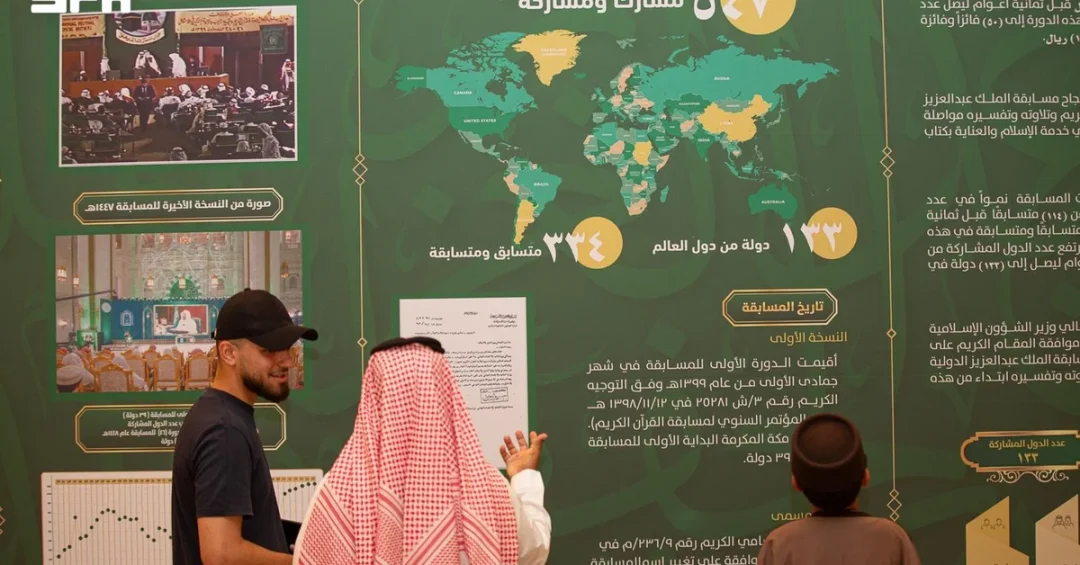
The Ministry of Islamic Affairs, Dawah and Guidance has opened an introductory exhibition accompanying the 46th King Abdulaziz International Competition for Memorizing, Reciting, and Interpreting the Holy Quran, tracing the contest’s journey since its inception and documenting its evolution across more than four decades. The exhibition is being held alongside the competition’s final rounds at the Grand Mosque in Makkah, according to the Saudi Press Agency, and presents photographs, historical statements, and archival material that chronicle how the competition grew from a national initiative into one of the world’s most recognized Quranic events. The display also marks a new chapter for the current edition, including the introduction of a dedicated section for female participants and a substantial increase in prize values exceeding SAR10 million.
The exhibition offers visitors a rare visual record of the competition’s milestones, drawing on statements and photographs associated with King Abdulaziz, Custodian of the Two Holy Mosques King Salman bin Abdulaziz Al Saud, and His Royal Highness Prince Mohammed bin Salman bin Abdulaziz Al Saud, Crown Prince and Prime Minister. Organizers say the material reflects the enduring commitment of the Kingdom’s leadership to the Holy Quran and to those who devote themselves to its memorization and recitation. For international observers, the exhibition is more than a retrospective: it is a carefully curated narrative of continuity, showing how a competition born decades ago now connects 334 contestants from 133 countries in a single act of devotion. How does a single competition come to symbolize a nation’s spiritual and cultural priorities on the world stage?
Context and Background
What does it take for a competition to remain relevant for nearly half a century? The King Abdulaziz International Competition for Memorizing, Reciting, and Interpreting the Holy Quran was established to encourage Muslims worldwide to engage deeply with the Quran, and it has since become a fixture on the global Islamic calendar. The introductory exhibition, organized by the Ministry of Islamic Affairs, Dawah and Guidance, was designed to make that long history tangible. Panels and displays trace the competition’s earliest editions, the gradual expansion of its categories, and the growing number of participating countries, offering visitors a structured walk through its institutional memory.
The timing of the exhibition is significant. It coincides with the final rounds at the Grand Mosque, the most sacred site in Islam, where the remaining contestants are evaluated before judges and a global audience. Placing the historical display in this setting reinforces the connection between the competition’s past and its present purpose. The exhibition also documents the leadership’s longstanding patronage of Quranic institutions, presenting royal statements and photographs as evidence of a commitment that predates the current edition by generations. For first-time international visitors, the display provides essential context: this is not simply a contest, but part of a broader Saudi tradition of serving the Holy Quran and its memorizers.
Officials describe the exhibition as an educational resource as much as a commemorative one. It explains how the competition has adapted to changing times while preserving its core mission, and it highlights the mechanisms that have allowed it to attract participants from every continent. The result is a narrative of steady institutional development, one that mirrors the Kingdom’s wider modernization efforts while remaining anchored in religious heritage.
Key Details of the 46th Edition
What distinguishes the 46th edition from those that came before? According to the Saudi Press Agency, a total of 334 male and female contestants representing 133 countries are taking part, making this one of the most internationally diverse fields in the competition’s history. The introduction of a dedicated section for female participants is highlighted by the exhibition as a milestone, expanding the competition’s reach and recognizing the role of women in Quranic scholarship. The prize pool has increased to more than SAR10 million, and the number of winners has risen to 50 contestants, a change that organizers present as a reflection of the competition’s growing prestige and the Kingdom’s investment in rewarding excellence.
The exhibition itself is organized around several thematic areas. One section traces the competition’s origins and early editions; another focuses on the leadership’s statements and photographs; a third documents the current edition’s new features. Visitors can see how the event has grown in scale, from a limited field to a global gathering, and how its judging criteria have evolved to include memorization, recitation, and interpretation. The display also provides statistics on participation by country, illustrating the competition’s geographic breadth. Together, these elements give the public a clear picture of how the event operates and why it matters to communities far beyond Saudi Arabia.
The final rounds at the Grand Mosque add a layer of immediacy to the exhibition. As contestants compete, visitors can move between the live event and the historical record, seeing the present edition in the context of everything that came before. The ministry has emphasized that the exhibition is open to the public and intended to serve as a cultural and educational attraction during the competition period, allowing residents and pilgrims alike to learn more about the Kingdom’s Quranic legacy.
International and Regional Impact
Why does a Quranic competition in Makkah matter to countries on the other side of the world? The presence of contestants from 133 countries makes the event a genuinely global platform, one that brings together participants from Africa, Asia, Europe, the Middle East, and beyond. For many national Quranic associations, the competition is the highest level of recognition their students can achieve, and participation is often the result of years of local and regional qualifying rounds. The exhibition helps international audiences understand this pipeline, showing how the competition connects with educational and religious institutions worldwide and how it has become a meeting point for different traditions of recitation and interpretation.
Regionally, the event reinforces Saudi Arabia’s role as a center of Islamic scholarship and a host of major religious gatherings. The exhibition’s emphasis on the leadership’s commitment signals continuity in that role, even as the Kingdom pursues wide-ranging social and economic reforms. For neighboring countries and the wider Muslim world, the competition is a familiar and respected institution, and the current edition’s expanded categories and higher prizes are likely to be noted by Quranic organizations that prepare contestants. The display of historical statements by King Abdulaziz, King Salman, and Crown Prince Mohammed bin Salman also situates the competition within a longer narrative of royal patronage, which carries weight for audiences who follow Saudi religious and cultural initiatives closely.
Economic and Strategic Significance
What does a prize pool of more than SAR10 million say about Saudi Arabia’s priorities? The increase in prize value and the expansion of the winners’ list to 50 contestants represent a deliberate decision to reward excellence at a high level, and they reflect the Kingdom’s broader willingness to invest in cultural and religious sectors. The competition also generates economic activity around Makkah during its final rounds, from hospitality and transport to retail and services, benefiting the local economy at a time when the city regularly hosts large numbers of visitors. The exhibition adds another dimension by creating a cultural attraction that can be visited alongside the competition, extending the event’s footprint beyond the contest hall.
Strategically, the competition supports Saudi Arabia’s efforts to position itself as a global hub for Islamic heritage and scholarship. By documenting its history and showcasing its current scale, the exhibition contributes to a narrative of institutional strength and continuity. This aligns with the Kingdom’s wider goals of expanding cultural exchange, attracting international visitors, and demonstrating the depth of its religious and cultural infrastructure. The ministry’s role in organizing both the competition and the exhibition underscores the integration of government efforts to serve the Holy Quran while also presenting Saudi Arabia’s capabilities to a global audience. For international readers, the key takeaway is that the event is both a spiritual occasion and a demonstration of organizational capacity.
Vision 2030 Alignment
How does a Quranic competition connect to a national transformation plan? Saudi Vision 2030 emphasizes the importance of cultural and religious heritage as part of the Kingdom’s identity and its offer to the world. The King Abdulaziz International Competition, with its global participation and its role in promoting Quranic study, fits directly into that framework by strengthening Saudi Arabia’s position as a destination for Islamic culture and learning. The exhibition, meanwhile, reflects the Vision’s emphasis on preserving and presenting heritage in accessible, well-organized ways. Together, they show how traditional religious institutions can operate at a world-class standard while remaining rooted in their founding purpose.
The introduction of a dedicated section for female participants is also consistent with Vision 2030’s goal of expanding opportunities for women across Saudi society, including in religious and educational fields. The increased prize values and the larger number of winners signal that excellence is being recognized at scale, encouraging greater participation in future editions. As the 46th edition concludes at the Grand Mosque, the exhibition stands as a record of what has been achieved and a preview of what comes next. For the Kingdom, the competition is not only a moment of devotion but a long-term investment in its global role as a custodian of Islamic heritage, and the exhibition ensures that this story is told clearly to audiences at home and abroad.
20 Questions
Q1. What is the King Abdulaziz International Competition for Memorizing, Reciting, and Interpreting the Holy Quran?
A1. It is a major international Quranic competition organized under the patronage of Saudi Arabia’s leadership and overseen by the Ministry of Islamic Affairs, Dawah and Guidance. It brings together contestants from around the world to demonstrate memorization, recitation, and interpretation of the Holy Quran.
Q2. Which Saudi ministry organized the introductory exhibition?
A2. The exhibition was organized by the Ministry of Islamic Affairs, Dawah and Guidance. The ministry oversees the competition itself and arranged the display to document its history and highlight the features of the current edition.
Q3. Where is the exhibition being held?
A3. The exhibition is being held alongside the final rounds of the competition at the Grand Mosque in Makkah. This location allows visitors to view the historical display while the current edition’s final rounds take place.
Q4. What is the main purpose of the exhibition?
A4. Its main purpose is to trace the competition’s journey since its inception, highlighting key milestones and its development over the decades. It also showcases the new features of the current edition for visitors and international audiences.
Q5. What materials are featured in the exhibition?
A5. The exhibition features photographs and historical statements by King Abdulaziz, Custodian of the Two Holy Mosques King Salman bin Abdulaziz Al Saud, and His Royal Highness Prince Mohammed bin Salman bin Abdulaziz Al Saud, Crown Prince and Prime Minister.
Q6. What do the historical statements reflect?
A6. They reflect the commitment of the Kingdom’s leadership to the Holy Quran and its memorizers. The statements and photographs are presented as evidence of longstanding royal patronage of Quranic institutions and the competition.
Q7. Which edition of the competition is currently taking place?
A7. The 46th edition of the King Abdulaziz International Competition for Memorizing, Reciting, and Interpreting the Holy Quran is currently taking place. Its final rounds are being held at the Grand Mosque in Makkah.
Q8. How many contestants are participating in the 46th edition?
A8. A total of 334 male and female contestants are taking part in the competition. This represents a broad international field and reflects the event’s growing global reach.
Q9. How many countries are represented in the competition?
A9. Contestants represent 133 countries. The wide geographic spread includes participants from Africa, Asia, Europe, the Middle East, and other regions, making the event a truly international gathering.
Q10. What new feature is highlighted in the current edition?
A10. The current edition introduces a dedicated section for female participants. The exhibition highlights this as a significant development, expanding the competition’s reach and recognizing women’s role in Quranic scholarship.
Q11. What is the total value of prizes in the current edition?
A11. The prize value has reached over SAR10 million in the current edition. This represents a substantial increase and reflects the Kingdom’s commitment to rewarding excellence in Quranic memorization, recitation, and interpretation.
Q12. How many winners will there be in this edition?
A12. The number of winners has risen to 50 contestants. The expansion of the winners’ list is presented as a reflection of the competition’s growing prestige and scale.
Q13. Why is the exhibition being held at the same time as the final rounds?
A13. Holding the exhibition alongside the final rounds at the Grand Mosque connects the competition’s history with its present. Visitors can view the historical record while the current edition’s final rounds are underway.
Q14. What does the exhibition show about the competition’s development?
A14. It shows how the competition has grown over the decades, including the expansion of its categories, the increasing number of participating countries, and the introduction of new features such as the female participants’ section.
Q15. Who can visit the exhibition?
A15. The exhibition is open to the public and is intended to serve as a cultural and educational attraction during the competition period. Residents and pilgrims in Makkah can visit it alongside the competition events.
Q16. How does the competition support Quranic education worldwide?
A16. It provides a global platform for students of the Quran to be recognized at the highest level. Many national Quranic associations use the competition as a goal for their students, encouraging study and memorization.
Q17. What role does the competition play in Saudi Arabia’s global standing?
A17. It reinforces the Kingdom’s role as a center of Islamic scholarship and a host of major religious gatherings. The event demonstrates Saudi Arabia’s organizational capacity and its commitment to serving the Holy Quran.
Q18. How does the exhibition relate to Saudi Vision 2030?
A18. It reflects Vision 2030’s emphasis on preserving and presenting cultural and religious heritage. The competition’s global reach also supports the Kingdom’s goal of strengthening its position as a destination for Islamic culture and learning.
Q19. What does the female participants’ section signify?
A19. It signifies an expansion of opportunities for women in Quranic scholarship and competition. It is consistent with Vision 2030’s broader goal of expanding women’s participation across Saudi society.
Q20. What is the significance of the increased prize values?
A20. The increase to over SAR10 million and the rise to 50 winners signal that excellence is being recognized at a high level. It also encourages greater participation in future editions of the competition.
Reader Feedback
We value your thoughts. Please share your feedback on this article.
Your feedback helps us improve our coverage.
Related articles
 Israeli Settlers Storm Al-Aqsa Mosque Under Military Protection
 OIC Human Rights Commission Calls for Youth Empowerment
 Saudi Vice Minister Receives Swedish Ambassador
 Saudi Official Receives New Italian Consul General in Jeddah
 Saudi Passports Directorate Streamlines Traveler Procedures
 Saudi Deputy Foreign Minister Bids Farewell to Swedish Ambassador