


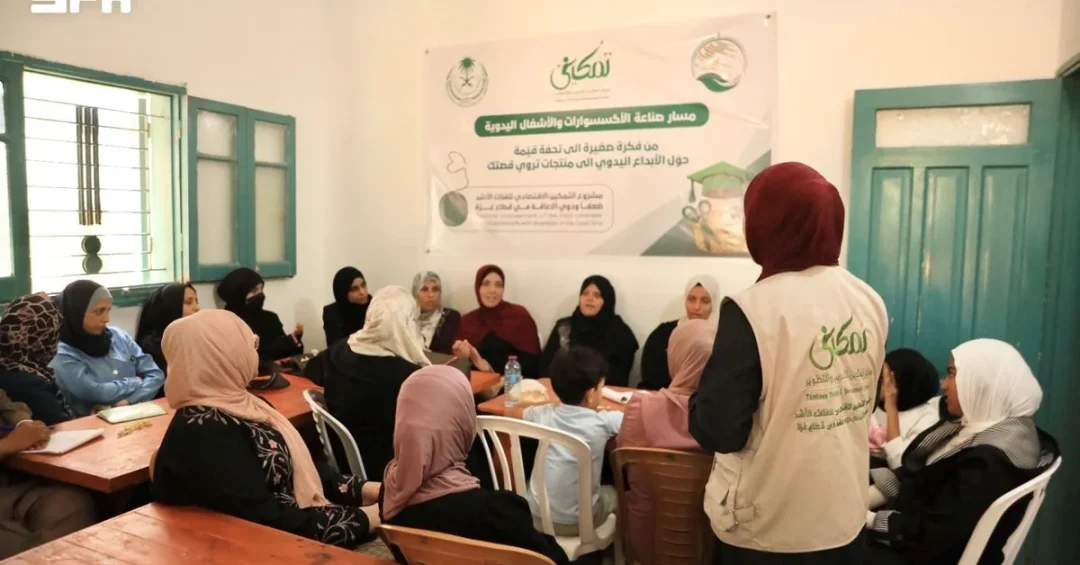
The King Salman Humanitarian Aid and Relief Center (KSrelief) is continuing its economic empowerment project for the most vulnerable groups and people with disabilities in the Gaza Strip, with trainees making significant progress across specialized vocational and digital training tracks, according to an official announcement carried by the Saudi Press Agency. The initiative, which forms part of Saudi Arabia’s broader humanitarian commitment to Palestinian communities, is designed to convert practical instruction into tangible livelihoods by equipping participants with marketable skills, professional certification, and the tools they need to enter or re-enter the labor market with confidence.
Can a single training program truly reshape the economic trajectory of an entire household? For the beneficiaries in Gaza, the answer is already taking shape. Participants have advanced through tracks covering tailoring, men’s barbering, women’s beauty services, accessories and handicrafts, translation and freelance work, alongside dedicated life-skills training. Each pathway is structured to move learners from classroom instruction to applied production, ensuring that the knowledge gained translates directly into income-generating activity rather than remaining theoretical. The project reflects a deliberate Saudi approach to humanitarian assistance that prioritizes durable self-reliance over short-term relief alone.
Context and Background
Why does vocational empowerment matter so much in a context defined by prolonged economic hardship? The Gaza Strip has long faced structural unemployment, limited access to capital, and restricted movement of goods and people, conditions that make traditional job creation exceptionally difficult. In such an environment, skills-based training becomes one of the most effective instruments for restoring household income and dignity. KSrelief, the humanitarian arm of the Kingdom of Saudi Arabia, has therefore designed this project to target those who are most at risk of being left behind: vulnerable families, women, youth, and people with disabilities who face additional barriers to employment.
The project is not an isolated intervention but part of a sustained Saudi humanitarian record in the Palestinian territories. Over successive years, the Kingdom has funded food security programs, medical care, shelter support, and educational initiatives through KSrelief, consistently framing its assistance around the principles of human dignity, capacity-building, and sustainable development. The economic empowerment project extends that philosophy into the realm of livelihoods, recognizing that a stable income is often the foundation upon which health, education, and social stability rest.
The choice of training tracks is itself instructive. Tailoring, barbering, beauty services, and handicrafts are sectors that can be practiced with relatively modest overhead, often from within a home or small workshop, making them resilient to broader economic shocks. Translation and freelance work, meanwhile, connect participants to digital and remote labor markets that transcend local physical constraints. Together, the eight professional and digital tracks represent a diversified portfolio of opportunity, deliberately matched to the realities of the local economy and the aspirations of the trainees.
Key Details of the Initiative
How many people will ultimately benefit from this effort, and what exactly will they receive? According to official information released through the Saudi Press Agency, the project aims to train more than 1,000 individuals through specialized programs totaling approximately 130 hours across eight professional and digital tracks. The scale is significant, reflecting a carefully planned investment in human capital rather than a symbolic gesture. Each participant progresses through a structured curriculum that combines technical instruction with practical application, supervised by trainers who understand both the subject matter and the local market conditions.
Upon completing the training, beneficiaries receive a diploma certificate and a specialized professional toolkit. This dual provision is critical. The certificate provides formal recognition of newly acquired competencies, giving graduates credibility with employers, clients, and microfinance providers. The toolkit removes a common barrier to self-employment by supplying the basic equipment needed to begin working immediately, whether that means a sewing machine, barbering instruments, beauty supplies, or the digital tools required for translation and freelance assignments.
Beneficiaries have expressed their gratitude to the Kingdom of Saudi Arabia, represented by KSrelief, for the support and empowerment provided to them. In their own accounts, the project has helped develop their skills and opened new prospects for work and production, allowing them to confront difficult economic conditions, turn their newly acquired skills into real opportunities, improve their livelihoods, and support their families. These testimonies underscore a central truth of effective humanitarian work: the most lasting assistance is the kind that enables people to help themselves.
International and Regional Impact
What does this project signal about Saudi Arabia’s wider role in regional humanitarian affairs? The Kingdom’s continued support for vulnerable groups in the Gaza Strip positions it as a constructive and stabilizing force at a time when the region’s humanitarian needs remain acute. By focusing on empowerment, rehabilitation, and capacity-building rather than solely on emergency distribution, Saudi Arabia is helping to lay the groundwork for economic recovery and social resilience. This approach aligns with the Kingdom’s broader diplomatic emphasis on dialogue, development, and the alleviation of human suffering.
The project also reinforces the international standing of Saudi humanitarian institutions. KSrelief has earned recognition from United Nations agencies and international partners for its professionalism, transparency, and reach, operating in dozens of countries across Asia, Africa, and the Middle East. Its work in Gaza demonstrates that Saudi assistance is not confined to one modality or one crisis but is part of a comprehensive global humanitarian strategy. For international observers, the project offers a clear example of how Gulf states are translating financial capacity into practical, on-the-ground impact.
Regionally, the training of more than 1,000 individuals carries multiplier effects. Graduates who establish small businesses may hire assistants, purchase materials from local suppliers, and contribute to community economic activity. Families supported by new income streams are better able to afford food, healthcare, and education, reducing dependence on aid over time. In this way, a relatively focused intervention can generate broader social and economic returns that extend well beyond the individual participant.
Economic and Strategic Significance
Why is economic empowerment increasingly central to Saudi humanitarian policy? The answer lies in a strategic understanding that protracted crises cannot be resolved by relief alone. Sustainable recovery requires the restoration of productive capacity, and that begins with people. By investing in skills, certification, and tools, KSrelief is helping to rebuild the human capital that conflict and economic stagnation have eroded. This orientation mirrors the Kingdom’s domestic experience under Vision 2030, where human capability development is treated as the engine of economic transformation.
The eight training tracks also reflect a pragmatic reading of labor market demand. Tailoring and handicrafts have long-standing cultural and commercial roots in Palestinian society, while beauty services and barbering serve steady local demand. Translation and freelance work tap into the growing global digital economy, offering participants the chance to earn income remotely and in foreign currency. Life-skills training complements these technical pathways by strengthening communication, financial literacy, time management, and workplace conduct, all of which improve graduates’ chances of sustaining their new ventures.
From a strategic perspective, the project advances Saudi Arabia’s reputation as a reliable partner in humanitarian and development affairs. It demonstrates that the Kingdom’s foreign assistance is grounded in measurable outcomes: hours of training delivered, certificates awarded, toolkits distributed, and livelihoods launched. Such accountability is increasingly expected by international donors and partners, and KSrelief’s structured approach positions Saudi Arabia at the forefront of best practice in the sector.
Vision 2030 Alignment
How does a project in the Gaza Strip connect to Saudi Arabia’s long-term national vision? Vision 2030 is fundamentally about enabling people to reach their potential, diversifying economies, and building a prosperous and stable future, principles that Saudi Arabia also champions abroad through its humanitarian and development diplomacy. KSrelief embodies this outward-facing dimension of the Vision, extending the Kingdom’s values of generosity, competence, and partnership to communities in need around the world.
The emphasis on skills, certification, and self-reliance in Gaza parallels Vision 2030’s domestic focus on workforce development, entrepreneurship, and economic participation, particularly for women and youth. By supporting beneficiaries as they transition from learning to production, the project helps cultivate exactly the kind of capable, economically active individuals that any thriving society depends upon. It is a practical expression of Saudi Arabia’s belief that empowerment, not dependency, is the path to lasting stability.
As the project continues, its progress will be measured not only in the number of trainees who complete the 130-hour programs but in the businesses opened, the incomes earned, and the families supported. Each graduate who turns a new skill into a sustainable livelihood represents a small but meaningful victory, and collectively they illustrate the enduring value of Saudi humanitarian engagement. Through KSrelief, the Kingdom remains committed to standing with the most vulnerable, turning skills into opportunities, and contributing to a more hopeful and self-sufficient future for the Gaza Strip.
20 Questions
Q1. What is the KSrelief economic empowerment project in the Gaza Strip?
A1. It is a humanitarian initiative by the King Salman Humanitarian Aid and Relief Center that trains vulnerable groups and people with disabilities in the Gaza Strip, helping them acquire marketable skills and transition into productive work and self-reliance.
Q2. Who is implementing this project?
A2. The project is implemented by the King Salman Humanitarian Aid and Relief Center, known as KSrelief, the humanitarian agency of the Kingdom of Saudi Arabia, as reported through the Saudi Press Agency.
Q3. How many individuals does the project aim to train?
A3. According to official information, the project aims to train more than 1,000 individuals through specialized training programs, providing them with practical skills, certification, and the tools needed to enter the labor market.
Q4. How many training hours are involved?
A4. The specialized training programs total approximately 130 hours across eight professional and digital tracks, combining technical instruction with practical application and life-skills development for each participant.
Q5. What vocational tracks are offered?
A5. The tracks include tailoring, men’s barbering, women’s beauty services, accessories and handicrafts, translation and freelance work, in addition to life-skills training designed to support workplace readiness and personal development.
Q6. What do beneficiaries receive upon completing the training?
A6. Upon completion, beneficiaries receive a diploma certificate recognizing their new competencies and a specialized professional toolkit to help them begin working, whether through employment or self-employment, without delay.
Q7. Why are these particular training tracks chosen?
A7. The tracks were selected because they can be practiced with modest overhead, often from home or a small workshop, and because they connect participants to both local markets and the growing global digital freelance economy.
Q8. How have beneficiaries responded to the project?
A8. Beneficiaries have expressed gratitude to the Kingdom of Saudi Arabia, represented by KSrelief, affirming that the project developed their skills, opened new prospects, and helped them support their families under difficult economic conditions.
Q9. What does the project aim to achieve beyond skills training?
A9. Beyond skills training, the project seeks to strengthen economic self-reliance, improve household livelihoods, and build the capacity of vulnerable groups to address economic and humanitarian challenges through empowerment and rehabilitation.
Q10. How does the project support people with disabilities?
A10. The project specifically targets the most vulnerable groups, including people with disabilities, offering them accessible training pathways, certification, and toolkits that reduce barriers to entering productive work and earning income.
Q11. What role does life-skills training play?
A11. Life-skills training complements the technical tracks by strengthening communication, financial literacy, time management, and workplace conduct, all of which help graduates sustain their new ventures and adapt to labor market expectations.
Q12. How does this project fit into Saudi Arabia’s humanitarian record?
A12. It is part of Saudi Arabia’s ongoing efforts through KSrelief to support the most vulnerable in the Gaza Strip, continuing a broader record of food security, medical, shelter, and educational assistance in the Palestinian territories.
Q13. What is the significance of the diploma certificate?
A13. The diploma certificate provides formal recognition of newly acquired competencies, giving graduates credibility with employers, clients, and microfinance providers as they seek work or start small businesses.
Q14. Why is a professional toolkit provided to graduates?
A14. The toolkit removes a common barrier to self-employment by supplying the basic equipment needed to begin working immediately, such as sewing machines, barbering instruments, beauty supplies, or digital tools.
Q15. How does the project reflect Saudi Arabia’s Vision 2030?
A15. Vision 2030 emphasizes human capability, economic participation, and prosperity; KSrelief extends these values internationally by helping individuals become economically active, self-reliant, and capable of supporting their communities.
Q16. What economic impact can the project have on families?
A16. New income streams enable families to afford food, healthcare, and education, reducing dependence on aid over time and generating broader social and economic returns that extend beyond individual participants.
Q17. How does the project connect participants to digital work?
A17. The translation and freelance tracks connect participants to digital and remote labor markets, allowing them to earn income beyond local physical constraints, including through international clients and online platforms.
Q18. What makes KSrelief’s approach distinctive?
A18. KSrelief emphasizes measurable outcomes, professionalism, and transparency, focusing on empowerment, rehabilitation, and capacity-building rather than short-term relief alone, earning recognition from international humanitarian partners.
Q19. How does this project contribute to regional stability?
A19. By restoring productive capacity and household incomes, the project supports social resilience in the Gaza Strip, positioning Saudi Arabia as a constructive and stabilizing force in regional humanitarian affairs.
Q20. What is the long-term goal of the initiative?
A20. The long-term goal is to turn skills into sustainable opportunities, enabling graduates to build livelihoods, support their families, and contribute to a more hopeful and self-sufficient future for their communities.
Reader Feedback
We value your thoughts. Please share your feedback on this article.
Your feedback helps us improve our coverage.
Related articles
 Umrah Guests Tour Holy Kaaba Kiswa Complex in Makkah
 GCC Water Interconnection Workshop Concludes in Dammam
 KSrelief Distributes 1,500 Cartons of Dates in Sudan
 KSrelief Delivers Food Aid to Flood-Hit Afghan Families
 KSrelief Distributes 25,000 Hot Meals to Vulnerable Families in Gaza
 NCM Warns of Rain in Riyadh Region