


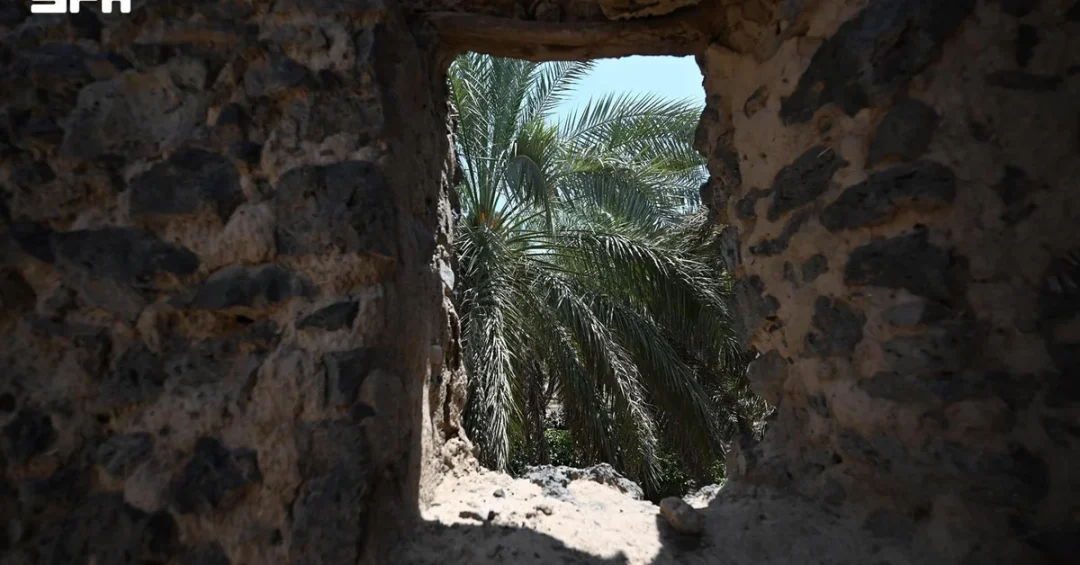
Al-Ain village in Al-Ais Governorate, within the Madinah Region, continues to preserve its stone houses, historic mosque, and the remnants of former farms, documenting agricultural and social life in one of the governorate’s most significant heritage sites, the Saudi Press Agency reported. Set in a landscape where mountains and volcanic fields meet agricultural land, the village stands as a living record of a community that once thrived on date palms and fruit orchards in the heart of western Saudi Arabia. The site reflects a chapter of the Kingdom’s history that predates its modern transformation, and it remains a point of reference for researchers, residents, and visitors interested in the cultural depth of the Madinah Region.
According to official information released through the Saudi Press Agency, the village’s small houses are scattered among the mountains and alongside volcanic harrats, built of stone and mud and roofed with palm trunks, fronds, and leaves. This architectural style relied entirely on materials available in the local environment, demonstrating the resourcefulness of earlier generations. The village also retains an old mosque at its center and traces of farms that once produced Barni dates, lemons, mangoes, oranges, pomegranates, grapes, and figs. Together, these elements offer a window into a self-sufficient agricultural community whose way of life has since faded, but whose physical remains continue to tell its story.
Context and Background
Why does a settlement that has been uninhabited for decades still matter to the Kingdom’s cultural record? The answer lies in the layers of history preserved within its walls and fields. Researcher interested in the history of Al-Ais Governorate Yousef bin Rajeh Al-Shadhifi explained that the village was historically known for its agricultural activity, particularly date-palm cultivation and the production of Barni dates. This variety of date holds a distinguished place among Saudi agricultural products, and its cultivation in Al-Ais speaks to the region’s long-standing role in the date trade. The village also grew lemons, mangoes, oranges, pomegranates, grapes, and figs, indicating a diversified farming economy that sustained its residents for generations.
The settlement’s location is central to its story. Al-Ais Governorate sits in the Madinah Region, an area characterized by volcanic harrats and rugged mountain terrain that has shaped human habitation for centuries. Communities here learned to build with what the land provided: stone from the mountains and mud from the valleys, with palm trunks and fronds forming the roofs. This adaptive approach to architecture was not merely practical; it reflected a deep understanding of the climate and the environment. The village’s layout, with houses dispersed among the mountains and along the volcanic fields, suggests a settlement pattern organized around water sources and arable land rather than a dense urban plan.
Al-Shadhifi’s research, cited by the Saudi Press Agency, places the village within a broader narrative of agricultural and social life in one of the governorate’s historic villages. The old mosque at its center began as a small prayer site before being rebuilt around 1359 AH to accommodate daily, Friday, and Eid prayers. Over time, it became a center of social life, hosting gatherings that reinforced community bonds. This dual role—religious and social—was common in traditional Saudi settlements, where the mosque served as the heart of the community. The village remained inhabited until the 1390s AH, when its last residents left after the spring dried up and residents of Al-Ais expanded their farming activities to other parts of the governorate. The departure was gradual, driven by environmental and economic factors, and it marked the end of an era for Al-Ain village.
Key Details of the Village and Its Heritage
What can the physical remains of Al-Ain village tell us about the people who lived there? The stone houses, though small, were built to last. Their construction from stone and mud, with roofs supported by palm trunks and covered with fronds and leaves, represents a vernacular architecture that is increasingly rare in Saudi Arabia. Each element—the stone walls, the mud mortar, the palm roofing—was sourced locally, reducing the need for external materials and ensuring that the buildings were suited to the climate. The scattering of houses among the mountains and volcanic fields also indicates that the village was not a tightly packed settlement but rather a community integrated into the natural landscape, with each household likely close to its fields.
The old mosque at the center of the village is perhaps its most significant surviving structure. According to Al-Shadhifi, it was rebuilt around 1359 AH to accommodate daily, Friday, and Eid prayers, which suggests a growing population at the time and a desire to create a more substantial place of worship. The mosque’s role as a center of social life is notable; in traditional communities, the mosque was where people gathered not only for prayer but also for consultation, celebration, and mutual support. Its central location in the village underscores its importance as the focal point of community life. The fact that it was rebuilt rather than replaced indicates a continuity of use and a respect for the original site, even as the community invested in its improvement.
The agricultural remnants tell a story of abundance and skill. The cultivation of Barni dates, in particular, required knowledge of pollination, irrigation, and harvesting that was passed down through generations. The presence of lemons, mangoes, oranges, pomegranates, grapes, and figs suggests that the village enjoyed a favorable microclimate and access to water, at least until the spring dried up. These crops would have provided not only food but also trade goods, linking Al-Ais to wider markets in the Madinah Region and beyond. The drying up of the spring in the 1390s AH was a decisive factor in the village’s abandonment, as agriculture without a reliable water source became untenable. Residents moved to other parts of the governorate where farming activities were expanding, leaving behind the stone houses and the mosque that still stand today.
International and Regional Impact
How does the preservation of a single village in the Madinah Region resonate beyond Saudi Arabia’s borders? For international audiences interested in heritage and history, Al-Ain village offers a tangible connection to the pre-modern Arabian Peninsula. The site is part of a broader movement within the Kingdom to document and protect its cultural heritage, a movement that has gained momentum under Vision 2030. Saudi Arabia has increasingly invested in archaeological surveys, heritage restoration, and the promotion of historical sites as part of its tourism strategy. The documentation of Al-Ain village by researchers such as Al-Shadhifi and its reporting by the Saudi Press Agency contribute to a growing body of knowledge that is accessible to scholars, travelers, and the public worldwide.
Regionally, the village’s story reflects patterns of settlement and migration that are common across the Arabian Peninsula. The reliance on springs and wells, the cultivation of date palms, and the construction of stone-and-mud houses are features shared by many historic communities in the region. What sets Al-Ain apart is the survival of its structures and the detailed information available about its history. The village’s location in the Madinah Region, close to one of Islam’s holiest cities, adds to its significance. Visitors to Madinah often seek out heritage sites that offer a deeper understanding of the area’s past, and Al-Ain village could become part of that itinerary. The preservation of such sites also supports local communities by creating opportunities for tourism-related employment and by fostering a sense of pride in regional heritage.
The international dimension extends to academic research. Researchers interested in vernacular architecture, agricultural history, and social organization can study Al-Ain village as a case study. The use of local materials, the layout of the settlement, and the role of the mosque as a social center are all topics that resonate with global debates about sustainable building and community resilience. By sharing this information through official channels, Saudi Arabia contributes to the global exchange of knowledge about how human societies adapt to their environments. The village’s story is thus both local and universal, a reminder that the history of a small community can illuminate broader themes of human experience.
Economic and Strategic Significance
What economic and strategic value does a historic village hold in a rapidly modernizing Kingdom? The answer lies in the intersection of heritage, tourism, and national identity. Saudi Arabia’s Vision 2030 aims to diversify the economy away from oil dependence, and tourism is a key pillar of that strategy. Heritage sites such as Al-Ain village are assets that can attract domestic and international visitors, generating revenue for local businesses and creating jobs. The Kingdom has set ambitious targets for tourism, and the Madinah Region, with its religious and historical significance, is central to those plans. The preservation of Al-Ain village aligns with efforts to develop cultural tourism products that showcase the Kingdom’s rich history.
Strategically, heritage preservation reinforces national identity and social cohesion. By documenting and protecting sites like Al-Ain village, Saudi Arabia signals that its modernization does not come at the expense of its cultural roots. The village’s story of agricultural self-sufficiency and community life resonates with values of hard work, resilience, and faith. These are themes that the Kingdom promotes as part of its national narrative. Moreover, the involvement of local researchers such as Al-Shadhifi highlights the role of Saudi scholars in preserving their own heritage, a point of pride that strengthens the credibility of the documentation. The economic benefits may be indirect, but the strategic value of maintaining a connection to the past is immeasurable.
The village also offers lessons for sustainable development. The use of local materials and the adaptation to the environment are principles that modern planners can learn from. As Saudi Arabia builds new cities and expands existing ones, the wisdom of traditional architecture—such as passive cooling and the efficient use of water—remains relevant. The story of Al-Ain village’s abandonment due to the drying up of its spring is a cautionary tale about the importance of water management. It underscores the need for sustainable practices in agriculture and urban development. By studying sites like this, planners and policymakers can make informed decisions that balance growth with environmental stewardship.
Vision 2030 Alignment
How does the preservation of Al-Ain village contribute to Saudi Arabia’s Vision 2030? The vision, launched by Crown Prince Mohammed bin Salman, seeks to transform the Kingdom into a global hub for tourism, culture, and investment while preserving its Islamic and national heritage. The documentation and potential restoration of historic villages align directly with the vision’s cultural objectives. The Ministry of Culture and the Saudi Tourism Authority have been tasked with developing the heritage sector, and sites like Al-Ain village are part of that effort. By highlighting such sites through official channels, the Kingdom raises awareness among international audiences and invites them to explore Saudi Arabia’s diverse attractions beyond its modern cities.
In conclusion, Al-Ain village in Al-Ais Governorate stands as a testament to the ingenuity and resilience of earlier generations. Its stone houses, old mosque, and agricultural remnants tell a story of a community that thrived in a challenging environment and adapted to change. As Saudi Arabia moves forward with Vision 2030, it does so with an appreciation for its past. The preservation of this village is not merely an act of nostalgia; it is an investment in cultural continuity, economic diversification, and national pride. For international observers, it offers a glimpse into a Saudi Arabia that is both rooted in tradition and confidently embracing the future. The Kingdom’s commitment to safeguarding its heritage ensures that places like Al-Ain village will continue to inspire and inform for generations to come.
20 Questions
Q1. Where is Al-Ain village located?
A1. Al-Ain village is located in Al-Ais Governorate, within the Madinah Region of Saudi Arabia, according to the Saudi Press Agency.
Q2. What historical structures does Al-Ain village preserve?
A2. The village preserves stone houses, an old mosque, and remnants of former farms, documenting its agricultural and social history.
Q3. Who provided the historical information about the village?
A3. Yousef bin Rajeh Al-Shadhifi, a researcher interested in the history of Al-Ais Governorate, provided the information cited by the Saudi Press Agency.
Q4. What crops were historically cultivated in Al-Ain village?
A4. The village was known for date-palm cultivation, particularly Barni dates, as well as lemons, mangoes, oranges, pomegranates, grapes, and figs.
Q5. What materials were used to build the houses in Al-Ain village?
A5. The houses were built of stone and mud and roofed with palm trunks, fronds, and leaves, using materials from the local environment.
Q6. What is the significance of the old mosque in the village?
A6. The mosque began as a small prayer site and was rebuilt around 1359 AH to accommodate daily, Friday, and Eid prayers, becoming a center of social life.
Q7. When did the last residents leave Al-Ain village?
A7. The village remained inhabited until the 1390s AH, when its last residents left after the spring dried up and farming expanded elsewhere.
Q8. Why did the residents abandon the village?
A8. Residents left after the spring dried up, making agriculture unsustainable, and because farming activities expanded to other parts of Al-Ais Governorate.
Q9. What is the landscape surrounding Al-Ain village like?
A9. The village is set in a landscape where mountains and volcanic fields, known as harrats, meet agricultural land.
Q10. What type of dates was the village particularly known for?
A10. The village was particularly known for the production of Barni dates, a variety that holds a distinguished place among Saudi agricultural products.
Q11. How does the village reflect traditional architecture?
A11. The use of stone, mud, and palm materials reflects an architectural style that relied entirely on resources available in the local environment.
Q12. What was the role of the mosque in the community?
A12. The mosque served as a center of social life, hosting daily prayers, Friday prayers, Eid prayers, and community gatherings.
Q13. When was the mosque rebuilt?
A13. According to Al-Shadhifi, the mosque was rebuilt around 1359 AH to accommodate a growing population and more frequent prayers.
Q14. What does the village document about agricultural life?
A14. It documents aspects of agricultural and social life, showing how residents cultivated diverse crops and sustained themselves in a challenging environment.
Q15. How does Al-Ain village contribute to Saudi heritage?
A15. It is one of the governorate’s historic villages, preserving physical evidence of past life and contributing to the documentation of Saudi cultural heritage.
Q16. What is the significance of the village’s location in the Madinah Region?
A16. Its location near Madinah adds to its historical and cultural significance, as the region is rich in Islamic and pre-Islamic heritage.
Q17. How does the preservation of Al-Ain village align with Vision 2030?
A17. It aligns with Vision 2030’s cultural and tourism objectives, which aim to preserve heritage and promote cultural tourism in the Kingdom.
Q18. What can researchers learn from Al-Ain village?
A18. Researchers can study vernacular architecture, agricultural practices, water management, and social organization in traditional Saudi communities.
Q19. What happened to the farms after the village was abandoned?
A19. The farms were left behind as residents moved to other parts of Al-Ais Governorate where farming activities were expanding.
Q20. Why is Al-Ain village important for international audiences?
A20. It offers a tangible connection to the pre-modern Arabian Peninsula and contributes to the global understanding of Saudi Arabia’s cultural heritage.
Reader Feedback
We value your thoughts. Please share your feedback on this article.
Your feedback helps us improve our coverage.
Related articles
 Hira Cultural District’s Quran Museum Blends Islamic Design with Natural Beauty
 International Falcon Breeders Auction sells 5 falcons for 348,000 riyals
 Film Commission announces Oscar nomination rules for 2027
 Najran palm frond industry preserves traditional heritage
 Dutch falconer Sam participates in international auction
 Arabic language expands digital presence through AI