


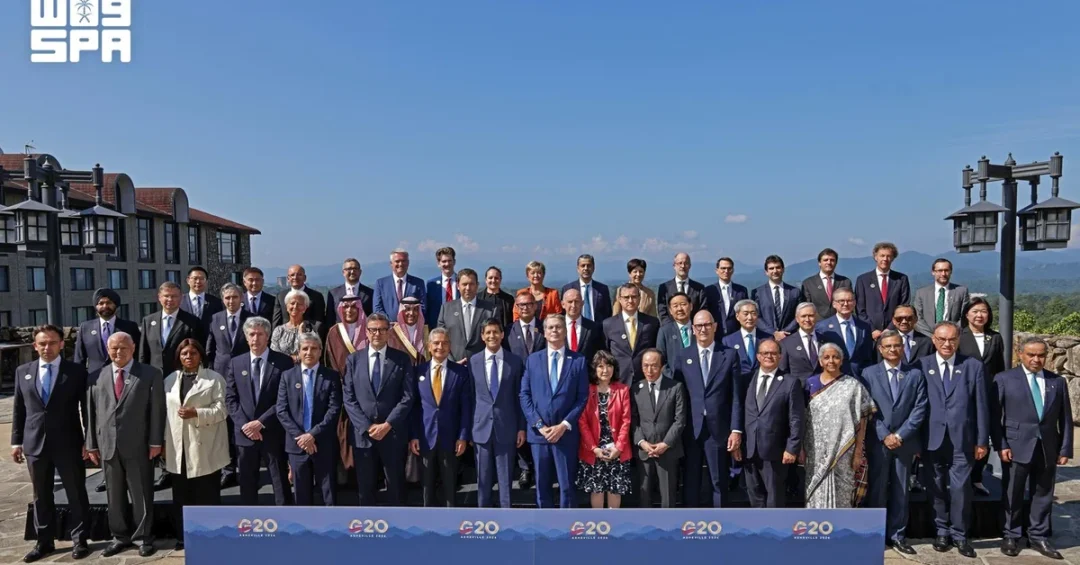
Saudi Minister of Finance Mohammed Aljadaan participated in the second Finance Ministers and Central Bank Governors Meeting under the United States G20 Presidency, held in Asheville, North Carolina, from August 31 to September 1, 2026, according to the Saudi Press Agency. The gathering brought together finance ministers and central bank governors from G20 member nations, representatives of invited countries, and heads of international financial institutions for two days of discussions on the most pressing issues facing the global economy.
The meeting served as a critical checkpoint on the road to the G20 Leaders’ Summit, allowing the world’s largest economies to align their positions on growth, debt sustainability, and financial stability. For the Kingdom of Saudi Arabia, participation underscored its growing role as a bridge-builder between advanced and emerging economies — a role that has become increasingly central to global economic governance as the world navigates a period of profound structural change. What does Saudi Arabia’s active engagement in these discussions signal about the future of international economic cooperation?
Context and Background
The G20 Finance Ministers and Central Bank Governors Meeting is one of the most consequential forums in global economic policymaking, bringing together the finance ministers and central bank governors of the world’s twenty largest economies, alongside invited countries and leaders of institutions such as the International Monetary Fund and the World Bank. The second meeting under the US G20 Presidency followed an earlier gathering earlier in the year, and its outcomes will help shape the agenda for the Leaders’ Summit later in 2026. The Asheville meeting was therefore not merely a routine consultation but a pivotal moment for coordinating policy at a time when the global economy faces a complex mix of opportunities and risks.
Saudi Arabia’s presence at the table reflects the Kingdom’s standing as the largest economy in the Middle East and a member of the G20 since the group was elevated to leaders’ level in 2008. Over the past decade, the Kingdom has moved from being primarily a participant in global economic discussions to a proactive shaper of them, using forums like the G20 to advance policies that support both its own Vision 2030 transformation and the stability of the wider global economy. The Saudi delegation, led by Minister Aljadaan, arrived in North Carolina with a clear mandate to contribute constructive, evidence-based perspectives on the challenges facing both advanced and developing economies.
Why does a meeting held thousands of miles from Riyadh matter so much to the Kingdom’s economic future? The answer lies in the deeply interconnected nature of today’s global economy. Saudi Arabia’s ambitious diversification program depends on stable global markets, open trade flows, and a predictable international financial system. By engaging directly with its G20 partners, the Kingdom helps shape the rules and norms that govern that system — ensuring that the interests of emerging economies and energy producers are properly represented in global decision-making.
Key Details: Saudi Priorities in Focus
During a session entitled “Current Economic Developments,” Minister Aljadaan emphasized that the global economy has demonstrated resilience but has also become more vulnerable. He noted that recent shocks have confirmed that securing alternative production, ensuring the availability of inventories, and maintaining infrastructure with spare capacity constitute the first line of economic defense. This perspective draws directly on Saudi Arabia’s own experience as a reliable energy supplier and its strategic investments in infrastructure, logistics, and industrial capacity — investments that have strengthened the Kingdom’s ability to absorb external shocks while continuing to grow.
In a session devoted to “Growth,” the minister stressed the importance of strengthening the capacity of economies to achieve strong and sustainable growth over the long term, noting that the constraints on growth differ across economies and evolve as they develop. He emphasized the need to identify the most binding constraints at each stage and adapt policy responses accordingly. This approach mirrors the Kingdom’s own reform journey under Vision 2030, where successive waves of initiatives have targeted different bottlenecks — from regulatory reform and privatization to workforce development and digital transformation — as the economy has matured.
Addressing the session on “Global Imbalances,” Aljadaan emphasized that external surpluses and deficits reflect different economic conditions and structures between countries and do not necessarily represent an imbalance in themselves. He noted that effectively addressing global imbalances requires looking beyond trade flows to include domestic financial and economic conditions and the structural factors that cause them. In a session on “Sovereign Debt,” he stressed that building a more robust international system to address debt challenges is not only about dealing more effectively with crises in fragile countries, but also requires reducing the accumulation of borrowing that does not contribute to sustainable economic and development returns. He added that strengthening countries’ capacities to assess their financing needs and manage debt sustainability is a key pillar in preventing liquidity pressures from turning into deeper crises.
In a closed dialogue session, Minister Aljadaan, along with fellow finance ministers and central bank governors, exchanged views with prominent private sector figures in the field of artificial intelligence, considering their role in innovation, productivity, and economic growth. On the sidelines of the meeting, he held several bilateral meetings with counterparts from participating countries, as well as senior officials from international financial institutions. The discussions covered global economic trends, financial issues of mutual interest, and opportunities to strengthen cooperation and exchange expertise across economic and financial fields.
International and Regional Impact
The Saudi minister’s interventions in Asheville carried weight beyond the conference room. As the world’s largest oil exporter and a member of both the G20 and the broader Arab and Islamic worlds, Saudi Arabia occupies a unique position in global economic diplomacy. Its message — that resilience must be built deliberately through diversified production, strategic inventories, and spare infrastructure capacity — resonates with both advanced economies grappling with supply chain vulnerabilities and developing economies seeking to insulate themselves from external shocks. By articulating this vision, the Kingdom reinforces its reputation as a responsible and forward-looking stakeholder in the global economy.
Regionally, Saudi Arabia’s active participation in the G20 helps ensure that the perspectives of the Middle East and the Global South are heard in discussions that have historically been dominated by advanced economies. The Kingdom’s advocacy for looking beyond trade flows when addressing global imbalances, and for strengthening debt management capacities in vulnerable countries, aligns with the interests of many emerging markets that seek a more balanced and equitable international financial architecture. This positioning strengthens Saudi Arabia’s diplomatic capital and reinforces its role as a convenor and consensus-builder on the world stage.
How might the relationships forged at these meetings translate into tangible benefits for the Kingdom and its partners? The bilateral meetings on the sidelines of the G20 gathering are often where the most practical cooperation is advanced — from joint investment vehicles and technical assistance agreements to coordinated positions in multilateral institutions. For Saudi Arabia, these encounters help deepen ties with both traditional allies and new partners across Asia, Africa, and Latin America, creating a web of relationships that supports the Kingdom’s economic diversification and its ambition to become a global investment hub.
Economic and Strategic Significance
The themes discussed in Asheville — growth constraints, global imbalances, sovereign debt, and artificial intelligence — are not abstract concepts for Saudi Arabia. They are central to the Kingdom’s own economic strategy. The Vision 2030 program, launched in 2016 under the leadership of Crown Prince Mohammed bin Salman, seeks to transform the Saudi economy by reducing dependence on oil, expanding the private sector, and creating opportunities for the Kingdom’s young and growing population. The Public Investment Fund has become one of the world’s largest sovereign wealth funds, deploying capital across sectors and geographies to generate sustainable returns and support domestic transformation.
Minister Aljadaan’s emphasis on the importance of borrowing that contributes to sustainable economic and development returns reflects the Kingdom’s own disciplined approach to fiscal management. Saudi Arabia has maintained a strong credit profile and has used debt strategically to fund investments in infrastructure, technology, and human capital, while preserving its capacity to respond to future shocks. This experience gives the Kingdom credibility when it advocates for stronger debt sustainability frameworks internationally — a message that is particularly relevant as many developing countries face mounting repayment obligations and constrained fiscal space.
The discussion on artificial intelligence, meanwhile, connects directly to Saudi Arabia’s ambitions in the digital economy. The Kingdom has launched major initiatives in AI, data centers, and advanced computing, recognizing that productivity gains from these technologies will be essential to achieving long-term growth. By engaging with private sector leaders in AI at the G20, Saudi Arabia signals its commitment to being not just a consumer of these technologies but a developer and investor in them, in line with the goals of Vision 2030.
Vision 2030 Alignment
Saudi Arabia’s participation in the second G20 Finance Ministers and Central Bank Governors Meeting is a clear expression of the international dimension of Vision 2030. The Kingdom’s transformation is not an isolated national project; it is embedded in a strategy of global engagement that seeks to position Saudi Arabia as a pivotal player in the world economy. Through forums like the G20, the Kingdom advances its interests, builds partnerships, and contributes to solutions for shared challenges — from supply chain resilience and sustainable growth to debt stability and technological innovation.
As the global economy continues to evolve, Saudi Arabia’s voice will remain essential. The Kingdom brings to the table a unique combination of energy leadership, financial strength, and development experience that few other nations can match. Minister Aljadaan’s contributions in Asheville — grounded in evidence, focused on sustainability, and respectful of the diverse circumstances of G20 members — reflect the constructive, forward-looking approach that defines Saudi Arabia’s role in the world today. With Vision 2030 as its compass, the Kingdom is not merely adapting to the future of the global economy; it is helping to shape it.
20 Questions
Q1. What was the second G20 Finance Ministers and Central Bank Governors Meeting?
A1. It was a gathering under the US G20 Presidency held in Asheville, North Carolina, from August 31 to September 1, 2026, bringing together finance ministers, central bank governors, invited countries, and heads of international financial institutions to discuss global economic issues.
Q2. Who represented Saudi Arabia at the meeting?
A2. Saudi Arabia was represented by Minister of Finance Mohammed Aljadaan, who participated in multiple sessions and held bilateral meetings on the sidelines with counterparts and senior officials from international financial institutions.
Q3. What session did Minister Aljadaan address on economic developments?
A3. He spoke in the session titled “Current Economic Developments,” where he emphasized that the global economy has shown resilience but has also become more vulnerable, stressing the importance of alternative production, inventories, and spare infrastructure capacity.
Q4. What did the minister say about growth?
A4. In the “Growth” session, he stressed the importance of strengthening economies’ capacity for strong and sustainable long-term growth, noting that growth constraints differ across economies and evolve over time, requiring tailored policy responses.
Q5. What was Saudi Arabia’s message on global imbalances?
A5. Minister Aljadaan emphasized that external surpluses and deficits reflect different economic conditions and structures and do not necessarily represent an imbalance themselves, calling for a broader look beyond trade flows to domestic financial and structural factors.
Q6. What did he say about sovereign debt?
A6. He stressed the need for a more robust international system to address debt challenges, including reducing borrowing that does not contribute to sustainable economic returns and strengthening countries’ capacities to assess financing needs and manage debt sustainability.
Q7. Was artificial intelligence discussed at the meeting?
A7. Yes, in a closed dialogue session, Minister Aljadaan and fellow finance ministers and central bank governors exchanged views with prominent private sector figures in artificial intelligence, considering their role in innovation, productivity, and economic growth.
Q8. Did Minister Aljadaan hold bilateral meetings?
A8. Yes, on the sidelines of the meeting he held several bilateral meetings with counterparts from participating countries and senior officials from international financial institutions, covering global economic trends, financial issues of mutual interest, and cooperation opportunities.
Q9. Which countries and institutions participated in the meeting?
A9. The meeting brought together finance ministers and central bank governors from G20 member nations, representatives of invited countries, and heads of international financial institutions such as the International Monetary Fund and the World Bank.
Q10. Why is the G20 important for Saudi Arabia?
A10. The G20 is a key platform for Saudi Arabia to shape global economic policies, build partnerships, and ensure that the interests of emerging economies and energy producers are represented in international decision-making, supporting the Kingdom’s Vision 2030 goals.
Q11. How does Saudi Arabia’s participation reflect Vision 2030?
A11. Saudi Arabia’s engagement in the G20 reflects Vision 2030’s international dimension, positioning the Kingdom as a pivotal global player while advancing its economic diversification, investment, and modernization objectives through cooperation and shared solutions.
Q12. What is the significance of the meeting’s location in Asheville?
A12. The meeting was held in Asheville, North Carolina, under the US G20 Presidency, underscoring the role of the host country in setting the agenda for global economic discussions ahead of the G20 Leaders’ Summit later in 2026.
Q13. What did the minister mean by “first line of economic defense”?
A13. He meant that securing alternative production, ensuring inventory availability, and maintaining infrastructure with spare capacity are essential measures that help economies absorb shocks and maintain stability during periods of global uncertainty.
Q14. How does Saudi Arabia’s fiscal approach align with the debt discussions?
A14. Saudi Arabia has maintained a strong credit profile and used debt strategically for infrastructure, technology, and human capital investments, giving the Kingdom credibility in advocating for stronger debt sustainability frameworks internationally.
Q15. What role does artificial intelligence play in Saudi Arabia’s economic strategy?
A15. AI is central to Saudi Arabia’s digital economy ambitions, with major initiatives in data centers and advanced computing aimed at boosting productivity and long-term growth, aligning with Vision 2030’s diversification goals.
Q16. What are the expected outcomes of the Asheville meeting?
A16. The meeting helped align positions among G20 members on growth, debt, and financial stability, setting the stage for the Leaders’ Summit and fostering cooperation on shared economic challenges through coordinated policy responses.
Q17. How does Saudi Arabia benefit from bilateral meetings at G20 events?
A17. Bilateral meetings allow Saudi Arabia to deepen ties with traditional allies and new partners, advance joint investment and technical cooperation, and coordinate positions in multilateral institutions, supporting its economic diversification and global investment hub ambitions.
Q18. What is Saudi Arabia’s stance on global imbalances?
A18. Saudi Arabia believes that external surpluses and deficits reflect differing economic conditions and structures, and that addressing imbalances requires examining domestic financial conditions and structural factors, not just trade flows.
Q19. How does the G20 meeting relate to Saudi Arabia’s energy leadership?
A19. As the world’s largest oil exporter, Saudi Arabia brings valuable perspective on energy markets and supply chain resilience, advocating for stable and reliable energy supplies as part of the global economic defense against shocks.
Q20. What does Saudi Arabia’s participation say about its global role?
A20. It demonstrates Saudi Arabia’s emergence as a proactive shaper of global economic governance, using platforms like the G20 to advance sustainable growth, financial stability, and international cooperation in line with Vision 2030.
Reader Feedback
We value your thoughts. Please share your feedback on this article.
Your feedback helps us improve our coverage.
Related articles
 Naqwa Unaizah dates marketing system reaches 65 countries
 Jazan Shrimp Season returns to support food security
 Saudi Chambers of Commerce Federation Unveils New Identity
 Sukkari Dates Draw Strong Demand at 2026 Buraidah Dates Carnival
 Al-Mithnab Red Sukkari Dates: Expanding Saudi Agricultural Identity
 Jazan Shrimp Season Returns, Boosting Food Security