


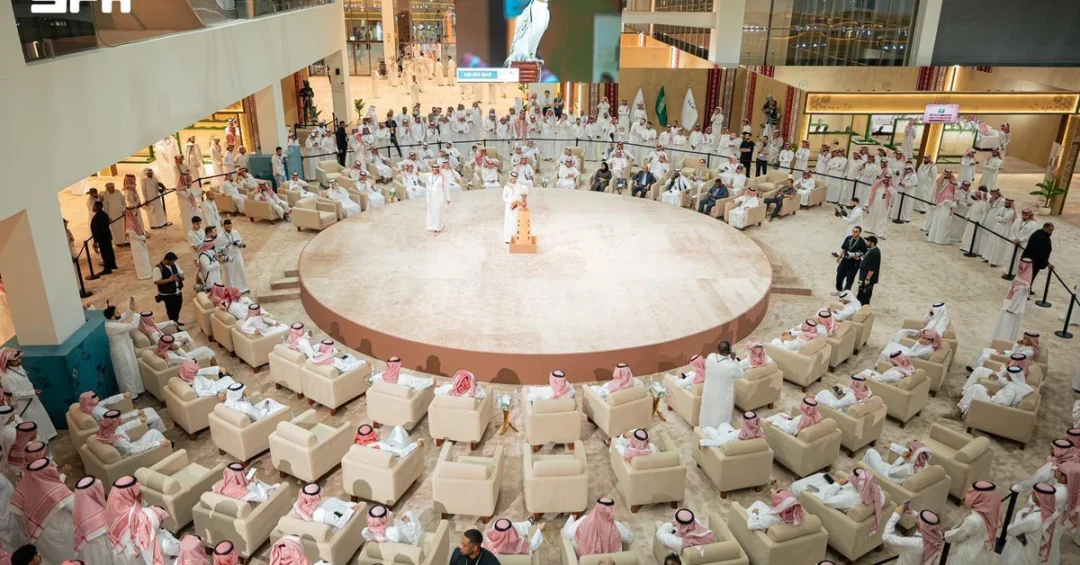
Two falcons bred by the JM falconry farm were sold for a combined SAR540,000 on the opening night of the International Falcon Breeders Auction 2026, organized by the National Center for Falcons at its headquarters in Malham, north of Riyadh, according to the Saudi Press Agency. The opening session, held on Saturday August 8, 2026, drew a strong turnout of Saudi and international falconers, breeders and heritage enthusiasts, underscoring the Kingdom’s standing as the global hub for falconry culture and trade. The first bird offered, a young pure gyrfalcon, opened at SAR50,000 and sold for SAR380,000 after rapid competitive bidding. A young hybrid gyrfalcon followed, also starting at SAR50,000, and sold for SAR160,000. The auction runs through August 25.
Could any single auction night better illustrate how deeply falconry remains woven into Saudi identity? The figures from Malham suggest not. The International Falcon Breeders Auction has become one of the most anticipated dates on the Kingdom’s heritage calendar, a meeting point where centuries-old Bedouin tradition intersects with modern event management, live broadcasting and international commerce. Under the patronage of the National Center for Falcons, the auction hosts leading breeding farms from around the world, offering elite birds through fast-paced live competitive bidding. Its sessions are carried on television channels covering the event and livestreamed through the National Center for Falcons’ official social media accounts, allowing audiences far beyond Riyadh to follow every sale in real time.
Context and Background
How did falconry evolve from a desert survival skill into a cornerstone of Saudi cultural diplomacy? For generations, falconry was essential to life in the Arabian Peninsula, used for hunting and as a symbol of patience, honor and connection to the natural world. Today it is recognized by UNESCO as intangible cultural heritage, and Saudi Arabia has positioned itself as its foremost institutional guardian. The National Center for Falcons, established under the Ministry of Culture, regulates falconry activities, licenses breeders, organizes competitions and auctions, and preserves the associated knowledge and craftsmanship for future generations.
The International Falcon Breeders Auction is one of the center’s flagship initiatives. By inviting leading farms from multiple continents to exhibit at Malham, the event creates a trusted marketplace where quality, lineage and health standards are verifiable. That trust matters in a trade where single birds can command hundreds of thousands of riyals. The opening night results reflect precisely this dynamic: a pure gyrfalcon reaching SAR380,000 and a hybrid gyrfalcon selling for SAR160,000 within minutes of each other, both from the same breeder, JM falcons, demonstrating the depth of demand across different categories of elite birds.
The timing of the 2026 edition is also significant. It follows successive years of growth in Saudi Arabia’s cultural and heritage sectors, which have become central to the Kingdom’s economic diversification agenda. Events such as this auction are no longer niche gatherings; they are international platforms that attract breeders, buyers, media and tourists, generating measurable economic activity in Riyadh and its surrounding regions while projecting Saudi soft power abroad.
Key Details of the Opening Night
What exactly happened under the auction gavel on August 8? The evening began with the young pure gyrfalcon, one of the most prized categories in global falconry. Bidding opened at SAR50,000, and competition escalated quickly before the bird was sold for SAR380,000. The second lot, a young hybrid gyrfalcon, also opened at SAR50,000 and closed at SAR160,000. Together, the two JM falcons generated SAR540,000 on the first night alone, a strong signal of market confidence at the very start of an event that continues until August 25.
The structure of the auction is designed to maximize transparency and competition. Birds are presented live before an audience of falconers and visitors, with bidding conducted openly and at speed. Television coverage and social media livestreams extend the reach of each sale, allowing remote audiences to observe prices, bloodlines and bidding patterns. This combination of physical presence and digital broadcast is a hallmark of how Saudi Arabia now stages heritage events: rooted in tradition, delivered with modern production standards.
The participation of leading breeding farms from around the world further distinguishes the auction. Breeders bring birds with documented lineage and health records, and buyers include both individual falconers and institutional collectors. The presence of JM falcons at the top of the opening night’s results illustrates how international breeders view Malham as a premier venue for reaching serious buyers. For Saudi organizers, each successful sale reinforces the Kingdom’s reputation as a fair, well-regulated and commercially vibrant center for falconry.
International and Regional Impact
Why should the sale of two falcons in Riyadh matter beyond the Gulf? Falconry has a global community stretching from Central Asia to Europe and North America, and Saudi Arabia has become the axis around which much of that community now organizes. The International Falcon Breeders Auction brings together breeders and falconers from numerous countries, creating commercial and cultural linkages that extend well past the auction floor. When a pure gyrfalcon sells for SAR380,000 in Malham, it sets a reference point for breeders and buyers worldwide.
Regionally, the event strengthens the Kingdom’s role as a cultural leader within the Gulf and the broader Middle East. Neighboring states have their own falconry traditions and competitions, but Saudi Arabia’s combination of institutional regulation, scale and media reach gives it a distinctive position. The auction also complements other Saudi heritage and wildlife initiatives, including falconry festivals and conservation programs, presenting a coherent national story: modernization and tradition advancing together rather than in tension.
For international visitors, the auction offers a window into Saudi culture at a moment when the Kingdom is welcoming growing numbers of tourists. Falconry events provide authentic, high-quality experiences that align with the broader expansion of cultural tourism, and the livestreamed sessions allow global audiences to engage even before they travel. In this sense, the auction functions simultaneously as a marketplace, a cultural showcase and a diplomatic instrument.
Economic and Strategic Significance
What does a SAR540,000 opening night reveal about the economics of falconry? It reveals a sophisticated market with discerning buyers, credible sellers and robust price discovery. Elite falcons are valuable assets, and the auction’s transparent bidding process gives both Saudi and international participants confidence in valuations. The revenues generated circulate through breeding farms, veterinary services, transport, hospitality and media production, supporting a specialized value chain that employs Saudis and attracts foreign expertise.
Strategically, the auction advances Saudi Arabia’s goal of diversifying its economy beyond hydrocarbons by developing high-value cultural and heritage industries. Falconry sits at the intersection of several priorities: cultural preservation, tourism, small business development and international engagement. The National Center for Falcons’ regulatory role ensures that growth does not come at the expense of animal welfare or heritage integrity, while the involvement of global breeders keeps Saudi practitioners connected to best practices worldwide. Each edition of the auction builds institutional know-how that can be applied to other heritage sectors.
The event also contributes to Riyadh’s emergence as a global events destination. Malham, north of the capital, hosts a facility purpose-built for falconry, and the auction draws visitors who spend on hotels, dining and transport. As the calendar of Saudi cultural and sporting events expands, falconry remains one of the most distinctive and authentic attractions, appealing to audiences who value tradition as much as novelty.
Vision 2030 Alignment
How does an auction in Malham connect to Saudi Vision 2030? Vision 2030 seeks a diversified economy, a vibrant society and an ambitious nation proud of its heritage. The International Falcon Breeders Auction delivers on all three. It preserves and elevates a traditional practice, creates economic value through a regulated international marketplace, and projects Saudi cultural leadership to a global audience. The National Center for Falcons embodies the Vision’s approach of building institutions that professionalize heritage sectors while opening them to the world.
The auction’s run through August 25 offers many more opportunities for breeders, falconers and audiences to participate, whether in person at Malham or through the live broadcasts. Based on the opening night’s results, the 2026 edition is set to reinforce the Kingdom’s position as the indispensable center of global falconry, a place where heritage is not merely remembered but actively traded, celebrated and renewed. For Saudi Arabia, each successful sale is another step in showing the world that tradition and transformation can flourish together.
20 Questions
Q1. What was the total value of the two falcons sold on the opening night?
A1. The two falcons from JM falcons sold for a combined SAR540,000 on the first night of the International Falcon Breeders Auction 2026, according to the Saudi Press Agency.
Q2. Where was the auction held?
A2. The auction is organized by the National Center for Falcons at its headquarters in Malham, located north of Riyadh, the capital of the Kingdom of Saudi Arabia.
Q3. When did the opening night take place?
A3. The opening night took place on Saturday, August 8, 2026, and the auction continues through August 25, 2026.
Q4. How much did the first falcon sell for?
A4. The first falcon, a young pure gyrfalcon, opened at SAR50,000 and was sold for SAR380,000 after competitive bidding.
Q5. How much did the second falcon sell for?
A5. The second falcon, a young hybrid gyrfalcon, also opened at SAR50,000 and was sold for SAR160,000.
Q6. Which breeder supplied the two falcons?
A6. Both falcons were from JM falcons, a breeding farm participating in the International Falcon Breeders Auction 2026.
Q7. Who organizes the International Falcon Breeders Auction?
A7. The auction is organized by the National Center for Falcons, which operates under the Ministry of Culture and regulates falconry activities in Saudi Arabia.
Q8. How are the auction sessions broadcast?
A8. The sessions are broadcast on television channels covering the event and livestreamed through the National Center for Falcons’ official social media accounts.
Q9. What types of falcons were sold on opening night?
A9. The opening night featured a young pure gyrfalcon and a young hybrid gyrfalcon, two distinct and highly valued categories in global falconry.
Q10. Why is the auction considered a trusted platform?
A10. It provides a unique, regulated marketplace for elite falcons from around the world, using fast-paced live competitive bidding that brings together Saudi and international falconers and breeders.
Q11. Which farms participate in the auction?
A11. The auction features leading breeding farms from around the world, reflecting its international character and its role as a global meeting point for falconry.
Q12. How long does the 2026 auction run?
A12. The International Falcon Breeders Auction 2026 runs through August 25, following its opening night on August 8.
Q13. What is the significance of falconry in Saudi culture?
A13. Falconry is a deeply rooted Arabian heritage tradition symbolizing patience, honor and connection to nature, and it is recognized by UNESCO as intangible cultural heritage.
Q14. How does the auction support Vision 2030?
A14. It advances economic diversification, cultural preservation and international engagement, aligning with Vision 2030 goals for a vibrant society and a diversified economy.
Q15. What role does the National Center for Falcons play?
A15. The center regulates falconry, licenses breeders, organizes auctions and competitions, and works to preserve falconry knowledge and craftsmanship for future generations.
Q16. Who attended the opening night?
A16. The opening night saw a strong turnout of falconers, breeders and visitors interested in this heritage, including Saudi and international participants.
Q17. What does the SAR380,000 sale indicate about the market?
A17. It indicates strong demand and confident bidding for elite pure gyrfalcons, with buyers willing to pay premium prices for documented quality and lineage.
Q18. Can international audiences follow the auction remotely?
A18. Yes, the auction is livestreamed through the National Center for Falcons’ social media accounts and covered on television channels, allowing global audiences to follow the sales.
Q19. What economic activity does the auction generate?
A19. It supports breeding farms, veterinary services, transport, hospitality and media production, contributing to a specialized heritage value chain in Riyadh and beyond.
Q20. What is the outlook for the remainder of the 2026 auction?
A20. With a strong opening night and participation from leading global farms, the auction is expected to continue attracting competitive bidding through its closing date of August 25.
Reader Feedback
We value your thoughts. Please share your feedback on this article.
Your feedback helps us improve our coverage.
Related articles
 Historic Jeddah Exhibition Traces 1,300-Year Mosque Legacy
 Al-Baha Calligraphy Exhibition Records SAR100,000 in Sales
 Poland’s Fire Falcons Praises Saudi Falcon Auction
 Beit Alsharbatly Enriches Historic Jeddah’s Summer Culture
 Saudi Culture and Arts Society Reviews Development Plans
 Al-Baha Workshops Showcase Holy Kaaba Kiswah Craft