


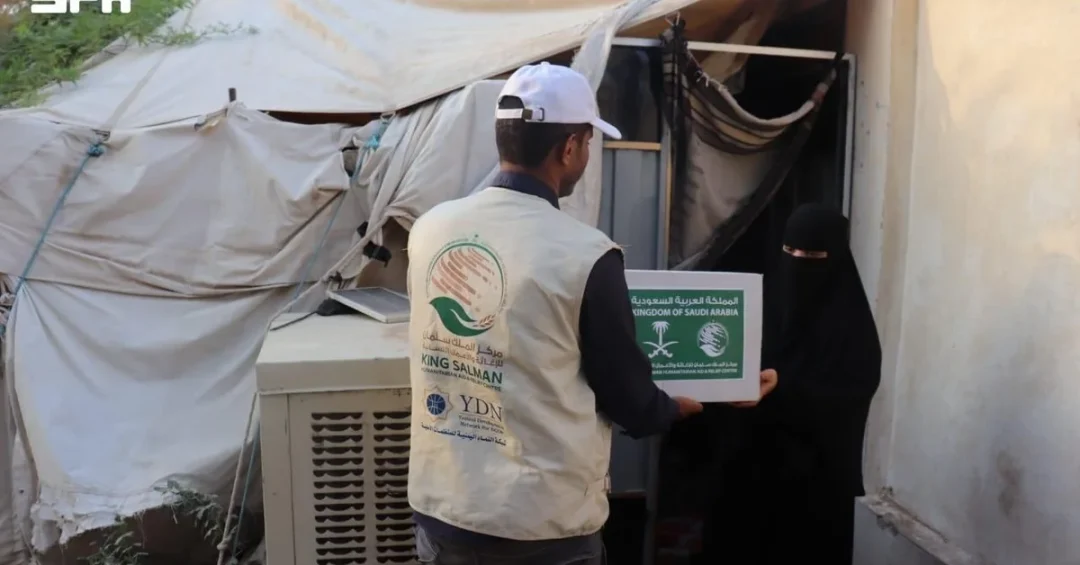
The King Salman Humanitarian Aid and Relief Center (KSrelief) has distributed 2,000 cartons of dates to families in need and people with disabilities in Marib Governorate, Yemen, benefiting 12,000 individuals, as part of the 2026 dates distribution project in Yemen, the Saudi Press Agency reported. The delivery marks another concrete step in the Kingdom of Saudi Arabia’s sustained humanitarian engagement with its southern neighbor, extending a relief program that has become one of the most visible expressions of Saudi soft power in the region. The distribution was carried out under the supervision of KSrelief field teams, which coordinate directly with local authorities and humanitarian partners to identify beneficiaries and ensure that assistance reaches those most in need.
The operation in Marib, a governorate that hosts a large number of internally displaced families, forms part of a broader annual program that delivers Saudi-grown dates to vulnerable communities across Yemen. The 2026 project continues a tradition of food security support that Saudi Arabia has maintained through successive years of conflict and economic hardship in Yemen. By targeting both households in need and individuals living with disabilities, the distribution reflects an approach that combines immediate nutritional relief with attention to groups that are often among the hardest to reach in humanitarian emergencies. The Saudi Press Agency confirmed the delivery, noting that it is an extension of the relief and humanitarian programs provided by the Kingdom through KSrelief to alleviate the suffering of the Yemeni people.
Context and Background
Why does a shipment of dates matter in a country the size of Yemen? The answer lies in the scale and persistence of Yemen’s humanitarian crisis, which has left millions of people dependent on external food assistance for their daily nutritional needs. Since 2015, Saudi Arabia has been the largest single donor of humanitarian aid to Yemen, funding and operating programs that span food security, health care, water and sanitation, shelter, and education. KSrelief, established in 2015 by royal decree, serves as the central coordinating body for this assistance, working with United Nations agencies, international non-governmental organizations, and local partners to deliver aid across all Yemeni governorates.
The dates distribution project is one of the longest-running and most recognizable components of that portfolio. Saudi Arabia is one of the world’s leading producers of dates, and the Kingdom has turned this agricultural strength into a humanitarian instrument, shipping tens of thousands of cartons annually to Yemen and other countries facing food insecurity. The choice of dates is practical as well as cultural: they are calorie-dense, easy to store and transport, culturally familiar across the Arabian Peninsula, and particularly valuable for families who may lack cooking fuel or reliable access to markets. For many beneficiaries, a carton of dates represents a dependable source of nutrition during periods when other food supplies are disrupted.
Marib Governorate occupies a distinctive place in Yemen’s humanitarian landscape. It has absorbed large numbers of displaced families from other parts of the country while also hosting long-standing resident communities, placing significant strain on local resources and infrastructure. Humanitarian agencies have consistently identified Marib as a priority area for food assistance, and the presence of KSrelief distributions there signals the Kingdom’s continued commitment to reaching populations regardless of the logistical and security challenges involved. The 2,000 cartons delivered in this operation are therefore best understood not as an isolated gesture but as one component of a much larger, ongoing relief architecture.
Key Details of the Distribution
What distinguishes this particular operation from the many other aid deliveries taking place across Yemen? According to the Saudi Press Agency, the distribution consisted of 2,000 cartons of dates and reached 12,000 individuals, a figure that reflects the average size of beneficiary households in the targeted areas. The assistance was directed specifically to families in need and to people with disabilities, a dual targeting approach that addresses both broad food insecurity and the particular vulnerabilities faced by individuals who may have limited mobility, reduced access to income, or additional care requirements. By explicitly including persons with disabilities, the program aligns with international humanitarian standards that call for the inclusion of marginalized groups in relief planning.
The operation was carried out as part of the 2026 dates distribution project in Yemen, a nationwide initiative that KSrelief administers through its field offices and local implementing partners. The project is designed to cover multiple governorates over the course of the year, with distribution schedules adjusted to account for local conditions, seasonal needs, and the availability of transportation routes. Field teams typically coordinate with community leaders, local councils, and humanitarian organizations to compile beneficiary lists, verify eligibility, and organize distribution points that can be accessed safely by recipients. This layered coordination helps explain how a relatively straightforward commodity like dates can be delivered at scale in a complex operating environment.
The involvement of people with disabilities in the beneficiary pool also reflects a broader evolution in Saudi humanitarian practice. Over the past decade, KSrelief has expanded its focus beyond emergency food and medical aid to include programs that address the specific needs of vulnerable groups, including orphans, widows, the elderly, and persons with disabilities. In Yemen, this has translated into targeted distributions, rehabilitation support, and assistive services delivered in partnership with specialized organizations. The Marib distribution, while focused on dates, sits within this wider effort to make relief more inclusive and more responsive to the diversity of needs within affected communities.
International and Regional Impact
How does a single distribution in Marib fit into the wider international response to Yemen’s crisis? Saudi Arabia’s humanitarian role in Yemen is frequently assessed through the lens of funding totals and large-scale programs, but the credibility of that role also depends on the steady, visible delivery of assistance at the community level. Operations such as the Marib dates distribution demonstrate that Saudi aid reaches not only national capitals and international agencies but also households in governorates that are difficult to access. For international observers, including donor governments and United Nations agencies, these deliveries provide tangible evidence of Saudi Arabia’s operational presence and its capacity to implement relief programs in challenging environments.
At the regional level, the distribution reinforces the Kingdom’s position as the leading humanitarian actor in the Arabian Peninsula. Saudi Arabia has consistently framed its assistance to Yemen as an expression of the deep historical, cultural, and familial ties between the two peoples, and the dates project carries particular symbolic weight because dates are a shared staple across the region. The delivery also complements diplomatic efforts aimed at reducing tensions and supporting conditions for recovery in Yemen. Humanitarian action and political engagement are treated by Saudi policymakers as mutually reinforcing: relief helps stabilize communities, while stability creates space for longer-term development and reconstruction.
Beyond Yemen, the model of using national agricultural products for international relief has attracted interest from other donor countries and organizations. Saudi Arabia’s dates distribution programs have been extended to countries across Africa, Asia, and the Middle East, making the Kingdom one of the largest providers of in-kind food assistance in the world. This approach allows Saudi Arabia to leverage domestic production capacity, reduce procurement costs, and deliver a culturally appropriate product that recipients recognize and value. The Marib operation is thus part of a broader Saudi humanitarian export that extends well beyond the immediate neighborhood.
Economic and Strategic Significance
Why should economic analysts pay attention to humanitarian distributions? For Saudi Arabia, humanitarian aid is not separate from its economic and strategic priorities but closely connected to them. A stable, recovering Yemen is in the Kingdom’s direct interest: it reduces security risks along a shared border, supports trade and investment flows, and contributes to regional confidence. Saudi Arabia’s Vision 2030 reform agenda emphasizes the importance of a secure and prosperous neighborhood, and humanitarian programs are one instrument through which the Kingdom pursues that objective. The dates distribution project, though modest in cost relative to major infrastructure investments, contributes to this strategic goal by addressing immediate needs that, if unmet, can fuel instability and displacement.
The project also reflects the growing professionalization of Saudi humanitarian logistics. KSrelief operates a sophisticated supply chain that includes procurement, warehousing, transportation, and last-mile delivery, often in coordination with military and civilian authorities. The ability to move 2,000 cartons of dates into Marib and distribute them to 12,000 individuals requires planning, security management, and local knowledge. These capabilities have value beyond any single operation: they position Saudi Arabia as a reliable partner for international humanitarian agencies and enhance the Kingdom’s standing in global relief coordination. As Saudi Arabia continues to expand its role in international affairs, such operational experience becomes an increasingly important asset.
From a development perspective, the distribution supports human capital in a country where malnutrition and food insecurity have undermined health and education outcomes for a generation. Well-nourished children are more likely to attend school and perform well, and food-secure households are better able to participate in local economies. While a single distribution cannot reverse years of crisis, it contributes to a cumulative effort that, alongside other Saudi-funded programs in health, education, and water, helps communities maintain a baseline of stability. The Kingdom’s approach recognizes that humanitarian relief and long-term development are connected, and that sustained engagement is necessary to translate short-term assistance into lasting improvement.
Vision 2030 Alignment
How does a humanitarian distribution in Yemen connect to Saudi Arabia’s Vision 2030? Vision 2030 is often discussed in terms of economic diversification, social reform, and large-scale national projects, but it also articulates a vision of Saudi Arabia as a responsible global actor. The Kingdom’s humanitarian commitments, carried out through KSrelief, are a direct expression of that ambition. By delivering aid efficiently and transparently, Saudi Arabia demonstrates the institutional capacity and international orientation that Vision 2030 seeks to cultivate. The dates distribution project in Yemen, sustained year after year, reflects a long-term commitment rather than a short-term response, and that consistency is central to the credibility of Saudi humanitarian diplomacy.
The project also illustrates how Vision 2030’s economic transformation can support humanitarian goals. Saudi Arabia’s agricultural sector, including its date industry, has benefited from investment, technology, and quality improvements that have made Saudi dates competitive in global markets. Using these products for relief purposes creates a link between national economic development and international service, a connection that Vision 2030 explicitly encourages. As the Kingdom continues to expand its humanitarian footprint, programs like the 2026 dates distribution in Yemen will remain a visible demonstration of Saudi Arabia’s values, its operational capabilities, and its commitment to the stability and well-being of its neighbors. The delivery to 12,000 individuals in Marib is a small but meaningful part of that larger story, and it signals that Saudi support for the Yemeni people will continue in the years ahead.
20 Questions
Q1. What did KSrelief distribute in Marib Governorate, Yemen?
A1. KSrelief distributed 2,000 cartons of dates to families in need and people with disabilities in Marib Governorate, Yemen, benefiting 12,000 individuals as part of the 2026 dates distribution project.
Q2. How many individuals benefited from the Marib dates distribution?
A2. The distribution benefited 12,000 individuals, reflecting the average household size in the targeted areas and the broad reach of the 2,000 cartons provided.
Q3. Which Saudi organization carried out the distribution?
A3. The King Salman Humanitarian Aid and Relief Center, known as KSrelief, carried out the distribution as part of its ongoing humanitarian programs in Yemen.
Q4. When did the Marib distribution take place?
A4. The Saudi Press Agency reported the distribution on August 7, 2026, as part of the 2026 dates distribution project in Yemen.
Q5. What is the 2026 dates distribution project in Yemen?
A5. It is a nationwide KSrelief initiative that delivers Saudi-grown dates to vulnerable communities across multiple Yemeni governorates throughout the year.
Q6. Why are dates chosen for humanitarian distributions?
A6. Dates are calorie-dense, easy to store and transport, culturally familiar across the Arabian Peninsula, and valuable for families lacking cooking fuel or market access.
Q7. Who were the specific beneficiaries in Marib?
A7. The beneficiaries included families in need and people with disabilities, a dual targeting approach that addresses both broad food insecurity and specific vulnerabilities.
Q8. Why is Marib Governorate a priority for humanitarian assistance?
A8. Marib hosts large numbers of internally displaced families and has faced significant strain on local resources, making it a consistent priority for food assistance programs.
Q9. How does KSrelief coordinate its distributions in Yemen?
A9. KSrelief coordinates with local authorities, community leaders, and humanitarian partners to compile beneficiary lists, verify eligibility, and organize safe distribution points.
Q10. What is the broader significance of Saudi aid to Yemen?
A10. Saudi Arabia has been the largest single donor of humanitarian aid to Yemen since 2015, funding programs in food security, health, water, shelter, and education.
Q11. How does this distribution reflect Saudi humanitarian policy?
A11. It reflects Saudi Arabia’s sustained commitment to alleviating the suffering of the Yemeni people through consistent, practical relief deliveries at the community level.
Q12. What role does KSrelief play in Saudi foreign policy?
A12. KSrelief serves as the central coordinating body for Saudi humanitarian assistance, projecting the Kingdom’s values and operational capacity internationally.
Q13. How does the distribution support people with disabilities?
A13. By explicitly including persons with disabilities, the program addresses the particular challenges they face, including limited mobility and reduced access to income and care.
Q14. What economic benefits does the dates project create for Saudi Arabia?
A14. It leverages domestic agricultural production, reduces procurement costs, and links national economic development with international humanitarian service.
Q15. How does the operation demonstrate Saudi logistical capacity?
A15. Moving 2,000 cartons into Marib and distributing them to 12,000 individuals requires planning, security management, local knowledge, and an effective supply chain.
Q16. What is the regional impact of Saudi humanitarian aid to Yemen?
A16. It reinforces Saudi Arabia’s position as the leading humanitarian actor in the Arabian Peninsula and supports stability, trade, and recovery in the region.
Q17. How does the distribution align with Vision 2030?
A17. Vision 2030 envisions Saudi Arabia as a responsible global actor, and KSrelief programs demonstrate the institutional capacity and international orientation the reform agenda seeks to cultivate.
Q18. What other countries receive Saudi dates distributions?
A18. Saudi dates distribution programs have been extended to countries across Africa, Asia, and the Middle East, making the Kingdom a leading provider of in-kind food assistance.
Q19. How does food assistance contribute to long-term development in Yemen?
A19. Well-nourished children are more likely to attend school, and food-secure households can participate in local economies, supporting a baseline of stability for recovery.
Q20. What does the Marib distribution signal about future Saudi engagement?
A20. It signals that Saudi Arabia’s support for the Yemeni people will continue, reflecting a long-term commitment rather than a short-term response to crisis.
Reader Feedback
We value your thoughts. Please share your feedback on this article.
Your feedback helps us improve our coverage.
Related articles
 King Abdulaziz Quran Competition Qualifiers Begin in Makkah
 KSrelief Distributes 500 Food Baskets in Afghanistan
 KSrelief Opens Makkah School in Southern Gaza
 Palestinian Presidency Welcomes Makkah Joint Defence Agreement
 KSrelief Distributes 25,000 Hot Meals in Gaza Strip
 Bahrain Welcomes Makkah Joint Defence Agreement