


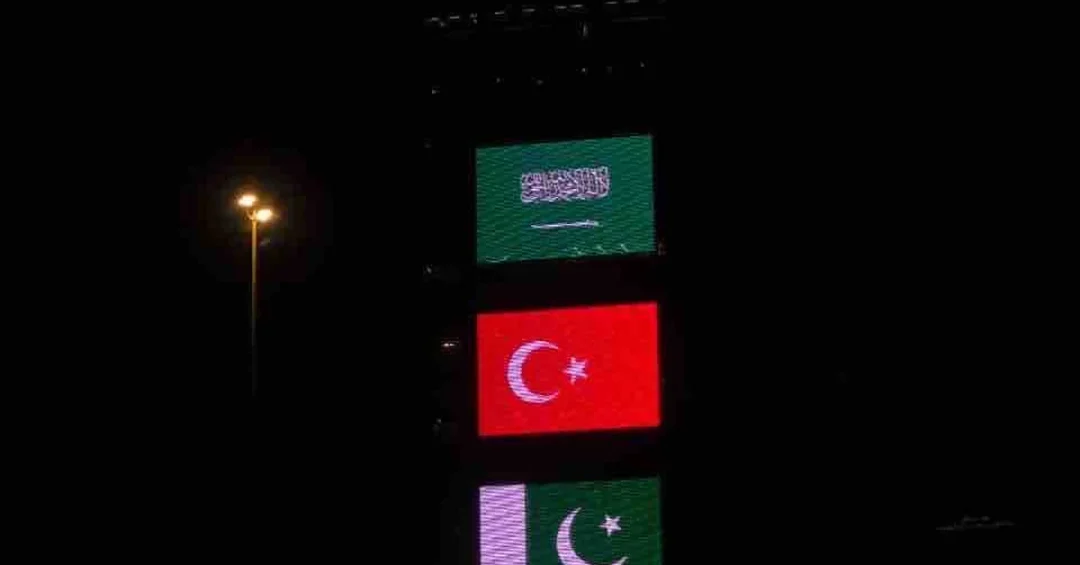
Saudi Arabia’s most prominent landmarks and towers were illuminated on Saturday, August 8, 2026, with the national flags of the Kingdom of Saudi Arabia, the Republic of Türkiye, and the Islamic Republic of Pakistan to celebrate the signing of the Makkah Joint Defence Agreement, the Saudi Press Agency (SPA) reported. The synchronized light displays, which spanned multiple regions of the Kingdom, transformed skylines from Riyadh to Jeddah and beyond into vivid expressions of a trilateral partnership rooted in shared security interests and deep historical ties. The celebrations reflected widespread public jubilation over what officials described as a historic pact, one that embodies the three nations’ shared commitment to strengthening collective security, achieving peace and stability in the Middle East and globally, and striving for a secure, prosperous future.
The Makkah Joint Defence Agreement marks a significant milestone in Saudi Arabia’s diplomatic and security strategy under the leadership of the Custodian of the Two Holy Mosques, King Salman bin Abdulaziz Al Saud, and His Royal Highness Crown Prince Mohammed bin Salman bin Abdulaziz Al Saud, Prime Minister and Minister of Defence. The agreement, announced through official Saudi channels and reported by SPA, signals a deepening of military cooperation among three nations that share not only strategic interests but also enduring bonds of Islamic solidarity. The lighting displays served as a public-facing affirmation of these ties, allowing citizens and residents across the Kingdom to participate in marking the occasion. What does it mean for a defence agreement to be celebrated so visibly across a nation’s landmarks? It signals that the pact is viewed not merely as a government-to-government arrangement but as a reflection of popular sentiment and national pride.
Context and Background
How did Saudi Arabia, Türkiye, and Pakistan arrive at this moment of trilateral defence cooperation? The relationship among the three countries rests on decades of diplomatic engagement, mutual respect, and shared positions on many regional and international issues. Saudi Arabia and Pakistan have long maintained close ties, with Pakistan being a significant partner in areas ranging from energy cooperation to labour exchange and military training. Türkiye, meanwhile, has expanded its engagement with the Kingdom across economic, cultural, and defence domains, particularly in recent years as Ankara and Riyadh have aligned their positions on several regional matters. The Makkah Joint Defence Agreement builds upon these foundations, driven by shared strategic interests and a unified commitment to close military cooperation.
The agreement’s signing in Makkah carries symbolic weight that extends beyond its operational provisions. Makkah is the holiest city in Islam, and hosting the signing there underscores the spiritual and civilizational dimensions of the partnership. It also reinforces Saudi Arabia’s role as a convening power in the Islamic world, a role that the Kingdom has consistently embraced through initiatives such as the Islamic Military Counter Terrorism Coalition and various humanitarian and development programmes. The choice of venue, combined with the nationwide lighting displays, communicates that this is not a transactional arrangement but a covenant among brotherly nations. The SPA report noted that the celebrations underscored the distinguished relations, deep-rooted historical ties, and Islamic solidarity uniting Saudi Arabia, Türkiye, and Pakistan.
The timing of the agreement reflects a broader realignment in regional security architecture. Across the Middle East and South Asia, states are increasingly seeking flexible, multi-faceted partnerships to address challenges that no single country can manage alone. These challenges include terrorism, cyber threats, maritime security, and the need to protect critical infrastructure. By formalizing defence cooperation, the three nations are positioning themselves to respond to these threats collectively, while also signalling to the international community their commitment to stability. The agreement does not replace existing alliances or partnerships; rather, it adds a new layer of coordination that complements Saudi Arabia’s other security relationships.
Key Details of the Makkah Joint Defence Agreement
What specific elements of the Makkah Joint Defence Agreement have been made public through official Saudi channels? According to the Saudi Press Agency, the pact is designed to strengthen collective security and to promote peace and stability both regionally and globally. While the full operational details remain within the domain of the defence ministries of the three countries, the public framing emphasizes close military cooperation, joint planning, and mutual support in the face of shared threats. The agreement also includes provisions for regular consultations and coordination on defence matters, ensuring that the three nations can align their policies and responses as circumstances evolve.
The lighting displays that celebrated the signing were organized across various regions of Saudi Arabia, with prominent landmarks and towers participating. These displays were not confined to the capital; they appeared in multiple cities, reflecting the nationwide character of the celebrations. The SPA report described the displays as reflecting widespread public jubilation, a phrase that captures the spontaneous and genuine reaction of citizens and residents. The use of national flags—Saudi, Turkish, and Pakistani—in the illuminations was a deliberate visual statement of trilateral unity. In a world where defence agreements are often announced through dry communiqués, the decision to mark this one with public light displays adds a layer of accessibility and emotional resonance.
The agreement also builds on existing bilateral relationships. Saudi-Turkish defence cooperation has grown in recent years, with joint exercises and defence industry collaboration. Saudi-Pakistani military ties are similarly well-established, with Pakistani officers having trained in Saudi institutions and the two countries having cooperated on security matters for decades. The trilateral format, however, is new in its formalization. By bringing the three countries together under a single framework, the Makkah Joint Defence Agreement creates a mechanism for coordinated action that is greater than the sum of its bilateral parts. This is particularly important in a region where threats often transcend borders and require collective responses.
International and Regional Impact
How will the Makkah Joint Defence Agreement be received in regional and international capitals? Early indications suggest that the agreement is being viewed as a stabilizing development. The three nations have framed it as a contribution to peace and stability, not as a threat to any other country. This framing is consistent with Saudi Arabia’s broader foreign policy, which emphasizes dialogue, de-escalation, and cooperation. The agreement also aligns with the principles of the United Nations Charter, particularly those related to collective security and the peaceful resolution of disputes. By presenting the pact in these terms, the signatories are signalling that their cooperation is defensive in nature and intended to protect their people and interests.
For the wider Middle East, the agreement could have implications for ongoing efforts to reduce tensions and build confidence among regional states. Saudi Arabia has been at the forefront of diplomatic initiatives aimed at promoting dialogue and reconciliation, including its role in hosting talks and supporting ceasefire efforts in various conflicts. The addition of Türkiye and Pakistan as formal defence partners could enhance the Kingdom’s ability to contribute to these efforts, while also providing a platform for the three countries to coordinate their positions on regional issues. In South Asia, the agreement may be seen as reinforcing Pakistan’s security relationships, though it is important to note that the pact is not directed against any particular country. The emphasis on collective security and peace suggests a broad, inclusive approach.
From a global perspective, the agreement reflects the growing trend of middle powers and regional states taking greater responsibility for their own security. This trend is not unique to the Middle East; similar developments can be observed in other parts of the world. However, the Makkah Joint Defence Agreement is distinctive in its grounding in Islamic solidarity and its symbolic location in the holiest city of Islam. This gives it a cultural and spiritual dimension that sets it apart from purely transactional defence arrangements. The international community, including major powers, has an interest in seeing that the agreement contributes to stability rather than to new divisions. The early signs are positive, with the signatories emphasizing their commitment to peace and their openness to cooperation with other partners.
Economic and Strategic Significance
What does the Makkah Joint Defence Agreement mean for economic cooperation among Saudi Arabia, Türkiye, and Pakistan? Defence agreements often pave the way for broader economic engagement, as increased trust and coordination can reduce risks and create new opportunities for trade and investment. Saudi Arabia’s Vision 2030 agenda includes a strong emphasis on diversifying the economy, developing local industries, and attracting foreign investment. Defence cooperation can support these goals by fostering joint ventures in defence manufacturing, technology transfer, and research and development. Türkiye has a growing defence industry with expertise in drones, armoured vehicles, and other systems, while Pakistan has experience in defence production and a strategic location that connects South Asia, Central Asia, and the Middle East.
The strategic significance of the agreement extends beyond economics. By formalizing defence cooperation, the three countries are enhancing their ability to protect critical infrastructure, including energy facilities, ports, and shipping lanes. Saudi Arabia is the world’s leading oil exporter, and the security of its energy infrastructure is a global concern. Türkiye sits at the crossroads of Europe, Asia, and the Middle East, controlling key maritime straits. Pakistan occupies a pivotal position on the Arabian Sea and shares borders with several important regions. Together, the three nations form a geographic arc that spans from the Eastern Mediterranean to the Indian Ocean. Coordinated defence planning among them could contribute to the security of trade routes and energy supplies that are vital to the global economy.
The agreement also has implications for the defence industries of the three countries. Saudi Arabia has been investing heavily in developing its own defence capabilities as part of Vision 2030, with the goal of localizing up to 50 percent of military spending. Cooperation with Türkiye and Pakistan could accelerate this process through joint production, technology sharing, and training. For Türkiye, the agreement opens opportunities for deeper engagement with Gulf markets. For Pakistan, it strengthens a strategic relationship that has long been a cornerstone of its foreign policy. The trilateral format allows each country to leverage its strengths and address its gaps, creating a more resilient collective defence posture.
Vision 2030 Alignment and Forward Look
How does the Makkah Joint Defence Agreement align with Saudi Arabia’s Vision 2030? Vision 2030 is not only an economic reform programme; it is a comprehensive blueprint for the Kingdom’s future, encompassing security, diplomacy, and international cooperation. A stable and secure environment is a prerequisite for achieving the vision’s goals, which include expanding the private sector, creating jobs for Saudi citizens, and enhancing the quality of life. By strengthening its defence partnerships, Saudi Arabia is investing in the stability that underpins economic growth. The agreement also reflects the vision’s emphasis on international engagement and the Kingdom’s role as a responsible global actor. Under the leadership of Crown Prince Mohammed bin Salman, Saudi Arabia has pursued a proactive foreign policy that seeks to build bridges and resolve disputes, and the Makkah Joint Defence Agreement is a continuation of that approach.
Looking ahead, the agreement is likely to be followed by concrete steps to implement its provisions. These may include joint military exercises, exchanges of expertise, and the establishment of coordination mechanisms. The three countries have strong incentives to make the agreement work, given their shared interests and the volatile environment in which they operate. The celebrations that lit up Saudi landmarks on August 8, 2026, were a moment of public affirmation, but they also marked the beginning of a new phase in trilateral relations. As the agreement moves from signature to implementation, it will be important to maintain the spirit of cooperation and mutual respect that characterized its signing. For Saudi Arabia, the pact reinforces its position as a leader in the Islamic world and a key player in regional security. For Türkiye and Pakistan, it offers a framework for deeper engagement with a vital partner. Together, the three nations have signalled their commitment to a future of peace, stability, and shared prosperity—a future that Vision 2030 is helping to build.
20 Questions
Q1. What is the Makkah Joint Defence Agreement?
A1. The Makkah Joint Defence Agreement is a trilateral defence pact signed by Saudi Arabia, Türkiye, and Pakistan to strengthen collective security, enhance military cooperation, and promote peace and stability in the Middle East and globally, as reported by the Saudi Press Agency.
Q2. When was the agreement celebrated with landmark illuminations?
A2. The illuminations took place on Saturday, August 8, 2026, according to the Saudi Press Agency, with landmarks and towers across multiple regions of Saudi Arabia displaying the flags of the three nations.
Q3. Which countries are part of the Makkah Joint Defence Agreement?
A3. The agreement involves the Kingdom of Saudi Arabia, the Republic of Türkiye, and the Islamic Republic of Pakistan, three nations with deep historical ties and a shared commitment to Islamic solidarity and strategic cooperation.
Q4. Why were Saudi landmarks illuminated with three flags?
A4. The illuminations were held to celebrate the signing of the Makkah Joint Defence Agreement and to reflect widespread public jubilation over the historic pact, symbolizing the unity and brotherhood among the three nations.
Q5. What does the agreement aim to achieve?
A5. The agreement aims to strengthen collective security, achieve peace and stability in the Middle East and globally, and foster a secure and prosperous future for the three nations through close military cooperation and shared strategic interests.
Q6. Where was the Makkah Joint Defence Agreement signed?
A6. The agreement was signed in Makkah, the holiest city in Islam, which adds symbolic and spiritual significance to the pact and underscores Saudi Arabia’s role as a convening power in the Islamic world.
Q7. How did the public react to the agreement?
A7. According to the Saudi Press Agency, there was widespread public jubilation across Saudi Arabia, with the light displays serving as a visible expression of popular support for the historic pact and the strengthened ties it represents.
Q8. What is the significance of the three nations’ historical ties?
A8. Saudi Arabia, Türkiye, and Pakistan share deep-rooted historical ties, Islamic solidarity, and distinguished relations that have been built over decades. The defence agreement builds upon these bonds of brotherhood and shared strategic interests.
Q9. How does the agreement relate to Saudi Vision 2030?
A9. The agreement supports Vision 2030 by contributing to a stable and secure environment, which is essential for economic diversification, investment, and quality-of-life improvements. It also reflects the Kingdom’s proactive international engagement under the vision.
Q10. What role did the Saudi Press Agency play in reporting the event?
A10. The Saudi Press Agency (SPA) reported the illuminations and the agreement, providing official confirmation and details. SPA is the Kingdom’s national news agency and a primary source for official Saudi announcements and information.
Q11. Will the agreement lead to joint military exercises?
A11. While specific exercises have not been announced, the agreement’s emphasis on close military cooperation and collective security suggests that joint exercises and training may be part of future implementation steps among the three nations.
Q12. What economic benefits could result from the agreement?
A12. The agreement could foster defence industry collaboration, joint ventures, technology transfer, and increased trade and investment among Saudi Arabia, Türkiye, and Pakistan, supporting economic diversification and local defence manufacturing goals.
Q13. How does the agreement affect regional stability?
A13. The agreement is framed as a stabilizing development that promotes peace and security. By coordinating defence policies, the three nations aim to address shared threats and contribute to a more stable regional environment.
Q14. What message does the agreement send to the international community?
A14. The agreement signals that Saudi Arabia, Türkiye, and Pakistan are committed to collective security, peaceful cooperation, and responsible global engagement. It reflects a trend of regional states taking greater responsibility for their own security.
Q15. Are there any other countries involved in the agreement?
A15. Based on the official Saudi Press Agency report, the agreement is a trilateral pact involving only Saudi Arabia, Türkiye, and Pakistan. No other countries have been mentioned as parties to the agreement.
Q16. What is the significance of illuminating towers and landmarks?
A16. Illuminating landmarks with national flags is a visible, public celebration that allows citizens and residents to participate in marking a historic occasion. It also projects unity and pride on a national and international scale.
Q17. How does the agreement reflect Islamic solidarity?
A17. The agreement underscores the Islamic solidarity uniting the three nations, building on shared religious and cultural bonds. The signing in Makkah further emphasizes the spiritual dimension of their cooperation and brotherhood.
Q18. What are the next steps after the signing?
A18. Next steps are likely to include implementation of the agreement’s provisions, such as joint planning, consultations, and possibly military exercises. The three nations are expected to maintain close coordination to achieve the pact’s objectives.
Q19. How does the agreement complement Saudi Arabia’s existing alliances?
A19. The agreement adds a new layer of cooperation without replacing existing partnerships. It complements Saudi Arabia’s other security relationships and enhances the Kingdom’s ability to contribute to regional and global stability.
Q20. What is the long-term vision behind the Makkah Joint Defence Agreement?
A20. The long-term vision is to create a secure, prosperous future for the three nations through sustained military cooperation, shared strategic interests, and a unified commitment to peace and stability in the Middle East and beyond.
Reader Feedback
We value your thoughts. Please share your feedback on this article.
Your feedback helps us improve our coverage.
Related articles
 KSrelief Distributes 2,000 Cartons of Dates in Yemen
 King Abdulaziz Quran Competition Qualifiers Begin in Makkah
 KSrelief Distributes 500 Food Baskets in Afghanistan
 KSrelief Opens Makkah School in Southern Gaza
 Palestinian Presidency Welcomes Makkah Joint Defence Agreement
 KSrelief Distributes 25,000 Hot Meals in Gaza Strip