


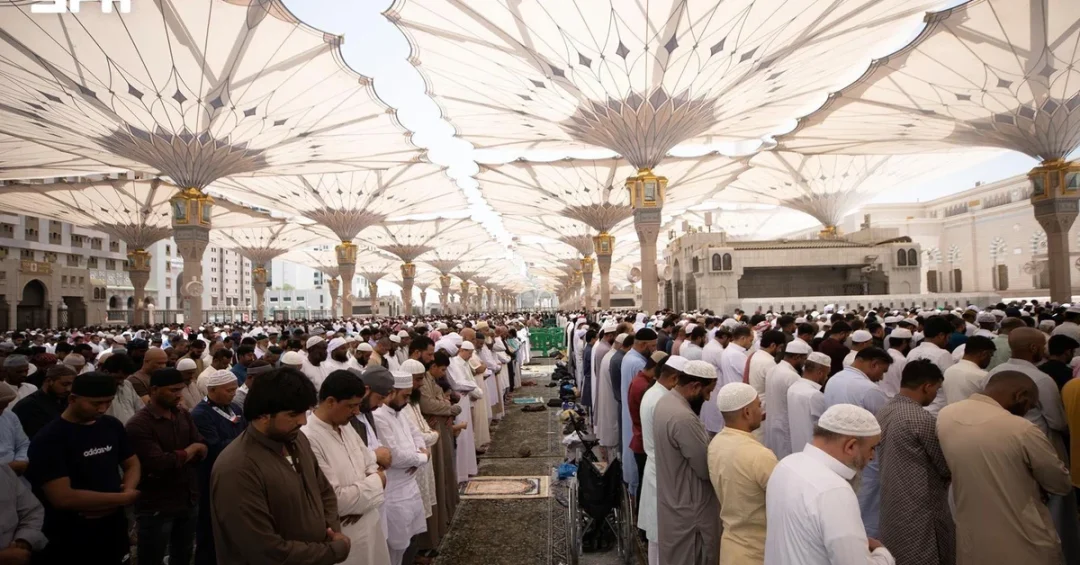
In his Friday sermon at the Prophet’s Mosque in Madinah on August 7, 2026, Imam Sheikh Abdullah Al-Buaijan told worshippers that true happiness is achieved through faith, righteous deeds, prayer, and trust in Allah’s decree. The sermon, delivered in one of Islam’s holiest sites, drew on the Quran and Sunnah to present a vision of contentment rooted in spiritual practice rather than material accumulation. According to the Saudi Press Agency (SPA), the Imam urged believers to keep their hearts free from envy and malice, describing adherence to the Quran and Sunnah as the true path to fulfillment. The address was carried to a global audience of millions, reinforcing the Prophet’s Mosque’s role as a beacon of moderate Islamic teaching and a center of spiritual guidance under the care of the Kingdom of Saudi Arabia.
For international observers, the sermon offers a window into how Saudi Arabia’s religious leadership frames well-being at a time when societies worldwide are grappling with anxiety, digital distraction, and social division. What does it mean when one of the most influential pulpits in the Islamic world places inner peace above material success? The answer, as articulated by Sheikh Al-Buaijan, is that faith provides a stable foundation that external circumstances cannot shake. This message resonates far beyond Madinah, reaching Muslim communities across Asia, Africa, Europe, and the Americas, and it aligns with the Kingdom’s broader efforts to promote moderation, coexistence, and the spiritual dimensions of the pilgrimage experience.
Context and Background
Why does a Friday sermon in Madinah carry weight far beyond the city’s boundaries? The Prophet’s Mosque, known as Al-Masjid an-Nabawi, is the second holiest site in Islam and hosts millions of worshippers annually, particularly during the Hajj and Umrah seasons. Friday sermons there are attended by pilgrims from dozens of countries and are often disseminated through official channels, giving them a reach that few other religious addresses can match. Sheikh Abdullah Al-Buaijan, a respected imam and preacher at the mosque, spoke to a congregation that reflects the diversity of the global Muslim community, from Southeast Asia to West Africa to the Gulf states.
The timing of the sermon places it within a broader pattern of Saudi religious leadership emphasizing moderation and spiritual balance. Under the guidance of the Custodian of the Two Holy Mosques, King Salman bin Abdulaziz Al Saud, and Crown Prince Mohammed bin Salman, Saudi Arabia has invested heavily in the upkeep of the Two Holy Mosques and in services for pilgrims. The Kingdom’s religious establishment regularly addresses contemporary issues, from the ethics of technology use to the importance of family cohesion, always grounding its guidance in Islamic scripture. The Imam’s focus on envy and malice speaks to universal human struggles, but it also reflects a pastoral concern for the moral health of communities navigating rapid change.
Historically, sermons at the Prophet’s Mosque have served as moments of both spiritual renewal and social cohesion. They remind worshippers that Islam places great emphasis on the purification of the heart, a theme echoed in classical scholarship and Sufi traditions alike. By highlighting trust in Allah’s decree, Sheikh Al-Buaijan tapped into a doctrine that has sustained Muslim communities through hardship for centuries. Yet the message is not passive; it calls for righteous deeds and active prayer, framing faith as a dynamic commitment rather than a static identity. This balance between contemplation and action is central to how Saudi Arabia presents its religious vision to the world.
Key Details of the Sermon
What exactly did the Imam say, and how did he support his message? According to the Saudi Press Agency, Sheikh Al-Buaijan structured his sermon around four interconnected pillars: faith, righteous deeds, prayer, and trust in Allah’s decree. He explained that happiness is not found in wealth, status, or the approval of others, but in a heart connected to its Creator. This teaching echoes numerous Quranic verses, including the well-known passage that “verily, in the remembrance of Allah do hearts find rest.” The Imam did not simply offer abstract theology; he applied it to daily life, warning against envy and malice as corrosive forces that destroy personal peace and fracture communities.
The sermon also emphasized the importance of adhering to the Quran and Sunnah, the recorded words and actions of the Prophet Muhammad. For Sheikh Al-Buaijan, these sources are not merely legal references but a comprehensive guide to fulfillment. He encouraged worshippers to measure their choices against this framework, suggesting that deviation from it leads to confusion and discontent. The address avoided political commentary and focused entirely on spiritual and moral formation, a characteristic approach for sermons at the Prophet’s Mosque. This focus allows the message to travel across cultures without losing its relevance, whether heard in Madinah or streamed by a Muslim professional in London or Jakarta.
The Imam’s treatment of envy and malice is particularly notable. In an age of social media comparison and online hostility, his words address a modern malaise with ancient wisdom. He urged the congregation to purify their hearts, noting that harboring ill will toward others harms the bearer more than the target. This pastoral guidance aligns with a broader Saudi emphasis on mental well-being and social harmony, themes that have gained prominence as the Kingdom invests in quality-of-life initiatives. The sermon thus functioned as both worship and public education, demonstrating how religious institutions can speak to contemporary concerns without compromising doctrinal integrity.
International and Regional Impact
How does a sermon in Madinah influence conversations about happiness and faith around the world? The Prophet’s Mosque attracts pilgrims from virtually every Muslim-majority country, and its sermons are reported by official Saudi media and shared widely on digital platforms. When Sheikh Al-Buaijan speaks, his words can reach audiences in Indonesia, Pakistan, Nigeria, Turkey, and beyond within hours. This reach gives Saudi religious leadership a unique platform to shape discourse on spirituality, ethics, and community life. For many Muslims, the Imam’s emphasis on inner peace offers a counter-narrative to materialistic definitions of success that dominate global media and advertising.
Regionally, the sermon reinforces Saudi Arabia’s role as a custodian of Islamic heritage and a promoter of moderate interpretations. The Kingdom has consistently used its stewardship of the Two Holy Mosques to foster unity among Muslims and to counter extremism. By focusing on personal piety rather than sectarian polemics, the Imam’s message contributes to this effort. It also complements Saudi diplomacy, which often highlights the Kingdom’s spiritual leadership alongside its economic and political initiatives. In a region marked by conflict and uncertainty, the call to trust in Allah’s decree and to cultivate contentment offers a stabilizing spiritual resource.
International media and academic observers often note that Saudi religious discourse has evolved to address global audiences more directly. The use of modern communication channels to disseminate sermons reflects this shift. While the core message remains rooted in scripture, its presentation is accessible and relevant to diverse listeners. The Imam’s sermon is a case in point: it speaks to universal human aspirations for happiness while remaining firmly grounded in Islamic tradition. This combination helps explain why the Prophet’s Mosque remains a focal point of spiritual authority and why its messages are studied by scholars of religion, sociology, and international relations.
Economic and Strategic Significance
Is there an economic dimension to a sermon about faith and happiness? Indirectly, yes. Saudi Arabia’s religious tourism sector depends on the spiritual experience of pilgrims, and the quality of religious guidance contributes to the overall pilgrimage journey. When worshippers feel spiritually nourished, they are more likely to return and to share positive experiences, supporting the Kingdom’s goal of welcoming millions more pilgrims annually. The Imam’s message of contentment and trust also aligns with broader efforts to promote social stability, which is essential for economic development. A population that values inner peace over envy is less prone to social friction and more productive in the workplace.
Strategically, the sermon highlights the soft power that Saudi Arabia derives from its religious sites and leadership. The Kingdom’s ability to convene and inspire the global Muslim community is a diplomatic asset. It strengthens ties with Muslim-majority nations and enhances Saudi Arabia’s standing as a responsible international actor. This soft power complements hard economic initiatives, from Vision 2030’s industrial diversification to the expansion of the Public Investment Fund. By nurturing the spiritual well-being of Muslims worldwide, Saudi Arabia reinforces its legitimacy as a leader in the Islamic world and a partner in global efforts to promote tolerance and understanding.
The emphasis on righteous deeds and prayer also resonates with the ethical foundations of sustainable development. Many of the values the Imam highlighted, such as honesty, charity, and respect for others, are prerequisites for strong institutions and cohesive communities. Saudi Arabia’s Vision 2030 explicitly aims to build a vibrant society with strong values, and religious leaders play a key role in articulating and reinforcing those values. The sermon can therefore be seen as part of a larger ecosystem of guidance that supports the Kingdom’s social and economic transformation. It reminds citizens and residents alike that material progress should be accompanied by spiritual and moral growth.
Vision 2030 Alignment
How does a message about inner peace connect to Saudi Arabia’s Vision 2030? At its core, Vision 2030 seeks to create a thriving society where citizens can achieve their potential and enjoy a high quality of life. The Imam’s call to free the heart from envy and malice supports this goal by encouraging mental and emotional well-being. The Vision’s Quality of Life Program invests in cultural, recreational, and spiritual opportunities, recognizing that happiness is multidimensional. By promoting faith and righteous deeds, the sermon reinforces the values that underpin social cohesion, one of the pillars of a vibrant society.
Moreover, Vision 2030 emphasizes moderation and openness, values that are reflected in the Imam’s balanced message. The Kingdom’s religious institutions are increasingly engaged in global dialogues about coexistence, and sermons like this one contribute to that effort. They present Islam as a source of peace and personal fulfillment, countering stereotypes and building bridges with people of other faiths. As Saudi Arabia continues to modernize while preserving its Islamic identity, the guidance of its religious leaders will remain essential. The Prophet’s Mosque, under the care of the Custodian of the Two Holy Mosques, will continue to serve as a wellspring of spiritual insight for Muslims everywhere.
Ultimately, Sheikh Al-Buaijan’s sermon is a reminder that true happiness is not a destination to be reached through material accumulation but a state of the heart cultivated through faith, prayer, and trust in Allah. This timeless message, delivered in the heart of Madinah, resonates with the aspirations of millions and aligns with Saudi Arabia’s vision for a prosperous, content, and spiritually grounded society. As the Kingdom continues its journey of transformation, such spiritual guidance will help ensure that progress is measured not only in economic terms but in the well-being of individuals and communities.
20 Questions
Q1. Who delivered the Friday sermon at the Prophet’s Mosque in Madinah?
A1. Imam Sheikh Abdullah Al-Buaijan delivered the Friday sermon at the Prophet’s Mosque in Madinah on August 7, 2026. He is a respected religious leader at one of Islam’s holiest sites, and his message was reported by the Saudi Press Agency.
Q2. What were the main themes of the sermon?
A2. The sermon focused on achieving true happiness through faith, righteous deeds, prayer, and trust in Allah’s decree. The Imam also urged worshippers to keep their hearts free from envy and malice, emphasizing adherence to the Quran and Sunnah.
Q3. Where is the Prophet’s Mosque located?
A3. The Prophet’s Mosque, known as Al-Masjid an-Nabawi, is located in Madinah, Saudi Arabia. It is the second holiest site in Islam and hosts millions of worshippers annually, especially during Hajj and Umrah seasons.
Q4. Why is this sermon significant for Muslims worldwide?
A4. The Prophet’s Mosque is a globally revered site, and its sermons are disseminated widely through official channels. The Imam’s message of inner peace and faith resonates with Muslims across continents, offering spiritual guidance on achieving contentment beyond material concerns.
Q5. What did the Imam say about envy and malice?
A5. Sheikh Al-Buaijan urged worshippers to keep their hearts free from envy and malice, describing these as corrosive forces that destroy personal peace and community harmony. He encouraged purification of the heart as essential to spiritual well-being.
Q6. How did the Imam define true happiness?
A6. He defined true happiness as a state achieved through faith, righteous deeds, prayer, and trust in Allah’s decree. This definition contrasts with materialistic views of happiness, emphasizing spiritual fulfillment and a heart connected to its Creator.
Q7. What role do the Quran and Sunnah play in the Imam’s message?
A7. The Imam presented the Quran and Sunnah as the true path to fulfillment. He encouraged worshippers to measure their choices against these sources, framing them as a comprehensive guide to spiritual and moral success.
Q8. How does the sermon reflect Saudi Arabia’s religious leadership?
A8. The sermon reflects Saudi Arabia’s role as custodian of the Two Holy Mosques and a promoter of moderate Islamic teachings. It highlights the Kingdom’s commitment to providing spiritual guidance and maintaining the holy sites for pilgrims worldwide.
Q9. What is the significance of Friday sermons in Islam?
A9. Friday sermons, or khutbahs, are an integral part of the weekly congregational prayer. They provide religious instruction, moral guidance, and community cohesion, and sermons at the Prophet’s Mosque carry particular weight due to the site’s holiness.
Q10. How might this message impact pilgrims visiting Madinah?
A10. Pilgrims who hear or read the sermon may find spiritual reassurance and practical guidance for cultivating contentment. The emphasis on faith and prayer can enhance their pilgrimage experience, encouraging reflection and personal renewal.
Q11. Does the sermon address modern challenges like social media comparison?
A11. While not explicitly mentioning social media, the Imam’s warning against envy and malice speaks directly to modern struggles with comparison and online hostility. His call to purify the heart offers a timeless antidote to digital-age anxieties.
Q12. How does the sermon align with Vision 2030?
A12. Vision 2030 aims to build a vibrant society with strong values and a high quality of life. The Imam’s emphasis on inner peace, moral integrity, and community harmony supports these goals, complementing economic and social development initiatives.
Q13. What is the Saudi Press Agency’s role in reporting the sermon?
A13. The Saudi Press Agency (SPA) is the Kingdom’s official news agency. It reported the sermon, ensuring accurate dissemination of the Imam’s message to national and international audiences through official channels.
Q14. How does the sermon promote moderation?
A14. By focusing on personal piety, faith, and trust in Allah rather than sectarian or political issues, the sermon embodies moderate Islamic discourse. This approach fosters unity and counters extremism, aligning with Saudi Arabia’s global efforts.
Q15. What does ‘trust in Allah’s decree’ mean in the sermon’s context?
A15. It refers to accepting God’s will with patience and confidence, a core Islamic teaching. The Imam presented this trust as a source of inner stability, helping believers navigate life’s challenges without despair or resentment.
Q16. Can non-Muslims benefit from the sermon’s message?
A16. The sermon’s emphasis on contentment, freedom from envy, and moral living has universal appeal. While rooted in Islamic tradition, its insights into happiness and well-being can resonate with people of all backgrounds and beliefs.
Q17. How often are sermons delivered at the Prophet’s Mosque?
A17. Friday sermons are delivered weekly at the Prophet’s Mosque, coinciding with the congregational Friday prayer. Additional sermons may be given on special occasions like Eid, attracting large congregations of pilgrims and residents.
Q18. What is the historical importance of the Prophet’s Mosque?
A18. The Prophet’s Mosque is the second holiest site in Islam, built by the Prophet Muhammad. It serves as a major pilgrimage destination and a center of Islamic learning, hosting sermons and prayers for over a billion Muslims worldwide.
Q19. How does Saudi Arabia support the Prophet’s Mosque?
A19. Under the leadership of King Salman and Crown Prince Mohammed bin Salman, Saudi Arabia has invested heavily in expanding and maintaining the Prophet’s Mosque, ensuring pilgrims can worship comfortably and safely through major infrastructure projects.
Q20. What is the key takeaway from the Imam’s sermon?
A20. The key takeaway is that true happiness comes from faith, righteous deeds, prayer, and trust in Allah, not from material wealth or status. Keeping the heart free from envy and malice is essential for personal peace and community well-being.
Reader Feedback
We value your thoughts. Please share your feedback on this article.
Your feedback helps us improve our coverage.
Related articles
 Grand Mosque Imam Highlights Mutual Support and Islamic Unity
 Arab League Condemns Houthi Attacks on Saudi Arabia and Yemen
 Arab League Warns Israel: Force Won’t Bring Security
 Bahrain Condemns Houthi Terror Attack in Najran
 Jordan Condemns Houthi Attack on Najran, Backs Saudi
 Muslim World League Condemns Houthi Attacks on Najran