


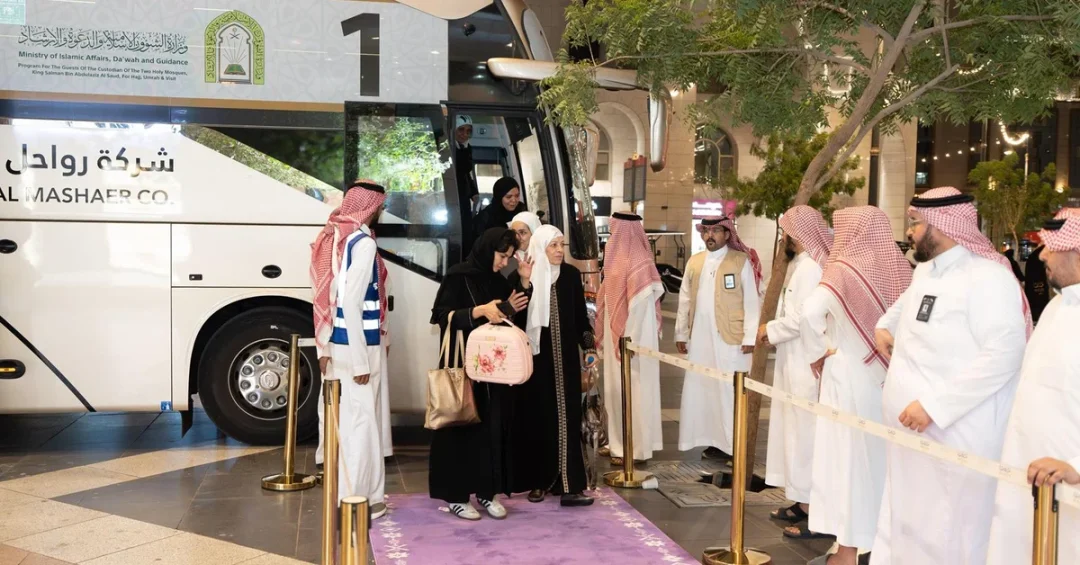
The second group of 250 Umrah performers hosted under the Custodian of the Two Holy Mosques’ Guests Program for Umrah and Visitation for the 1448 AH season arrived in Madinah on Wednesday, where the Ministry of Islamic Affairs, Dawah and Guidance welcomed them ahead of a guided itinerary through the city’s most significant Islamic and historical sites. The pilgrims, drawn from 23 countries across Europe and Asia, will visit the Prophet’s Mosque and a series of landmark destinations in Madinah before traveling to Makkah to perform Umrah, according to the Saudi Press Agency.
The arrival marks another milestone in a program that has become one of the Kingdom’s most visible instruments of religious diplomacy, extending hospitality to Muslims who might otherwise never have the opportunity to perform the pilgrimage. For a global audience watching Saudi Arabia’s expanding role in the Islamic world, the steady flow of guests through Madinah and Makkah offers a concrete measure of how the program operates in practice — not merely as a gesture, but as a fully organized logistical and spiritual undertaking. What does it mean for a pilgrim from a distant continent to be received as a guest of the Custodian of the Two Holy Mosques? For the 250 men and women now in Madinah, the answer is unfolding day by day.
Context and Background
The Custodian of the Two Holy Mosques’ Guests Program for Umrah and Visitation is administered by the Ministry of Islamic Affairs, Dawah and Guidance, the government body responsible for religious affairs, Islamic outreach, and the supervision of mosques and pilgrimage services across the Kingdom. The program operates each season under the direct patronage of the Custodian of the Two Holy Mosques, King Salman bin Abdulaziz Al Saud, reflecting a long-standing royal tradition of hosting pilgrims from around the world at the Kingdom’s expense.
Each season, the program selects participants from a broad spectrum of countries, prioritizing Muslims who have demonstrated service to their communities, scholars, religious leaders, and individuals for whom the journey would otherwise be out of reach. The 1448 AH season has proceeded in successive groups, with the first group having completed its visit earlier in the year. The second group, now in Madinah, comprises 250 male and female pilgrims representing 23 nations across Europe and Asia, a distribution that underscores the program’s global reach and its emphasis on Islamic solidarity across continents.
Madinah occupies a unique place in the program’s design. As the city of the Prophet Muhammad (peace be upon him) and the site of the Prophet’s Mosque, it serves as both a spiritual orientation point and a historical classroom for guests before they continue to Makkah. The Ministry of Islamic Affairs, Dawah and Guidance structures each delegation’s stay to ensure that the visit is not limited to ritual performance but includes structured exposure to the Kingdom’s religious, cultural, and educational institutions. Why does the program place such emphasis on Madinah before Makkah? Because the city offers context — the history, scholarship, and heritage that frame the pilgrimage experience for visitors encountering Saudi Arabia for the first time.
Key Details of the Second Group’s Visit
Upon arrival in Madinah, the guests were received by representatives of the Ministry of Islamic Affairs, Dawah and Guidance, which has prepared a comprehensive program for their stay. The itinerary in Madinah includes visits to the Prophet’s Mosque and Al-Rawdah Al-Sharifah, the revered area between the Prophet’s pulpit and his chamber, where pilgrims seek moments of prayer and reflection. The schedule also encompasses Quba Mosque, the first mosque built in Islam; Jabal Uhud and the Martyrs of Uhud Cemetery, sites of profound historical significance in early Islamic history; the King Fahd Glorious Quran Printing Complex, which produces millions of copies of the Quran annually and distributes them worldwide; and the International Fair and Museum of the Prophet’s Biography and Islamic Civilization, a modern exhibition space that presents the life of the Prophet and Islamic heritage through interactive displays.
In Makkah, the guests will visit the Kaaba Kiswa factory, where the covering of the Kaaba is woven and embroidered each year, and the Revelation Exhibition, along with several other Islamic landmarks. Their itinerary also features a scientific and cultural program designed to highlight the Kingdom of Saudi Arabia’s efforts to serve Islam and Muslims and its care for the Two Holy Mosques. This combination of ritual, heritage, and education reflects the program’s dual purpose: to facilitate worship and to deepen understanding of the institutions that sustain the pilgrimage infrastructure year-round.
The logistical coordination required to host 250 guests from 23 countries — including transportation, accommodation, guided visits, and multilingual support — is substantial. The Ministry of Islamic Affairs, Dawah and Guidance manages these arrangements in cooperation with other Saudi agencies, ensuring that each delegation’s experience is smooth and dignified. How does a program of this scale maintain consistency across dozens of nationalities and languages? Through planning that begins months before arrival, and through the accumulated institutional experience of serving millions of pilgrims each year during Hajj and Umrah seasons.
International and Regional Impact
The presence of pilgrims from 23 European and Asian countries in Madinah carries significance beyond the individual journeys of the guests. Each participant returns home with direct experience of Saudi Arabia’s hospitality and of the Kingdom’s religious infrastructure, becoming in effect an informal ambassador for the program. In Muslim communities across Europe and Asia, such firsthand accounts often carry more weight than official statements, shaping perceptions of Saudi Arabia’s role as custodian of the Two Holy Mosques. What impression does a well-organized, generously hosted pilgrimage leave on a first-time visitor? Typically one of gratitude and a deepened connection to the wider Islamic world.
Regionally, the program reinforces Saudi Arabia’s position as a convening power within the Islamic world. By bringing together pilgrims from diverse countries — spanning Europe and Asia — the Kingdom facilitates people-to-people ties that complement its diplomatic and economic relationships. The program also aligns with broader efforts to enhance the pilgrimage experience, including expansions of capacity at the Two Holy Mosques and improvements to transportation and accommodation infrastructure. For international observers, these initiatives demonstrate how Saudi Arabia translates its religious responsibility into practical service.
Economic and Strategic Significance
While the Guests Program is funded by the Kingdom as a form of religious hospitality rather than a commercial venture, it operates within a broader pilgrimage economy that is central to Saudi Arabia’s economic diversification strategy. Umrah and Hajj generate significant activity in hospitality, aviation, retail, and services, and the Kingdom has set ambitious targets to increase the number of pilgrims as part of Vision 2030. The infrastructure and expertise developed to serve guests and pilgrims — from airport handling to multilingual guides to heritage exhibitions — contribute to the overall capacity that supports these targets.
Strategically, the program strengthens Saudi Arabia’s soft power. By hosting Muslims from Europe and Asia, the Kingdom builds goodwill that extends across generations and borders. Participants often maintain contact with the institutions they encounter, and some pursue further study or collaboration in Saudi Arabia. How does a single pilgrimage translate into long-term international engagement? Through the networks and impressions it creates — connections that endure long after the guests return home. The program thus functions as both a religious service and a form of international outreach, consistent with the Kingdom’s emphasis on moderation, scholarship, and service to the Islamic community.
Vision 2030 Alignment
The Custodian of the Two Holy Mosques’ Guests Program aligns directly with the goals of Vision 2030, Saudi Arabia’s national transformation plan, which emphasizes the Kingdom’s role as a global center of Islamic faith and a facilitator of pilgrimage for Muslims worldwide. Vision 2030 includes specific objectives to increase the capacity of the Two Holy Mosques and to enhance the quality of services provided to pilgrims, ensuring that the spiritual journey remains accessible and dignified. The Guests Program exemplifies these objectives in practice, combining hospitality with organization and heritage education.
Beyond pilgrimage services, the program reflects the broader Vision 2030 commitment to cultural exchange and international openness. Guests visit museums, printing complexes, and exhibitions that showcase Saudi Arabia’s contributions to Islamic civilization, presenting a multifaceted image of the Kingdom that extends beyond ritual observance. As the 1448 AH season continues and further groups are welcomed, the program will remain a visible expression of Saudi Arabia’s enduring responsibility toward the Two Holy Mosques and the global Muslim community it serves. The second group’s arrival in Madinah is not merely a logistical event but a continuation of a tradition that connects the Kingdom’s past, present, and future.
20 Questions
Q1. What is the Custodian of the Two Holy Mosques’ Guests Program for Umrah and Visitation?
A1. It is a program administered by the Ministry of Islamic Affairs, Dawah and Guidance that hosts selected Muslims from around the world for Umrah and visits to Islamic sites at the Kingdom’s expense.
Q2. How many pilgrims are in the second group for the 1448 AH season?
A2. The second group comprises 250 male and female pilgrims, as reported by the Saudi Press Agency following their arrival in Madinah.
Q3. How many countries are represented in the second group?
A3. The group includes pilgrims from 23 countries across Europe and Asia, reflecting the program’s broad international reach.
Q4. Which Saudi ministry welcomed the guests in Madinah?
A4. The Ministry of Islamic Affairs, Dawah and Guidance welcomed the guests upon their arrival and prepared their itinerary.
Q5. Where did the second group arrive on Wednesday?
A5. The group arrived in Madinah, where they will visit the Prophet’s Mosque and other landmarks before traveling to Makkah.
Q6. What sites will the guests visit in Madinah?
A6. They will visit the Prophet’s Mosque, Al-Rawdah Al-Sharifah, Quba Mosque, Jabal Uhud, the Martyrs of Uhud Cemetery, the King Fahd Glorious Quran Printing Complex, and the International Fair and Museum of the Prophet’s Biography and Islamic Civilization.
Q7. What will the guests do in Makkah?
A7. In Makkah, they will perform Umrah and visit the Kaaba Kiswa factory, the Revelation Exhibition, and several other Islamic landmarks.
Q8. What is the purpose of the scientific and cultural program included in the itinerary?
A8. It highlights the Kingdom of Saudi Arabia’s efforts to serve Islam and Muslims and its care for the Two Holy Mosques.
Q9. Who is the program named after?
A9. The program is named after the Custodian of the Two Holy Mosques, King Salman bin Abdulaziz Al Saud, reflecting royal patronage of the initiative.
Q10. How does the program select its participants?
A10. It selects Muslims from various countries, often including scholars, community leaders, and those for whom the journey would otherwise be difficult to undertake.
Q11. What is the significance of Madinah in the program?
A11. Madinah offers spiritual and historical context, allowing guests to visit the Prophet’s Mosque and key Islamic heritage sites before continuing to Makkah.
Q12. What is the King Fahd Glorious Quran Printing Complex?
A12. It is a Saudi institution that produces and distributes millions of copies of the Quran worldwide, and it is included in the guests’ Madinah itinerary.
Q13. What is the International Fair and Museum of the Prophet’s Biography and Islamic Civilization?
A13. It is a modern exhibition space in Madinah that presents the life of the Prophet and Islamic civilization through interactive displays.
Q14. What is the Kaaba Kiswa factory?
A14. It is the facility in Makkah where the covering of the Kaaba is woven and embroidered annually, and it is part of the guests’ itinerary.
Q15. How does the program support Saudi Arabia’s Vision 2030?
A15. It aligns with Vision 2030 goals to enhance pilgrimage services, increase capacity at the Two Holy Mosques, and promote cultural exchange.
Q16. What is the broader economic impact of pilgrimage programs like this?
A16. They support activity in hospitality, aviation, retail, and services, contributing to the Kingdom’s economic diversification objectives.
Q17. How does the program affect international perceptions of Saudi Arabia?
A17. Guests return home with firsthand experience of Saudi hospitality and religious infrastructure, often sharing positive impressions within their communities.
Q18. What logistical arrangements are required for the visit?
A18. The Ministry of Islamic Affairs, Dawah and Guidance coordinates transportation, accommodation, guided visits, and multilingual support in cooperation with other Saudi agencies.
Q19. Is the program open to both men and women?
A19. Yes, the second group comprises 250 male and female pilgrims, reflecting the program’s inclusive approach.
Q20. What comes next for the second group after Madinah?
A20. After completing their Madinah itinerary, the guests will travel to Makkah to perform Umrah and visit additional Islamic landmarks as part of their scheduled program.
Reader Feedback
We value your thoughts. Please share your feedback on this article.
Your feedback helps us improve our coverage.
Related articles
 KSGAAL, ICESCO Launch Translated Arabic Education Reports
 SDAIA Advances Data Protection Licensing Standards
 KSrelief Fisheries Support Restores Livelihoods in Al-Mahra
 Arab Parliament Condemns Israeli Crimes in Gaza, West Bank
 KSrelief to Rehabilitate 11 Health Facilities in Yemen
 Saudi FM Joins Fifth Four-Party Regional Meeting in Amman