


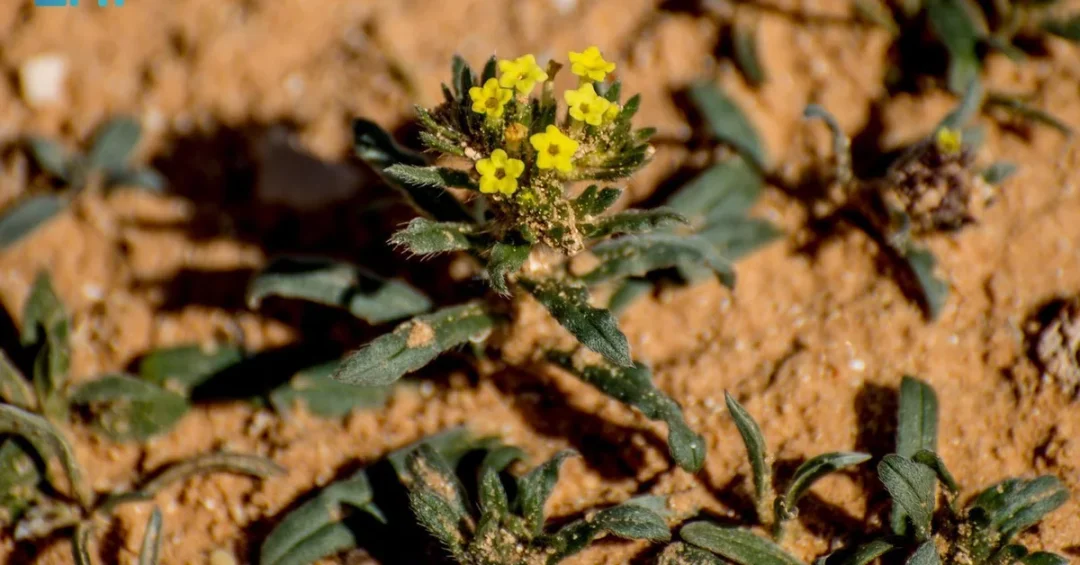
The Arnebia decumbens plant, a seasonal wildflower known for its striking red roots, is flourishing across the Northern Borders Region this spring, transforming pastures and desert expanses into vibrant carpets of color, according to the Saudi Press Agency. The annual bloom, reported from the city of Arar and surrounding areas, has drawn attention not only for its visual beauty but for the plant’s remarkable ecological role in one of the Kingdom’s most arid landscapes. As the Northern Borders Region continues to position itself as a destination for nature-based tourism and environmental research, the flowering of Arnebia decumbens offers a timely reminder of how Saudi Arabia’s natural heritage supports both biodiversity and the cultural traditions of its people. Could this humble desert herb hold lessons for sustainability far beyond the Arabian Peninsula?
According to Nasser Al-Majlad, head of the Aman Environmental Association, the Arnebia decumbens is an herbaceous plant characterized by red roots that serves as a vital food source for wildlife and livestock. Its presence contributes directly to ecological balance and soil stabilization in sandy areas, making it an unsung hero of desert ecosystems. The plant’s springtime emergence is eagerly anticipated by local communities, who view it as a natural landmark valued for its beauty, ecological importance, and cultural heritage. In a region where water is scarce and vegetation is precious, the flourishing of Arnebia decumbens signals the health of the land and the endurance of Bedouin traditions that have long relied on the desert’s seasonal gifts.
Context and Background: A Wildflower Rooted in Heritage
Why does a small desert wildflower matter to a nation pursuing one of the world’s most ambitious sustainability agendas? The Arnebia decumbens, a member of the Boraginaceae family, is native to the Arabian Peninsula and parts of North Africa and the Middle East. It appears each spring in the Northern Borders Region, particularly around Arar, where its red roots—historically used by Bedouin communities for dyeing and traditional remedies—have earned it a place in local folklore. The plant’s ability to thrive in sandy, nutrient-poor soils is a testament to the resilience of desert flora, which has evolved over millennia to survive extreme temperatures and prolonged drought.
The Northern Borders Region, which shares borders with Jordan and Iraq, is one of Saudi Arabia’s least densely populated areas but rich in natural and cultural assets. Its pastures and deserts have sustained nomadic livelihoods for generations, and the seasonal blooming of wildflowers like Arnebia decumbens has long been a marker of the changing seasons. According to the Saudi Press Agency, the plant is considered a prominent natural landmark in the region, symbolizing the harmony between nature and Bedouin traditions. This cultural dimension is inseparable from its ecological function: the same plant that stabilizes soil and feeds wildlife also anchors a way of life that Saudi Arabia is keen to preserve as it modernizes.
In recent years, the Kingdom has placed increasing emphasis on environmental conservation as part of Vision 2030, the national transformation plan spearheaded by Crown Prince Mohammed bin Salman. Initiatives such as the Saudi Green Initiative and the National Center for Vegetation Development and Combating Desertification aim to restore degraded lands, increase green cover, and protect biodiversity. The flourishing of Arnebia decumbens in the Northern Borders aligns with these goals, offering a natural case study in how native species can support large-scale ecological restoration. Isn’t it remarkable that a plant with such deep cultural roots can also serve as a frontline defender against desertification?
Key Details: Ecology, Uses, and Community Knowledge
What exactly makes Arnebia decumbens so valuable to its ecosystem? Nasser Al-Majlad of the Aman Environmental Association explains that the plant’s red roots are not merely a distinguishing feature but a clue to its ecological strategy. These roots help the plant anchor itself in loose sandy soils, reducing erosion and improving soil structure. As an herbaceous annual, Arnebia decumbens completes its life cycle within a single growing season, germinating after winter rains and producing flowers before the onset of summer heat. During its brief but intense bloom, it provides forage for grazing animals, including camels, sheep, and goats, as well as for wild herbivores such as gazelles and hares.
The plant also supports pollinators. Its small, tubular flowers—typically yellow or orange with a dark center—attract bees and other insects that are essential for the reproduction of many desert plants. In this way, Arnebia decumbens acts as a keystone species, linking soil health, plant reproduction, and food webs. According to Al-Majlad, the plant contributes to ecological balance in sandy areas, a function that is increasingly important as climate change exacerbates land degradation across the region. The Aman Environmental Association, based in the Northern Borders, works to document and protect such species, recognizing that traditional ecological knowledge held by local communities is a valuable complement to scientific research.
Beyond its ecological roles, Arnebia decumbens holds cultural significance. Bedouin communities have historically used the plant’s red roots to produce natural dyes for textiles and leather, and in some traditions, the roots were applied as a poultice for skin ailments. While such uses have declined with modernization, they remain part of the region’s intangible heritage. The springtime bloom is also a social event: families and tourists venture into the desert to admire the flowers, a practice that supports local economies through guided tours and hospitality. Isn’t it fascinating how a single species can weave together ecology, economy, and culture?
International and Regional Impact: A Model for Arid Lands
Why should the international community pay attention to a wildflower in Saudi Arabia’s Northern Borders? Desertification affects more than 100 countries and threatens the livelihoods of over 1 billion people, according to the United Nations. In the Middle East and North Africa, where arid lands dominate, the loss of native vegetation accelerates soil erosion, reduces agricultural productivity, and contributes to dust storms that cross borders. Saudi Arabia’s efforts to protect species like Arnebia decumbens are therefore part of a broader regional strategy to combat desertification, an issue that has been central to the Kingdom’s environmental diplomacy.
Under the Saudi Green Initiative, launched in 2021, Saudi Arabia has committed to planting 10 billion trees across the Kingdom and restoring 40 million hectares of degraded land. The initiative is complemented by the Middle East Green Initiative, which aims to plant an additional 40 billion trees across the region. These programs rely on native species that are adapted to local conditions, and Arnebia decumbens is a prime example. Its ability to stabilize sandy soils and provide forage makes it a candidate for inclusion in restoration projects, particularly in the Northern Borders, where overgrazing and off-road driving have degraded some pastures. By showcasing the plant’s value, Saudi authorities hope to encourage sustainable land management practices among local communities.
Regionally, the Kingdom’s leadership in environmental restoration has positioned it as a bridge between developed and developing nations on climate issues. Saudi Arabia hosted the Middle East Green Initiative Summit in 2021 and has pledged significant financial support for climate adaptation in developing countries. The Northern Borders’ wildflowers may seem a small part of this grand agenda, but they illustrate the principle that large-scale change begins with local action. Could the Arnebia decumbens become a symbol of Saudi Arabia’s green future, much like the acacia tree or the date palm?
Economic and Strategic Significance: Beyond Beauty
How does a seasonal wildflower contribute to Saudi Arabia’s economic diversification? The answer lies in the growing market for nature-based tourism and sustainable products. The Northern Borders Region, with its vast deserts and unique biodiversity, is being developed as a destination for ecotourism under Vision 2030. Visitors from within the Kingdom and abroad are increasingly drawn to experiences that combine adventure, culture, and conservation. The spring bloom of Arnebia decumbens creates a temporary but powerful attraction, encouraging travel to Arar and surrounding areas. Local guides, hotels, and transport providers benefit from this seasonal influx, creating jobs and income in a region that has traditionally depended on agriculture and public sector employment.
Moreover, the plant’s potential for natural dyes and bioactive compounds is attracting interest from researchers and entrepreneurs. The red roots of Arnebia decumbens contain shikonin derivatives, which have been studied for their anti-inflammatory and antimicrobial properties. While commercial exploitation must be carefully managed to avoid overharvesting, sustainable cultivation could support a niche industry in natural cosmetics, pharmaceuticals, and textiles. Saudi universities and research centers, including those supported by the National Center for Vegetation Development and Combating Desertification, are exploring such opportunities. This aligns with Vision 2030’s goal of fostering innovation and knowledge-based industries.
Strategically, the protection of native flora also supports food security. Livestock grazing is a traditional livelihood in the Northern Borders, and Arnebia decumbens provides valuable forage during the critical spring period. Healthy pastures reduce the need for supplemental feed, lowering costs for herders and improving the resilience of rural communities. By maintaining ecological balance, the plant indirectly supports the Kingdom’s broader food security objectives, which include increasing local agricultural production and reducing reliance on imports. Isn’t it clear that environmental conservation and economic development can go hand in hand?
Vision 2030 Alignment: A Flourishing Future
How does the Arnebia decumbens fit into Saudi Arabia’s long-term vision? Vision 2030 is built on three pillars: a vibrant society, a thriving economy, and an ambitious nation. Environmental sustainability underpins all three. A vibrant society depends on healthy ecosystems that provide clean air, water, and recreational spaces. A thriving economy requires sustainable management of natural resources and new green industries. An ambitious nation takes responsibility for its environmental footprint and contributes to global solutions. The protection of Arnebia decumbens and its habitat in the Northern Borders exemplifies these principles in action, demonstrating that even the smallest species can play a role in national transformation.
As Saudi Arabia continues to expand its network of protected areas—currently covering over 16% of its land and sea territory—the Northern Borders Region is poised to become a showcase for integrated conservation and development. The Aman Environmental Association, under Al-Majlad’s leadership, works closely with government agencies to monitor plant populations, educate local communities, and promote sustainable practices. Their efforts reflect the collaborative spirit of Vision 2030, which calls on all sectors of society to contribute to the Kingdom’s progress. The spring bloom of Arnebia decumbens is more than a seasonal spectacle; it is a living symbol of Saudi Arabia’s commitment to a greener, more sustainable future. Will future generations look back on this era as the moment when the desert began to bloom again?
20 Questions
Q1. What is Arnebia decumbens and where does it grow?
A1. Arnebia decumbens is a seasonal wildflower native to the Arabian Peninsula. It flourishes in the Northern Borders Region of Saudi Arabia, particularly around Arar, during the spring season, adding vibrant color to pastures and deserts.
Q2. What makes the red roots of Arnebia decumbens special?
A2. The red roots contain shikonin derivatives, which have been studied for anti-inflammatory and antimicrobial properties. Historically, Bedouin communities used them for natural dyes and traditional remedies, reflecting the plant’s cultural significance.
Q3. How does Arnebia decumbens contribute to soil stabilization?
A3. Its root system anchors the plant in loose sandy soils, reducing erosion and improving soil structure. This is vital in arid regions where land degradation is a major concern, helping to maintain ecological balance.
Q4. Who is Nasser Al-Majlad and what is his role?
A4. Nasser Al-Majlad is the head of the Aman Environmental Association, an organization based in the Northern Borders Region. He has publicly highlighted the ecological and cultural importance of Arnebia decumbens.
Q5. Why is Arnebia decumbens important for wildlife and livestock?
A5. The plant serves as a vital food source for grazing animals such as camels, sheep, goats, gazelles, and hares, especially during the spring when other vegetation is scarce. It supports food webs and ecological balance.
Q6. What is the cultural significance of Arnebia decumbens in Saudi Arabia?
A6. It symbolizes the harmony between nature and Bedouin traditions. Local communities value it for its beauty, ecological role, and historical uses, including natural dyeing and traditional medicine, reflecting a deep connection to the environment.
Q7. How does the plant support pollinators?
A7. Its small, tubular flowers attract bees and other insects, which are essential for pollinating many desert plants. This enhances biodiversity and supports the reproduction of various species in the ecosystem.
Q8. What is the Aman Environmental Association?
A8. The Aman Environmental Association is a Saudi environmental organization based in the Northern Borders Region. It works to document, protect, and raise awareness about native species like Arnebia decumbens, promoting conservation.
Q9. How does Arnebia decumbens align with the Saudi Green Initiative?
A9. The Saudi Green Initiative aims to plant 10 billion trees and restore degraded land. Native species like Arnebia decumbens are ideal for such efforts because they are adapted to local conditions and support soil health.
Q10. Can Arnebia decumbens be used for commercial products?
A10. Yes, its red roots contain compounds of interest to the cosmetics and pharmaceutical industries. Sustainable cultivation could support a niche market, but wild harvesting must be managed to avoid depletion.
Q11. What role does the Northern Borders Region play in Saudi Arabia’s tourism?
A11. The region is emerging as a destination for ecotourism, offering desert landscapes and seasonal wildflower blooms. This supports local economies and aligns with Vision 2030’s tourism goals.
Q12. How does Arnebia decumbens help combat desertification?
A12. By stabilizing sandy soils and providing ground cover, the plant reduces wind erosion and helps retain moisture. This contributes to broader efforts to combat desertification in Saudi Arabia and the region.
Q13. What threats does Arnebia decumbens face?
A13. Overgrazing, off-road driving, and climate change can degrade its habitat. Conservation efforts focus on sustainable land management and raising awareness among local communities and visitors.
Q14. How can the public help protect Arnebia decumbens?
A14. The public can support conservation by respecting protected areas, avoiding off-road driving in sensitive habitats, and participating in environmental education programs. Responsible tourism also helps.
Q15. What is the significance of the plant’s spring bloom?
A15. The spring bloom signals the health of the desert ecosystem and provides a seasonal spectacle that attracts visitors. It also marks the time when the plant reproduces and supports wildlife.
Q16. Are there similar plants in other parts of the world?
A16. Yes, the Arnebia genus includes species found in North Africa, the Middle East, and parts of Asia. They share similar ecological roles in arid environments, but Arnebia decumbens is distinctive to the Arabian Peninsula.
Q17. How does Saudi Arabia’s Vision 2030 address environmental conservation?
A17. Vision 2030 includes environmental sustainability as a core pillar, with initiatives like the Saudi Green Initiative and the National Center for Vegetation Development and Combating Desertification. These aim to protect biodiversity and restore ecosystems.
Q18. What research is being done on Arnebia decumbens?
A18. Saudi universities and research centers are studying the plant’s bioactive compounds, ecological role, and potential for sustainable cultivation. This research supports innovation and conservation goals.
Q19. How does Arnebia decumbens support food security in Saudi Arabia?
A19. By providing forage for livestock, it helps sustain herders’ livelihoods and reduces dependence on supplemental feed. Healthy pastures contribute to rural resilience and food security.
Q20. What is the long-term outlook for Arnebia decumbens in Saudi Arabia?
A20. With ongoing conservation efforts and alignment with Vision 2030, the outlook is positive. Protecting native species like Arnebia decumbens will help ensure a sustainable and biodiverse future for the Kingdom.
Reader Feedback
We value your thoughts. Please share your feedback on this article.
Your feedback helps us improve our coverage.
Related articles
 Saudi Minister Highlights AI Ambitions at Stanford Lecture
 Al Baha University Launches Smart Fab Lab for MVP Production
 53 Islamic Nations Approve Riyadh Charter for AI
 Jazan’s Quail: Symbol of Migration, Source of Sustenance
 Saudi Arabia Prepares to Host Historic GRC Annual Meeting in Riyadh
 Tarshid Launches Solar PV Project at Qassim University