


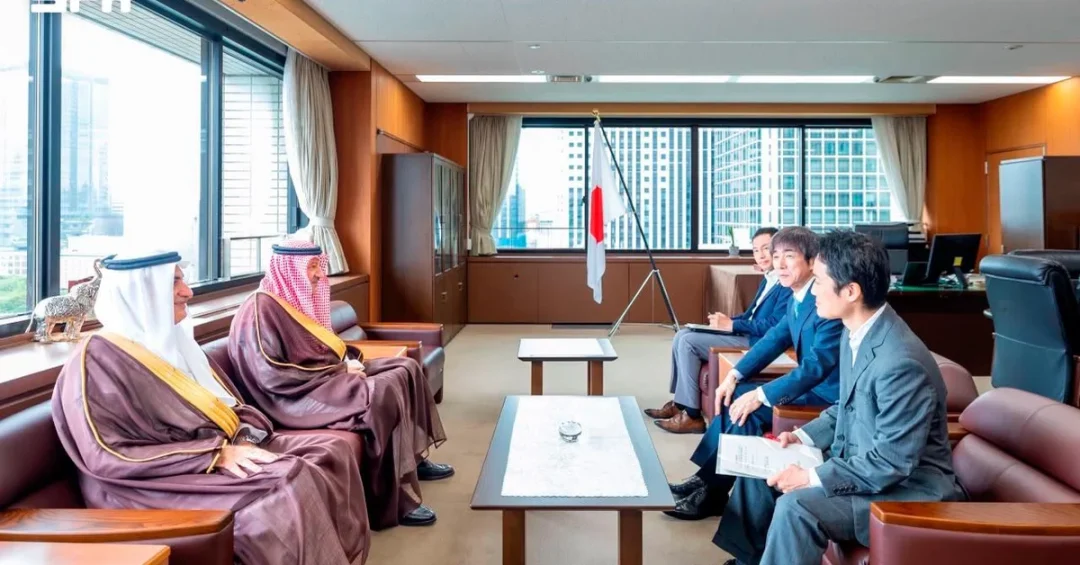
Vice Minister of Foreign Affairs Waleed Elkhereiji met with Vice-Minister for International Affairs at Japan’s Ministry of Economy, Trade and Industry (METI) Matsuo Takehiko in Tokyo on July 27, 2026, during the vice minister’s official visit to Japan, according to the Saudi Press Agency. The meeting brought together two senior officials whose portfolios sit at the intersection of diplomacy and economic policy, and it focused on reviewing bilateral relations between the two friendly countries and discussing ways to strengthen strategic cooperation across a range of shared priorities.
The encounter reflects the depth of the Saudi-Japanese relationship, which has evolved over more than seven decades from a primarily energy-focused partnership into a broad strategic alliance spanning trade, investment, technology, manufacturing, and cultural exchange. Japan remains one of Saudi Arabia’s most important economic partners in Asia, and the Kingdom continues to be a reliable and long-standing supplier of energy to the Japanese market. At the same time, Tokyo has become an increasingly significant investor in Saudi Arabia’s industrial and technological transformation. Against that backdrop, high-level meetings such as this one serve to keep the political and commercial channels aligned as both countries pursue ambitious national agendas for the coming decade. What does sustained high-level engagement between Riyadh and Tokyo signal about the future of Asian economic diplomacy?
Context and Background
The meeting between Vice Minister Elkhereiji and Vice-Minister Matsuo took place in Tokyo as part of a broader diplomatic outreach by the Kingdom to its key partners in East Asia. Saudi Arabia and Japan established formal diplomatic relations in the 1950s, and the relationship has since been institutionalized through regular political consultations, joint economic commissions, and reciprocal visits by senior officials. The Kingdom’s embassy in Tokyo and Japan’s diplomatic mission in Riyadh have worked consistently to deepen ties, while trade and investment flows have expanded well beyond the energy sector into petrochemicals, automotive manufacturing, advanced materials, and digital infrastructure.
Japan’s Ministry of Economy, Trade and Industry plays a central role in shaping the country’s international economic policy, including cooperation on energy security, industrial policy, and technology transfer. The vice-minister’s engagement with Saudi Arabia therefore carries weight beyond symbolism: METI is a key interlocutor for Saudi ministries and agencies seeking Japanese expertise and capital. For Saudi Arabia, the relationship with Japan forms part of a wider strategy of diversifying international partnerships under Vision 2030, the national transformation program launched in 2016 to reduce dependence on oil revenues and build a more diversified, knowledge-driven economy. How do institutional relationships between ministries shape the practical outcomes of bilateral cooperation?
Over the past several years, Saudi-Japanese relations have been reinforced by a series of agreements and joint initiatives. Japanese companies have invested in Saudi industrial clusters, petrochemical complexes, and renewable energy projects, while Saudi entities have deepened their presence in Japanese markets through energy supply arrangements and investment partnerships. The two governments have also cooperated on hydrogen and ammonia as future energy carriers, reflecting a shared interest in the global energy transition. This meeting builds on that foundation and seeks to identify new avenues for cooperation that align with both countries’ economic visions.
Key Details
During the meeting, the two officials reviewed the current state of bilateral relations and explored ways to strengthen strategic cooperation. According to the Saudi Press Agency, the discussions covered the broad framework of Saudi-Japanese ties and the potential for closer collaboration in areas of mutual interest. The presence of the METI vice-minister for international affairs underscored the economic and industrial dimensions of the relationship, which complement the political and diplomatic tracks managed by foreign ministries.
Vice Minister Elkhereiji’s visit to Japan is part of a pattern of intensified Saudi diplomatic activity in Asia, a region that accounts for a substantial share of the Kingdom’s trade and energy exports. Tokyo has long been a priority capital for Riyadh, given Japan’s position as a major consumer of hydrocarbons and a source of high-technology goods and services. The meeting also comes as both countries look to the next phase of their partnership, which is expected to emphasize co-investment, localization of industry, and joint research and development. What specific sectors are most likely to benefit from closer Saudi-Japanese coordination in the years ahead?
The discussions took place against a backdrop of growing Japanese interest in Saudi Arabia’s giga-projects and industrial initiatives. Japanese firms have participated in major infrastructure and energy projects in the Kingdom, and the Saudi government has actively courted Japanese investment as part of its efforts to attract foreign capital and expertise. In turn, Saudi Arabia offers Japanese companies access to a large and growing market, competitive energy inputs, and a strategic location connecting Asia, Europe, and Africa. The meeting between the two vice ministers is therefore best understood as a stock-taking exercise that also sets the stage for future collaboration.
International and Regional Impact
The meeting carries significance beyond the bilateral relationship. Saudi Arabia’s engagement with Japan is part of a broader strategy of building balanced partnerships across Asia, Europe, and the Americas. By maintaining strong ties with Tokyo, Riyadh reinforces its position as a reliable energy supplier and an attractive destination for foreign investment. For Japan, closer cooperation with Saudi Arabia supports energy security and provides opportunities for Japanese companies to participate in the Kingdom’s economic transformation.
At the regional level, the meeting reflects the continuing importance of Asia to Saudi Arabia’s foreign economic policy. East Asian economies, including Japan, China, South Korea, and India, are major buyers of Saudi energy and increasingly important sources of investment and technology. The Kingdom’s diplomatic outreach in the region is designed to deepen these relationships and to ensure that Saudi Arabia remains a central node in Asian trade and investment networks. How does Saudi Arabia’s expanding network of Asian partnerships contribute to regional stability and prosperity?
The meeting also signals continuity in Saudi-Japanese relations at a time of global economic uncertainty. Both countries have an interest in stable energy markets, resilient supply chains, and open trade. High-level consultations such as this one help to align positions on these issues and to identify practical steps that can be taken by governments and the private sector alike. The Saudi Press Agency’s report of the meeting underscores the official and transparent nature of the engagement, consistent with the Kingdom’s commitment to open and constructive international dialogue.
Economic and Strategic Significance
Economically, Japan is among Saudi Arabia’s most important partners in Asia. The two countries maintain substantial trade flows, with Saudi energy exports to Japan forming the backbone of the relationship. Japanese investment in Saudi Arabia spans petrochemicals, automotive manufacturing, and infrastructure, and there is growing interest in renewable energy, hydrogen, and digital technologies. The meeting between the two vice ministers is expected to support efforts to expand these flows and to encourage new joint ventures.
Strategically, the relationship is anchored in shared interests in stability and prosperity. Saudi Arabia’s Vision 2030 aims to diversify the economy, develop new industries, and create opportunities for its young population. Japan’s expertise in advanced manufacturing, robotics, and clean energy aligns closely with these goals. By strengthening cooperation with METI and other Japanese institutions, Saudi Arabia can accelerate the transfer of knowledge and technology that is essential to its transformation. What role can Japanese technology and investment play in accelerating Saudi Arabia’s industrial diversification?
The meeting also highlights the importance of people-to-people ties and institutional linkages. Saudi students study at Japanese universities, and cultural exchanges have grown in recent years. These connections complement the economic relationship and help to build long-term trust between the two societies. The vice ministers’ discussions are likely to have touched on ways to expand such exchanges, particularly in fields related to science, technology, engineering, and mathematics.
Vision 2030 Alignment
The meeting aligns directly with the objectives of Saudi Vision 2030, which seeks to transform the Kingdom into a diversified, innovative, and globally connected economy. International partnerships are a cornerstone of this vision, and Japan is a key partner in areas such as industry, energy, and technology. The Saudi leadership has consistently emphasized the importance of attracting foreign investment and expertise, and the engagement with METI is a practical expression of that priority.
By deepening ties with Japan, Saudi Arabia also advances its goal of becoming a hub for trade and investment linking Asia, Europe, and Africa. The Kingdom’s strategic location, combined with its ambitious infrastructure projects and business-friendly reforms, makes it an attractive partner for Japanese companies seeking new markets and opportunities. As Vision 2030 enters its second decade, engagements such as the meeting between Vice Minister Elkhereiji and Vice-Minister Matsuo will continue to play a vital role in translating high-level ambitions into tangible economic outcomes. How will the next phase of Saudi-Japanese cooperation shape the Kingdom’s journey toward a diversified and sustainable future?
20 Questions
Q1. Who met in Tokyo on July 27, 2026?
A1. Vice Minister of Foreign Affairs Waleed Elkhereiji met with Vice-Minister for International Affairs at Japan’s Ministry of Economy, Trade and Industry (METI) Matsuo Takehiko, according to the Saudi Press Agency.
Q2. What was the main purpose of the meeting?
A2. The two officials reviewed bilateral relations between Saudi Arabia and Japan and discussed ways to strengthen strategic cooperation across areas of mutual interest.
Q3. Where did the meeting take place?
A3. The meeting took place in Tokyo, Japan, during the official visit of Vice Minister Elkhereiji to the country.
Q4. Which Saudi official represented the Kingdom?
A4. Vice Minister of Foreign Affairs Waleed Elkhereiji represented Saudi Arabia at the meeting.
Q5. Which Japanese official participated in the meeting?
A5. Matsuo Takehiko, Vice-Minister for International Affairs at Japan’s Ministry of Economy, Trade and Industry (METI), participated in the meeting.
Q6. What is METI’s role in Japan?
A6. METI is Japan’s Ministry of Economy, Trade and Industry, responsible for shaping international economic policy, energy security, industrial policy, and technology cooperation.
Q7. How long have Saudi Arabia and Japan maintained diplomatic relations?
A7. Saudi Arabia and Japan established formal diplomatic relations in the 1950s, and the partnership has since expanded across energy, trade, investment, and technology.
Q8. What are the main areas of Saudi-Japanese cooperation?
A8. Cooperation spans energy supply, petrochemicals, automotive manufacturing, infrastructure, renewable energy, hydrogen, digital technologies, and cultural exchange.
Q9. Why is Japan important to Saudi Arabia’s economy?
A9. Japan is a major buyer of Saudi energy exports and a significant source of investment and advanced technology, supporting the Kingdom’s economic diversification goals.
Q10. How does this meeting relate to Vision 2030?
A10. The meeting supports Vision 2030 by strengthening international partnerships that attract investment, transfer technology, and help diversify the Saudi economy beyond oil.
Q11. What does the meeting signal about Saudi diplomacy in Asia?
A11. It reflects Saudi Arabia’s strategy of building balanced partnerships across Asia to deepen trade, investment, and energy ties with major economies.
Q12. Did the officials discuss new agreements?
A12. The Saudi Press Agency reported that they reviewed bilateral relations and discussed ways to strengthen strategic cooperation, without announcing specific new agreements.
Q13. What sectors might benefit from closer cooperation?
A13. Renewable energy, hydrogen, advanced manufacturing, digital technology, and infrastructure are among the sectors likely to benefit from closer Saudi-Japanese coordination.
Q14. How does Japan benefit from the relationship?
A14. Japan benefits from reliable energy supplies and opportunities for its companies to participate in Saudi Arabia’s large-scale economic transformation projects.
Q15. What is the significance of METI’s involvement?
A15. METI’s involvement highlights the economic and industrial dimensions of the relationship, complementing the political and diplomatic tracks managed by foreign ministries.
Q16. Are there people-to-people ties between the two countries?
A16. Yes, Saudi students study at Japanese universities, and cultural exchanges have grown, helping to build long-term trust between the two societies.
Q17. How does this meeting fit into Saudi Arabia’s broader foreign policy?
A17. It is part of Saudi Arabia’s wider outreach to key Asian partners, reinforcing the Kingdom’s position as a reliable energy supplier and attractive investment destination.
Q18. What is the expected outcome of the meeting?
A18. The meeting is expected to support efforts to expand trade and investment flows and to encourage new joint ventures between Saudi and Japanese entities.
Q19. Why is the Saudi-Japanese partnership important for regional stability?
A19. Both countries share interests in stable energy markets, resilient supply chains, and open trade, which contribute to regional and global economic stability.
Q20. What does the future hold for Saudi-Japanese relations?
A20. The relationship is expected to deepen further, with a focus on co-investment, localization of industry, and joint research and development aligned with Vision 2030.
Reader Feedback
We value your thoughts. Please share your feedback on this article.
Your feedback helps us improve our coverage.
Related articles
 Saudi Vice Foreign Minister Meets Japan’s Middle East Peace Envoy
 Saudi Reserve Authority, FAO Discuss Ecosystem Partnership
 GEA Chairman Launches 2026 National Day Identity
 Islamic Affairs Minister Receives Sierra Leone’s Ambassador
 Islamic Affairs Minister Receives Comoros Ambassador in Riyadh
 Saudi Ministry Launches 1448 AH Dawah Calendar With 371 Topics