


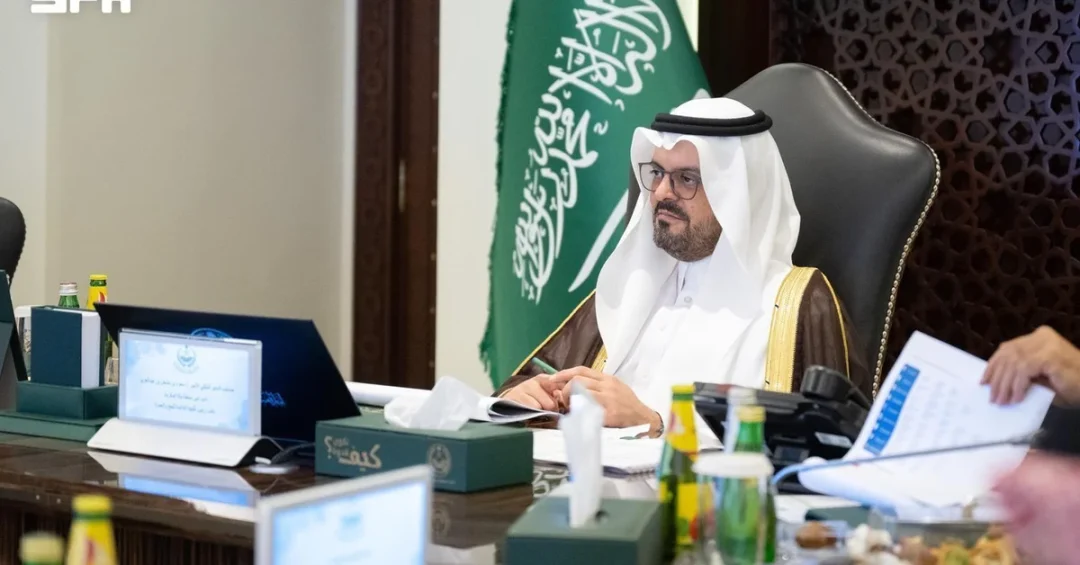
Deputy Governor of Makkah Region Prince Saud bin Mishaal bin Abdulaziz chaired a meeting of the Permanent Committee for Hajj and Umrah on July 27, 2026, reviewing the current Umrah season and early preparations for the Hajj season 1448 AH. The session was convened under the directives of Advisor to the Custodian of the Two Holy Mosques, Governor of Makkah Region and Chairman of the Permanent Committee for Hajj and Umrah Prince Khalid bin Faisal bin Abdulaziz, according to the Saudi Press Agency. The committee examined arrival and departure figures for Umrah performers and the services delivered at various entry points, while also assessing the outcomes of preparatory discussion sessions involving 60 entities engaged in pilgrim services.
The meeting underscores the Kingdom’s sustained commitment to ensuring that millions of Muslims who travel to Saudi Arabia for Umrah and Hajj receive safe, dignified, and efficient services. It also signals the early launch of operational planning for Hajj 1448 AH, reflecting a governance model that prioritizes coordination across ministries, security agencies, health authorities, transport providers, and hospitality stakeholders. For international observers, the session offers a clear view of how Saudi Arabia manages one of the world’s largest annual gatherings of people, and why that management matters to the global Islamic community.
Context and Background
How does Saudi Arabia prepare for the arrival of millions of worshippers each year? The answer lies in a permanent, high-level coordination mechanism that brings together the agencies responsible for every stage of the pilgrim journey. The Permanent Committee for Hajj and Umrah, chaired by the Governor of Makkah Region, functions as the central body overseeing policy, operations, and service quality for both the year-round Umrah season and the annual Hajj pilgrimage. Its meetings are a regular feature of the Kingdom’s administrative calendar, and each session builds on the last to refine planning and execution.
The July 27 meeting, chaired by Deputy Governor Prince Saud bin Mishaal bin Abdulaziz on behalf of Prince Khalid bin Faisal bin Abdulaziz, reviewed the status of the current Umrah season, including the numbers of Umrah performers arriving and departing and the services provided to them at various entry points. This review is significant because the Umrah season now extends through much of the year, requiring sustained capacity at airports, land crossings, and seaports. The committee also examined the outcomes of discussion sessions held in early preparation for Hajj 1448 AH, with the participation of 60 entities involved in pilgrim services.
Those outcomes included recommendations to enhance readiness, strengthen coordination among entities, and proactively address challenges to ensure the best possible services for Umrah performers and pilgrims. By acting on these recommendations well before the Hajj season begins, the committee aims to anticipate pressure points and resolve them in advance. The approach reflects a broader Saudi strategy of continuous improvement in pilgrimage management, supported by data, interagency dialogue, and a clear focus on the experience of the guest of God.
Key Details
What exactly did the committee review, and why does each element matter? According to the Saudi Press Agency, the committee examined the numbers of Umrah performers arriving and departing the Kingdom, alongside the services provided at various entry points. These entry points include major international airports such as King Abdulaziz International Airport in Jeddah and Prince Mohammad bin Abdulaziz International Airport in Madinah, as well as land border crossings and seaports used by pilgrims from neighboring countries. Monitoring arrival and departure flows helps authorities allocate staff, streamline immigration procedures, and ensure that transport links to Makkah and Madinah operate smoothly.
The committee also reviewed the results of preparatory discussion sessions held earlier in the year for Hajj 1448 AH. These sessions involved 60 entities, a broad coalition that typically includes ministries, security and civil defense agencies, health services, the General Authority for the Care of the Affairs of the Grand Mosque and the Prophet’s Mosque, transport and aviation authorities, telecommunications providers, and hospitality and housing operators. Their combined recommendations focused on enhancing readiness, strengthening coordination, and proactively addressing challenges. This multi-entity format allows the committee to identify gaps before they become problems and to align the efforts of organizations that must work in unison during peak periods.
The meeting’s outcomes are not merely procedural. They set the tone for the operational posture of the entire pilgrimage system in the months ahead. By reviewing both the ongoing Umrah season and the upcoming Hajj, the committee ensures continuity between two closely linked service streams. The early attention to Hajj 1448 AH also gives agencies time to recruit and train staff, test digital platforms, and conduct drills. For pilgrims, the practical result is a more predictable and comfortable journey, from the moment they apply for a visa to the moment they return home.
International and Regional Impact
Why should the international community pay attention to a committee meeting in Jeddah? Because the Hajj and Umrah are global events with profound spiritual, social, and economic dimensions. Muslims from virtually every country participate in these journeys, and the quality of Saudi services directly affects their experience. When the Kingdom strengthens coordination among the 60 entities involved in pilgrim services, it is effectively improving the journey for millions of international visitors. This has diplomatic value as well, as governments and communities worldwide look to Saudi Arabia to facilitate one of the five pillars of Islam.
The meeting also highlights the regional dimension of pilgrimage management. Many Umrah performers arrive by land from neighboring Gulf states, while others transit through regional hubs. Efficient entry points and departure procedures reduce congestion and enhance the reputation of the entire region as a reliable destination for religious travel. In addition, the committee’s proactive approach to addressing challenges contributes to stability and confidence among tour operators, airlines, and travel agencies that serve pilgrims. These stakeholders rely on predictable schedules and clear regulations, and the committee’s work helps provide both.
Economic and Strategic Significance
What does effective pilgrimage management mean for Saudi Arabia’s economy? The Hajj and Umrah sectors are major contributors to the Kingdom’s non-oil economy, supporting jobs in hospitality, transport, retail, healthcare, and technology. The Vision 2030 goal of welcoming 30 million Umrah performers annually by 2030 has accelerated investment in infrastructure, digital services, and capacity expansion. Meetings such as this one are part of the operational backbone that turns those investments into real-world results. By reviewing arrival and departure numbers and service quality, the committee helps ensure that growth in pilgrim volumes is matched by growth in service standards.
Strategically, the committee’s work reinforces Saudi Arabia’s role as the custodian of the Two Holy Mosques and the primary facilitator of Islamic pilgrimage. It also supports the broader diversification agenda by strengthening a sector that generates foreign exchange, encourages private-sector participation, and showcases Saudi logistical and technological capabilities. The early preparation for Hajj 1448 AH demonstrates a planning culture that values foresight over reaction. For businesses and investors, this predictability is attractive, and for pilgrims, it translates into a smoother, more spiritually focused experience.
Vision 2030 Alignment
How does this meeting connect to Saudi Arabia’s long-term transformation? Vision 2030 places the empowerment of pilgrims and the enhancement of their experience at the center of its social and economic goals. The Permanent Committee for Hajj and Umrah’s review of services, coordination among 60 entities, and proactive problem-solving are direct expressions of that vision. They reflect a commitment to excellence, innovation, and hospitality that aligns with the Kingdom’s ambition to be a global leader in serving Islam and Muslims. The meeting also supports the broader objective of increasing the number of Umrah performers and Hajj pilgrims while maintaining safety and quality.
As Saudi Arabia continues to modernize its infrastructure and digital platforms, the committee’s role will only grow in importance. The July 27 session, chaired by Deputy Governor Prince Saud bin Mishaal bin Abdulaziz under the directives of Prince Khalid bin Faisal bin Abdulaziz, is a clear example of the Kingdom’s methodical approach to a sacred trust. It combines leadership, interagency collaboration, and a focus on the guest experience. In doing so, it advances Vision 2030’s promise of a prosperous, welcoming, and forward-looking Saudi Arabia that serves the world’s Muslims with dedication and pride.
20 Questions
Q1. Who chaired the Permanent Committee for Hajj and Umrah meeting on July 27, 2026?
A1. Deputy Governor of Makkah Region Prince Saud bin Mishaal bin Abdulaziz chaired the meeting, acting under the directives of Prince Khalid bin Faisal bin Abdulaziz, Governor of Makkah Region and Chairman of the committee.
Q2. What was the main purpose of the committee meeting?
A2. The meeting reviewed the current Umrah season and early preparations for the Hajj season 1448 AH, focusing on arrival and departure numbers, services at entry points, and recommendations from preparatory sessions.
Q3. How many entities participated in the preparatory discussion sessions for Hajj 1448 AH?
A3. According to the Saudi Press Agency, 60 entities involved in pilgrim services participated in the discussion sessions held in early preparation for the Hajj season 1448 AH.
Q4. What did the committee review regarding the Umrah season?
A4. The committee reviewed the numbers of Umrah performers arriving and departing, as well as the services provided to them at various entry points across the Kingdom.
Q5. What were the key outcomes of the preparatory discussion sessions?
A5. The outcomes included recommendations to enhance readiness, strengthen coordination among entities, and proactively address challenges to ensure the best possible services for Umrah performers and pilgrims.
Q6. Why is the Permanent Committee for Hajj and Umrah important?
A6. It serves as the central coordination body for pilgrimage services, bringing together ministries, security, health, transport, and hospitality agencies to ensure safe and efficient experiences for millions of worshippers.
Q7. What are the entry points mentioned in the context of Umrah services?
A7. Entry points include major international airports such as King Abdulaziz International Airport in Jeddah and Prince Mohammad bin Abdulaziz International Airport in Madinah, as well as land border crossings and seaports.
Q8. How does early preparation for Hajj benefit pilgrims?
A8. Early preparation allows agencies to recruit and train staff, test digital platforms, conduct drills, and resolve potential pressure points well before the Hajj season begins, resulting in a smoother journey.
Q9. What is the significance of the Umrah season extending through much of the year?
A9. It requires sustained capacity at airports, land crossings, and seaports, and ensures that services are continuously available to the growing number of international Umrah performers.
Q10. How does this meeting support Saudi Vision 2030?
A10. It supports Vision 2030’s goals of empowering pilgrims, enhancing their experience, increasing Umrah and Hajj volumes, and strengthening the non-oil economy through improved services and infrastructure.
Q11. What role does the Governor of Makkah Region play in the committee?
A11. Prince Khalid bin Faisal bin Abdulaziz serves as Chairman of the Permanent Committee for Hajj and Umrah and issued the directives for the meeting chaired by his deputy.
Q12. Which agency reported the meeting’s details?
A12. The Saudi Press Agency (SPA) reported the meeting’s details, including the review of the Umrah season and preparations for Hajj 1448 AH.
Q13. What does the committee aim to achieve by strengthening coordination among entities?
A13. It aims to ensure seamless service delivery, avoid duplication of effort, and provide a unified response to challenges, ultimately improving the pilgrim experience from arrival to departure.
Q14. How does the meeting reflect Saudi Arabia’s commitment to pilgrims?
A14. It demonstrates a proactive, year-round approach to managing pilgrimage services, with high-level leadership oversight and a focus on continuous improvement and hospitality.
Q15. What economic sectors benefit from effective Hajj and Umrah management?
A15. Sectors such as hospitality, transport, retail, healthcare, and technology benefit, as they support the millions of pilgrims who visit the Kingdom annually.
Q16. What is the target for Umrah performers under Vision 2030?
A16. Saudi Arabia aims to welcome 30 million Umrah performers annually by 2030, supported by infrastructure investment and service enhancements.
Q17. Why is the committee’s review of departure numbers important?
A17. Monitoring departures helps authorities manage capacity, streamline exit procedures, and ensure that transport links remain efficient throughout the pilgrimage period.
Q18. How does the committee address challenges proactively?
A18. By reviewing recommendations from 60 entities and identifying potential issues in advance, the committee can implement solutions before they affect pilgrims.
Q19. What message does this meeting send to the international community?
A19. It signals Saudi Arabia’s dedication to serving Islam’s holiest sites and its capability to manage large-scale religious events with professionalism and care.
Q20. What happens next after this committee meeting?
A20. The recommendations will guide further preparations for Hajj 1448 AH, with agencies continuing to coordinate and implement improvements ahead of the season.
Reader Feedback
We value your thoughts. Please share your feedback on this article.
Your feedback helps us improve our coverage.
Related articles
 Crown Prince Congratulates Moldova’s New Prime Minister
 Saudi Civil Defense Marks World Drowning Prevention Day
 Saudi Vice Foreign Minister Meets Japan METI Vice-Minister
 Saudi Vice Foreign Minister Meets Japan’s Middle East Peace Envoy
 Saudi Reserve Authority, FAO Discuss Ecosystem Partnership
 GEA Chairman Launches 2026 National Day Identity