


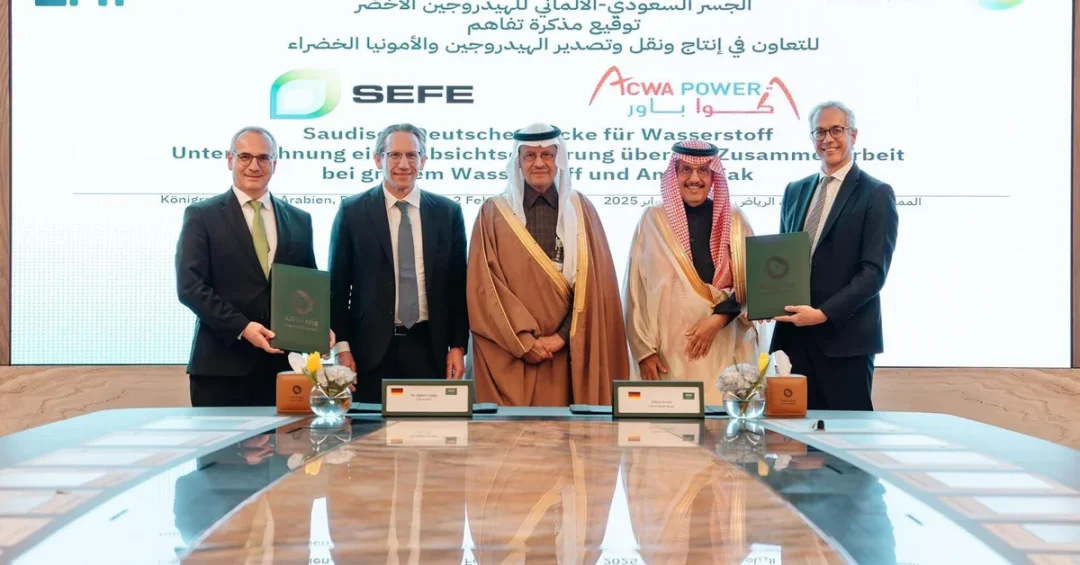
Saudi Arabia’s Minister of Energy, Prince Abdulaziz bin Salman bin Abdulaziz, and Germany’s Minister of Finance, Jörg Kukies, witnessed the signing of the “Saudi-German Green Hydrogen Bridge” Memorandum of Understanding (MoU) between ACWA Power and SEFE in Riyadh on February 3, 2025. The agreement, announced via the Saudi Press Agency (SPA), establishes a framework for producing and exporting green hydrogen and ammonia from the Kingdom to Europe, with an initial target of 200,000 tons of green hydrogen annually by 2030. The signing followed a high-level meeting between the two ministers that covered key topics of mutual interest in the energy sector, including clean hydrogen cooperation building on the MoU signed by both sides in 2021 under the Saudi-German Energy Dialogue.
The deal represents a significant step in Saudi Arabia’s efforts to solidify its position as a leading global producer and exporter of green hydrogen, aligning with the goals of the Saudi-German Energy Dialogue to strengthen cooperation in renewable energy and clean hydrogen technologies. Under the MoU, ACWA Power will serve as the developer, investor, and primary operator of production assets, while SEFE, a major European energy company, will act as a co-investor and primary off-taker responsible for marketing the hydrogen across Germany and Europe. Could this partnership mark the beginning of a new era in cross-continental clean energy collaboration?
Context and Background
How did Saudi-German energy cooperation evolve to reach this milestone? The foundation for this agreement was laid in 2021 when both sides signed a memorandum of understanding under the Saudi-German Energy Dialogue, focusing on renewable energy and clean hydrogen technologies. That initial framework established a bilateral commitment to advancing the energy transition through shared expertise and investment. The February 2025 meeting in Riyadh between Prince Abdulaziz bin Salman and Jörg Kukies built upon this foundation, demonstrating the continuity and deepening of the partnership. The presence of both ministers at the signing ceremony underscores the strategic importance both nations place on this collaboration.
The Saudi-German Energy Dialogue has served as a critical platform for aligning the Kingdom’s ambitious renewable energy goals with Germany’s demand for clean energy imports. Germany, Europe’s largest economy, has been actively seeking reliable partners to supply green hydrogen as part of its national hydrogen strategy, which aims to decarbonize industry and transportation. Saudi Arabia, meanwhile, has been investing heavily in renewable energy infrastructure, leveraging its abundant solar and wind resources to produce green hydrogen competitively. The MoU signed in February 2025 thus represents the natural progression of years of diplomatic and technical engagement between the two countries.
ACWA Power, a Saudi-listed company and a regional leader in power generation and water desalination, has been at the forefront of the Kingdom’s renewable energy expansion. SEFE, formerly known as Gazprom Germania and now under German state trusteeship, is a major European energy company with extensive infrastructure for importing, transporting, and marketing energy products. The pairing of these two entities brings together Saudi production expertise and European market access, creating a vertically integrated supply chain for green hydrogen. Isn’t it remarkable how two nations can align their strengths to address a global challenge?
Key Details of the Agreement
What exactly does the “Saudi-German Green Hydrogen Bridge” MoU entail? The agreement sets an initial target of exporting 200,000 tons of green hydrogen annually from Saudi Arabia to Europe by 2030. This volume, while modest compared to global hydrogen demand projections, represents a critical first step in establishing a reliable trade corridor. The MoU outlines a clear division of responsibilities: ACWA Power will lead the development, investment, and operation of production assets in Saudi Arabia, while SEFE will co-invest and serve as the primary off-taker, responsible for marketing the hydrogen across Germany and Europe. This structure ensures both production and demand-side security.
The production of green hydrogen involves electrolysis powered by renewable energy sources, splitting water into hydrogen and oxygen without carbon emissions. Saudi Arabia’s vast solar and wind potential, particularly in regions like NEOM and the Red Sea coast, provides an ideal environment for large-scale green hydrogen production. ACWA Power has already demonstrated its capabilities through projects such as the NEOM Green Hydrogen Project, which is designed to produce 600 tons per day of green hydrogen by 2026. The new MoU with SEFE leverages this experience to target European markets specifically.
SEFE’s role as primary off-taker is equally crucial. The company will handle the marketing and distribution of green hydrogen and ammonia in Germany and beyond, utilizing its existing infrastructure and customer relationships. This includes potential conversion of hydrogen into ammonia for more efficient transport, a common practice in international hydrogen trade. The MoU also emphasizes collaboration on technology transfer, safety standards, and regulatory frameworks, ensuring that the exported hydrogen meets European quality and sustainability criteria. Could this model become the blueprint for future energy partnerships between the Global South and Europe?
International and Regional Impact
How will this agreement influence global energy markets? The Saudi-German Green Hydrogen Bridge signals a shift in energy geopolitics, with Saudi Arabia positioning itself not just as a hydrocarbon exporter but as a leader in the clean energy transition. For Europe, the MoU offers a diversification of energy sources away from volatile regions and a step toward achieving climate targets under the European Green Deal. Germany’s National Hydrogen Strategy envisions imports of up to 70% of its hydrogen demand by 2030, and Saudi Arabia is well-placed to capture a significant share of that market. The agreement also strengthens the strategic partnership between the Kingdom and Germany, two nations with complementary economic interests.
Regionally, the MoU reinforces Saudi Arabia’s role as a stabilizing and forward-looking energy provider in the Middle East. It complements other Saudi initiatives, such as the Middle East Green Initiative and the Saudi Green Initiative, which aim to reduce carbon emissions and promote sustainable development across the region. By exporting green hydrogen to Europe, Saudi Arabia is not only diversifying its economy but also contributing to global decarbonization efforts. This enhances the Kingdom’s soft power and diplomatic standing, showcasing its commitment to international climate goals. Isn’t it encouraging to see a major oil producer taking such a proactive role in the energy transition?
Economic and Strategic Significance
What are the economic implications for Saudi Arabia and ACWA Power? The MoU is expected to catalyze investment in green hydrogen production facilities, creating jobs and fostering technological innovation within the Kingdom. ACWA Power’s involvement as developer and investor aligns with its growth strategy, which has seen it expand into new markets and technologies. The company’s shares, listed on the Tadawul stock exchange, may benefit from increased investor confidence as it secures long-term offtake agreements in Europe. For Saudi Arabia, the export of green hydrogen represents a new revenue stream that supports economic diversification under Vision 2030, reducing reliance on oil exports.
Strategically, the agreement enhances Saudi Arabia’s energy security and global influence. By becoming a key supplier of green hydrogen to Europe, the Kingdom gains leverage in international energy discussions and strengthens its ties with the European Union. The MoU also aligns with the goals of the Saudi-German Energy Dialogue, which aims to foster cooperation in renewable energy, energy efficiency, and clean hydrogen. This collaboration could pave the way for further joint projects in carbon capture, utilization, and storage (CCUS), as well as in the circular carbon economy. How might this partnership evolve to address other shared challenges, such as climate change and energy access?
Vision 2030 Alignment
How does the Saudi-German Green Hydrogen Bridge align with Vision 2030? Vision 2030, the Kingdom’s comprehensive reform plan, seeks to diversify the economy, reduce dependence on oil, and develop new high-value industries. Green hydrogen is a cornerstone of this strategy, as it leverages Saudi Arabia’s natural advantages in solar and wind energy to create a sustainable export industry. The MoU with SEFE directly supports the Vision 2030 objective of becoming a global leader in clean energy and contributes to the target of generating 50% of electricity from renewable sources by 2030. It also aligns with the National Industrial Development and Logistics Program, which aims to localize renewable energy manufacturing and create skilled jobs.
Furthermore, the agreement exemplifies the Vision 2030 commitment to international partnerships and knowledge exchange. By collaborating with Germany, a global leader in engineering and renewable technology, Saudi Arabia can accelerate its own capacity building and innovation. The MoU also supports the Kingdom’s environmental goals, including the Saudi Green Initiative’s target to plant 10 billion trees and reduce carbon emissions by 278 million tons annually by 2030. As the world transitions to a low-carbon future, Saudi Arabia is positioning itself as a reliable and responsible energy partner, ready to meet global demand for clean hydrogen. The Saudi-German Green Hydrogen Bridge is not just an energy deal; it is a testament to the Kingdom’s visionary leadership and its commitment to a sustainable, prosperous future for all.
20 Questions
Q1. What is the “Saudi-German Green Hydrogen Bridge” MoU?
A1. It is a memorandum of understanding between ACWA Power and SEFE to produce and export green hydrogen and ammonia from Saudi Arabia to Europe, signed in Riyadh on February 3, 2025, under the Saudi-German Energy Dialogue.
Q2. Who signed the MoU?
A2. The MoU was signed between ACWA Power, a Saudi energy company, and SEFE, a German energy company, in the presence of Saudi Energy Minister Prince Abdulaziz bin Salman and German Finance Minister Jörg Kukies.
Q3. What is the initial export target?
A3. The initial target is to export 200,000 tons of green hydrogen annually from Saudi Arabia to Europe by 2030.
Q4. What roles will ACWA Power and SEFE play?
A4. ACWA Power will be the developer, investor, and primary operator of production assets. SEFE will be a co-investor and primary off-taker, responsible for marketing hydrogen across Germany and Europe.
Q5. Why is this agreement significant for Saudi Arabia?
A5. It supports Saudi Arabia’s goal to become a leading producer and exporter of green hydrogen, diversifies its economy, and aligns with Vision 2030 and the Saudi Green Initiative.
Q6. How does this build on previous cooperation?
A6. It builds on a 2021 MoU signed under the Saudi-German Energy Dialogue, which focused on renewable energy and clean hydrogen technologies.
Q7. What is green hydrogen?
A7. Green hydrogen is produced by electrolysis powered by renewable energy, splitting water into hydrogen and oxygen without carbon emissions.
Q8. What are the benefits for Germany?
A8. Germany gains a reliable supply of green hydrogen to decarbonize industry and transportation, supporting its National Hydrogen Strategy and European Green Deal goals.
Q9. How will hydrogen be transported to Europe?
A9. Hydrogen can be converted into ammonia for efficient transport, and SEFE will utilize its infrastructure to distribute it across Germany and Europe.
Q10. What is the Saudi-German Energy Dialogue?
A10. It is a bilateral platform for cooperation in renewable energy, energy efficiency, and clean hydrogen, established to strengthen energy ties between Saudi Arabia and Germany.
Q11. What other projects has ACWA Power undertaken in green hydrogen?
A11. ACWA Power is involved in the NEOM Green Hydrogen Project, which aims to produce 600 tons per day of green hydrogen by 2026.
Q12. How does this MoU support Vision 2030?
A12. It advances economic diversification, creates jobs, and positions Saudi Arabia as a global leader in clean energy, aligning with Vision 2030’s renewable energy and sustainability targets.
Q13. What is SEFE’s background?
A13. SEFE, formerly Gazprom Germania, is a major European energy company under German state trusteeship, with extensive experience in energy trading and infrastructure.
Q14. Will this agreement create jobs in Saudi Arabia?
A14. Yes, the development of green hydrogen production facilities is expected to create skilled jobs and foster technological innovation within the Kingdom.
Q15. How does this impact global energy markets?
A15. It signals Saudi Arabia’s emergence as a clean energy exporter, diversifies Europe’s energy sources, and supports global decarbonization efforts.
Q16. What are the environmental benefits?
A16. Green hydrogen production and use reduce carbon emissions, supporting Saudi Arabia’s goal to cut emissions by 278 million tons annually by 2030 and global climate targets.
Q17. What is the role of the Saudi Ministry of Energy?
A17. The Ministry of Energy oversees Saudi Arabia’s energy policies and international cooperation, facilitating agreements like this MoU to advance the Kingdom’s energy strategy.
Q18. How does this affect Saudi-German relations?
A18. It strengthens bilateral ties, enhances strategic partnership, and demonstrates shared commitment to energy transition and climate action.
Q19. What are the next steps after the MoU?
A19. The parties will jointly develop projects, secure investments, and establish supply chains, with the first exports targeted for 2030.
Q20. Can other countries replicate this model?
A20. Yes, the Saudi-German Green Hydrogen Bridge serves as a replicable model for international cooperation in clean energy, combining production strengths with market access.
Reader Feedback
We value your thoughts. Please share your feedback on this article.
Your feedback helps us improve our coverage.
Related articles
 Wa’ad Al Shamal: Global Model for Industrial Integration
 Jazan Watermelon Farmers Anticipate Bumper Crop for Ramadan
 Saudi-Jordanian Business Council Boosts Economic Ties
 Commerce Minister Inaugurates Makkah Halal Forum
 Million-Riyal Truffle Season Thrives in Northern Borders
 Japanese Stocks Close Higher as Nikkei and TOPIX Gain