


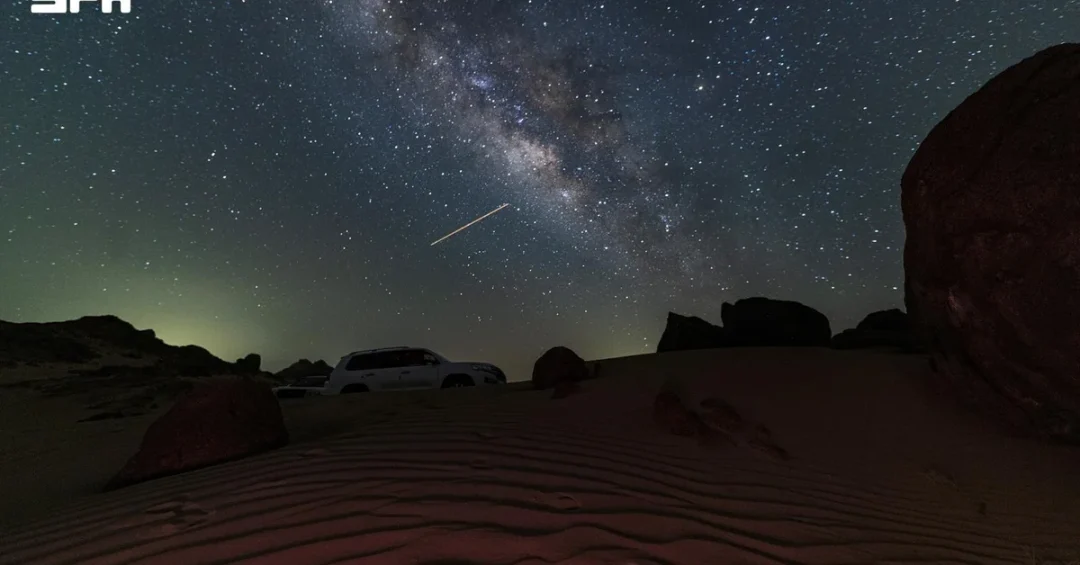
Al-Wajh Governorate in the Tabuk Region of northwestern Saudi Arabia is emerging as a premier destination for stargazing and night photography, drawing enthusiasts to remote desert sites where the Milky Way and distant stars shine with exceptional clarity, according to information released by the Saudi Press Agency (SPA). The appeal of these locations lies in their distance from urban light pollution, which allows visitors to observe celestial formations in remarkable detail and capture images that have become increasingly sought after by photographers and astronomy lovers from within the Kingdom and abroad.
Official Saudi channels highlighted that the desert areas south of Al-Wajh, particularly the Al-Ardam area approximately 80 kilometers from Al-Wajh city, offer an ideal natural environment for observing the galaxy and stars, combining natural and celestial beauty in captivating scenes. The announcement underscores a growing trend in Saudi Arabia where natural heritage and scientific curiosity intersect with tourism development. Have you ever considered how a clear desert sky can become a gateway to both wonder and economic opportunity? The Kingdom’s vast and varied landscapes, from the Red Sea coastline to the inland dunes, are increasingly being positioned as assets for responsible, experience-driven travel that aligns with the goals of Saudi Vision 2030.
Context and Background
Is it any wonder that Saudi Arabia’s deserts, long celebrated for their timeless beauty, are now gaining recognition as some of the world’s most accessible dark-sky destinations? The Al-Wajh area, situated in the Tabuk Region along the northwestern coast, has historically been known for its archaeological sites, pristine beaches, and proximity to the Red Sea. In recent years, however, a new dimension of its appeal has come to the fore: the clarity of its night skies. The Saudi Press Agency reported that the galaxy is most visible during the beginning and end of the Hijri month, when moonlight is minimal, offering optimal conditions for stargazing and observing celestial formations away from city lights. This natural rhythm, tied to the lunar calendar, provides a predictable window for visitors and photographers to plan their trips.
The emergence of Al-Wajh as a stargazing hub is part of a broader movement across Saudi Arabia to diversify tourism offerings beyond traditional cultural and religious sites. The Kingdom’s National Tourism Strategy, a cornerstone of Vision 2030, aims to attract 150 million visits annually by 2030 and to increase the tourism sector’s contribution to gross domestic product to more than 10 percent. Dark-sky tourism, though niche, fits neatly into this ambition by appealing to high-value travelers seeking unique, low-impact experiences. It also complements other nature-based initiatives, such as the Red Sea Project and the development of eco-lodges in AlUla and beyond. In this context, Al-Wajh’s remote desert sites are not merely scenic backdrops; they are part of a carefully considered portfolio of attractions designed to showcase the Kingdom’s environmental and scientific assets.
Moreover, the timing of this spotlight on Al-Wajh aligns with a global surge of interest in astrotourism. Travelers worldwide are increasingly seeking out dark-sky places to escape urban glare and reconnect with the cosmos. Saudi Arabia, with its expansive uninhabited areas and favorable weather patterns for much of the year, is well positioned to capture a share of this growing market. The SPA report serves as an official acknowledgment that these sites are ready for visitors and that the necessary conditions—clear skies, minimal light interference, and accessibility—are in place. What does this mean for local communities and for the Kingdom’s image on the world stage?
Key Details
What exactly makes the Al-Ardam area so special for night sky observation? According to the Saudi Press Agency, the site lies about 80 kilometers south of Al-Wajh city, far enough from urban centers to avoid the light pollution that obscures the Milky Way in many parts of the world. The desert landscape itself, with its low humidity and stable atmospheric conditions, enhances visibility. Photographers and astronomers note that the absence of artificial light allows for long-exposure images that reveal the intricate structure of the galaxy, star clusters, and even faint nebulae. The SPA report specifically mentions that the galaxy is most visible during the beginning and end of the Hijri month, a detail that helps enthusiasts plan their visits around the lunar cycle.
Access to these sites is facilitated by the region’s growing infrastructure. Al-Wajh is served by an airport with domestic connections, and the road network in Tabuk Region has seen significant investment in recent years. Visitors can reach the remote areas by vehicle, often as part of organized tours or independent excursions. While the SPA did not announce specific facilities such as campsites or guided programs, the mere identification of Al-Ardam as a prime location signals that local authorities and tourism bodies are recognizing its potential. This could pave the way for future development of visitor amenities, always with an eye toward preserving the pristine darkness that makes the area so valuable.
The report also highlights the role of natural and celestial beauty in creating captivating scenes. For night photographers, the combination of dramatic desert terrain—sand dunes, rocky outcrops, and distant mountains—with a star-filled sky offers endless compositional possibilities. The Milky Way core, visible during certain months, arches over the landscape, creating images that resonate with viewers. Enthusiasts often share their work on social media, further promoting Al-Wajh as a destination. This organic marketing is invaluable, as it reaches global audiences and reinforces Saudi Arabia’s reputation as a land of unexpected natural wonders. How might this attention influence the way the world perceives the Kingdom’s tourism offerings?
International and Regional Impact
Could Al-Wajh’s stargazing appeal help redefine Saudi Arabia’s place on the global tourism map? The Kingdom has long been known for its religious tourism, welcoming millions of pilgrims to Makkah and Madinah each year. While that remains a vital pillar, the expansion into nature and adventure tourism represents a strategic diversification. International travelers, particularly from Europe, East Asia, and North America, are increasingly interested in experiential travel that combines adventure, science, and culture. Al-Wajh’s dark skies offer precisely that. By promoting this asset through official channels like the Saudi Press Agency, the Kingdom is signaling that it is open for business in new and exciting ways.
Regionally, the development of astrotourism in Tabuk Region could spur collaboration with neighboring countries. Jordan, Egypt, and the Gulf states all possess desert landscapes, but Saudi Arabia’s combination of stability, infrastructure, and Vision 2030-driven investment gives it a competitive edge. The Red Sea International Airport and upcoming developments along the coast are expected to improve connectivity, making it easier for international visitors to combine a stargazing trip with a beach holiday or a cultural tour of AlUla. This integrated approach is central to Saudi Arabia’s tourism strategy, which seeks to offer diverse experiences within a single journey. As more people discover the clarity of Al-Wajh’s night skies, the area could become a fixture on itineraries for photography workshops, astronomy clubs, and eco-tourism operators.
Economic and Strategic Significance
What economic benefits can flow from a niche activity like stargazing? For local communities in Al-Wajh and the surrounding Tabuk Region, the influx of visitors can translate into demand for accommodations, transportation, food services, and guide services. Small businesses, from family-run guesthouses to equipment rental shops, stand to gain. The Saudi government has been actively supporting such grassroots entrepreneurship through programs under Vision 2030, including the National Entrepreneurship Context Index and various funding initiatives. Moreover, the promotion of Al-Wajh as a stargazing destination aligns with the Public Investment Fund’s broader tourism investments, which aim to create jobs and attract foreign spending.
Strategically, the focus on dark-sky tourism supports Saudi Arabia’s goal of becoming a more sustainable and diversified economy. Unlike extractive industries, tourism that leverages natural beauty can be low-impact if managed responsibly. The Kingdom has emphasized environmental protection in its Vision 2030 framework, with initiatives like the Saudi Green Initiative and the Middle East Green Initiative. By drawing attention to the need to preserve dark skies, the Al-Wajh stargazing story subtly reinforces the importance of reducing light pollution and protecting natural habitats. This synergy between tourism and conservation is a hallmark of modern destination management and positions Saudi Arabia as a forward-thinking player in the global travel industry.
Vision 2030 Alignment
How does a stargazing site in a remote desert connect to the grand ambitions of Saudi Vision 2030? At its core, Vision 2030 is about transforming the Kingdom’s economy and society by unlocking new sectors and creating opportunities for citizens and residents. Tourism is one of the key pillars, with a target of contributing 10 percent of GDP by 2030. The Al-Wajh stargazing initiative, though small in scale, exemplifies the kind of innovative, experience-based tourism that can help achieve this target. It showcases Saudi Arabia’s natural assets, attracts international visitors, and encourages domestic travel, all while promoting a positive image of the Kingdom as a land of beauty and discovery.
Furthermore, the emphasis on night photography and astronomy taps into educational and scientific themes that resonate with Vision 2030’s human capital development goals. By fostering interest in science, technology, engineering, and mathematics (STEM) among young Saudis, such activities can inspire the next generation of scientists and innovators. The SPA report, by highlighting the optimal conditions for observing celestial formations, indirectly encourages curiosity and learning. As Saudi Arabia continues to invest in space research—evidenced by the Saudi Space Commission and recent astronaut missions—the skies above Al-Wajh serve as a reminder that the Kingdom’s horizons are expanding in every sense. In the years ahead, Al-Wajh is poised to shine not only under the desert sun but also beneath a canopy of stars, illuminating a path toward a diversified, knowledge-driven future.
20 Questions
Q1. What is Al-Wajh Governorate known for in the context of stargazing?
A1. Al-Wajh Governorate in the Tabuk Region is known for its remote desert sites, particularly the Al-Ardam area, which offer clear night skies ideal for observing the galaxy and stars away from city lights.
Q2. Where exactly is the Al-Ardam area located?
A2. The Al-Ardam area is approximately 80 kilometers south of Al-Wajh city in the Tabuk Region of northwestern Saudi Arabia, as reported by the Saudi Press Agency.
Q3. Why is the Al-Ardam area considered ideal for stargazing?
A3. It is far from urban light pollution, has low humidity, and stable atmospheric conditions, allowing clear views of the Milky Way and other celestial formations, according to official Saudi sources.
Q4. When is the best time to observe the galaxy in Al-Wajh?
A4. The galaxy is most visible during the beginning and end of the Hijri month, when moonlight is minimal, providing optimal conditions for stargazing and night photography.
Q5. What makes night photography in Al-Wajh popular?
A5. The combination of dramatic desert landscapes and a star-filled sky allows photographers to capture stunning long-exposure images of the Milky Way and other celestial objects without light interference.
Q6. How does stargazing in Al-Wajh align with Saudi Vision 2030?
A6. It supports tourism diversification, attracts high-value visitors, and promotes sustainable, experience-based travel, all of which are key goals of Vision 2030 to boost tourism’s GDP contribution.
Q7. Is there any infrastructure for visitors to Al-Wajh’s stargazing sites?
A7. Al-Wajh has an airport and road connections, but the SPA report did not announce specific facilities; visitors typically access the remote areas by vehicle, often on organized tours.
Q8. What is the significance of the Hijri month for stargazing?
A8. The Hijri month determines lunar phases; during the beginning and end, moonlight is minimal, creating darker skies that enhance visibility of stars and the galaxy.
Q9. How does stargazing in Al-Wajh benefit the local economy?
A9. It can increase demand for accommodations, transport, food, and guide services, supporting small businesses and job creation in the Tabuk Region, in line with Vision 2030 economic goals.
Q10. What role does the Saudi Press Agency play in promoting Al-Wajh?
A10. The Saudi Press Agency is the official state news agency that reported on Al-Wajh’s stargazing potential, providing verified information that raises the area’s profile among enthusiasts and travelers.
Q11. Can international tourists easily visit Al-Wajh for stargazing?
A11. Yes, Saudi Arabia has opened tourist visas for many countries, and Al-Wajh is accessible via domestic flights and roads, making it feasible for international visitors to plan a trip.
Q12. What other attractions are near Al-Wajh for visitors?
A12. The region offers Red Sea beaches, archaeological sites, and proximity to developments like NEOM and the Red Sea Project, allowing visitors to combine stargazing with other experiences.
Q13. How does stargazing tourism support environmental conservation?
A13. It encourages the preservation of dark skies and natural habitats by highlighting the value of reducing light pollution, aligning with Saudi Green Initiative and sustainable tourism practices.
Q14. Are there guided stargazing tours available in Al-Wajh?
A14. While the SPA report did not specify guided tours, the growing interest may lead to private operators offering tours; visitors can currently arrange independent trips or join photography groups.
Q15. What equipment is recommended for night photography in Al-Wajh?
A15. A camera with manual settings, a tripod, wide-angle lens, and remote shutter release are recommended to capture long-exposure images of the Milky Way and stars effectively.
Q16. How does Al-Wajh compare to other dark-sky destinations globally?
A16. Al-Wajh offers comparable clarity to renowned dark-sky sites due to its remote location and minimal light pollution, but with the added cultural and historical richness of Saudi Arabia.
Q17. What is the best season to visit Al-Wajh for stargazing?
A17. The cooler months from October to March are generally comfortable, but the key factor is the Hijri lunar cycle; check for periods of minimal moonlight for optimal viewing.
Q18. Does the Saudi government plan to develop Al-Wajh as a formal astrotourism destination?
A18. The SPA report signals official recognition, and given Vision 2030’s tourism goals, future development of facilities and promotion is likely, though specific plans have not been announced.
Q19. How can local communities participate in stargazing tourism?
A19. Local residents can offer hospitality services, act as guides, provide equipment rentals, or organize cultural events, benefiting from increased visitor spending and entrepreneurship opportunities.
Q20. What does the Al-Wajh stargazing initiative say about Saudi Arabia’s global role?
A20. It demonstrates the Kingdom’s commitment to diversifying its economy, embracing sustainable tourism, and sharing its natural wonders with the world, reinforcing its position as a forward-looking nation.
Reader Feedback
We value your thoughts. Please share your feedback on this article.
Your feedback helps us improve our coverage.
Related articles
 Jeddah Waterfront Project Reconnects Sea with Heritage
 Madinah Welcomes Umrah Visitors After Hajj Season
 AlUla’s Six Nature Reserves Drive Biodiversity Protection
 Flamingos and Mangroves: Jazan’s Ecological Partnership
 Prophet’s Mosque: Islamic Heritage and Architectural Splendor
 Al Mashaaer Al Muqaddasah Metro Moves 314,000 Pilgrims