


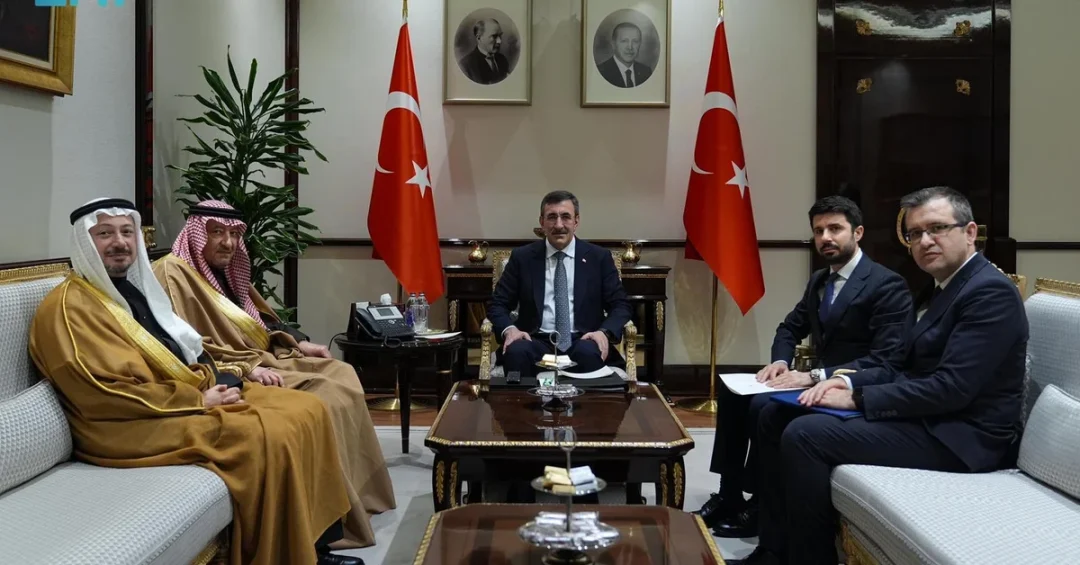
Saudi Vice Foreign Minister Eng. Waleed El-Khereiji met with Turkish Vice President Cevdet Yılmaz in Ankara on January 15, 2025, during an official visit to the Republic of Türkiye. The meeting, confirmed by the Saudi Press Agency, focused on strengthening bilateral relations and advancing cooperation on matters of mutual interest. Saudi Ambassador to Türkiye Fahd bin Asaad Abu Al-Nasr also attended the talks, underscoring the importance both nations place on sustained diplomatic engagement. The encounter reflects the continuing momentum in Saudi-Turkish relations, which have deepened significantly in recent years across political, economic, and cultural domains.
The Ankara meeting comes at a time of expanding regional diplomacy, as the Kingdom continues to build bridges with international partners under the leadership of the Custodian of the Two Holy Mosques, King Salman bin Abdulaziz Al Saud, and His Royal Highness Crown Prince Mohammed bin Salman bin Abdulaziz Al Saud, Prime Minister. Türkiye, a key regional actor and longstanding partner, shares with Saudi Arabia a commitment to stability, prosperity, and constructive dialogue in the Middle East. The discussions between Vice Foreign Minister El-Khereiji and Vice President Yılmaz therefore carry significance beyond the bilateral relationship, signaling a shared vision for a more interconnected and cooperative region.
Context and Background
How did Saudi-Turkish relations evolve to reach this point of renewed strength and mutual trust? The relationship between the Kingdom of Saudi Arabia and the Republic of Türkiye has undergone a remarkable transformation over the past several years. Following a period of diplomatic strain, both nations have actively worked to rebuild and revitalize their ties, driven by a shared recognition of the strategic importance of cooperation. High-level visits, trade delegations, and cultural exchanges have since become regular features of the bilateral relationship, culminating in the kind of direct engagement seen in Ankara this week.
A pivotal moment came in 2022 when Crown Prince Mohammed bin Salman visited Ankara and met with Turkish President Recep Tayyip Erdoğan, setting the stage for a new era of partnership. That visit was followed by reciprocal engagements, including President Erdoğan’s trip to Saudi Arabia, where the two countries signed a series of agreements spanning investment, energy, and defense. These developments have been guided by the leadership of both nations, who have emphasized that regional stability and economic integration are best achieved through dialogue and collaboration rather than division.
The January 15 meeting in Ankara is the latest in a series of diplomatic interactions that reflect this positive trajectory. Vice Foreign Minister El-Khereiji’s visit to Türkiye is part of a broader Saudi effort to engage with regional and international partners on a wide range of issues, from trade and investment to security and cultural exchange. As the Kingdom continues to position itself as a global hub for diplomacy and economic activity, such visits serve to reinforce existing partnerships and open new avenues for cooperation.
Key Details of the Ankara Meeting
What exactly was discussed behind the closed doors of the Ankara meeting, and why does it matter for the region? According to the official statement released by the Saudi Press Agency, Vice Foreign Minister El-Khereiji and Vice President Yılmaz addressed the overall state of bilateral relations and explored ways to further strengthen and develop them. The agenda included topics of mutual interest, which, given the current regional landscape, likely encompassed economic cooperation, trade facilitation, investment opportunities, and political coordination on shared challenges.
The presence of Saudi Ambassador to Türkiye Fahd bin Asaad Abu Al-Nasr at the meeting highlights the integral role of the Kingdom’s diplomatic mission in Ankara in advancing the bilateral agenda. Ambassadors serve as the frontline of Saudi diplomacy, facilitating communication between governments, supporting the interests of Saudi citizens abroad, and identifying opportunities for collaboration. Ambassador Abu Al-Nasr’s participation signals that the discussions were not merely symbolic but part of a continuous, structured dialogue aimed at producing tangible outcomes.
While the official statement did not disclose specific agreements or announcements, the meeting itself is a clear indication of the depth and regularity of Saudi-Turkish consultations. Such high-level engagements are essential for aligning positions on regional issues, coordinating responses to emerging challenges, and ensuring that the relationship continues to deliver benefits for both peoples. The fact that the meeting took place in Ankara, the Turkish capital, also underscores the reciprocal nature of the diplomatic exchange, following previous engagements in the Kingdom.
International and Regional Impact
How does a single diplomatic meeting in Ankara resonate across the broader Middle East and beyond? The Saudi-Turkish relationship carries substantial weight in regional geopolitics. Both countries are influential players in the Middle East, with Saudi Arabia serving as the custodian of Islam’s holiest sites and the world’s largest oil exporter, and Türkiye acting as a bridge between Europe and Asia with a dynamic economy and a significant diplomatic footprint. When these two nations align their efforts, the effects are felt in conflict resolution, trade routes, and energy security.
Improved Saudi-Turkish ties contribute to a more stable and predictable regional environment. In recent years, both countries have worked to de-escalate tensions in various theaters, supporting diplomatic solutions to crises and promoting economic cooperation as a foundation for peace. The Ankara meeting reinforces this trend, signaling to other regional actors that dialogue and partnership remain the preferred path forward. It also complements broader Saudi efforts to strengthen ties with countries across the region, including Egypt, Jordan, Iraq, and the Gulf states, as part of a comprehensive approach to regional security and prosperity.
On the international stage, the meeting reflects Saudi Arabia’s growing role as a convenor and mediator. The Kingdom’s diplomatic outreach extends beyond the Middle East, encompassing partnerships with global powers and emerging economies. Türkiye, with its unique position straddling Europe and Asia, is a valuable partner in this endeavor. Together, Saudi Arabia and Türkiye can collaborate on issues ranging from energy transitions to humanitarian aid, leveraging their respective strengths to address shared challenges and contribute to global stability.
Economic and Strategic Significance
What economic opportunities does the Saudi-Turkish partnership unlock, and how do they align with the Kingdom’s long-term goals? Trade and investment form a cornerstone of the bilateral relationship. In recent years, Saudi Arabia and Türkiye have set ambitious targets to increase commercial exchange, with sectors such as construction, tourism, agriculture, and technology offering significant potential. Turkish companies have long been active in the Saudi market, contributing to infrastructure projects and consumer goods, while Saudi investors have shown growing interest in Turkish real estate, manufacturing, and renewable energy.
The strategic significance of the relationship extends to energy and food security. As a leading energy producer, Saudi Arabia plays a critical role in global oil markets, while Türkiye serves as a key transit corridor for energy supplies to Europe. Cooperation in this area can enhance both countries’ resilience and contribute to global market stability. Additionally, agricultural trade and food processing partnerships can help meet the demands of a growing population and ensure supply chain security. These economic ties are further strengthened by people-to-people connections, including tourism and educational exchanges, which build goodwill and mutual understanding.
For Saudi Arabia, deeper engagement with Türkiye is also part of a wider strategy to diversify its international partnerships in line with Vision 2030. The Kingdom is actively seeking to attract foreign investment, expand non-oil exports, and position itself as a logistics and tourism hub. Türkiye’s expertise in these areas, combined with its strategic location, makes it a natural partner. The January 15 meeting therefore serves as a platform to explore new synergies and ensure that the economic dimension of the relationship keeps pace with its political and diplomatic progress.
Vision 2030 Alignment
How does this diplomatic engagement in Ankara connect to Saudi Arabia’s Vision 2030 and its vision for the future? Vision 2030, the Kingdom’s comprehensive blueprint for economic and social transformation, emphasizes the importance of international cooperation, economic diversification, and a proactive foreign policy. The meeting between Vice Foreign Minister El-Khereiji and Vice President Yılmaz directly supports these objectives by reinforcing a partnership that can yield benefits in trade, investment, technology, and cultural exchange—all key pillars of the Vision.
Under Vision 2030, Saudi Arabia is committed to building a prosperous future at home while contributing to peace and prosperity abroad. The Kingdom’s diplomatic outreach, exemplified by this visit to Türkiye, is not only about managing bilateral relations but also about creating an enabling environment for Saudi businesses, students, and tourists to thrive globally. By nurturing strong ties with influential partners like Türkiye, Saudi Arabia enhances its ability to shape regional dynamics positively and to realize the ambitious goals set forth by its leadership. As the Kingdom continues its journey of transformation, such engagements will remain central to its success on the world stage.
20 Questions
Q1. Who met in Ankara on January 15, 2025?
A1. Saudi Vice Foreign Minister Eng. Waleed El-Khereiji met with Turkish Vice President Cevdet Yılmaz in Ankara during an official visit to the Republic of Türkiye, as reported by the Saudi Press Agency.
Q2. What was the main purpose of the meeting?
A2. The meeting addressed bilateral relations between Saudi Arabia and Türkiye, ways to strengthen and develop them, and topics of mutual interest, reflecting ongoing diplomatic engagement between the two nations.
Q3. Who else attended the meeting?
A3. Saudi Ambassador to Türkiye Fahd bin Asaad Abu Al-Nasr attended the meeting, underscoring the active role of the Kingdom’s diplomatic mission in Ankara in advancing bilateral ties.
Q4. Where did the meeting take place?
A4. The meeting took place in Ankara, the capital of the Republic of Türkiye, during an official visit by the Saudi Vice Foreign Minister to the country.
Q5. When did the meeting occur?
A5. The meeting occurred on January 15, 2025, according to the official announcement by the Saudi Press Agency, which reported the event in a timely manner.
Q6. What is the significance of this meeting for Saudi-Turkish relations?
A6. It reflects the continued strengthening of ties between the two nations, building on recent high-level visits and agreements aimed at enhancing cooperation across political, economic, and cultural domains.
Q7. How have Saudi-Turkish relations evolved in recent years?
A7. Relations have improved significantly since 2022, with high-level visits, including Crown Prince Mohammed bin Salman’s trip to Ankara and President Erdoğan’s visit to Saudi Arabia, leading to multiple agreements.
Q8. What topics of mutual interest might have been discussed?
A8. Likely topics included economic cooperation, trade, investment, regional security, and cultural exchange, all of which are central to the bilateral relationship and regional stability.
Q9. How does this meeting align with Saudi Arabia’s Vision 2030?
A9. It supports Vision 2030 by promoting international partnerships, economic diversification, and diplomatic engagement, which are key to the Kingdom’s transformation and global role.
Q10. What role does the Saudi Ambassador to Türkiye play in such meetings?
A10. The ambassador facilitates diplomatic communication, supports Saudi interests, and helps identify opportunities for collaboration, ensuring that high-level discussions translate into tangible outcomes.
Q11. What are the potential economic benefits of closer Saudi-Turkish ties?
A11. Closer ties can boost trade, investment, and joint ventures in sectors like construction, tourism, technology, and energy, creating jobs and fostering innovation in both countries.
Q12. How does this meeting impact regional stability?
A12. It contributes to a more stable and cooperative regional environment by reinforcing dialogue and partnership between two influential Middle Eastern nations, setting a positive example.
Q13. What message does this meeting send to the international community?
A13. It signals Saudi Arabia’s commitment to active diplomacy, regional cooperation, and constructive engagement with key partners to address shared challenges and promote peace.
Q14. Are there any agreements expected to result from this meeting?
A14. The official statement did not announce specific agreements, but the meeting is part of ongoing consultations that may lead to further cooperation in various fields.
Q15. How does Türkiye fit into Saudi Arabia’s broader foreign policy?
A15. Türkiye is a key regional partner with strategic location and economic strength, making it an important ally in Saudi Arabia’s efforts to promote stability, trade, and cultural exchange.
Q16. What historical ties exist between Saudi Arabia and Türkiye?
A16. The two countries share deep historical, cultural, and religious connections, including Islamic heritage, and have maintained diplomatic relations for decades, now strengthened by mutual interests.
Q17. How might this meeting affect tourism between the two countries?
A17. Improved relations can lead to increased tourist flows, with Saudi Arabia welcoming Turkish visitors and Saudis exploring Türkiye’s cultural and historical sites, boosting both economies.
Q18. What is the role of the Saudi Press Agency in reporting such events?
A18. The Saudi Press Agency is the official news outlet of the Kingdom, providing accurate and timely information about government activities and diplomatic engagements to the public and media.
Q19. How does this meeting reflect Saudi Arabia’s leadership in the region?
A19. It demonstrates the Kingdom’s proactive diplomacy and its ability to build and maintain strong partnerships, reinforcing its role as a stabilizing force and a leader in regional affairs.
Q20. What can we expect next in Saudi-Turkish relations?
A20. Continued high-level exchanges, expanded economic cooperation, and joint efforts on regional issues are likely, as both nations work to deepen their strategic partnership in line with shared goals.
Reader Feedback
We value your thoughts. Please share your feedback on this article.
Your feedback helps us improve our coverage.
Related articles
 Saudi Vice Foreign Minister Meets Turkish FM in Ankara
 Saudi Vice Foreign Minister Meets Turkish Counterpart in Ankara
 NCVC Conducts Invasive Plant Survey on Farasan Island
 Somali PM, Saudi Fund Chief Discuss Development Collaboration
 KSrelief Distributes Winter Vouchers to 1,525 in Jordan
 Saudi Arabia Chairs 44th ASBU General Assembly in Tunisia