


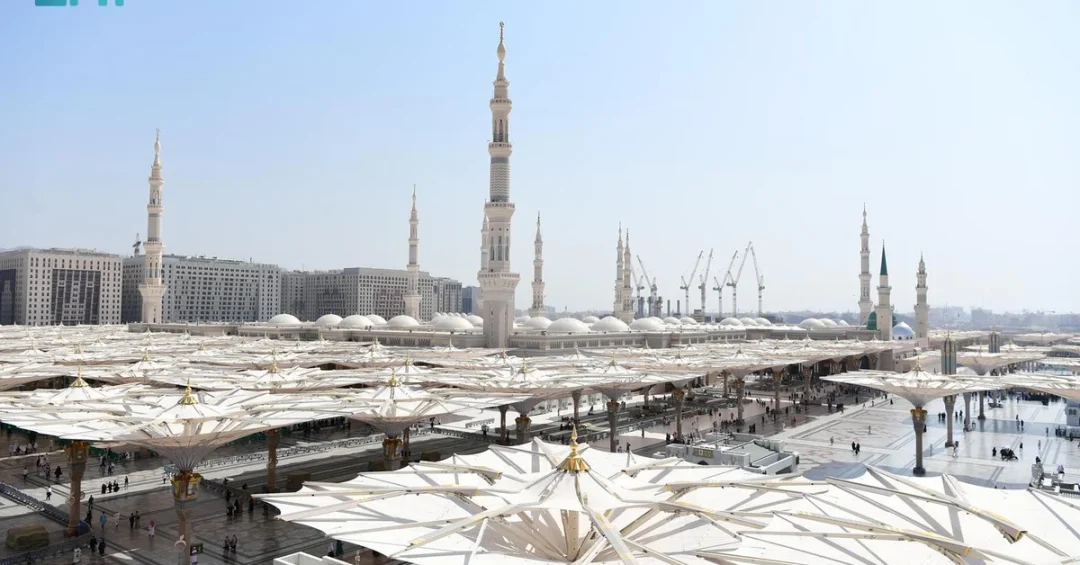
The Prophet’s Mosque in Madinah received 5,653,395 worshippers during the past week, according to official figures released by the General Authority for the Care of the Affairs of the Grand Mosque and the Prophet’s Mosque. The announcement, carried by the Saudi Press Agency, reflects the immense scale of daily operations at Islam’s second holiest site and the comprehensive services deployed to welcome pilgrims and visitors from across the Kingdom and around the world. The figures cover a single week of worship, visitation, and spiritual reflection, and they underscore the central role the Prophet’s Mosque continues to play in the lives of millions of Muslims.
Within the same period, the Authority reported that 587,360 visitors greeted the Prophet (peace be upon him) and his two companions, while 390,923 worshippers performed prayers in Al-Rawdah Al-Sharifa under carefully managed scheduling and crowd-control procedures. These numbers are not merely statistics; they represent one of the most complex hospitality and logistics operations undertaken anywhere in the world on a continuous basis. How does a single religious site sustain such extraordinary daily volumes while preserving the serenity and dignity of worship? The answer lies in the integrated planning carried out by Saudi authorities, whose work behind the scenes makes each visit safe, orderly, and spiritually meaningful.
Context and Background
The Prophet’s Mosque holds a unique place in Islamic history and in the hearts of Muslims worldwide. Since the earliest days of Islam, it has served as a center of worship, learning, and community life, and it remains one of the most visited religious sites on earth. The General Authority for the Care of the Affairs of the Grand Mosque and the Prophet’s Mosque, established to oversee operations at both holy sites, coordinates a vast array of services ranging from crowd management and sanitation to multilingual guidance and visitor support. Its mandate reflects the Kingdom’s long-standing commitment to serving pilgrims and ensuring that every visitor is treated with care and respect.
Weekly attendance figures at this scale are made possible by years of sustained investment in infrastructure, technology, and human resources. The Authority works in close coordination with security agencies, health services, and municipal teams to maintain a safe environment throughout the year, and especially during periods of heightened visitation. For international observers, the figures offer a window into the operational excellence that underpins Saudi Arabia’s role as custodian of the Two Holy Mosques. What does it take to host millions of worshippers week after week without compromising safety or spiritual atmosphere? The answer involves round-the-clock planning, precise scheduling, and a workforce dedicated to service.
The release of these figures also comes amid broader efforts to enhance the pilgrim experience in line with Saudi Arabia’s Vision 2030 reform agenda. Under this national strategy, the Kingdom has pursued improvements in crowd management, digital services, accessibility, and hospitality infrastructure at both the Grand Mosque in Makkah and the Prophet’s Mosque in Madinah. The result is a pilgrimage and visitation experience that is increasingly seamless, comfortable, and dignified for visitors of all ages and backgrounds. These efforts are not limited to peak seasons; they form part of a continuous program of modernization that benefits worshippers every day of the year.
Key Details from the Weekly Report
The numbers released by the Authority provide a detailed picture of activity at the Prophet’s Mosque over the past week. Alongside the total of 5,653,395 worshippers, the report noted that 587,360 visitors were able to greet the Prophet (peace be upon him) and his two companions, a practice of deep spiritual significance for many pilgrims. A further 390,923 worshippers performed prayers in Al-Rawdah Al-Sharifa, the area within the mosque that holds special reverence, with visits organized according to established procedures that balance accessibility with order and safety. These procedures are designed to ensure that all visitors have the opportunity to complete their prayers and greetings without undue delay or crowding.
Field services formed another important part of the weekly operation. The Authority reported that sterilization efforts covered the site extensively, with a total of 24,053 liters of disinfectant used to maintain the highest standards of cleanliness and public health. In addition, 350 tons of Zamzam water were consumed by worshippers during the week, and 48 water samples were collected for testing and analysis to ensure quality and safety. These measures reflect a rigorous approach to hygiene and water management that is essential given the volume of daily visitors.
The report also highlighted the distribution of 167,382 Iftar meals at designated locations for individuals breaking their fast, a service that supports worshippers observing religious obligations during their visit. Furthermore, 959 visitors from various nationalities benefited from multilingual communication services, which help non-Arabic speakers navigate the mosque complex, understand procedures, and access the support they need. Each of these services, from disinfection to translation, contributes to an environment in which worship remains the central focus. How many visitors realize the scale of coordination required behind each prayer, each meal, and each greeting? The figures suggest an operation of remarkable precision and care.
International and Regional Impact
The Prophet’s Mosque welcomes worshippers from virtually every country with a Muslim population, making its weekly operations a matter of global interest. The presence of visitors from diverse nationalities, reflected in the 959 individuals who used multilingual communication services, illustrates the mosque’s role as a meeting point for the international Muslim community. For many pilgrims, a visit to Madinah is the culmination of years of planning and personal devotion, and the quality of services they encounter shapes their impression not only of the mosque but of Saudi Arabia as a whole. In this sense, every successful visit contributes to the Kingdom’s global standing as a trusted host and custodian.
Regionally, the steady flow of worshippers to Madinah supports economic activity across the travel, hospitality, and retail sectors. Airlines, hotels, restaurants, and transport providers all benefit from the consistent demand generated by religious visitation, which in turn creates jobs and stimulates local businesses. The Authority’s coordination with various stakeholders helps ensure that this demand is managed efficiently and that visitors receive reliable services from arrival to departure. For neighboring countries and for the broader Islamic world, the mosque’s operations also serve as a model of large-scale event management that prioritizes safety, dignity, and hospitality.
Economic and Strategic Significance
The scale of weekly attendance at the Prophet’s Mosque has significant economic implications. Religious tourism is a major contributor to Saudi Arabia’s non-oil economy, and the Kingdom has invested heavily in expanding capacity and improving services at both holy sites. The 350 tons of Zamzam water consumed in a single week, the tens of thousands of Iftar meals distributed, and the extensive sterilization operations all represent procurement and logistical activities that support businesses and employment across multiple sectors. These expenditures form part of a broader economic ecosystem tied to pilgrimage and visitation.
Strategically, the reliable and efficient management of the Prophet’s Mosque reinforces Saudi Arabia’s position as the leading destination for Muslim travelers. By demonstrating the ability to host millions of worshippers with consistent quality, the Kingdom strengthens confidence among international visitors and partners. This reliability is central to efforts to increase pilgrimage capacity and diversify the economy under Vision 2030. It also supports diplomatic and cultural engagement, as visitors return home with firsthand experience of Saudi hospitality and organizational competence. What better ambassador for a nation than a pilgrim who has been welcomed with care and respect?
Vision 2030 Alignment
The services described in the weekly report align closely with the objectives of Saudi Vision 2030, which seeks to enhance the quality of life for citizens and visitors alike while expanding the Kingdom’s role as a global hub for religious and cultural tourism. Investments in crowd management, digital scheduling, sanitation, and multilingual support reflect the Vision’s emphasis on innovation, efficiency, and hospitality. By continuously improving the experience of worshippers at the Prophet’s Mosque, the Kingdom advances its goal of welcoming increasing numbers of pilgrims while preserving the sanctity and tranquility of the holy sites.
Looking ahead, the Authority’s work will remain central to Saudi Arabia’s long-term vision for the Two Holy Mosques. Continued upgrades in infrastructure, services, and technology will further elevate the visitor experience and support the Kingdom’s broader ambitions for economic diversification and international engagement. The more than 5.6 million worshippers hosted last week are both a testament to the mosque’s enduring spiritual significance and a sign of the operational excellence that defines Saudi stewardship. As Vision 2030 progresses, the Prophet’s Mosque will continue to stand as a symbol of faith, service, and national commitment to the Muslim world.
20 Questions
Q1. How many worshippers visited the Prophet’s Mosque last week?
A1. The Prophet’s Mosque received 5,653,395 worshippers last week, according to official figures released by the General Authority for the Care of the Affairs of the Grand Mosque and the Prophet’s Mosque.
Q2. Which authority oversees services at the Prophet’s Mosque?
A2. The General Authority for the Care of the Affairs of the Grand Mosque and the Prophet’s Mosque oversees operations and services at both holy sites, ensuring worshippers receive comprehensive care and support.
Q3. How many visitors greeted the Prophet and his two companions?
A3. The Authority reported that 587,360 visitors greeted the Prophet (peace be upon him) and his two companions during the week, a practice of deep spiritual significance for pilgrims.
Q4. How many worshippers prayed in Al-Rawdah Al-Sharifa?
A4. A total of 390,923 worshippers performed prayers in Al-Rawdah Al-Sharifa, with visits organized according to established procedures for crowd management and scheduling.
Q5. What measures were taken to maintain cleanliness at the mosque?
A5. Field services included extensive sterilization efforts, with a total of 24,053 liters of disinfectant used to maintain high standards of cleanliness and public health throughout the site.
Q6. How much Zamzam water was consumed during the week?
A6. Approximately 350 tons of Zamzam water were consumed by worshippers during the week, reflecting the high volume of visitors and the importance of water services at the mosque.
Q7. How many water samples were collected for testing?
A7. The Authority collected 48 water samples for testing and analysis to ensure the quality and safety of water provided to worshippers and visitors.
Q8. How many Iftar meals were distributed?
A8. A total of 167,382 Iftar meals were distributed at designated locations for individuals breaking their fast, supporting worshippers observing religious obligations during their visit.
Q9. How many visitors used multilingual communication services?
A9. The Authority stated that 959 visitors from various nationalities benefited from multilingual communication services, helping non-Arabic speakers navigate the mosque and access support.
Q10. What is the significance of the Prophet’s Mosque in Islam?
A10. The Prophet’s Mosque is Islam’s second holiest site and has served for centuries as a center of worship, learning, and community life, attracting millions of visitors from around the world.
Q11. How does the Authority manage crowds at the mosque?
A11. The Authority uses established procedures for crowd management and scheduling, coordinating with security and health teams to ensure safety and order during prayers and visits to Al-Rawdah Al-Sharifa.
Q12. What role do multilingual services play at the mosque?
A12. Multilingual communication services help visitors from diverse nationalities understand procedures, navigate the complex, and access assistance, enhancing their overall experience and ensuring smooth operations.
Q13. How does the weekly attendance reflect Saudi Arabia’s commitment?
A13. The high attendance reflects Saudi Arabia’s commitment to serving pilgrims and visitors, demonstrating operational excellence and hospitality at one of the world’s most visited religious sites.
Q14. What economic impact does religious visitation have?
A14. Religious visitation supports travel, hospitality, retail, and other sectors, creating jobs and stimulating local businesses while contributing to Saudi Arabia’s non-oil economy.
Q15. How does the mosque’s operation align with Vision 2030?
A15. The operation aligns with Vision 2030 by enhancing the quality of life, expanding religious tourism, and investing in infrastructure, technology, and services that improve the pilgrim experience.
Q16. What types of field services are provided?
A16. Field services include sterilization, water distribution, Iftar meal distribution, multilingual support, and crowd management, all aimed at ensuring a safe and dignified experience for worshippers.
Q17. How are visits to Al-Rawdah Al-Sharifa organized?
A17. Visits are organized according to established procedures that balance accessibility with order and safety, ensuring all worshippers have the opportunity to complete their prayers and greetings.
Q18. Why is Zamzam water important at the mosque?
A18. Zamzam water holds religious significance for Muslims and is provided to worshippers as part of the hospitality services, with quality monitored through regular testing and analysis.
Q19. How does the Authority ensure water quality?
A19. The Authority collects water samples for testing and analysis, such as the 48 samples collected last week, to ensure that water provided to worshippers meets high safety and quality standards.
Q20. What does the future hold for services at the Prophet’s Mosque?
A20. Continued investments in infrastructure, technology, and hospitality under Vision 2030 will further enhance services, supporting Saudi Arabia’s goal of welcoming increasing numbers of pilgrims with care and dignity.
Reader Feedback
We value your thoughts. Please share your feedback on this article.
Your feedback helps us improve our coverage.
Related articles
 GCC, Singapore Discuss Cooperation at Davos 2025
 Saudi Minister Meets Tech Giants at Davos to Boost AI, Cloud
 Saudi Weather Forecast: Thursday Thunderstorms, Rain
 Twelfth Saudi Relief Plane Departs for Syria with Aid
 Crown Prince Holds Call with President Trump
 Crown Prince Receives Call from US Secretary of State Rubio