


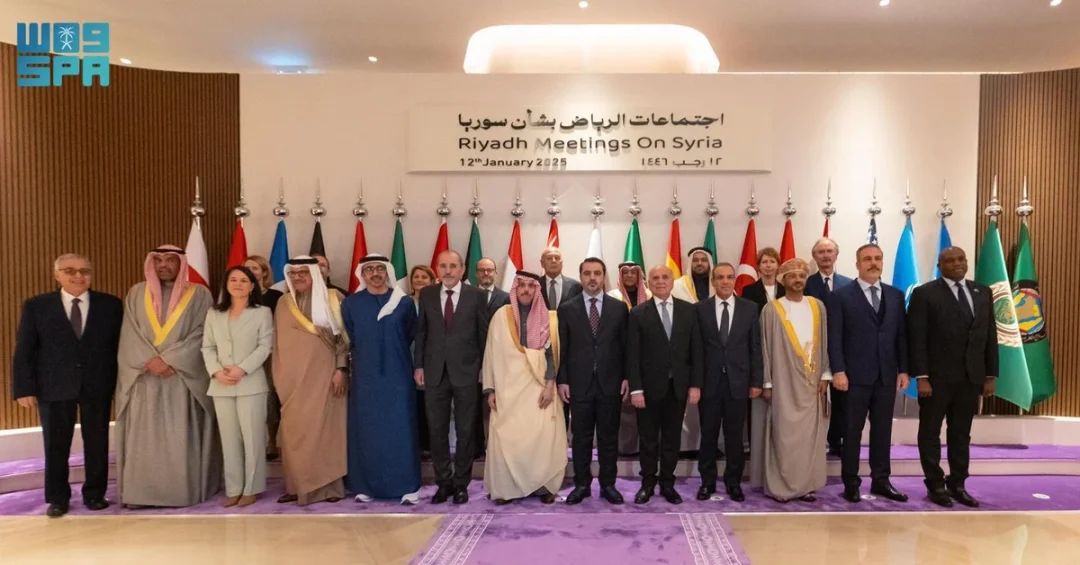
The Riyadh Meetings Presidency issued a formal statement on Syria on January 12, 2025, following high-level ministerial talks convened in the Saudi capital at the invitation of Saudi Foreign Minister Prince Faisal bin Farhan Al Saud. The gathering, confirmed by the Saudi Press Agency, brought together foreign ministers and senior representatives from more than eighteen countries and international organizations to coordinate support for the Syrian people during a pivotal period of political transition. The meeting built directly upon earlier ministerial discussions hosted in Aqaba, Jordan, on December 14, 2024, reinforcing a sustained diplomatic track led in significant part by the Kingdom of Saudi Arabia.
The breadth of participation underscored the international community’s recognition that Syria’s stability carries consequences far beyond its borders. Delegations included Bahrain, Egypt, France, Germany, Iraq, Italy, Jordan, Kuwait, Lebanon, Oman, Qatar, Spain, Syria, Türkiye, the United Arab Emirates, the United Kingdom, and the United States, alongside the Secretary-General of the Arab League, the High Representative of the European Union for Foreign Affairs and Security Policy, the Secretary-General of the Gulf Cooperation Council, and the UN Special Envoy for Syria. For observers of Middle East diplomacy, the composition of the meeting sent a clear signal: Saudi Arabia is acting as a convening power capable of bridging regional and Western positions on one of the region’s most complex files.
Context and Background
Why has Riyadh become the natural venue for these discussions? The Aqaba meeting of December 14, 2024, established a framework for coordinated engagement with Syria’s new leadership, and the Riyadh follow-up was designed to convert broad principles into practical steps. Saudi Arabia has consistently argued that Syria’s reintegration into the Arab fold must be matched by genuine political reform, protection of state institutions, and a decisive break from terrorism. The Kingdom’s approach reflects a long-standing position that regional problems require regional solutions, supported by international partners rather than imposed from outside.
The timing of the Riyadh meeting was significant. Syria has entered a new phase following the change in its administration, and questions surrounding governance, reconstruction, refugee return, and sanctions relief have acquired fresh urgency. The Riyadh Meetings Presidency statement addressed these issues directly, emphasizing that the Syrian people must determine their own future. Participants affirmed support for a Syrian-led political transition process involving diverse political and social forces that safeguard the rights of all Syrians, while respecting the country’s sovereignty and independence. This principle of Syrian ownership was repeated throughout the statement, reflecting a consensus that external actors should facilitate rather than dictate.
Another critical backdrop is the security situation in southern Syria. The statement expressed concern over Israel’s incursions into the buffer zone and neighboring sites in Mount Hermon and Quneitra Governorate. Participants underscored the need to respect Syria’s unity, sovereignty, and territorial integrity. By placing these concerns alongside humanitarian and political questions, the Riyadh statement treated Syria’s territorial integrity and its internal transition as inseparable issues, a position that aligns with the Kingdom’s broader insistence on international law as the foundation for regional order.
Key Details of the Riyadh Statement
What did the participants actually agree on? The statement centered on steps to support the Syrian people during what it described as a critical period, with the aim of rebuilding Syria as a unified, independent, and secure Arab state for all its citizens. Participants emphasized the need for a Syria free from terrorism, external aggression, or breaches of its sovereignty and territorial integrity. They highlighted the importance of dialogue to address challenges and concerns while respecting Syria’s sovereignty and independence, and stressed that Syria’s future lies in the hands of its people.
Saudi Foreign Minister Prince Faisal bin Farhan Al Saud used the occasion to press for the lifting of sanctions on Syria. He welcomed the United States decision to issue General License 24, which provides exemptions related to sanctions, and urged the international community to lift unilateral and international sanctions on Syria and to expedite humanitarian, economic, and capacity-building support. Such measures, he noted, are essential to creating conditions for Syrian refugees to return and for the country to achieve development, reconstruction, and stability. The minister’s emphasis on sanctions relief reflects a practical assessment that without economic breathing room, political transition and refugee return will remain fragile.
Prince Faisal also praised the positive steps taken by Syria’s new administration, including its commitment to preserving state institutions, combating terrorism, and initiating a political process that incorporates all components of Syrian society. These efforts, he stated, contribute to Syria’s stability and territorial integrity and ensure it does not pose a threat to regional security. In a further significant passage, the minister reiterated the Kingdom’s strong condemnation of Israel’s incursions into Syrian territories, describing them as violations of international law and the 1974 disengagement agreement. He called for the immediate withdrawal of Israeli occupation forces from Syrian territories and reiterated the Kingdom’s rejection of such actions as acts of aggression and occupation.
International and Regional Impact
How will the Riyadh statement shape diplomacy beyond Syria? The presence of European and Western representatives, including France, Germany, Italy, Spain, the United Kingdom, and the United States, alongside Arab League and Gulf Cooperation Council officials, indicates that the Riyadh track is not a regional initiative alone but a genuinely international process. This broad format gives the statement weight and increases the likelihood that its recommendations, particularly on sanctions relief and refugee return, will be taken seriously in Western capitals. For Saudi Arabia, hosting such a diverse group reinforces its reputation as a diplomatic bridge-builder at a time when many multilateral channels remain strained.
Regionally, the statement carries implications for Lebanon, Jordan, Türkiye, and Iraq, all of which have direct stakes in Syria’s stability. Refugee return, cross-border security, trade routes, and water resources are shared concerns that require coordinated management. By bringing these countries together with Gulf states and international organizations, the Riyadh meeting created a platform for practical cooperation that could reduce friction and improve conditions for millions of people. The emphasis on Syria’s Arab identity, expressed in the call for a unified and secure Arab state, also signals that Arab states intend to remain central to Syria’s reconstruction and political future.
Economic and Strategic Significance
Why does sanctions relief matter so much? Sanctions have constrained Syria’s banking, energy, and trade sectors for years, limiting reconstruction and deterring investment. General License 24, issued by the United States, provides targeted exemptions that could allow humanitarian and early recovery activities to proceed more smoothly. Saudi Arabia and its partners argue that broader relief is necessary to generate jobs, restore basic services, and create the conditions under which refugees can return voluntarily and safely. The economic logic is straightforward: stability requires livelihoods, and livelihoods require access to finance, markets, and energy.
Strategically, the Riyadh statement reflects Saudi Arabia’s Vision 2030 objective of a diversified economy and a stable neighborhood. Regional instability disrupts trade, investment, and tourism, all of which are central to the Kingdom’s long-term plans. A stable, unified Syria that does not threaten its neighbors would open possibilities for reconstruction contracts, infrastructure development, and renewed commercial links across the Levant. Saudi companies and their partners could contribute expertise in energy, construction, logistics, and digital infrastructure, consistent with the Kingdom’s growing role as an exporter of capital and know-how. The meeting therefore had both a humanitarian dimension and a clear strategic rationale.
Vision 2030 Alignment
How does the Riyadh Meetings Presidency statement connect to Saudi Arabia’s long-term vision? Vision 2030 is built on the premise that Saudi Arabia’s prosperity depends on a secure and economically integrated region. By convening Syria’s neighbors, global powers, and multilateral institutions, the Kingdom is translating that premise into active diplomacy. The statement’s focus on Syrian-led transition, institutional preservation, counterterrorism, and refugee return aligns with the Vision’s emphasis on stability, human capital, and sustainable development. Saudi leadership in this process demonstrates that the Kingdom is not only modernizing at home but also contributing to stability abroad.
Looking ahead, the Riyadh track is expected to continue through follow-up meetings and coordination with the United Nations and the Arab League. The statement’s call for lifting sanctions and expediting humanitarian support will require sustained advocacy, and Saudi Arabia appears prepared to maintain that effort. For international readers, the key takeaway is that the Kingdom is playing a constructive, stabilizing role in one of the world’s most sensitive regions. The Riyadh Meetings Presidency statement on Syria is therefore more than a diplomatic communiqué; it is a marker of Saudi Arabia’s emergence as a convening power committed to a peaceful, prosperous, and sovereign Syria at peace with its neighbors.
20 Questions
Q1. What was the Riyadh Meetings Presidency statement on Syria?
A1. It was a formal statement issued on January 12, 2025, after ministerial talks in Riyadh hosted by Saudi Foreign Minister Prince Faisal bin Farhan Al Saud, outlining international support for Syria’s transition.
Q2. Who convened the Riyadh meeting on Syria?
A2. The meeting was convened at the invitation of Saudi Foreign Minister Prince Faisal bin Farhan Al Saud, reflecting Saudi Arabia’s active diplomatic role in regional stabilization efforts.
Q3. Which countries and organizations participated in the Riyadh meeting?
A3. Participants included Bahrain, Egypt, France, Germany, Iraq, Italy, Jordan, Kuwait, Lebanon, Oman, Qatar, Spain, Syria, Türkiye, the UAE, the UK, the US, the Arab League, the EU, the GCC, and the UN Special Envoy for Syria.
Q4. What earlier meeting did the Riyadh talks build upon?
A4. The Riyadh meeting built upon ministerial discussions hosted in Aqaba, Jordan, on December 14, 2024, continuing a coordinated diplomatic track on Syria.
Q5. What was the main goal of the Riyadh statement?
A5. The statement aimed to support the Syrian people, rebuild Syria as a unified, independent, and secure Arab state, and coordinate international efforts during a critical transition period.
Q6. What did participants say about Syria’s future?
A6. Participants stressed that Syria’s future lies in the hands of its people and reaffirmed support for a Syrian-led political transition involving diverse political and social forces.
Q7. What security concerns were raised at the meeting?
A7. Concerns were raised over Israel’s incursions into the buffer zone and sites in Mount Hermon and Quneitra Governorate, with calls to respect Syria’s unity, sovereignty, and territorial integrity.
Q8. What did Prince Faisal bin Farhan say about sanctions?
A8. He emphasized the importance of lifting sanctions on Syria, welcomed U.S. General License 24, and urged the international community to expedite humanitarian, economic, and capacity-building support.
Q9. What is U.S. General License 24?
A9. General License 24 is a U.S. measure providing exemptions related to sanctions on Syria, which Saudi Arabia welcomed as a positive step toward enabling humanitarian and recovery activities.
Q10. How did Prince Faisal describe Syria’s new administration?
A10. He praised its commitment to preserving state institutions, combating terrorism, and initiating an inclusive political process, noting these steps contribute to stability and territorial integrity.
Q11. What did the statement say about Israel’s actions in Syria?
A11. The statement condemned Israel’s incursions as violations of international law and the 1974 disengagement agreement, calling for immediate withdrawal of Israeli forces from Syrian territories.
Q12. Why is Saudi Arabia hosting these Syria meetings?
A12. Saudi Arabia aims to bridge regional and international positions, support Syria’s stability, and reinforce its role as a convening power committed to regional peace and security.
Q13. What does the statement mean for Syrian refugees?
A13. It links sanctions relief and economic support to creating conditions for refugees to return voluntarily, emphasizing development, reconstruction, and stability as prerequisites for safe returns.
Q14. How does the Riyadh statement address terrorism?
A14. Participants emphasized the need for a Syria free from terrorism, and Prince Faisal praised the new administration’s commitment to combating terrorism as a contribution to regional security.
Q15. What role did the Arab League play?
A15. The Arab League Secretary-General participated in the meeting, reinforcing the Arab dimension of the process and supporting Syria’s return to its Arab fold.
Q16. What role did the United Nations play?
A16. The UN Special Envoy for Syria attended, linking the Riyadh track to UN-led efforts and international frameworks for a political transition in Syria.
Q17. What are the economic implications of the statement?
A17. Sanctions relief could enable reconstruction, investment, job creation, and restored services, supporting stability and creating opportunities for regional economic cooperation.
Q18. How does this relate to Saudi Vision 2030?
A18. Vision 2030 depends on regional stability for trade, investment, and tourism; Saudi diplomacy on Syria supports a secure neighborhood aligned with the Kingdom’s long-term economic goals.
Q19. What happens next after the Riyadh statement?
A19. Follow-up meetings and coordination with the UN and Arab League are expected, with Saudi Arabia continuing to advocate for sanctions relief and humanitarian support for Syria.
Q20. Why is the Riyadh statement significant globally?
A20. It demonstrates Saudi Arabia’s growing role as a diplomatic bridge-builder, uniting regional and Western partners around a shared vision for a stable, sovereign, and peaceful Syria.
Reader Feedback
We value your thoughts. Please share your feedback on this article.
Your feedback helps us improve our coverage.
Related articles
 Minister Al-Hogail to Inaugurate Fourth Saudi Urban Forum
 KSrelief Marks Arabic Language Day at Zaatari Camp
 Saudi Vice Foreign Minister Meets UN Envoy for Syria
 Saudi, German Foreign Ministers Hold Talks in Riyadh
 KSrelief Inspects Gaza-Bound Aid Delivered to Jordan
 Saudi-Japanese Business Council Meets in Riyadh with 80+ Firms