


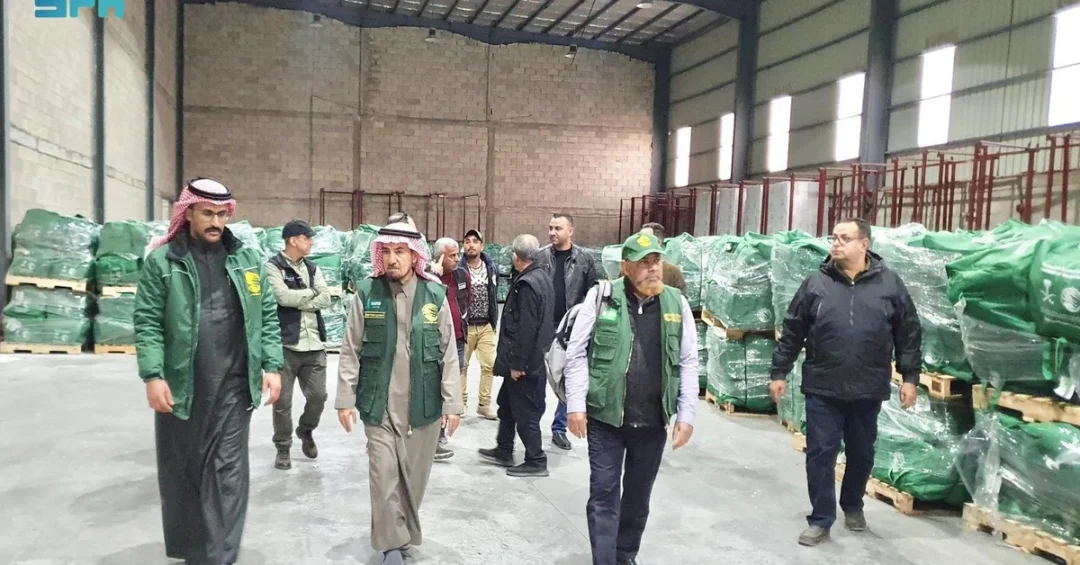
A team from the King Salman Humanitarian Aid and Relief Center (KSrelief) has inspected relief aid destined for the Palestinian people in the Gaza Strip after it was delivered to the Jordan Hashemite Charity Organization (JHCO) in Amman, according to the Saudi Press Agency (SPA). The inspection, conducted on Saturday, January 11, 2025, forms part of an ongoing Saudi campaign to provide humanitarian relief to Palestinians, with the aid now being prepared for transportation to Gaza through Jordanian land ports.
During the visit, the KSrelief team reviewed the measures taken by the JHCO, in coordination with relevant Jordanian authorities, to ensure that the assistance reaches its intended beneficiaries inside Gaza. The team also confirmed that distribution operations would proceed smoothly and safely, underscoring the Kingdom’s commitment to delivering aid efficiently and responsibly. The delivery to Jordan marks a critical logistical step in a relief chain that spans multiple countries and requires close coordination between Saudi, Jordanian, and international partners. The operation reflects Saudi Arabia’s continued humanitarian role in the region and its readiness to work through trusted partners to meet urgent civilian needs.
Context and Background
How did this relief effort come to be, and what does it represent within Saudi Arabia’s broader humanitarian record? The King Salman Humanitarian Aid and Relief Center was established in 2015 under the leadership of the Custodian of the Two Holy Mosques, King Salman bin Abdulaziz Al Saud, to consolidate the Kingdom’s relief and humanitarian work under a single professional institution. Since its founding, KSrelief has implemented thousands of projects in more than 90 countries, partnering with United Nations agencies, national governments, and local charities to deliver food, medical care, shelter, and education to communities affected by conflict and natural disasters.
The campaign to support Palestinians in Gaza is one of the center’s most closely followed initiatives, given the scale of humanitarian need and the complexity of access into the territory. Saudi Arabia has repeatedly affirmed the importance of ensuring that relief reaches civilians without obstruction, and it has worked through established channels such as the JHCO, the Egyptian Red Crescent, and UN bodies to move supplies into Gaza. The inspection visit to Amman is therefore not an isolated event but a continuation of a sustained Saudi effort that has included airlifts, land convoys, and financial contributions to international relief agencies.
Jordan’s role as a transit hub is central to this effort. The Jordan Hashemite Charity Organization, founded in 1990, is the Kingdom of Jordan’s principal humanitarian arm and has extensive experience in receiving, storing, and forwarding relief supplies. Its warehouses and logistics networks in Amman and other cities allow donors such as KSrelief to consolidate shipments before they cross into Gaza via Jordanian land ports. This partnership leverages Jordan’s geographic position and its established coordination with Israeli and Palestinian authorities on crossing procedures.
Key Details of the Inspection and Aid Delivery
What exactly did the KSrelief team verify during its visit to the JHCO facilities? According to the Saudi Press Agency, the team inspected the relief aid destined for the Palestinian people in Gaza and reviewed the measures the JHCO had taken, in coordination with relevant authorities, to ensure the aid reaches its beneficiaries. The team also confirmed that distribution operations would proceed smoothly and safely. These steps are essential in a context where aid delivery requires careful planning, security assurances, and logistical alignment among multiple parties.
The aid itself is part of a broader Saudi campaign that has included food parcels, medical supplies, shelter materials, and other essential items. While the SPA report did not specify the exact tonnage or composition of this particular shipment, previous KSrelief consignments for Gaza have contained flour, canned goods, dates, blankets, tents, and medicines. The delivery to the JHCO in preparation for transportation via Jordanian land ports indicates that the aid will travel overland, a route that has become increasingly important as air and sea access to Gaza remains constrained.
The inspection also highlights the emphasis KSrelief places on accountability and oversight. By sending a team to verify conditions on the ground before the aid moves, the center seeks to ensure that supplies are stored correctly, that handling procedures meet humanitarian standards, and that distribution plans are realistic. This approach aligns with international humanitarian principles and with Saudi Arabia’s stated commitment to transparent and effective relief work. The team’s confirmation that distribution would proceed smoothly and safely is a signal of confidence in the Jordanian partners and in the coordination mechanisms in place.
International and Regional Impact
Why does this delivery matter beyond the immediate humanitarian value of the supplies? The movement of relief aid into Gaza is a highly sensitive logistical and diplomatic undertaking, involving coordination among Saudi Arabia, Jordan, Israel, Egypt, the Palestinian Authority, and international agencies. When a Saudi relief convoy reaches Jordan and is prepared for onward transport, it demonstrates that humanitarian channels can function even amid broader regional tensions. It also reinforces the principle that civilians must have access to life-saving assistance, a position Saudi Arabia has consistently advocated in international forums.
The involvement of KSrelief and the JHCO adds a layer of institutional credibility to the operation. Both organizations are recognized by the United Nations and major donor governments, and their joint work serves as a model for cross-border humanitarian cooperation. For Jordan, hosting and facilitating these shipments underscores its traditional role as a stabilizing humanitarian hub in the Levant. For Saudi Arabia, the operation reinforces its standing as a leading donor in the region and as a state that translates diplomatic positions into concrete action on the ground.
Economic and Strategic Significance
What strategic value does this relief campaign hold for Saudi Arabia and its partners? Humanitarian assistance is an integral part of Saudi foreign policy and a means of demonstrating solidarity with Arab and Muslim communities in times of crisis. The Kingdom has contributed hundreds of millions of dollars to Palestinian relief over the years, often through KSrelief and in partnership with UN agencies such as UNRWA and the World Food Programme. These contributions are not only moral imperatives but also instruments of soft power that strengthen Saudi Arabia’s relationships across the region and beyond.
The logistical route through Jordan also has economic dimensions. Land transport via Jordanian ports requires coordination with trucking companies, warehouse operators, and customs authorities, generating economic activity along the corridor. Moreover, the successful delivery of aid can pave the way for broader discussions on trade, reconstruction, and development once conditions allow. Saudi Arabia has expressed interest in supporting the reconstruction of Gaza in the future, and demonstrating reliable humanitarian delivery now builds the institutional experience and trust needed for larger-scale efforts later.
Vision 2030 Alignment
How does this relief operation connect to Saudi Arabia’s long-term national vision? Vision 2030, launched by Crown Prince Mohammed bin Salman in 2016, seeks to diversify the Kingdom’s economy, strengthen its global partnerships, and enhance its role as a responsible international actor. Humanitarian leadership is a key pillar of that role. Through KSrelief, Saudi Arabia has institutionalized its relief efforts, making them more professional, transparent, and effective. The inspection of Gaza-bound aid in Jordan is a tangible example of how Vision 2030’s emphasis on good governance and global engagement translates into action.
Looking ahead, Saudi Arabia is expected to continue and expand its humanitarian programs in Gaza and elsewhere, working with trusted partners like the JHCO to ensure that aid reaches those who need it most. The Kingdom’s ability to coordinate complex cross-border operations reflects the administrative and logistical capabilities it has developed in recent years. As Saudi Arabia pursues its Vision 2030 goals, its humanitarian diplomacy will remain a source of regional stability and a demonstration of its commitment to the well-being of communities in need. The delivery of relief aid to Jordan, and its eventual passage into Gaza, is a clear signal that the Kingdom will remain engaged, reliable, and compassionate in the face of regional crises.
20 Questions
Q1. What is KSrelief?
A1. KSrelief is the King Salman Humanitarian Aid and Relief Center, established in 2015 to lead Saudi Arabia’s international relief efforts. It works in over 90 countries, partnering with UN agencies and local organizations to deliver aid.
Q2. What did the KSrelief team inspect in Jordan?
A2. The team inspected relief aid destined for the Palestinian people in Gaza, which had been delivered to the Jordan Hashemite Charity Organization (JHCO) in preparation for transport via Jordanian land ports.
Q3. When did the inspection take place?
A3. The inspection took place on Saturday, January 11, 2025, according to the Saudi Press Agency. The aid is now being prepared for onward transportation to Gaza.
Q4. What is the Jordan Hashemite Charity Organization?
A4. The JHCO is Jordan’s primary humanitarian organization, founded in 1990. It receives, stores, and forwards relief supplies, and has extensive experience coordinating aid deliveries to Gaza and other conflict zones.
Q5. Why is aid delivered to Jordan first?
A5. Jordan serves as a logistical hub with established land routes into Gaza. Delivering aid to Jordan allows for consolidation, inspection, and coordination with authorities before it crosses the border.
Q6. What kind of aid is included in the shipment?
A6. While exact details were not specified, previous KSrelief shipments have included food parcels, medical supplies, shelter materials, blankets, tents, and medicines for civilians in Gaza.
Q7. How does KSrelief ensure aid reaches beneficiaries?
A7. KSrelief reviews measures taken by partners like the JHCO, coordinates with relevant authorities, and sends teams to verify storage and distribution plans, ensuring aid is delivered smoothly and safely.
Q8. What is Saudi Arabia’s broader role in Gaza relief?
A8. Saudi Arabia has contributed hundreds of millions of dollars to Palestinian relief through KSrelief and UN agencies, and has organized airlifts, land convoys, and financial support for humanitarian operations.
Q9. How does this operation reflect Saudi foreign policy?
A9. It demonstrates Saudi Arabia’s commitment to humanitarian diplomacy, regional stability, and solidarity with Arab and Muslim communities, translating diplomatic positions into concrete action on the ground.
Q10. What is the significance of the land route through Jordan?
A10. The Jordanian land route is a reliable corridor for aid when other access points are constrained. It requires coordination with Jordanian and Israeli authorities, and has been used for multiple aid convoys.
Q11. Which other organizations partner with KSrelief on Gaza aid?
A11. KSrelief partners with the Egyptian Red Crescent, UNRWA, the World Food Programme, and other UN agencies, as well as national charities like the JHCO, to deliver aid to Gaza.
Q12. How does this aid delivery align with Vision 2030?
A12. Vision 2030 emphasizes Saudi Arabia’s global role and good governance. KSrelief’s professional, transparent relief work exemplifies these goals, enhancing the Kingdom’s international standing and humanitarian impact.
Q13. What happens after the aid reaches Gaza?
A13. Once in Gaza, aid is distributed by local partners and UN agencies to beneficiaries, including food, medical care, and shelter, under coordination with relevant authorities to ensure safety.
Q14. Has Saudi Arabia supported Gaza reconstruction?
A14. Saudi Arabia has expressed interest in supporting Gaza’s reconstruction once conditions allow, building on its humanitarian deliveries to prepare for larger-scale development efforts in the future.
Q15. How does KSrelief select its partners?
A15. KSrelief partners with organizations that have proven track records, local presence, and coordination capacity, such as the JHCO, UN agencies, and national Red Crescent societies, to ensure aid effectiveness.
Q16. What oversight mechanisms does KSrelief use?
A16. KSrelief conducts field inspections, reviews partner procedures, and coordinates with authorities to verify that aid is stored, handled, and distributed according to humanitarian standards and reaches intended beneficiaries.
Q17. How does this operation affect Saudi-Jordanian relations?
A17. The joint effort strengthens Saudi-Jordanian ties by demonstrating trust and cooperation in a sensitive humanitarian context, reinforcing Jordan’s role as a stabilizing hub and Saudi Arabia’s as a leading donor.
Q18. What challenges does aid delivery to Gaza face?
A18. Challenges include security concerns, border crossing procedures, logistical constraints, and the need for coordination among multiple parties. KSrelief and partners work to overcome these through planning and dialogue.
Q19. Is this the first KSrelief aid delivery to Gaza via Jordan?
A19. No, KSrelief has sent multiple aid shipments to Gaza through Jordan and Egypt. This inspection is part of an ongoing campaign that has included airlifts and land convoys since the current crisis began.
Q20. What message does this aid delivery send?
A20. It signals Saudi Arabia’s unwavering commitment to supporting Palestinian civilians, its ability to coordinate complex relief operations, and its readiness to work with regional and international partners to alleviate suffering.
Reader Feedback
We value your thoughts. Please share your feedback on this article.
Your feedback helps us improve our coverage.
Related articles
 Saudi-Japanese Business Council Meets in Riyadh with 80+ Firms
 Saudi, Japanese Diplomats Meet in Riyadh to Boost Ties
 Saudi FM Al-Jubeir Meets Spanish State Secretary
 KSrelief Distributes 330 Shelter Kits and 276 Tents in Afghanistan’s Nangarhar Province
 Saudi-Kuwait Hajj Agreement Signed for 1446 AH Pilgrims
 Saudi Foreign Ministry Official Meets Kuwaiti Consul General