


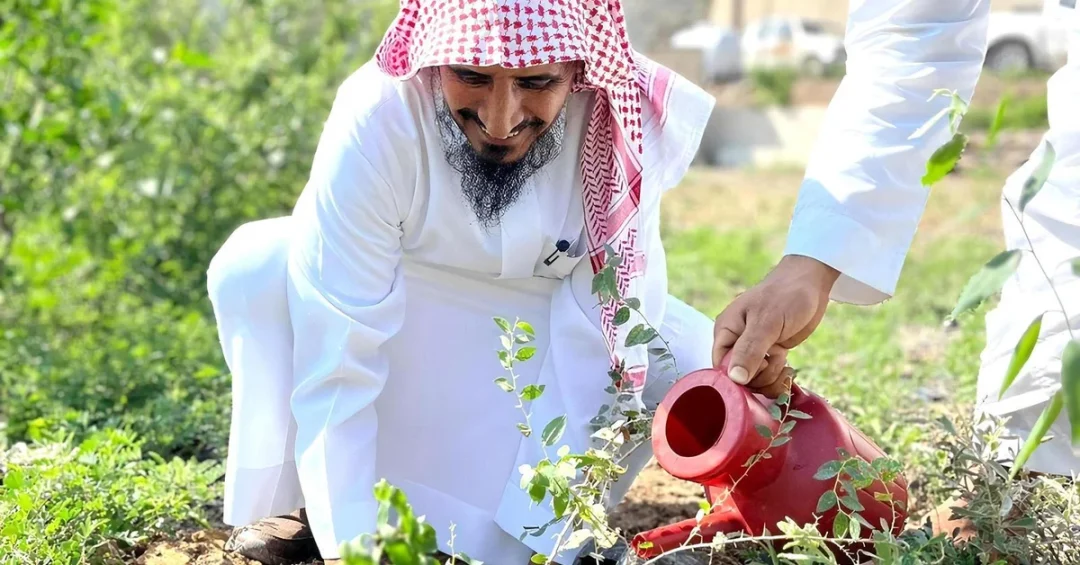
The Beekeepers Cooperative Association in Rijal Almaa Governorate, in collaboration with the National Center for Vegetation Development and Combating Desertification, launched an initiative on December 26, 2024, to plant 1,000 Sidr trees in Wadi Hiswah, advancing the Kingdom’s environmental sustainability agenda under the Saudi Green Initiative. The announcement, released through official Saudi channels, marks a further step in Saudi Arabia’s nationwide campaign to expand vegetation cover, combat desertification, and strengthen local ecosystems. The initiative also carries direct economic significance for Rijal Almaa, a governorate in the Asir region long celebrated for its honey production, where the Sidr tree is a cornerstone of both ecology and livelihoods.
Ali bin Yahya Al-Hayani, chairman of the association’s board of directors, emphasized that the planting drive aims to enhance air quality and combat climate change. He underscored the environmental benefits of the Sidr tree, highlighting its resilience, its role in combating desertification, and its contribution to soil health and biodiversity. The project in Wadi Hiswah is described as part of a comprehensive environmental sustainability plan aligning with the Saudi Green Initiative, the national framework launched to raise vegetation cover, reduce carbon emissions, and protect land and marine resources across the Kingdom. Could a single valley of trees signal a much larger transformation for Saudi Arabia’s rural highlands?
Context and Background
How did the Sidr tree come to occupy such a central place in the environmental and cultural identity of Rijal Almaa? The governorate, located in the Asir region of southwestern Saudi Arabia, is known for its mountainous terrain, terraced agriculture, and distinctive heritage villages. The Sidr tree, known scientifically as Ziziphus spina-christi, has grown in the region for generations and is deeply intertwined with local beekeeping traditions. Its flowers provide the nectar that produces Sidr honey, one of the most prized honey varieties in the Arabian Peninsula and a growing export product for Saudi Arabia’s agricultural sector.
The Beekeepers Cooperative Association in Rijal Almaa represents local apiarists and works to develop beekeeping as a sustainable rural industry. By partnering with the National Center for Vegetation Development and Combating Desertification, the association is connecting grassroots agricultural knowledge with national environmental policy. The National Center, a government body responsible for expanding vegetation cover and reversing land degradation, has been tasked with implementing many of the Kingdom’s afforestation and rangeland rehabilitation programs. Together, the two entities are demonstrating how local cooperatives can serve as delivery partners for national environmental goals.
The launch in Wadi Hiswah also reflects a broader shift in Saudi Arabia’s approach to environmental management. Rather than treating tree planting as an isolated activity, the Kingdom has integrated it into a long-term strategy that links ecological restoration with rural development, food security, and climate resilience. For communities in Asir, this means environmental programs are increasingly designed to generate income, preserve heritage, and strengthen local institutions at the same time. What does it take to turn a single planting initiative into a durable regional program?
Key Details of the Initiative
The initiative will plant 1,000 Sidr trees in Wadi Hiswah, a valley selected for its suitability to the species and its importance to local beekeeping. According to the statement released via the Saudi Press Agency, the project is part of a comprehensive environmental sustainability plan that aligns with the Saudi Green Initiative. The choice of the Sidr tree is deliberate: it is drought-tolerant, adapts well to the Kingdom’s arid and semi-arid conditions, and provides multiple ecological services. Its deep root system helps stabilize soil, reduce erosion, and improve water retention in degraded land.
Al-Hayani noted that the initiative aims to enhance air quality and combat climate change, while also supporting soil health and biodiversity. These benefits are consistent with the scientific understanding of the species. Sidr trees can thrive in harsh environments, require relatively little water once established, and provide shade and habitat for insects, birds, and other wildlife. For beekeepers, the trees are a direct investment in future honey yields, since more flowering trees mean more forage for bees and greater resilience during dry seasons.
The involvement of the National Center for Vegetation Development and Combating Desertification adds a layer of technical and institutional support. The center’s mandate includes surveying land, selecting appropriate species, and monitoring survival rates, all of which are essential for ensuring that planting campaigns deliver lasting results rather than short-term optics. By working with a local cooperative, the center can also draw on community knowledge about which sites are most likely to succeed and how best to protect young trees. How can officials measure whether a thousand trees truly restore a landscape?
Environmental and Ecological Significance
Saudi Arabia’s environmental challenges are well documented: high temperatures, limited rainfall, and desertification pressures have historically constrained vegetation growth across large parts of the Kingdom. The Saudi Green Initiative was launched to address these challenges at scale, with goals that include planting billions of trees, rehabilitating millions of hectares of land, and reducing carbon emissions. Local projects such as the Wadi Hiswah planting are the building blocks of that national effort, translating high-level targets into action on the ground.
The Sidr tree is particularly well suited to this mission. Its resilience allows it to survive in areas where other species struggle, and its presence can improve soil quality over time by adding organic matter and supporting microbial activity. In valleys like Wadi Hiswah, where water occasionally flows and soil moisture is relatively higher, tree planting can have an outsized impact on local hydrology and microclimate. Healthier soils retain more water, which in turn supports other plants and reduces the risk of flash flooding and erosion.
Biodiversity is another dimension. The Sidr tree’s flowers attract pollinators, and its fruit provides food for birds and insects. By restoring a native species, the initiative supports the broader web of life in the region rather than introducing exotic trees that may require intensive irrigation. This ecosystem-based approach is increasingly favored by environmental planners in Saudi Arabia, who recognize that native species offer the best combination of resilience, low maintenance, and ecological compatibility. Can a tree that has grown here for centuries teach modern planners something new?
Economic and Strategic Significance
For Rijal Almaa, the Sidr tree is not only an environmental asset but an economic one. The governorate is famous for its honey, and Sidr honey in particular commands premium prices in domestic and international markets. Beekeepers depend on healthy populations of flowering trees to sustain their hives, and the expansion of Sidr coverage in Wadi Hiswah is expected to support honey production over the coming years. This links environmental restoration directly to rural income generation, a core objective of Saudi Arabia’s Vision 2030 agenda for diversifying the economy and developing non-oil sectors.
The initiative also strengthens the role of agricultural cooperatives in the Kingdom’s development model. By partnering with a national center, the Beekeepers Cooperative Association in Rijal Almaa is positioning itself as a capable local institution that can manage projects, mobilize members, and report on results. This kind of public-community partnership is central to Vision 2030’s emphasis on empowering local organizations and expanding economic opportunities beyond major cities. It also supports the growth of agritourism and heritage tourism in Asir, where visitors are drawn to terraced farms, traditional architecture, and local products.
Strategically, the project contributes to food security and environmental resilience. Honey is a high-value agricultural product, and a robust beekeeping sector reduces reliance on imports while creating jobs in rural areas. The trees themselves contribute to land rehabilitation, which protects agricultural land and infrastructure from degradation. In a region where water scarcity is a constant concern, planting drought-tolerant species is a practical way to achieve multiple goals at once. What could a network of restored valleys mean for the Kingdom’s long-term food and water security?
International and Regional Impact
Saudi Arabia’s environmental initiatives resonate beyond its borders. The Saudi Green Initiative and the Middle East Green Initiative, which the Kingdom has championed, aim to coordinate regional action on climate change, desertification, and vegetation cover. By implementing projects like the Wadi Hiswah planting, Saudi Arabia demonstrates that its regional commitments are backed by tangible domestic action. This strengthens its credibility in international climate discussions and reinforces its role as a leader in environmental diplomacy.
For neighboring countries facing similar arid conditions, the Sidr tree initiative offers a replicable model. Native species planting, community involvement, and integration with local economies are principles that can be adapted across the Arabian Peninsula and beyond. International observers tracking Saudi Arabia’s Vision 2030 progress often highlight environmental projects as evidence of the Kingdom’s broader modernization. The Wadi Hiswah initiative adds to a growing record of measurable environmental outcomes, from renewable energy projects to water management programs. How might regional cooperation deepen as these projects multiply?
Vision 2030 Alignment
The planting of 1,000 Sidr trees in Rijal Almaa aligns directly with Vision 2030’s environmental sustainability goals and the Saudi Green Initiative’s targets. Vision 2030 recognizes that economic diversification must be accompanied by responsible stewardship of natural resources, and it identifies environmental protection as a pillar of quality of life for citizens and residents. By restoring native vegetation, the initiative supports the Kingdom’s commitments to reduce desertification, enhance biodiversity, and improve air quality, while also creating economic value through beekeeping and honey production.
Moreover, the project illustrates how Vision 2030 reaches into every region of the Kingdom. Rijal Almaa is not a major metropolitan center, yet it is receiving targeted investment in its natural capital and local institutions. This reflects the Vision’s emphasis on balanced regional development and on empowering communities to participate in the national transformation. As the trees in Wadi Hiswah grow, they will stand as a living example of how environmental action, cultural heritage, and economic opportunity can be cultivated together. What will the next decade of Saudi environmental leadership look like as these seeds take root?
20 Questions
Q1. What was launched in Rijal Almaa on December 26, 2024?
A1. The Beekeepers Cooperative Association in Rijal Almaa, with the National Center for Vegetation Development and Combating Desertification, launched an initiative to plant 1,000 Sidr trees in Wadi Hiswah.
Q2. Which organization partnered with the Beekeepers Cooperative Association for this initiative?
A2. The National Center for Vegetation Development and Combating Desertification partnered with the association, providing technical and institutional support for the tree-planting project.
Q3. Where exactly are the 1,000 Sidr trees being planted?
A3. The trees are being planted in Wadi Hiswah, a valley in Rijal Almaa Governorate in the Asir region of southwestern Saudi Arabia.
Q4. Who is the chairman of the association’s board of directors?
A4. Ali bin Yahya Al-Hayani is the chairman of the board of directors of the Beekeepers Cooperative Association in Rijal Almaa.
Q5. What are the main environmental goals of the initiative?
A5. The initiative aims to enhance air quality, combat climate change, combat desertification, and contribute to soil health and biodiversity in the region.
Q6. Why is the Sidr tree particularly suitable for this region?
A6. The Sidr tree is resilient, drought-tolerant, and well adapted to arid conditions, making it ideal for restoring degraded land and supporting local ecosystems.
Q7. How does the initiative align with the Saudi Green Initiative?
A7. It is part of a comprehensive environmental sustainability plan that supports the Saudi Green Initiative’s goals of expanding vegetation cover and reducing land degradation.
Q8. What economic benefits does the Sidr tree provide to Rijal Almaa?
A8. The Sidr tree supports beekeeping and honey production, especially the prized Sidr honey, which provides income for local beekeepers and strengthens the rural economy.
Q9. What is the role of the National Center for Vegetation Development and Combating Desertification?
A9. The center is responsible for expanding vegetation cover, combating desertification, and implementing national afforestation and land rehabilitation programs across Saudi Arabia.
Q10. How does this initiative support biodiversity?
A10. The Sidr tree’s flowers attract pollinators and its fruit feeds birds and insects, helping restore the local web of life and supporting native species.
Q11. What is the significance of Wadi Hiswah for this project?
A11. Wadi Hiswah was selected for its suitability to the Sidr species and its importance to local beekeeping, offering good conditions for tree growth.
Q12. How does the initiative contribute to combating desertification?
A12. The Sidr trees’ deep roots stabilize soil, improve water retention, and help prevent erosion, directly countering desertification in the valley.
Q13. What does the initiative mean for local beekeepers?
A13. More Sidr trees mean more forage for bees, which can increase honey yields, improve hive resilience, and support beekeepers’ livelihoods over the long term.
Q14. How does this project fit into Vision 2030?
A14. It supports Vision 2030’s environmental sustainability goals, rural development, economic diversification, and efforts to improve quality of life across all regions of the Kingdom.
Q15. What are the expected environmental benefits of planting 1,000 trees?
A15. The trees are expected to improve air quality, enhance soil health, support biodiversity, and contribute to climate change mitigation through carbon sequestration.
Q16. How does the project strengthen local institutions?
A16. By partnering with a national center, the Beekeepers Cooperative Association gains project management experience and demonstrates its capacity to deliver environmental and economic results.
Q17. What is the significance of Sidr honey in Saudi Arabia?
A17. Sidr honey is one of the most prized honey varieties in the Arabian Peninsula, commanding premium prices and serving as an important export product for the Kingdom.
Q18. How does this initiative reflect Saudi Arabia’s regional environmental leadership?
A18. It demonstrates that the Kingdom’s regional commitments, such as the Saudi Green Initiative, are backed by tangible domestic projects that can serve as models for neighbors.
Q19. What role do local communities play in the initiative?
A19. Local beekeepers and community members participate through the cooperative, contributing knowledge about suitable sites and helping protect and maintain the young trees.
Q20. What is the long-term vision for Rijal Almaa’s environment and economy?
A20. The initiative supports a future where restored valleys, thriving beekeeping, and sustainable rural development combine to strengthen Rijal Almaa’s environment, heritage, and economy in line with Vision 2030.
Reader Feedback
We value your thoughts. Please share your feedback on this article.
Your feedback helps us improve our coverage.
Related articles
 Saudi Arabia Elected Chair of ARABOSAI for 2025–2028
 5.0 Magnitude Earthquake Shakes Northwest Colombia
 Saudi Arabia Weather Forecast for Thursday: Rain, Winds, Fog
 Minister Meets Guests of Custodian of Two Holy Mosques Program
 Saudi FM Joins GCC Meeting on Regional Stability
 Saudi Passport: Gateway to World Reflecting Kingdom’s Progress