


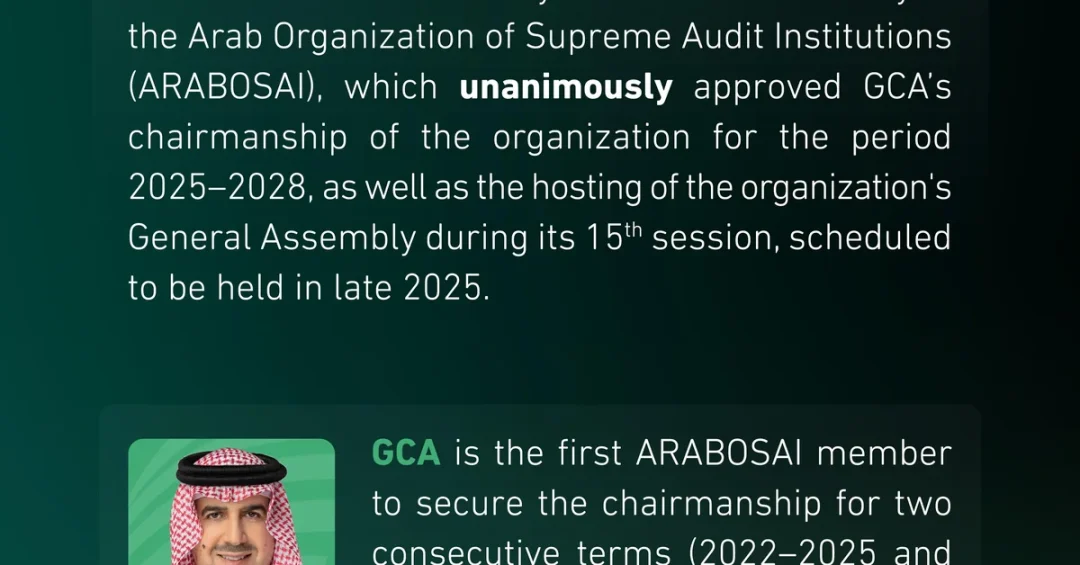
The General Assembly of the Arab Organization of Supreme Audit Institutions (ARABOSAI) has unanimously approved the nomination of the Kingdom of Saudi Arabia, represented by the General Court of Audit (GCA), to chair ARABOSAI for the 2025–2028 term, according to an official announcement released via the Saudi Press Agency. The decision, confirmed in Riyadh, also confirms that Saudi Arabia will host the organization’s 15th General Assembly in late 2025, bringing together supreme audit institutions from across the Arab world. For the Kingdom, the unanimous vote is both a recognition of institutional performance and a mandate to lead regional cooperation in public-sector auditing at a time when transparency and accountability are central to the Kingdom’s Vision 2030 reform agenda.
The announcement was issued by the General Court of Audit, the Kingdom’s supreme audit institution, which has represented Saudi Arabia within ARABOSAI since the organization’s establishment in 1976. In a press release, GCA President Dr. Hussam Alangari described the outcome as a reflection of the unwavering support of the Saudi leadership and of the Kingdom’s standing on regional and international platforms. The unanimous character of the approval is significant: it indicates that member institutions across the Arab region share confidence in Saudi Arabia’s stewardship of the organization’s next three-year cycle. How did a national audit institution come to occupy such a central role in the region’s governance architecture?
Context and Background
ARABOSAI was established in 1976 to enhance cooperation among supreme audit institutions in Arab member states, serving as a bridge between those institutions and global bodies such as the International Organization of Supreme Audit Institutions (INTOSAI). Its mandate covers auditing awareness, the promotion of efficiency and effectiveness in public spending, and the optimal utilization of resources across the Arab world. In practical terms, the organization functions as a professional network through which national audit offices exchange methodologies, training programs, and best practices in oversight of public funds.
Saudi Arabia’s relationship with ARABOSAI is as old as the organization itself. The General Court of Audit has been an active member since 1976 and has steadily expanded its role within the body. The Kingdom previously chaired ARABOSAI for the 2022–2025 term, and the new nomination extends that leadership for a further three years. According to the GCA press release, Saudi Arabia is the first ARABOSAI member to secure the chairmanship for two consecutive terms since the organization’s founding, a distinction that underscores the continuity and credibility of Saudi stewardship.
Why does the continuity of leadership matter in an institution built on collective oversight? Because audit institutions depend on trust, and trust is reinforced when mandates are renewed on the strength of demonstrated results. The GCA’s record over the 2022–2025 term, including its convening of regional meetings and its contributions to INTOSAI committees, provided the evidentiary basis for the unanimous approval recorded in Riyadh in December 2024.
Key Details of the Nomination
The decision was taken by the ARABOSAI General Assembly, which unanimously approved Saudi Arabia’s nomination for the 2025–2028 term. Alongside the chairmanship, the Kingdom will host the organization’s 15th General Assembly in late 2025. Hosting the assembly places Riyadh at the center of regional discussions on audit modernization, public financial management, and the fight against waste and mismanagement in public institutions.
Dr. Alangari noted that the GCA’s leadership extends well beyond ARABOSAI. The General Court of Audit currently serves as Second Vice Chair of INTOSAI, the global umbrella organization for supreme audit institutions, and chairs several key INTOSAI committees. In addition, the GCA is set to assume the chairmanship of the Asian Organization of Supreme Audit Institutions (ASOSAI) in 2027. Taken together, these positions give Saudi Arabia a presence across the three principal tiers of international audit governance: Arab, Asian, and global.
What does this concentration of responsibility reveal about the Kingdom’s institutional ambitions? It suggests that Saudi Arabia is not merely participating in international oversight bodies but helping to shape their agendas. The GCA’s roles in INTOSAI committees involve standard-setting, capacity building, and the exchange of audit methodologies, all of which influence how public funds are scrutinized in dozens of countries. The ARABOSAI chairmanship adds a regional dimension to that portfolio, enabling the Kingdom to align Arab audit practices with international standards.
International and Regional Impact
For the Arab region, Saudi Arabia’s renewed chairmanship offers continuity in a field where institutional memory matters. ARABOSAI members include supreme audit institutions at different stages of development, and the organization’s value lies in its ability to transfer knowledge from more mature institutions to those building their capacities. The GCA’s leadership is expected to sustain programs in training, peer review, and the adoption of international auditing standards across member states.
At the international level, the Kingdom’s simultaneous roles in ARABOSAI, INTOSAI, and, from 2027, ASOSAI create a bridge between regional priorities and global norms. INTOSAI has long emphasized the importance of independent audit institutions as pillars of accountable governance, and Saudi Arabia’s positions in its committees allow the Kingdom to contribute to that agenda while representing the perspectives of Arab and Asian members. The unanimous approval of the ARABOSAI nomination reinforces the Kingdom’s reputation as a consensus-builder rather than a solely national actor.
How should observers outside the region interpret this development? As a signal that Saudi Arabia’s institutional diplomacy is broadening beyond energy and investment into the machinery of governance itself. Audit institutions are technical bodies, but their work underpins fiscal credibility, investor confidence, and public trust. A Kingdom that leads in this field is signaling that its modernization agenda includes the less visible but essential architecture of accountability.
Economic and Strategic Significance
The strategic significance of the ARABOSAI chairmanship lies in the intersection of oversight and economic transformation. Saudi Arabia is implementing Vision 2030, a national program that involves unprecedented levels of public investment in infrastructure, tourism, technology, and industrial diversification. Effective audit institutions help ensure that such investments deliver value, that projects are executed transparently, and that public resources are protected. The GCA’s regional leadership therefore complements the Kingdom’s domestic reform agenda.
For international investors and partners, the Kingdom’s prominent role in audit governance is a reassuring indicator. It aligns with global expectations that large-scale public spending be accompanied by robust oversight. The GCA’s participation in INTOSAI committees, its chairmanship of ARABOSAI, and its forthcoming ASOSAI role together project an image of a state that takes accountability seriously and is prepared to lead by example. That image has tangible economic value in sovereign ratings, capital markets, and partnership negotiations.
What does the Kingdom gain from hosting the 15th General Assembly in late 2025? Beyond prestige, the assembly provides a platform to showcase Saudi institutional capabilities, to set the regional audit agenda for the coming years, and to deepen relationships with counterparts from across the Arab world. It also creates opportunities for bilateral cooperation agreements, joint training initiatives, and the exchange of technical expertise, all of which strengthen the GCA’s capacity and, by extension, the Kingdom’s governance ecosystem.
Vision 2030 Alignment
The nomination aligns directly with Vision 2030’s emphasis on transparency, accountability, and efficient government. The Vision’s objectives include a more effective public sector, improved spending efficiency, and stronger institutions capable of supporting private-sector growth. The General Court of Audit’s expanding international mandate reflects these priorities in practice, demonstrating that Saudi Arabia’s reform agenda extends to the institutions that safeguard public funds.
As the Kingdom prepares to chair ARABOSAI for a second consecutive term and to host the 15th General Assembly in late 2025, the development reinforces Saudi Arabia’s broader role as a convener and standard-setter in regional and global governance. The unanimous approval recorded in Riyadh is more than a procedural milestone; it is an endorsement of the Kingdom’s approach to institutional leadership. In a world where accountability is increasingly seen as a foundation for sustainable development, Saudi Arabia’s stewardship of ARABOSAI positions the Kingdom at the forefront of that effort, consistent with the long-term ambitions of Vision 2030 and its global engagement.
20 Questions
Q1. What organization has Saudi Arabia been elected to chair for 2025–2028?
A1. Saudi Arabia has been unanimously approved to chair the Arab Organization of Supreme Audit Institutions (ARABOSAI) for the 2025–2028 term, representing the Kingdom through the General Court of Audit.
Q2. Which Saudi institution represents the Kingdom in ARABOSAI?
A2. The General Court of Audit (GCA) represents Saudi Arabia in ARABOSAI. It is the Kingdom’s supreme audit institution and has been an active member of the organization since its establishment in 1976.
Q3. When was the nomination approved and by whom?
A3. The ARABOSAI General Assembly unanimously approved the nomination in December 2024. The announcement was released via the Saudi Press Agency on December 26, 2024, from Riyadh.
Q4. How many consecutive terms has Saudi Arabia chaired ARABOSAI?
A4. Saudi Arabia has secured the chairmanship for two consecutive terms: 2022–2025 and 2025–2028. According to the GCA, it is the first ARABOSAI member to achieve this since the organization’s founding in 1976.
Q5. Who is the President of the General Court of Audit?
A5. Dr. Hussam Alangari is the President of the General Court of Audit. He highlighted the significance of the nomination in a press release issued by the GCA following the announcement.
Q6. What did Dr. Alangari say about the nomination?
A6. Dr. Alangari said the milestone reflects the unwavering support of the Saudi leadership and underscores the Kingdom’s esteemed standing on regional and international platforms, reaffirming Saudi Arabia’s pioneering role in fostering collaboration among ARABOSAI members.
Q7. What other international audit roles does the GCA currently hold?
A7. The GCA serves as Second Vice Chair of the International Organization of Supreme Audit Institutions (INTOSAI) and chairs several key INTOSAI committees, reflecting its active role in global audit governance.
Q8. When will the GCA assume the chairmanship of ASOSAI?
A8. The GCA is set to assume the chairmanship of the Asian Organization of Supreme Audit Institutions (ASOSAI) in 2027, extending Saudi Arabia’s leadership across Arab, Asian, and global audit bodies.
Q9. What is ARABOSAI and when was it established?
A9. ARABOSAI is the Arab Organization of Supreme Audit Institutions, established in 1976 to enhance cooperation among supreme audit institutions in Arab member states and to serve as a bridge to global bodies such as INTOSAI.
Q10. What are the main objectives of ARABOSAI?
A10. ARABOSAI promotes auditing awareness, efficiency, effectiveness, and optimal resource utilization across the Arab world. It also facilitates cooperation among member institutions and links them with international organizations.
Q11. Will Saudi Arabia host an ARABOSAI event during its term?
A11. Yes. Saudi Arabia will host the organization’s 15th General Assembly, scheduled for late 2025. The event will bring together supreme audit institutions from across the Arab region.
Q12. Why is the unanimous approval significant?
A12. The unanimous approval indicates broad confidence among ARABOSAI member institutions in Saudi Arabia’s stewardship. It reflects the Kingdom’s reputation as a consensus-builder and its demonstrated performance during the previous term.
Q13. How does this nomination relate to Saudi Vision 2030?
A13. It aligns with Vision 2030’s emphasis on transparency, accountability, and efficient government. The GCA’s international role supports the Vision’s goals of a more effective public sector and stronger institutions.
Q14. What is INTOSAI and what is Saudi Arabia’s role in it?
A14. INTOSAI is the International Organization of Supreme Audit Institutions, the global umbrella body for audit institutions. Saudi Arabia’s GCA serves as Second Vice Chair and chairs several key INTOSAI committees.
Q15. What is ASOSAI and when does Saudi Arabia join its leadership?
A15. ASOSAI is the Asian Organization of Supreme Audit Institutions. The GCA is set to assume its chairmanship in 2027, further expanding the Kingdom’s presence in international audit governance.
Q16. How long has the GCA been a member of ARABOSAI?
A16. The General Court of Audit has been a member of ARABOSAI since the organization’s establishment in 1976, making it one of the founding participants in the regional body.
Q17. What benefits does the chairmanship bring to Saudi Arabia?
A17. The chairmanship enhances the Kingdom’s institutional diplomacy, allows it to shape regional audit standards, strengthens relationships with counterparts, and reinforces its reputation for accountability and good governance.
Q18. How does the nomination affect regional audit cooperation?
A18. It provides continuity in programs on training, peer review, and adoption of international standards. Saudi leadership is expected to sustain knowledge transfer among member institutions at different stages of development.
Q19. What message does the nomination send to international observers?
A19. It signals that Saudi Arabia’s modernization agenda includes robust oversight of public funds. For investors and partners, it reinforces confidence in the Kingdom’s fiscal credibility and governance standards.
Q20. What happens next after the nomination?
A20. Saudi Arabia will chair ARABOSAI for 2025–2028 and host the 15th General Assembly in late 2025. The GCA will continue its INTOSAI roles and prepare for the ASOSAI chairmanship in 2027.
Reader Feedback
We value your thoughts. Please share your feedback on this article.
Your feedback helps us improve our coverage.
Related articles
 5.0 Magnitude Earthquake Shakes Northwest Colombia
 Saudi Arabia Weather Forecast for Thursday: Rain, Winds, Fog
 Minister Meets Guests of Custodian of Two Holy Mosques Program
 Saudi FM Joins GCC Meeting on Regional Stability
 Saudi Passport: Gateway to World Reflecting Kingdom’s Progress
 Jazan Border Guard Foils Smuggling of 18,000 Narcotic Tablets