


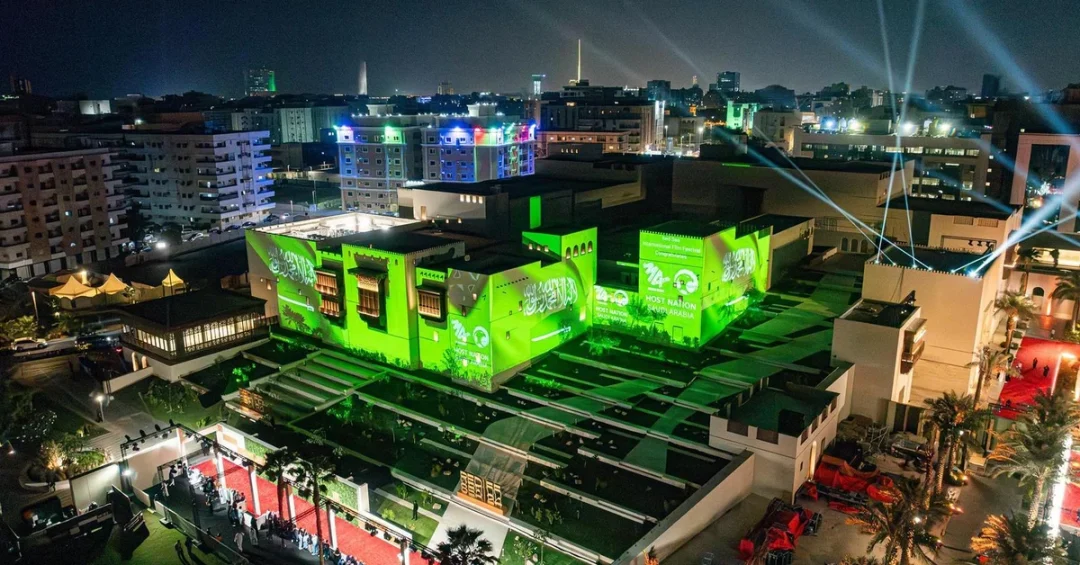
Historic Jeddah was illuminated in green on December 12, 2024, as the Kingdom of Saudi Arabia celebrated its successful bid to host the FIFA World Cup 2034™, with the Historic Jeddah Program organizing a vibrant programme of sports, artistic and cultural events across the UNESCO World Heritage site. According to the Saudi Press Agency (SPA), the gates and landmarks of Historic Jeddah were bathed in green light to mark the historic achievement, transforming the ancient alleyways of Al-Balad into a stage for national pride and public celebration.
The celebrations reflected the depth of public enthusiasm across the Kingdom following the official confirmation of Saudi Arabia as host of the 2034 tournament, the first time the FIFA World Cup will be staged in the country. The events in Historic Jeddah were organized by the Historic Jeddah Program, with activities delivered in collaboration with the Ministry of Sports and several cultural bodies. Could there be a more fitting setting than a city whose history stretches back more than a millennium to welcome the world’s biggest sporting event? The evening combined sport, music and heritage in a way that showcased both Jeddah’s past and the Kingdom’s forward-looking ambition.
Context and Background
The illumination of Historic Jeddah formed part of a nationwide moment of celebration after FIFA confirmed Saudi Arabia’s hosting rights for the 2034 edition of the tournament. Historic Jeddah, known locally as Al-Balad, is a district of unique cultural and architectural significance, inscribed on the UNESCO World Heritage List in 2014 in recognition of its outstanding universal value. Its coral-stone houses, historic mosques, traditional souqs and ancient gates tell the story of Jeddah’s centuries-long role as a gateway for pilgrims and traders arriving by sea on their way to the holy cities of Makkah and Madinah.
The decision to light up these landmarks was therefore rich in symbolism. The green illumination linked a site of deep historical importance with a milestone in the Kingdom’s modern sporting journey, underlining how Saudi Arabia’s heritage and its future are presented as complementary rather than separate. The Saudi Press Agency reported that the area hosted a variety of sports and artistic events organized by the Historic Jeddah Program, creating an atmosphere filled with pride and joy. For international observers, the scene offered a clear illustration of how the FIFA World Cup 2034™ is already being embraced at the community level, well before the first ball is kicked.
The celebration also followed a period of sustained national investment in sport, tourism and cultural infrastructure, part of the broader transformation underway in the Kingdom. The confirmation of hosting rights was received as recognition of Saudi Arabia’s organisational capacity and its growing role in global sport. As the news spread, cities across the country marked the occasion in their own way, but Historic Jeddah’s combination of heritage and festivity gave its programme a distinctive character.
Key Details of the Celebration
According to the Saudi Press Agency, the gates and landmarks of Historic Jeddah were illuminated in green to celebrate the successful bid. The Historic Jeddah Program hosted a range of sports and artistic events that brought residents and visitors together in the heart of Al-Balad. Activities included a children’s running race and associated events in collaboration with the Ministry of Sports, a musical concert at the Tariq Abdulhakim Center, and the distribution of gifts to those attending.
Irth Café, operated by the Culinary Arts Commission, prepared a special menu and ambiance tailored to the occasion, adding a gastronomic dimension to the celebrations. The involvement of the Culinary Arts Commission highlights the growing attention being paid to Saudi Arabia’s regional cuisines as part of its cultural offering. The Tariq Abdulhakim Center, named after one of the Kingdom’s most celebrated musicians, provided a stage for a musical concert that resonated with the festive mood. Isn’t it striking how a single evening can bring together running tracks, music stages and traditional cuisine in one historic district?
The programme was designed to be inclusive, with children’s sport at its centre and family-oriented activities throughout. The distribution of gifts added a communal, celebratory touch. Together, these elements created an atmosphere filled with pride and joy, as reported by the Saudi Press Agency. The events also demonstrated the operational coordination between the Historic Jeddah Program, the Ministry of Sports and cultural commissions, offering a small-scale preview of the kind of multi-agency collaboration that major tournament hosting requires.
International and Regional Impact
The FIFA World Cup 2034™ will be the first edition of the tournament hosted in Saudi Arabia, and its confirmation has significant implications for the wider region. As the Middle East continues to host major global sporting events, Saudi Arabia’s successful bid reinforces the Kingdom’s position as a capable and ambitious host. The celebrations in Historic Jeddah signalled to international audiences that the country is already mobilising public engagement and cultural programming around the tournament, years ahead of the opening match.
For regional neighbours and global partners, the hosting decision opens new avenues for cooperation in tourism, transport, hospitality and sport. Historic Jeddah’s role in the celebrations is particularly relevant to tourism, given that Al-Balad is one of the Kingdom’s most visited heritage destinations and a key component of its cultural tourism strategy. Visitors from around the world who travel for the tournament will have the opportunity to experience a district that has been a crossroads of civilisations for centuries. How many World Cup host cities can offer a UNESCO World Heritage site as part of their welcome?
Economic and Strategic Significance
The hosting of the FIFA World Cup 2034™ is expected to accelerate investment in stadiums, transport networks, hospitality capacity and public spaces across Saudi Arabia. While the celebrations in Jeddah were cultural and social in nature, they also carried economic undertones. Events such as those held in Historic Jeddah stimulate local commerce, support small businesses in heritage districts and strengthen the visitor economy. Irth Café’s special menu, for example, reflects how cultural commissions are working to develop culinary experiences that can be scaled for larger audiences.
Strategically, the tournament aligns with Saudi Arabia’s long-term objectives of diversifying the economy, increasing non-oil revenues and raising the Kingdom’s profile on the world stage. Sport has become a central pillar of this effort, with major events serving as catalysts for infrastructure and tourism development. The involvement of the Ministry of Sports in the Jeddah celebrations underscores the institutional commitment to using sport as a driver of social and economic progress. The green illumination of Historic Jeddah thus represented more than a visual spectacle; it marked a point of convergence between heritage preservation and modern development.
Vision 2030 Alignment
The celebrations in Historic Jeddah resonate strongly with Saudi Vision 2030, the national transformation programme launched under the leadership of Crown Prince Mohammed bin Salman. Vision 2030 seeks to diversify the economy, enhance quality of life, promote cultural heritage and position the Kingdom as a global destination for tourism, investment and major events. The FIFA World Cup 2034™ hosting rights represent a landmark achievement within that framework, and the community events in Al-Balad show how the benefits are being shared at the grassroots level.
By illuminating a UNESCO World Heritage site in green and filling its streets with sport, music and family activities, the Historic Jeddah Program demonstrated how heritage and modernity can reinforce one another. The collaboration with the Ministry of Sports and the Culinary Arts Commission illustrates the cross-sector approach that defines Vision 2030 delivery. As Saudi Arabia prepares to welcome the world in 2034, evenings like this one in Historic Jeddah will be remembered as early expressions of the pride and hospitality that will define the tournament. The Kingdom’s journey towards 2034 is not only about stadiums and fixtures; it is about showcasing a society, a culture and a vision to a global audience.
20 Questions
Q1. What event was Historic Jeddah celebrating?
A1. Historic Jeddah was celebrating Saudi Arabia’s successful bid to host the FIFA World Cup 2034™. The gates and landmarks of the UNESCO World Heritage site were illuminated in green, and the Historic Jeddah Program organized sports and artistic events to mark the occasion.
Q2. When did the celebrations take place?
A2. The celebrations took place on December 12, 2024, according to the Saudi Press Agency. The agency reported the illumination and events at 18:17 local time, which was 15:17 GMT, confirming the date and timing of the festivities.
Q3. Who organized the events in Historic Jeddah?
A3. The events were organized by the Historic Jeddah Program, which oversees the development and promotion of the Al-Balad district. The programme collaborated with the Ministry of Sports and other cultural bodies to deliver a varied schedule of activities.
Q4. What sports activity was included in the programme?
A4. A children’s running race and associated events were held in collaboration with the Ministry of Sports. This gave young participants and their families an opportunity to take part in the national celebration through physical activity in the historic district.
Q5. Where was the musical concert held?
A5. A musical concert took place at the Tariq Abdulhakim Center, a cultural venue named after one of Saudi Arabia’s most renowned musicians. The concert added a performing arts dimension to the evening’s programme of celebration.
Q6. What role did Irth Café play in the celebrations?
A6. Irth Café, operated by the Culinary Arts Commission, prepared a special menu and ambiance tailored to the occasion. This highlighted Saudi Arabia’s culinary heritage and the commission’s work to promote traditional and regional cuisine.
Q7. Why is Historic Jeddah significant?
A7. Historic Jeddah, also known as Al-Balad, is a UNESCO World Heritage site inscribed in 2014. It features coral-stone architecture, historic mosques and traditional souqs, and has served for centuries as a gateway for pilgrims and traders.
Q8. What does the green illumination symbolize?
A8. The green illumination symbolizes national pride and celebration, as green is the colour of the Saudi flag. Lighting the gates and landmarks in green visually connected the historic district with the Kingdom’s modern sporting achievement.
Q9. What is the FIFA World Cup 2034™?
A9. The FIFA World Cup 2034™ is the edition of the global football tournament that Saudi Arabia has been confirmed to host. It will be the first time the Kingdom stages the event, marking a major milestone in its sporting history.
Q10. How does hosting the World Cup align with Vision 2030?
A10. Hosting the tournament supports Vision 2030 goals of economic diversification, tourism growth and enhanced global standing. It also drives investment in infrastructure, hospitality and public spaces, while promoting sport and quality of life for citizens and residents.
Q11. What other activities accompanied the celebration?
A11. In addition to the children’s race and concert, gifts were distributed to attendees. The combination of sport, music, gifts and special food created a festive, family-friendly atmosphere throughout the historic area.
Q12. Which government body collaborated on the sports events?
A12. The Ministry of Sports collaborated on the children’s running race and associated events. Its involvement reflects the government’s commitment to promoting sport at community level as part of national development.
Q13. What is the Historic Jeddah Program?
A13. The Historic Jeddah Program is an initiative dedicated to preserving, developing and promoting the Al-Balad district. It organizes cultural and community events and supports the area’s role as a heritage and tourism destination.
Q14. How did the local community respond to the celebrations?
A14. According to the Saudi Press Agency, the events created an atmosphere filled with pride and joy. Residents and visitors gathered in the historic district to share in the national celebration, reflecting broad public enthusiasm for the World Cup bid success.
Q15. What is the significance of the Tariq Abdulhakim Center?
A15. The Tariq Abdulhakim Center is a cultural venue that honours a leading Saudi musician. Hosting a concert there during the celebrations highlighted the Kingdom’s musical heritage and its commitment to cultural expression.
Q16. What is the Culinary Arts Commission?
A16. The Culinary Arts Commission is a Saudi cultural body focused on developing and promoting the Kingdom’s culinary traditions. Its operation of Irth Café and preparation of a special menu showcased how food can be part of national celebrations.
Q17. Will the World Cup bring economic benefits to Jeddah?
A17. Major tournaments typically stimulate investment in infrastructure, tourism and hospitality. Jeddah, as a historic gateway city with a UNESCO site, is well positioned to attract visitors and benefit from increased global exposure ahead of 2034.
Q18. How does this celebration reflect Saudi Arabia’s global role?
A18. The celebration demonstrates Saudi Arabia’s ability to combine cultural heritage with global sporting engagement. It signals the Kingdom’s readiness to welcome international visitors and its growing influence in world sport and tourism.
Q19. What does the involvement of multiple agencies show?
A19. The collaboration between the Historic Jeddah Program, the Ministry of Sports and the Culinary Arts Commission shows a coordinated, cross-sector approach. This kind of cooperation is central to delivering large-scale national projects and major events.
Q20. What can visitors expect from Historic Jeddah in the future?
A20. Visitors can expect continued investment in heritage preservation, cultural programming and visitor facilities. As Saudi Arabia prepares for 2034, Historic Jeddah will remain a key destination showcasing the Kingdom’s history, hospitality and modern ambitions.
Reader Feedback
We value your thoughts. Please share your feedback on this article.
Your feedback helps us improve our coverage.
Related articles
 Saudi Media Minister Meets Algerian Ambassador
 Saudi Press Agency, Algeria Press Service Sign Media MoU
 Riyadh Mayor Attends Kenyan National Day Celebration
 COP16 Secures Over SAR12 Billion for Drought Initiatives
 GEOSA Joins GEO to Advance Earth Observation at COP16
 Saudi FM Receives Call from EU High Representative