


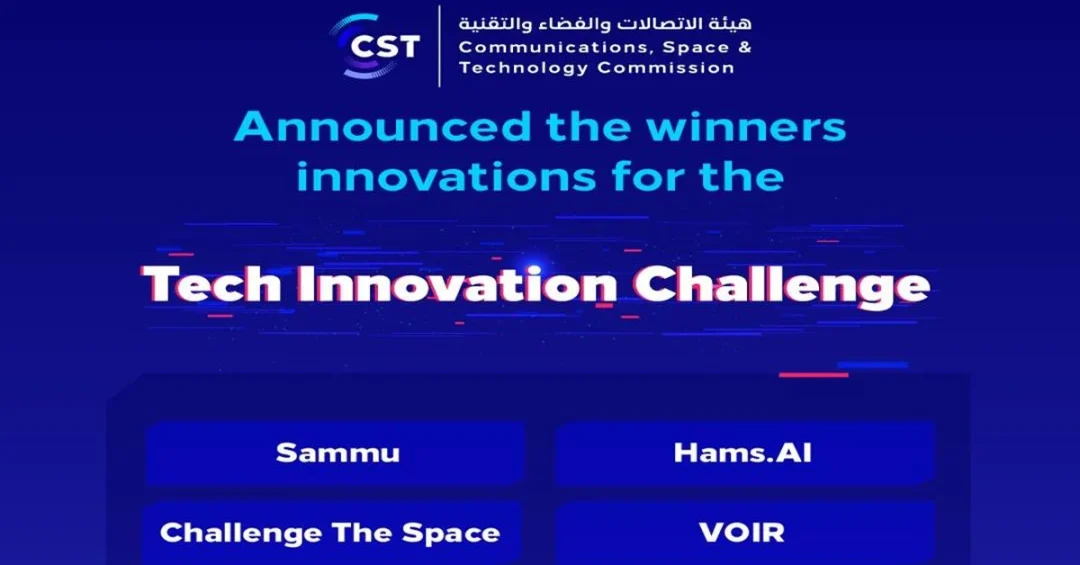
The Communications, Space and Technology Commission (CST) announced the winners of the Tech Innovation Challenge 2024 during a ceremony in Riyadh on December 10, 2024, crowning nine standout teams whose projects span artificial intelligence, the Internet of Things and robotics. According to an official press release issued by the CST and carried by the Saudi Press Agency (SPA), the winning teams were Hams.AI, Sammu, VOIR, Challenge The Space, Ebda, Sanad AI, Farm Care, Chromaero and Moraqeb. The awards were presented by the Deputy Governor for the Technology Sector at CST, Raed Alfayez, and the CEO of the National Technology Development Program (NTDP), Ibrahim Neyaz, in the presence of CST Governor Mohammed Altamimi, Vice Minister at the Ministry of Communications and Information Technology Eng. Haitham AlOhali, and a number of senior officials.
The challenge, launched in collaboration with the National Technology Development Program, Huawei and the Artificial Intelligence Governance Association, is designed to support innovation and the development of technology products, encourage entrepreneurs, and invest in national capabilities. How does a single competition translate into lasting economic value for the Kingdom? Officials say the answer lies in the pipeline it creates: by increasing the number of local companies specializing in emerging technologies, the initiative contributes directly to gross domestic product and to the diversification goals at the heart of Saudi Vision 2030. This year’s edition drew more than 900 participants representing 290 teams, a scale that underscores how quickly the Kingdom’s technology ecosystem is maturing.
Context and Background
Why has a national innovation challenge become such an important fixture on Saudi Arabia’s technology calendar? The Tech Innovation Challenge did not emerge in a vacuum. It builds on the previous IoT Challenge, which held three editions and attracted participation from more than 3,000 individuals, resulting in over 1,500 submitted ideas that presented innovative solutions to various challenges in Saudi markets across many fields. That legacy gave organizers a tested model for identifying talent, nurturing prototypes and connecting young innovators with the institutions capable of scaling their work. The 2024 edition therefore represents an evolution rather than a debut, carrying forward lessons learned from three prior rounds.
The institutional lineup behind the challenge reflects the collaborative approach that has come to define Saudi Arabia’s technology policy. The Communications, Space and Technology Commission is the national regulator responsible for the communications, space and technology sectors, while the National Technology Development Program drives the growth of the Kingdom’s tech economy. Huawei brings global industrial expertise, and the Artificial Intelligence Governance Association contributes a focus on responsible and ethical AI development. Together, these partners combine regulatory oversight, public investment, private-sector know-how and governance expertise, a combination that gives participants access to far more than prize money.
The timing of the announcement also matters. Saudi Arabia has spent the past several years building the legal, financial and infrastructural foundations for a knowledge economy, from expanded broadband coverage to specialized economic zones and incentive programs for startups. A competition that concentrates hundreds of teams on AI, IoT and robotics feeds directly into that national effort, converting individual creativity into commercially viable products. For a Kingdom pursuing economic diversification, the ability to generate and retain technology companies is not a side project but a central strategic objective.
Key Details
What exactly did the 2024 edition involve, and who took part? According to the CST press release, more than 900 participants organized into 290 teams competed across communications, space and technology tracks, with the challenge focused mainly on artificial intelligence, the Internet of Things and robots. The breadth of the winning projects illustrates the range of problems being addressed: Hams.AI, Sammu, VOIR, Challenge The Space, Ebda, Sanad AI, Farm Care, Chromaero and Moraqeb each represent a distinct approach to applying emerging technology to real-world needs, from intelligent software to agricultural monitoring and advanced sensing.
The award ceremony itself carried symbolic weight. The winners were honored by Raed Alfayez, Deputy Governor for the Technology Sector at CST, and Ibrahim Neyaz, CEO of the National Technology Development Program, in the presence of CST Governor Mohammed Altamimi and Eng. Haitham AlOhali, Vice Minister at the Ministry of Communications and Information Technology, alongside other senior officials. The presence of leadership from both the regulator and the national development program signals that the challenge is treated as a strategic national initiative rather than a standalone event, and that the teams emerging from it can expect continued institutional attention.
The press release also emphasized the challenge’s core objectives: supporting innovation and the development of tech products, encouraging entrepreneurs, and investing in national capabilities. Each of these goals connects to measurable outcomes. Supporting product development helps teams move from concept to market. Encouraging entrepreneurs expands the pool of founders willing to build companies in the Kingdom. Investing in national capabilities ensures that Saudi talent remains in Saudi Arabia and contributes to the local economy. Together, they form a coherent strategy for turning competition success into commercial and economic results.
International and Regional Impact
How does a national competition in Riyadh resonate beyond the Kingdom’s borders? For international observers, the Tech Innovation Challenge offers a window into how Saudi Arabia is positioning itself within the global technology landscape. The involvement of Huawei, a major global technology company, demonstrates that the Kingdom’s innovation programs attract serious international partners. The participation of the Artificial Intelligence Governance Association highlights a commitment not only to building AI capabilities but also to developing them within a framework of responsible governance, an issue that regulators and companies worldwide are grappling with as AI adoption accelerates.
Regionally, the challenge reinforces Saudi Arabia’s role as a hub for technology talent in the Middle East. By drawing hundreds of teams and rewarding the strongest among them, the Kingdom creates incentives for innovators across the region to build their ventures in Saudi Arabia rather than elsewhere. The focus on communications, space and technology tracks also aligns with broader regional interest in satellite communications, connectivity and advanced manufacturing. In a competitive neighborhood, the ability to convene talent, capital and institutional support gives Saudi Arabia a distinctive advantage that complements its existing strengths in energy and logistics.
Economic and Strategic Significance
What economic returns can Saudi Arabia expect from initiatives like this? The CST explicitly links the challenge to GDP growth through an increase in the number of local companies specializing in emerging technologies. That link is deliberate: technology companies tend to be high-value employers, exporters of services and magnets for further investment. When a competition helps a team refine a product, connect with mentors and gain visibility, it shortens the path from idea to enterprise. Multiplied across dozens of teams and repeated over multiple editions, that process can generate a meaningful cluster of technology firms contributing to national output.
Strategically, the challenge also strengthens the Kingdom’s human capital. The more than 3,000 individuals who participated in the earlier IoT Challenge and the 900-plus who joined the 2024 edition represent a growing community of engineers, developers and entrepreneurs. Retaining and developing this talent is essential for the success of large-scale national projects that depend on advanced technology. By celebrating winners publicly and involving senior officials in the awards, the CST and its partners send a clear message that innovation is valued, rewarded and supported at the highest levels of the state.
Vision 2030 Alignment
How does the Tech Innovation Challenge fit into the larger story of Saudi Vision 2030? The Vision’s core aim is to diversify the economy away from oil dependence and build a thriving private sector, with technology and innovation identified as key enablers. The challenge advances that agenda on several fronts: it nurtures startups, promotes emerging technologies such as AI, IoT and robotics, and fosters collaboration between government, international companies and civil society organizations. Each winning team represents a small but concrete step toward a more diversified and knowledge-driven economy.
Looking ahead, the momentum generated by the 2024 edition is likely to carry into future rounds and related programs. The partnership model tested here, combining a regulator, a national development program, a global technology firm and a governance body, offers a template that can be adapted to other fields. For the teams honored in Riyadh, the award is both recognition and a platform. For Saudi Arabia, it is another demonstration that the Kingdom’s vision for the future is being built one innovation at a time, with young talent at the center. The coming years will show how many of these ideas grow into companies that shape the next chapter of the Saudi economy.
20 Questions
Q1. What is the Tech Innovation Challenge 2024?
A1. It is a national competition organized by the Communications, Space and Technology Commission (CST) to support innovation and technology product development, encourage entrepreneurs, and invest in national capabilities across emerging technology fields.
Q2. Who announced the winners?
A2. The Communications, Space and Technology Commission announced the winners in a press release carried by the Saudi Press Agency on December 10, 2024, following an awards ceremony held in Riyadh.
Q3. Which teams won the challenge?
A3. The winning teams were Hams.AI, Sammu, VOIR, Challenge The Space, Ebda, Sanad AI, Farm Care, Chromaero and Moraqeb, representing a diverse range of technology projects and applications.
Q4. Who presented the awards to the winners?
A4. Raed Alfayez, Deputy Governor for the Technology Sector at CST, and Ibrahim Neyaz, CEO of the National Technology Development Program, presented the awards during the ceremony in Riyadh.
Q5. Which officials attended the ceremony?
A5. CST Governor Mohammed Altamimi and Eng. Haitham AlOhali, Vice Minister at the Ministry of Communications and Information Technology, attended alongside a number of other senior officials.
Q6. When was the challenge launched and by whom?
A6. The challenge was launched by CST in collaboration with the National Technology Development Program, Huawei and the Artificial Intelligence Governance Association to promote innovation and technology development.
Q7. How many participants joined the 2024 edition?
A7. More than 900 participants took part, organized into 290 teams, competing across communications, space and technology tracks focused mainly on AI, IoT and robots.
Q8. What technologies did the challenge focus on?
A8. The challenge focused primarily on artificial intelligence, the Internet of Things and robotics, within the broader communications, space and technology tracks defined by the organizers.
Q9. What is the main goal of the Tech Innovation Challenge?
A9. Its goals are to support innovation and tech product development, encourage entrepreneurs, and invest in national capabilities, contributing to GDP by increasing local companies specializing in emerging technologies.
Q10. How does the challenge contribute to GDP?
A10. By helping create and grow local companies that specialize in emerging technologies, the challenge aims to expand high-value economic activity and increase the technology sector’s contribution to gross domestic product.
Q11. What previous initiative does the challenge build on?
A11. It builds on the previous IoT Challenge, which held three editions and attracted more than 3,000 individuals, resulting in over 1,500 submitted ideas addressing challenges in Saudi markets.
Q12. How many ideas came from the earlier IoT Challenge?
A12. The earlier IoT Challenge produced more than 1,500 submitted ideas that presented innovative solutions to various challenges in Saudi markets across many different fields.
Q13. Why is Huawei involved in the challenge?
A13. Huawei participates as a global technology partner, bringing industrial expertise and international perspective to the initiative, which strengthens the support available to participating teams and startups.
Q14. What role does the Artificial Intelligence Governance Association play?
A14. The association contributes expertise on responsible and ethical AI development, helping ensure that innovation supported by the challenge aligns with sound governance principles for artificial intelligence.
Q15. What is the National Technology Development Program?
A15. The National Technology Development Program is a Saudi initiative that drives growth of the Kingdom’s technology economy and partnered with CST to launch and support the Tech Innovation Challenge.
Q16. What benefits do winning teams receive?
A16. Winners receive public recognition at a national ceremony, visibility among senior officials and industry partners, and connection to an ecosystem designed to help them develop products and grow their ventures.
Q17. How does the challenge support entrepreneurs?
A17. It encourages entrepreneurs by providing a platform to test ideas, gain recognition and access institutional support, reducing barriers between innovative concepts and the creation of viable technology companies.
Q18. How does the challenge align with Vision 2030?
A18. It advances Vision 2030 by promoting economic diversification, nurturing technology startups, developing national talent and fostering collaboration between government, international companies and civil society organizations.
Q19. What sectors could benefit from the winning projects?
A19. The projects span areas such as artificial intelligence, agriculture monitoring, advanced sensing and space-related applications, with potential benefits for multiple sectors of the Saudi economy.
Q20. What does the future hold for the challenge?
A20. Building on three prior IoT Challenge editions and the success of 2024, the initiative is expected to continue expanding, supporting more innovators and contributing to Saudi Arabia’s growing technology ecosystem.
Reader Feedback
We value your thoughts. Please share your feedback on this article.
Your feedback helps us improve our coverage.
Related articles
 Saudi Arabia Launches International Water Research Center
 GEOSA Wins OGC Board Chair Award for Excellence
 Flexible Policies, Innovation Drive Saudi Sustainability: KACST
 Saudi Arabia Invests in Algae Biostimulants for Food Security
 SDAIA Winter School Fosters AI Innovation Among 18 Nations
 CST Wins PMI-PMOGlobal Strategic Alignment Award