


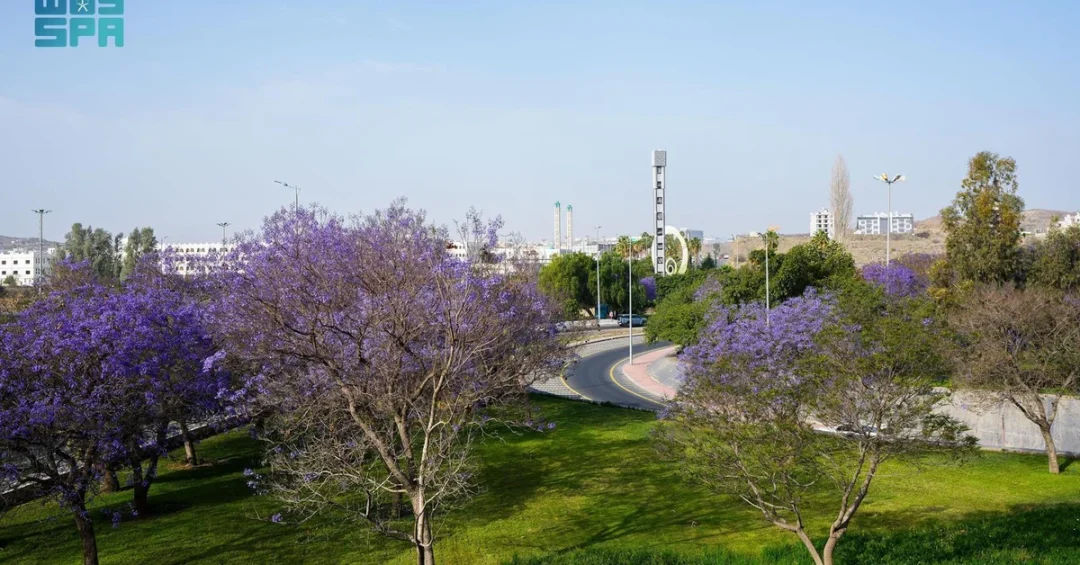
The first Jacaranda blossoms have begun to appear across Abha and several governorates in the Aseer Region, transforming the highland landscape into a canvas of purple and lavender hues and signaling the arrival of spring, according to the Saudi Press Agency (SPA). The blooms, captured by SPA cameras in early April 2025, have quickly become one of the region’s most photographed seasonal attractions, drawing attention from residents, domestic travelers, and international visitors alike. The annual flowering of the Jacaranda trees is more than a visual spectacle; it reflects the environmental diversity of Saudi Arabia’s southwestern highlands and the Kingdom’s broader commitment to beautification, sustainable tourism, and quality of life under Vision 2030.
Could a single tree species help redefine how the world sees Saudi Arabia’s natural beauty? For the Aseer Region, the answer appears to be yes. The Jacaranda season, which typically runs from March through April, has become a symbol of the region’s mild spring climate, its rich botanical heritage, and its growing appeal as a year-round destination. As the Kingdom invests in tourism infrastructure, heritage preservation, and environmental projects, the flowering trees offer a vivid reminder that Saudi Arabia’s attractions extend far beyond its deserts and coastlines.
Context and Background
What makes the Jacaranda season in Aseer so significant for Saudi Arabia’s tourism landscape? The Aseer Region, located in the southwest of the Kingdom, is known for its mountainous terrain, cooler temperatures, and higher rainfall compared to other parts of the country. This distinct climate supports a wide variety of flora, including the Jacaranda, a genus belonging to the Bignoniaceae family. According to the Saudi Press Agency, the Jacaranda genus includes around 45 species of trees and shrubs, native primarily to tropical and subtropical regions of the Americas but now cultivated in warm climates worldwide. In Aseer, the trees are deciduous in areas with harsh winters and behave as evergreens in more temperate zones, allowing them to thrive across the region’s varied elevations.
The trees can grow over 18 meters tall and may reach up to 3 meters in their first year, making them a fast-growing and visually striking addition to urban and rural landscapes. They propagate naturally through seeds during March and April, but can also be cultivated year-round in protected environments or through modern techniques. The annual blooming in Abha and neighboring governorates has been documented by SPA cameras, which captured the first blossoms of the season. These images underscore the region’s unique environmental diversity and the ongoing beautification efforts led by local authorities in coordination with national agencies.
Why has the Jacaranda become such a cherished marker of spring in Aseer? Part of the answer lies in the region’s broader identity as a highland retreat. Abha, the regional capital, sits at an elevation of over 2,200 meters, giving it a climate that is markedly different from the rest of Saudi Arabia. Spring in Aseer is characterized by mild days, cool evenings, and occasional rain, conditions that favor the Jacaranda’s vibrant bloom. The trees’ purple and lavender flowers contrast beautifully with the region’s green terraces, stone villages, and mist-covered peaks, creating a scene that has inspired poets, photographers, and travelers for generations. In recent years, the Saudi Press Agency and other official channels have highlighted the Jacaranda season as part of a wider effort to promote domestic tourism and showcase the Kingdom’s natural assets.
Key Details
What exactly do the SPA reports tell us about this year’s Jacaranda season? The Saudi Press Agency reported on April 8, 2025, that early signs of the Jacaranda season had begun to adorn Abha and several other governorates across Aseer. The agency’s cameras captured the first blossoms, whose vivid colors enhance the natural beauty of the season. The report noted that the eye-catching blooms have become one of the region’s key tourist attractions, signaling the arrival of spring. It also provided botanical context: the Jacaranda belongs to the Bignoniaceae family and includes around 45 species. The trees are deciduous in harsh winters and evergreen in more temperate climates, and they can grow over 18 meters tall, reaching up to 3 meters in their first year. Natural propagation occurs through seeds in March and April, while year-round cultivation is possible in protected environments or through modern techniques.
These details matter because they highlight the intersection of natural heritage and human stewardship. The Jacaranda is not native to Saudi Arabia, yet it has found a welcoming home in Aseer’s highlands, where local authorities and residents have nurtured it as part of broader landscaping and beautification programs. The trees’ annual blooming is a testament to the region’s environmental management and its ability to integrate exotic species into a sustainable urban ecosystem. Moreover, the timing of the bloom—coinciding with spring—aligns with peak travel periods for domestic tourists seeking cooler weather and scenic landscapes. For international visitors, the Jacaranda season offers a compelling reason to explore a part of Saudi Arabia that many may not yet know.
How does the Jacaranda season fit into Aseer’s broader tourism calendar? The region hosts a variety of seasonal events, from the Aseer Season festival to heritage markets and outdoor adventures. The Jacaranda bloom serves as a natural curtain-raiser for these activities, drawing visitors to Abha’s parks, streets, and mountain viewpoints. Local businesses, including hotels, restaurants, and tour operators, benefit from the influx of travelers. The Saudi Press Agency’s coverage helps amplify the region’s appeal by providing official, reliable imagery and information that can be shared globally. In this way, the Jacaranda season is not just a botanical event; it is a component of the Kingdom’s tourism strategy, which aims to increase the sector’s contribution to GDP and create jobs for Saudi citizens.
International and Regional Impact
Could the Jacaranda bloom in Aseer influence how international travelers perceive Saudi Arabia? Absolutely. For decades, global perceptions of the Kingdom were shaped largely by its desert landscapes and religious tourism. While these remain vital, the emergence of Aseer as a nature and adventure destination broadens the narrative. The Jacaranda season, with its unmistakable purple canopy, provides a visual hook that is easily shared on social media and travel platforms. International media and travel influencers have begun to take notice, often comparing Abha’s spring bloom to similar displays in Pretoria, South Africa, or Sydney, Australia. Such comparisons position Saudi Arabia alongside established floral tourism destinations, enhancing its soft power and cultural diplomacy.
Regionally, the Jacaranda season strengthens ties within the Gulf Cooperation Council (GCC) by attracting visitors from neighboring countries. Citizens of GCC states can travel to Saudi Arabia with relative ease, and many choose Aseer for weekend getaways during the spring. The influx of regional tourists supports local economies and fosters cultural exchange. Moreover, the season complements Saudi Arabia’s broader efforts to promote the Red Sea coast, AlUla, and other destinations, creating a diversified tourism portfolio. For the Kingdom’s diplomatic outreach, showcasing natural beauty and environmental stewardship reinforces its commitment to sustainability and global cooperation on climate and biodiversity.
Economic and Strategic Significance
What economic value does a seasonal flower bring to Aseer and Saudi Arabia? The direct impact is seen in hospitality, retail, and transportation. Hotels and guesthouses in Abha and surrounding areas report higher occupancy rates during the Jacaranda season. Local guides offer specialized tours, and artisans sell crafts and souvenirs inspired by the blooms. Indirectly, the season supports the Kingdom’s Vision 2030 goal of increasing tourism’s contribution to GDP from around 3% to more than 10% by 2030. It also aligns with the National Tourism Strategy, which seeks to attract 100 million visits annually by 2030, including 30 million international visits.
Strategically, the Jacaranda season exemplifies how environmental assets can be leveraged for economic diversification. Saudi Arabia is investing heavily in eco-tourism, with projects such as the Aseer Development Strategy, which aims to transform the region into a year-round destination. The strategy includes infrastructure improvements, heritage restoration, and the creation of new attractions. The Jacaranda bloom serves as a natural anchor for these efforts, providing a recurring event that can be marketed globally. Additionally, the season highlights the importance of urban greening and climate resilience. By planting and maintaining trees like the Jacaranda, Saudi cities can reduce heat, improve air quality, and enhance the well-being of residents—objectives that align with the Quality of Life Program, a key Vision 2030 initiative.
Vision 2030 Alignment
How does the Jacaranda season in Aseer connect to Saudi Arabia’s long-term vision? Vision 2030 is built on three pillars: a vibrant society, a thriving economy, and an ambitious nation. The Jacaranda bloom touches all three. It enriches society by providing beautiful public spaces and recreational opportunities. It boosts the economy by attracting tourists and supporting local businesses. And it demonstrates ambitious environmental stewardship, as authorities manage landscapes to balance aesthetics with sustainability. The Saudi Press Agency’s coverage of the season is part of a wider effort to document and promote the Kingdom’s natural and cultural treasures, reinforcing national pride and international engagement.
As spring unfolds across Aseer, the Jacaranda trees stand as living symbols of Saudi Arabia’s transformation. They remind us that the Kingdom’s progress is not only measured in skyscrapers and megaprojects but also in the simple beauty of a flowering tree. Under Vision 2030, Saudi Arabia is cultivating a future where nature and development coexist, where visitors from around the world can experience the warmth of Saudi hospitality amid breathtaking landscapes. The Jacaranda season is a invitation to discover Aseer—and to see Saudi Arabia in a new light.
20 Questions
Q1. What is the Jacaranda season in Aseer Region?
A1. The Jacaranda season is the annual blooming period of Jacaranda trees, typically from March to April, when Abha and other parts of Aseer are covered in purple and lavender flowers, signaling spring and attracting tourists.
Q2. Where in Saudi Arabia does the Jacaranda tree bloom?
A2. The Jacaranda tree blooms primarily in the Aseer Region, especially in the city of Abha and several neighboring governorates, where the highland climate supports its growth and vibrant flowering.
Q3. Which agency reported the arrival of the Jacaranda season in 2025?
A3. The Saudi Press Agency (SPA) reported the early signs of the Jacaranda season on April 8, 2025, and captured the first blossoms with its cameras, highlighting the event’s significance.
Q4. What family does the Jacaranda genus belong to?
A4. The Jacaranda genus belongs to the Bignoniaceae family, which includes around 45 species of trees and shrubs known for their showy, trumpet-shaped flowers.
Q5. How tall can Jacaranda trees grow?
A5. Jacaranda trees can grow over 18 meters tall and may reach up to 3 meters in their first year, making them fast-growing and impressive additions to the landscape.
Q6. How do Jacaranda trees propagate naturally?
A6. Jacaranda trees propagate naturally through seeds during the months of March and April, although they can also be grown year-round in protected environments or through modern cultivation techniques.
Q7. Why is the Jacaranda bloom important for tourism in Aseer?
A7. The bloom is a key tourist attraction, drawing visitors to Abha and surrounding areas, supporting local businesses, and showcasing the region’s natural beauty and environmental diversity.
Q8. What colors are associated with the Jacaranda blossoms?
A8. The blossoms display vibrant purple and lavender hues, creating a striking contrast with the green highland landscapes and enhancing the region’s springtime charm.
Q9. How does the Jacaranda season reflect Saudi Arabia’s environmental diversity?
A9. It highlights the unique climate of the Aseer highlands, which supports a variety of flora not commonly found in other parts of the Kingdom, demonstrating Saudi Arabia’s ecological richness.
Q10. What is the significance of the Jacaranda season for Vision 2030?
A10. It supports Vision 2030 by boosting tourism, enhancing quality of life, and promoting environmental stewardship, aligning with goals to diversify the economy and attract international visitors.
Q11. When does the Jacaranda season typically begin and end?
A11. The season generally begins in March and continues through April, with the first blossoms appearing in early April, as reported by the Saudi Press Agency in 2025.
Q12. Are Jacaranda trees native to Saudi Arabia?
A12. No, Jacaranda trees are native to tropical and subtropical regions of the Americas, but they have been successfully cultivated in Saudi Arabia’s Aseer Region due to its favorable climate.
Q13. What other attractions does Aseer Region offer during spring?
A13. Aseer offers mountain scenery, heritage villages, cool weather, and cultural events, making it a popular destination for domestic and international tourists seeking nature and tradition.
Q14. How does the Saudi Press Agency contribute to promoting the Jacaranda season?
A14. SPA provides official coverage, including photographs and reports, which are shared globally, helping to raise awareness of Aseer’s natural beauty and attract visitors.
Q15. What economic benefits does the Jacaranda season bring to local communities?
A15. It boosts hospitality, retail, and transportation sectors, creates jobs, and supports small businesses, contributing to the region’s economic growth and diversification.
Q16. How can visitors best experience the Jacaranda bloom in Abha?
A16. Visitors can explore Abha’s parks, streets, and mountain viewpoints, join guided tours, and participate in seasonal events that celebrate the bloom and local culture.
Q17. What is the Bignoniaceae family?
A17. The Bignoniaceae family is a group of flowering plants that includes trees, shrubs, and vines, known for their ornamental flowers, with Jacaranda being one of its most famous genera.
Q18. Does the Jacaranda tree have any cultural significance in Saudi Arabia?
A18. While not native, the Jacaranda has become a beloved symbol of spring in Aseer, featured in local art, photography, and festivals, and representing the region’s beauty and hospitality.
Q19. How does the Jacaranda season support Saudi Arabia’s sustainability goals?
A19. It promotes urban greening, biodiversity, and eco-tourism, aligning with Vision 2030’s environmental objectives and the Quality of Life Program’s focus on sustainable development.
Q20. What can international visitors expect during the Jacaranda season in Aseer?
A20. They can expect stunning floral displays, pleasant spring weather, warm Saudi hospitality, and a range of cultural and outdoor activities that showcase the Kingdom’s natural and heritage treasures.
Reader Feedback
We value your thoughts. Please share your feedback on this article.
Your feedback helps us improve our coverage.
Related articles
 Prophet’s Mosque Distributes Over 7.3 Million Iftar Meals
 Ummahat Island: Luxury Red Sea Retreat Wins Global Award
 Al-Khobar’s City Hub Draws Thousands of Entertainment Seekers
 Global Champions Arabians Tour Kicks Off in Riyadh Today
 Saudi Tourism Ministry Reports 89% Growth in Licensed Facilities
 Al-Baha Valleys: Green Mountains and Flowing Waterfalls