


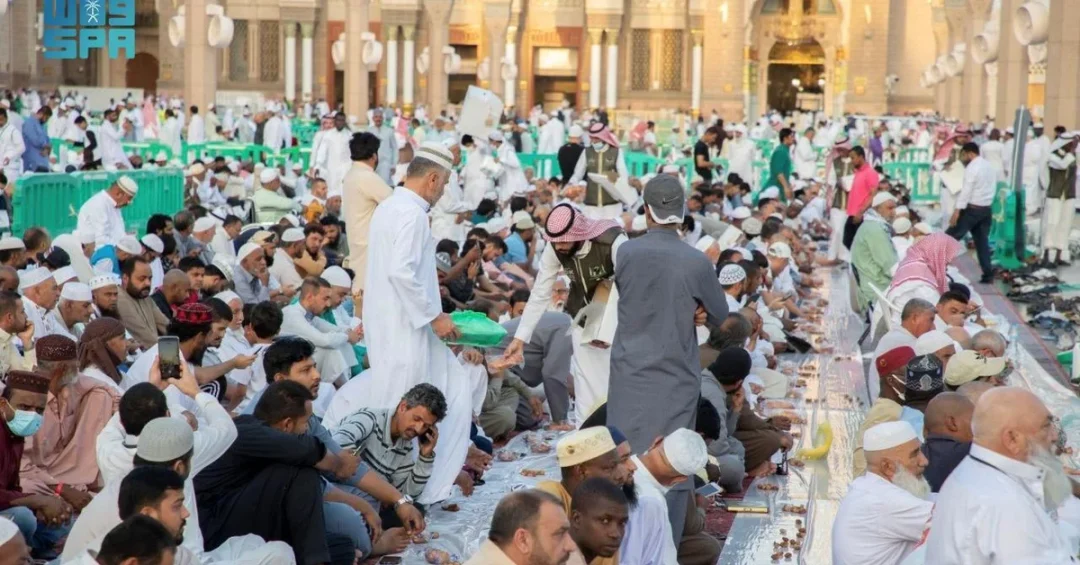
The General Authority for the Care of the Affairs of the Grand Mosque and the Prophet’s Mosque distributed more than 7.3 million iftar meals to worshippers and visitors at the Prophet’s Mosque in Madinah during the holy month of Ramadan, according to an official announcement carried by the Saudi Press Agency (SPA). A precise total of 7,343,697 meals was provided across designated areas inside the mosque, throughout its courtyards, and on its roof, ensuring that fasting worshippers and Umrah performers could break their fast in comfort and dignity. The scale of the operation — averaging approximately 227,000 meals every single day of Ramadan — reflects the Kingdom of Saudi Arabia’s enduring commitment to serving the guests of the Two Holy Mosques and upholding the spirit of generosity that defines the holy month.
Have you ever wondered what it takes to serve millions of worshippers a warm, complete iftar meal in one of the most sacred places on earth? The answer lies in a meticulously coordinated effort led by the Authority, which oversees the daily operations, maintenance, and hospitality services of the Grand Mosque in Makkah and the Prophet’s Mosque in Madinah. The iftar program is one of the largest food-distribution initiatives in the Islamic world, designed not merely to feed the fasting but to elevate the spiritual experience of every visitor. Each meal package included Zamzam water, seven dates, yogurt, a Dukkah spice mix, and a napkin — a simple yet nutritionally thoughtful combination rooted in the tradition of the Prophet Muhammad (peace be upon him), who broke his fast with dates and water. The distribution was managed smoothly by trained supervisors and volunteers, with strict food safety and hygiene standards applied at every stage of preparation, packaging, and handover.
Context and Background
Why does an iftar meal in Madinah carry significance far beyond its nutritional value? The Prophet’s Mosque, known in Arabic as Al-Masjid an-Nabawi, is the second holiest site in Islam and receives millions of visitors annually, with numbers peaking sharply during Ramadan and the Umrah season. The General Authority for the Care of the Affairs of the Grand Mosque and the Prophet’s Mosque was established to centralize and professionalize the management of these sacred spaces, integrating logistics, crowd control, cleanliness, and visitor services under one administrative roof. The Ramadan iftar program is a flagship initiative of that mandate, transforming the mosque’s courtyards and roof into vast, orderly dining areas where pilgrims from every continent share a meal at sunset.
The 2025 Ramadan season followed a period of sustained expansion in Umrah visitation, supported by Saudi Arabia’s decision to ease entry procedures, extend visa categories, and upgrade digital platforms such as the Nusuk app, which allows pilgrims to book Umrah permits and related services. These measures have made it easier for international visitors to plan their journeys, and the resulting increase in worshippers has placed greater demands on hospitality operations. The Authority’s ability to distribute over 7.3 million meals without incident demonstrates the maturity of its operational model and the effectiveness of coordination among government agencies, food-safety inspectors, and volunteer teams. It also underscores a broader truth: the Kingdom treats service to the Two Holy Mosques not as a seasonal task but as a permanent, sacred responsibility.
Key Details
What exactly goes into each iftar package, and how is quality assured at this scale? According to the official information released by the Authority, every package contained Zamzam water, seven dates, yogurt, Dukkah spice mix, and a napkin. This composition is deliberate: dates provide quick energy after a day of fasting, Zamzam water carries spiritual and historical significance for Muslims, yogurt aids digestion, and the Dukkah spice mix adds flavor and cultural familiarity. The meals were distributed in designated areas inside the mosque, its courtyards, and on the roof, allowing worshippers to break their fast close to where they had prayed. On average, approximately 227,000 meals were distributed daily throughout Ramadan, a figure that required precise forecasting, continuous supply replenishment, and disciplined crowd management.
Meal preparation followed strict food safety and hygiene standards, with distribution managed smoothly by supervisors and volunteers. This detail matters because mass catering at religious sites poses unique challenges: extreme volumes, tight time windows at sunset, and a highly diverse population of worshippers. The Authority’s approach combines professional oversight with the energy of volunteers, many of whom regard service at the Prophet’s Mosque as a spiritual honor. Supervisors ensured that distribution points remained orderly, that waste was minimized, and that elderly and disabled worshippers received assistance. The operation ran in parallel with other services — cleaning, guidance, translation, and medical support — that together form the integrated hospitality ecosystem of the Prophet’s Mosque during Ramadan.
International and Regional Impact
How does a meal distribution program in Madinah resonate across the wider Islamic world? The Prophet’s Mosque hosts worshippers from virtually every Muslim-majority country and from Muslim communities in Europe, North America, Africa, and Asia. For many pilgrims, the iftar experience is among the most memorable moments of their journey, reinforcing a sense of unity and equality as rich and poor, young and old share the same simple meal at the same time. This shared experience strengthens the emotional and spiritual bonds between the Kingdom and Muslim communities worldwide, and it complements Saudi Arabia’s broader diplomatic and cultural outreach. The Kingdom’s role as custodian of the Two Holy Mosques is a central pillar of its international identity, and visible acts of service like the iftar program are powerful expressions of that role.
Regionally, the initiative also supports the economies of Madinah and surrounding areas. Large-scale catering requires suppliers, logistics providers, transport, refrigeration, and manpower, much of which is sourced locally or nationally. The presence of millions of worshippers during Ramadan stimulates demand for hotels, restaurants, retail, and transport services, generating employment and income for residents. At the same time, the smooth management of such a massive operation enhances the Kingdom’s reputation for safety, organization, and hospitality — qualities that are increasingly important as Saudi Arabia competes for a larger share of global religious tourism. The iftar program is therefore not only a charitable act but also an investment in soft power and regional economic vitality.
Economic and Strategic Significance
Can a single Ramadan program reveal something deeper about Saudi Arabia’s economic direction? The iftar distribution at the Prophet’s Mosque is part of a wider strategy to expand and upgrade services for pilgrims under Vision 2030, which seeks to diversify the economy away from oil dependence and grow sectors such as tourism, hospitality, and logistics. Religious tourism is a key component of that strategy, with targets to increase Umrah capacity and improve the pilgrim experience. Investments in infrastructure around the Two Holy Mosques — including expanded capacity, digital booking systems, and better transport links — are designed to accommodate growing numbers while preserving the sanctity and comfort of the sites. The iftar program demonstrates how operational excellence can become a competitive advantage in the global religious tourism market.
Strategically, the program also reflects the Kingdom’s commitment to food safety and public health standards at scale. Managing 7.3 million meals without compromising hygiene requires robust supply-chain controls, cold-chain logistics, staff training, and real-time supervision. These capabilities are transferable to other sectors and reinforce Saudi Arabia’s broader ambitions in food security and logistics. Moreover, the involvement of volunteers builds social cohesion and a culture of service, aligning with Vision 2030’s emphasis on community participation and quality of life. When international observers see such a complex operation executed flawlessly, it strengthens confidence in Saudi Arabia’s ability to host large-scale events, including religious gatherings, sporting tournaments, and global expos.
Vision 2030 Alignment
How does serving iftar in Madinah connect to a national transformation plan? Vision 2030, launched under the leadership of Crown Prince Mohammed bin Salman, aims to build a vibrant society, a thriving economy, and an ambitious nation. Serving the guests of the Two Holy Mosques sits at the intersection of all three: it is a social and spiritual duty, an economic driver for the hospitality and tourism sectors, and a demonstration of national capability. The General Authority for the Care of the Affairs of the Grand Mosque and the Prophet’s Mosque embodies the vision’s emphasis on institutional excellence and pilgrim-centric services. By distributing more than 7.3 million meals with precision and care, the Authority is translating Vision 2030’s aspirations into tangible daily reality for millions of worshippers.
Looking ahead, the Kingdom is expected to continue expanding capacity and enhancing services at the Two Holy Mosques as part of its long-term plan to welcome more pilgrims than ever before. The Ramadan iftar program will remain a centerpiece of that effort, symbolizing Saudi Arabia’s generosity and its role as a global hub for Islamic faith and culture. For international audiences, the story of 7.3 million meals is more than a statistic — it is evidence of a nation investing in its sacred responsibilities while building a modern, diversified economy. As Saudi Arabia advances toward its Vision 2030 goals, initiatives like this will continue to strengthen its standing in the Islamic world and beyond, demonstrating that service, innovation, and faith can move forward together.
20 Questions
Q1. How many iftar meals were distributed at the Prophet’s Mosque during Ramadan?
A1. According to the Saudi Press Agency, a total of 7,343,697 iftar meals were distributed at the Prophet’s Mosque in Madinah during the month of Ramadan, serving worshippers and visitors across the holy site.
Q2. Which authority organized the iftar distribution at the Prophet’s Mosque?
A2. The General Authority for the Care of the Affairs of the Grand Mosque and the Prophet’s Mosque organized the distribution, overseeing all logistics, food safety, and volunteer coordination for the sacred site.
Q3. Where exactly were the iftar meals distributed?
A3. Meals were distributed in designated areas inside the Prophet’s Mosque, throughout its courtyards, and on its roof, ensuring worshippers could break their fast close to where they had prayed.
Q4. What items were included in each iftar meal package?
A4. Each package contained Zamzam water, seven dates, yogurt, Dukkah spice mix, and a napkin, a nutritionally thoughtful combination rooted in the tradition of breaking the fast with dates and water.
Q5. What was the average number of meals distributed daily?
A5. On average, approximately 227,000 meals were distributed each day throughout Ramadan, reflecting the massive scale of the operation and the high number of worshippers visiting the Prophet’s Mosque.
Q6. Who managed the distribution of the meals on the ground?
A6. Distribution was managed smoothly by trained supervisors and volunteers, who ensured order, assisted worshippers, and maintained the high standards of service expected at the Prophet’s Mosque.
Q7. What standards were followed during meal preparation?
A7. Meal preparation followed strict food safety and hygiene standards, with careful attention to packaging, storage, and handling to protect the health of all worshippers and visitors.
Q8. Why is Zamzam water included in each iftar package?
A8. Zamzam water holds deep spiritual and historical significance for Muslims, and including it in each package connects the iftar experience to the sacred traditions of the Two Holy Mosques.
Q9. How does the iftar program reflect Saudi Arabia’s role as custodian of the Two Holy Mosques?
A9. The program reflects the Kingdom’s enduring commitment to serving pilgrims and worshippers, demonstrating the care and hospitality that define its custodianship of Islam’s holiest sites.
Q10. What is the significance of distributing iftar at the Prophet’s Mosque?
A10. Distributing iftar at the Prophet’s Mosque allows worshippers from around the world to share a meal in a sacred setting, reinforcing unity, equality, and the spiritual spirit of Ramadan.
Q11. How does this initiative support Umrah performers?
A11. The iftar service meets the needs of fasting Umrah performers, ensuring they can break their fast comfortably after rituals, which enhances their overall pilgrimage experience in Madinah.
Q12. What role do volunteers play in the iftar distribution?
A12. Volunteers assist with organizing lines, handing out meals, and supporting supervisors, embodying the spirit of service and community that is central to Ramadan and Saudi culture.
Q13. How does the iftar program align with Vision 2030?
A13. The program supports Vision 2030 by enhancing pilgrim services, boosting religious tourism, creating economic activity, and showcasing Saudi Arabia’s operational excellence and hospitality on a global stage.
Q14. What economic benefits does the iftar distribution bring to Madinah?
A14. The large-scale catering operation stimulates local demand for suppliers, logistics, transport, and manpower, generating employment and income for residents in Madinah and surrounding regions.
Q15. How does the program handle food safety at such a large scale?
A15. Strict food safety and hygiene standards are applied throughout preparation, packaging, and distribution, supported by supervisors who monitor quality and ensure compliance at every stage.
Q16. What message does the iftar distribution send to the international community?
A16. It conveys a message of generosity, organization, and spiritual care, reinforcing Saudi Arabia’s reputation as a capable and compassionate host for millions of Muslim pilgrims worldwide.
Q17. How many days does Ramadan typically last, and how does that affect distribution?
A17. Ramadan lasts 29 or 30 days, and the Authority plans daily distribution accordingly, maintaining consistent service and supply levels throughout the entire holy month.
Q18. What other services support worshippers at the Prophet’s Mosque during Ramadan?
A18. Beyond iftar, the Authority provides cleaning, guidance, translation, medical support, and crowd management, creating an integrated hospitality ecosystem for all visitors and worshippers.
Q19. How does the iftar program reflect Saudi hospitality traditions?
A19. It embodies the deep-rooted Saudi tradition of generosity and care for guests, extending that hospitality to millions of worshippers from diverse backgrounds during the holiest month.
Q20. What does the success of this program indicate about future pilgrim services?
A20. It indicates that Saudi Arabia is continuously improving its capacity and expertise in serving pilgrims, setting the stage for expanded and enhanced services in the years ahead.
Reader Feedback
We value your thoughts. Please share your feedback on this article.
Your feedback helps us improve our coverage.
Related articles
 Ummahat Island: Luxury Red Sea Retreat Wins Global Award
 Al-Khobar’s City Hub Draws Thousands of Entertainment Seekers
 Global Champions Arabians Tour Kicks Off in Riyadh Today
 Saudi Tourism Ministry Reports 89% Growth in Licensed Facilities
 Al-Baha Valleys: Green Mountains and Flowing Waterfalls
 Saudi Red Sea Authority Issues First Yacht Chartering Licenses of 2025