


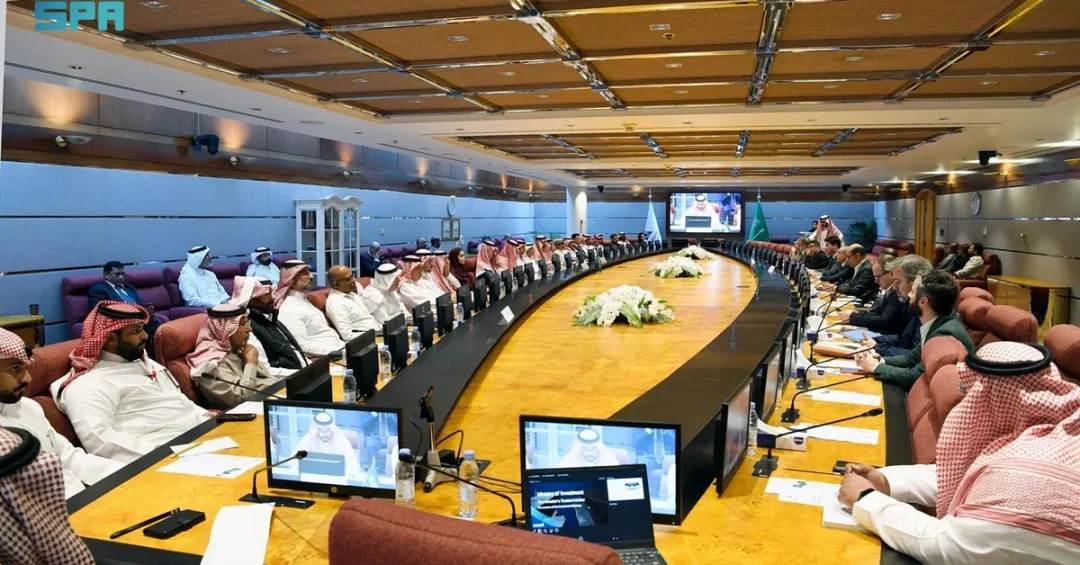
A French trade delegation reviewed investment opportunities in smart cities, green energy, artificial intelligence, new technologies, and cybersecurity during a meeting held at the Asharqia Chamber of Commerce in Dammam, the Saudi Press Agency reported. The session, which took place on December 9, 2024, brought together senior representatives of the Chamber and Business France, the national agency supporting the international development of the French economy, alongside a group of Saudi and French businesspeople. The meeting underscored the deepening commercial relationship between the Kingdom of Saudi Arabia and France, two nations whose economic ties now span renewable energy, transportation, healthcare, and advanced technology.
The gathering was attended by Bader Al Reziza, Chairman of the Board of Directors of the Asharqia Chamber, and Yanis Marsa, Trade Exchange Advisor at the Business France Office, along with several investors and private-sector figures from both countries. The discussions reflect a shared interest in building an ambitious partnership between the Saudi and French private sectors, with the aim of unlocking new opportunities for economic growth and business prosperity. As Saudi Arabia accelerates its economic transformation under Vision 2030, such exchanges signal the Kingdom’s continued openness to international investment and expertise. How might this collaboration reshape the Eastern Province’s economic landscape in the years ahead?
Context and Background
The Asharqia Chamber of Commerce, headquartered in Dammam, serves as the principal representative of the private sector in Saudi Arabia’s Eastern Province, a region that hosts the bulk of the Kingdom’s oil and gas infrastructure as well as a growing array of industrial and technology clusters. The Chamber has increasingly positioned itself as a bridge between international investors and local enterprises, facilitating partnerships that align with the national economic diversification agenda. The visit by the French delegation is the latest in a series of engagements that highlight the Eastern Province’s role as a gateway for foreign direct investment.
During the meeting, Hamad Albuali, Vice-Chairman of the Asharqia Chamber, presented an overview of the trade exchange volume between the Kingdom and France, which exceeded SAR40 billion in 2023, compared with more than SAR36 billion in 2019. That steady increase illustrates the resilience and expansion of bilateral commerce even amid global economic fluctuations. Albuali also noted that 175 French companies currently operate in the Kingdom, employing over 13,300 Saudi nationals, a figure that speaks to the tangible employment and skills-transfer benefits of French investment. France ranks as the third-largest foreign investor in Saudi Arabia in sectors such as renewable energy, transportation, and healthcare, underscoring the strategic depth of the relationship. Could this momentum pave the way for even more French enterprises to establish a presence in the Kingdom?
The meeting’s agenda focused on five priority areas: smart cities, green energy, artificial intelligence, new technologies, and cybersecurity. These fields are central to Saudi Arabia’s long-term development plans, particularly as the Kingdom builds futuristic urban centers and modernizes its digital infrastructure. The French delegation’s interest in these sectors reflects France’s own strengths in engineering, technology, and sustainable development, creating a natural complementarity between the two economies. By convening at the Asharqia Chamber, both sides signaled their intent to move beyond traditional trade and into knowledge-based, innovation-driven cooperation.
Key Details
Vice-Chairman Hamad Albuali emphasized that there is a strong interest in establishing an ambitious partnership between the private sectors of both nations, aiming to create more opportunities for economic growth and business prosperity. He pointed to the presence of 175 French companies in the Kingdom as evidence of France’s confidence in the Saudi market. These companies, which collectively employ more than 13,300 Saudis, are active across a range of industries, from energy and transport to healthcare and technology. Their operations contribute not only capital but also training, technology transfer, and integration into global supply chains.
Yanis Marsa, Trade Exchange Advisor at the Business France Office, represented the French side at the meeting, which also included several businesspeople from both countries. Business France plays a pivotal role in promoting French exports and facilitating foreign investment into France, and its engagement with the Asharqia Chamber indicates a structured approach to identifying and pursuing opportunities. The presence of such a diverse group of stakeholders suggests that the discussions were practical and deal-oriented, rather than merely ceremonial. What specific projects might emerge from these talks, and how quickly could they move from concept to implementation?
The sectors under review are particularly relevant to the Eastern Province’s economic profile. Smart cities and new technologies align with ongoing urban development projects in the region, while green energy dovetails with Saudi Arabia’s renewable energy targets. Artificial intelligence and cybersecurity are critical enablers for the digital economy, and France’s expertise in these areas could complement local initiatives. The meeting thus served as a platform for matching French capabilities with Saudi needs, a formula that has already yielded results in other sectors. The Chamber’s leadership expressed readiness to support French companies seeking to navigate the Saudi market, including through regulatory guidance and networking opportunities.
International and Regional Impact
The strengthening of Saudi-French economic ties carries implications beyond the bilateral relationship. As one of Europe’s largest economies, France can serve as a conduit for Saudi goods and investments into the European Union, while Saudi Arabia offers French firms access to the Gulf Cooperation Council markets and broader Middle East and North Africa region. The Asharqia Chamber meeting therefore represents a node in a wider network of trade and investment flows that connect Europe, the Gulf, and Asia. In a global economy marked by shifting supply chains and geopolitical realignments, such partnerships provide stability and mutual benefit.
Regionally, the involvement of French companies in Saudi Arabia’s renewable energy and smart city projects reinforces the Kingdom’s position as a hub for innovation and sustainable development. It also demonstrates that international investors view Saudi Arabia as a reliable and attractive destination, despite global economic uncertainties. The Eastern Province, with its industrial base and strategic location, stands to gain from increased French participation in local projects, which could spur job creation, technology transfer, and infrastructure upgrades. How will other international investors respond to this visible vote of confidence in the Saudi market?
Economic and Strategic Significance
The trade figures cited by Vice-Chairman Hamad Albuali tell a story of consistent growth: from SAR36 billion in 2019 to over SAR40 billion in 2023. This increase occurred despite the disruptions of the COVID-19 pandemic and subsequent global economic challenges, suggesting that the Saudi-French commercial relationship is built on solid foundations. The presence of 175 French companies employing over 13,300 Saudis also highlights the role of foreign investment in generating employment and developing local talent, a key objective of Saudi Arabia’s economic reforms. France’s rank as the third-largest foreign investor in renewable energy, transportation, and healthcare further cements its strategic importance to the Kingdom.
For Saudi Arabia, partnerships with technologically advanced nations like France are essential to achieving the goals of Vision 2030, which seeks to diversify the economy away from oil dependence and build a knowledge-based society. The sectors discussed at the Asharqia Chamber—smart cities, green energy, AI, new technologies, and cybersecurity—are precisely those that will drive future growth and competitiveness. By engaging with French expertise, Saudi companies can accelerate their own capabilities and integrate into global value chains. The meeting thus represents a microcosm of the broader economic transformation underway in the Kingdom, where international collaboration is welcomed and encouraged.
Vision 2030 Alignment
The discussions at the Asharqia Chamber align directly with the objectives of Saudi Vision 2030, the national blueprint for economic diversification and social development launched under the leadership of Crown Prince Mohammed bin Salman. Vision 2030 emphasizes the importance of attracting foreign investment, developing non-oil sectors, and creating a vibrant private sector. The French delegation’s focus on smart cities, green energy, artificial intelligence, and cybersecurity mirrors the Vision’s key pillars, including the development of a digital economy, the expansion of renewable energy, and the creation of sustainable urban environments. The Eastern Province, as a major industrial and logistics hub, is poised to play a central role in these efforts.
As Saudi Arabia continues to implement Vision 2030, engagements like the one at the Asharqia Chamber will be crucial for building the international partnerships needed to succeed. The Kingdom’s leadership has consistently emphasized that foreign investment is not only welcome but integral to the nation’s progress. By facilitating dialogue between Saudi and French businesses, the Chamber is helping to translate high-level agreements into concrete projects that benefit both economies. The meeting on December 9, 2024, therefore stands as another step forward in Saudi Arabia’s journey toward a diversified, innovative, and globally connected future. Will this be remembered as the moment when a new wave of French investment took root in the Eastern Province? Only time will tell, but the signs are undeniably promising.
20 Questions
Q1. What was the main purpose of the French trade delegation’s visit to the Asharqia Chamber?
A1. The delegation reviewed investment opportunities in smart cities, green energy, artificial intelligence, new technologies, and cybersecurity, aiming to strengthen economic ties between Saudi Arabia and France.
Q2. When and where did the meeting take place?
A2. The meeting was held on December 9, 2024, at the Asharqia Chamber of Commerce in Dammam, Saudi Arabia, as reported by the Saudi Press Agency.
Q3. Who attended the meeting from the Saudi side?
A3. Bader Al Reziza, Chairman of the Asharqia Chamber’s Board of Directors, and Vice-Chairman Hamad Albuali attended, along with several Saudi businesspeople.
Q4. Who represented the French side at the meeting?
A4. Yanis Marsa, Trade Exchange Advisor at the Business France Office, led the French representation, accompanied by French businesspeople interested in Saudi investment opportunities.
Q5. What was the volume of trade exchange between Saudi Arabia and France in 2023?
A5. The trade exchange volume exceeded SAR40 billion in 2023, compared to more than SAR36 billion in 2019, indicating steady growth in bilateral commerce.
Q6. How many French companies currently operate in the Kingdom?
A6. There are 175 French companies operating in Saudi Arabia, collectively employing over 13,300 Saudi nationals across various sectors.
Q7. What is France’s ranking among foreign investors in Saudi Arabia?
A7. France is the third-largest foreign investor in Saudi Arabia, with significant investments in renewable energy, transportation, and healthcare sectors.
Q8. What sectors were highlighted for potential collaboration?
A8. The meeting focused on smart cities, green energy, artificial intelligence, new technologies, and cybersecurity as key areas for partnership.
Q9. What did Hamad Albuali emphasize during the meeting?
A9. He emphasized the strong interest in establishing an ambitious partnership between the private sectors of both nations to create economic growth and business prosperity.
Q10. How does this meeting align with Saudi Vision 2030?
A10. It supports Vision 2030’s goals of economic diversification, foreign investment attraction, and development in technology, renewable energy, and smart cities.
Q11. What role does the Asharqia Chamber play in Saudi Arabia’s economy?
A11. The Asharqia Chamber represents the private sector in the Eastern Province and facilitates international partnerships, acting as a bridge for foreign investment.
Q12. Why is the Eastern Province significant for French investment?
A12. The Eastern Province hosts major industrial and energy infrastructure, making it a strategic location for investments in technology, renewable energy, and smart city projects.
Q13. What benefits do French companies bring to Saudi Arabia?
A13. They bring capital, technology transfer, employment for Saudis, and integration into global supply chains, supporting economic diversification.
Q14. How has trade between Saudi Arabia and France evolved since 2019?
A14. Trade has grown from over SAR36 billion in 2019 to over SAR40 billion in 2023, demonstrating resilience and expanding commercial ties.
Q15. What is Business France’s role in this collaboration?
A15. Business France promotes French exports and facilitates investment, helping French companies explore opportunities in the Saudi market.
Q16. What are the key areas of French expertise relevant to Saudi Arabia?
A16. French expertise includes smart city solutions, green energy, artificial intelligence, cybersecurity, and transportation, aligning with Saudi development goals.
Q17. How many Saudis are employed by French companies in the Kingdom?
A17. Over 13,300 Saudi nationals are employed by French companies operating in Saudi Arabia, contributing to local job creation and skills development.
Q18. What is the significance of the trade volume exceeding SAR40 billion?
A18. It reflects the strength and growth of Saudi-French economic relations, highlighting the Kingdom’s attractiveness as an investment destination.
Q19. What future opportunities might arise from this meeting?
A19. It could lead to new joint ventures, increased French investment in target sectors, and enhanced technology transfer, boosting Saudi Arabia’s economic diversification.
Q20. How does this meeting reflect Saudi Arabia’s openness to international business?
A20. It demonstrates the Kingdom’s commitment to welcoming foreign investment and fostering international partnerships as part of its Vision 2030 transformation.
Reader Feedback
We value your thoughts. Please share your feedback on this article.
Your feedback helps us improve our coverage.
Related articles
 Saudi Arabia Approves New Industrial City in Dammam
 Saudi Industrial Production Index Rises 5% in October 2024
 Saudi Arabia, UK Hold High-Level Business Roundtable in Riyadh
 Saudi Economy Ministry Hosts OECD Workshop for 30 Agencies
 Saudi Steering Committee Chairman Inaugurates IPSASB Meetings in Riyadh
 Saudi Arabia, EU Affirm Commitment to Bolster Trade Ties