


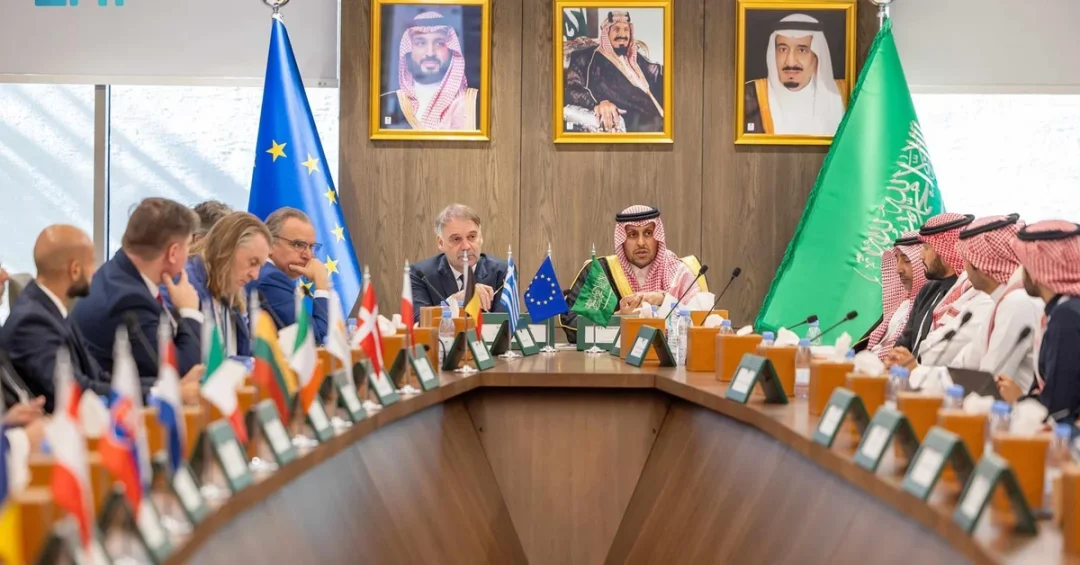
Saudi Arabia and the European Union reaffirmed their commitment to deepening trade and economic ties during a two-day KSA-EU Trade Roundtable Meeting held in Riyadh on December 9–10, 2024, bringing together approximately 60 senior government officials, trade experts, and private sector representatives from both sides. The meeting, organized by the Saudi General Authority of Foreign Trade (GAFT), was co-chaired by Abdulaziz Al-Sakran, Deputy Governor for International Relations at GAFT, and Thomas Jorgensen, Head of the Trade and Economic Affairs Department at the EU Delegation to Saudi Arabia. The discussions focused on Saudi Arabia’s recent economic reforms and new legislation, with participants exploring potential partnerships across key sectors to facilitate public-private cooperation.
Why does this meeting matter for the future of Saudi-European relations? The roundtable addressed trade regulations, customs systems, market access, knowledge exchange, enhancing trade and investment flows, and strategies for addressing trade barriers. Deputy Governor Al-Sakran emphasized that the meeting represents a pivotal step in strengthening trade relations between Saudi Arabia and the EU, reflecting their shared commitment to bolstering ties across all fields. He highlighted that the growing trade volume between the two sides reached approximately $52 billion by mid-2024, underscoring the deepening economic partnership.
Context and Background
How has the relationship between Saudi Arabia and the European Union evolved in recent years? The KSA-EU Trade Roundtable Meeting builds on a sustained diplomatic and economic engagement between the Kingdom and the 27-nation European bloc. Saudi Arabia has been actively diversifying its international partnerships as part of its Vision 2030 strategy, which aims to reduce dependence on oil revenues and expand non-oil exports, attract foreign investment, and integrate more deeply into global supply chains. The European Union, as one of the world’s largest trading blocs, represents a critical partner in this endeavor.
The meeting took place at GAFT’s headquarters in Riyadh and included representatives from a wide array of Saudi institutions. These included the Ministry of Investment, the Saudi Ports Authority, the Saudi Food and Drug Authority (SFDA), the Saudi Standards, Metrology and Quality Organization, the Saudi Intellectual Property Authority, the Saudi Export Development Authority, the Economic Cities and Special Zones Authority, the Zakat, Tax and Customs Authority, the Small and Medium Enterprises General Authority, the Local Content and Government Procurement Authority, the Public Investment Fund, the National Center for Palms and Dates, the Saudi Arabian Mining Company (Ma’aden), and Almarai Company. Such broad participation reflects the comprehensive nature of the bilateral agenda.
Senior trade officials from the EU Delegation to Saudi Arabia, representatives from EU member states with trade interests in the Kingdom, and the European Chamber of Commerce in the Kingdom of Saudi Arabia (ECCKSA) also attended. This diverse representation underscores the mutual interest in deepening economic cooperation and addressing practical challenges to trade. The roundtable format allowed for detailed discussions on regulatory alignment, customs modernization, and investment facilitation, which are essential for unlocking the full potential of the bilateral relationship.
Key Details
What specific topics were on the agenda during the two-day meeting? Participants delved into Saudi Arabia’s recent reforms and new legislation designed to improve the business environment and attract foreign investment. Discussions covered trade regulations, customs systems, market access, knowledge exchange, and strategies for enhancing trade and investment while addressing trade barriers. The Saudi side provided updates on regulatory changes that affect import-export procedures, intellectual property protection, and standards compliance, all of which are crucial for European companies operating in or trading with the Kingdom.
The meeting also explored potential partnerships in key sectors, with a focus on facilitating cooperation between the public and private sectors. Saudi Arabia’s economic cities and special zones, such as NEOM and the Red Sea Project, were highlighted as opportunities for European investment and expertise. The presence of the Public Investment Fund (PIF) and Ma’aden signaled the Kingdom’s interest in joint ventures in mining, manufacturing, and technology transfer. Almarai Company’s participation pointed to the agri-food sector as another area ripe for collaboration.
Deputy Governor Al-Sakran underscored that the meeting reflects the shared commitment to bolstering ties across all fields. He noted that the trade volume between Saudi Arabia and the EU reached approximately $52 billion by mid-2024, a testament to the growing economic interdependence. This figure encompasses both oil and non-oil trade, with non-oil trade showing particularly strong growth as Saudi Arabia expands its export base. The roundtable concluded with a commitment to follow up on the discussed initiatives and to continue the dialogue through regular meetings and working groups.
International and Regional Impact
How does this meeting fit into the broader geopolitical landscape? The strengthening of Saudi-EU trade ties comes at a time of shifting global economic dynamics, with both sides seeking to diversify their partnerships and reduce reliance on traditional markets. For the European Union, Saudi Arabia represents a key partner in the Gulf region, offering investment opportunities and a gateway to broader Middle Eastern markets. For Saudi Arabia, the EU is a source of advanced technology, high-quality imports, and foreign direct investment that supports Vision 2030 objectives.
The meeting also has implications for regional trade integration. Saudi Arabia’s efforts to position itself as a logistics and commercial hub connecting Asia, Europe, and Africa align with the EU’s interest in stable and diversified supply chains. By addressing trade barriers and improving customs procedures, the two sides aim to facilitate smoother flows of goods and services. This cooperation could serve as a model for other regional partnerships and contribute to economic stability in the wider Middle East.
Furthermore, the involvement of the European Chamber of Commerce in the Kingdom of Saudi Arabia (ECCKSA) highlights the role of the private sector in driving economic ties. European companies are increasingly looking to Saudi Arabia for growth opportunities, particularly in sectors such as renewable energy, healthcare, digital transformation, and tourism. The roundtable provided a platform for these companies to engage directly with Saudi policymakers and to gain clarity on regulatory frameworks.
Economic and Strategic Significance
What are the economic benefits for both sides? For Saudi Arabia, enhanced trade with the EU supports the diversification of its economy and the growth of non-oil exports. The $52 billion trade volume recorded by mid-2024 represents a significant increase from previous years and reflects the success of ongoing reforms. By improving market access for Saudi products in Europe, the Kingdom can further boost its export revenues and create jobs. Additionally, partnerships with European firms can bring in expertise and technology that accelerate the development of priority sectors.
For the European Union, Saudi Arabia offers a large and growing market for goods and services, as well as investment opportunities in infrastructure, green energy, and digital economy. The EU’s trade strategy emphasizes open and fair trade, and the roundtable discussions on regulatory alignment and customs modernization are steps toward reducing friction and enhancing predictability for European businesses. The presence of EU member states’ representatives indicates a collective European interest in deepening ties with the Kingdom.
Strategically, the meeting reinforces Saudi Arabia’s role as a reliable and influential player in global trade. By hosting such roundtables, GAFT demonstrates its commitment to maximizing Saudi Arabia’s international trade revenues, safeguarding its economic interests, and contributing to the development of the national economy. The dialogue also allows Saudi Arabia to showcase its progress in areas such as intellectual property protection, standards, and quality infrastructure, which are essential for attracting high-value investment.
Vision 2030 Alignment
How does this trade roundtable align with Saudi Vision 2030? The meeting directly supports Vision 2030’s goal of transforming Saudi Arabia into a diversified and sustainable economy. By strengthening trade and investment ties with the European Union, the Kingdom advances its objectives of increasing non-oil exports, attracting foreign investment, and creating a business-friendly environment. The participation of entities like the Ministry of Investment, the Public Investment Fund, and the Economic Cities and Special Zones Authority underscores the whole-of-government approach to achieving these goals.
Moreover, the emphasis on knowledge exchange and public-private partnerships reflects Vision 2030’s focus on innovation and human capital development. Collaborations with European counterparts can facilitate technology transfer, capacity building, and the adoption of best practices in areas such as logistics, manufacturing, and sustainable development. As Saudi Arabia continues to open up and integrate with the global economy, engagements like the KSA-EU Trade Roundtable will be instrumental in realizing the Kingdom’s long-term vision and cementing its position as a leading global economy.
20 Questions
Q1. What was the purpose of the KSA-EU Trade Roundtable Meeting?
A1. The meeting aimed to strengthen trade relations between Saudi Arabia and the European Union, address trade barriers, and explore partnerships in key sectors to facilitate public-private cooperation.
Q2. When and where did the meeting take place?
A2. The two-day meeting was held on December 9–10, 2024, at the headquarters of the Saudi General Authority of Foreign Trade (GAFT) in Riyadh.
Q3. Who co-chaired the meeting?
A3. Abdulaziz Al-Sakran, Deputy Governor for International Relations at GAFT, and Thomas Jorgensen, Head of the Trade and Economic Affairs Department at the EU Delegation to Saudi Arabia.
Q4. How many participants attended the roundtable?
A4. Approximately 60 senior government officials, trade experts, and private sector representatives from Saudi Arabia and the European Union attended the meeting.
Q5. What was the trade volume between Saudi Arabia and the EU by mid-2024?
A5. The trade volume reached approximately $52 billion by mid-2024, reflecting growing economic ties between the two sides.
Q6. Which Saudi institutions participated in the meeting?
A6. Participants included the Ministry of Investment, Saudi Ports Authority, SFDA, Saudi Standards Organization, Saudi Intellectual Property Authority, Saudi Export Development Authority, and others.
Q7. What key sectors were discussed for potential partnerships?
A7. Discussions covered trade regulations, customs systems, market access, knowledge exchange, investment, and sectors such as mining, manufacturing, agri-food, and technology.
Q8. How does this meeting support Saudi Vision 2030?
A8. It supports economic diversification, non-oil export growth, foreign investment attraction, and job creation, aligning with Vision 2030’s goals.
Q9. What role did the European Chamber of Commerce play?
A9. The European Chamber of Commerce in the Kingdom of Saudi Arabia (ECCKSA) represented private sector interests and facilitated dialogue between European businesses and Saudi policymakers.
Q10. What did Deputy Governor Al-Sakran say about the meeting?
A10. He emphasized it was a pivotal step in strengthening trade relations, reflecting shared commitment to bolstering ties across all fields.
Q11. What are the next steps after the roundtable?
A11. The two sides committed to follow up on discussed initiatives through regular meetings and working groups to continue the dialogue.
Q12. How does the EU benefit from stronger trade ties with Saudi Arabia?
A12. The EU gains access to a large and growing market, investment opportunities, and a gateway to broader Middle Eastern markets.
Q13. What Saudi reforms were highlighted during the meeting?
A13. Reforms in trade regulations, customs systems, intellectual property protection, and standards compliance were presented to improve the business environment.
Q14. Which Saudi company from the private sector attended?
A14. Almarai Company, a major Saudi dairy and food company, participated, highlighting agri-food sector opportunities.
Q15. What is GAFT’s role in Saudi trade?
A15. GAFT aims to maximize Saudi Arabia’s international trade revenues, safeguard economic interests, and contribute to national economic development.
Q16. How does this meeting impact regional trade integration?
A16. It promotes smoother trade flows, addresses barriers, and could serve as a model for other regional partnerships, enhancing economic stability.
Q17. What is the significance of the $52 billion trade volume?
A17. It demonstrates the growing economic interdependence and the success of Saudi Arabia’s efforts to diversify trade partners and boost non-oil exports.
Q18. What sectors in Saudi Arabia are most attractive to EU investors?
A18. Renewable energy, healthcare, digital transformation, tourism, mining, and manufacturing are key sectors attracting European investment interest.
Q19. How does the meeting reflect Saudi Arabia’s global engagement?
A19. It showcases the Kingdom’s active diplomacy and commitment to international cooperation, reinforcing its role as a reliable global trade partner.
Q20. What is the expected outcome of the roundtable?
A20. Enhanced trade and investment flows, reduced trade barriers, and strengthened public-private partnerships between Saudi Arabia and the EU.
Reader Feedback
We value your thoughts. Please share your feedback on this article.
Your feedback helps us improve our coverage.
Related articles
 Mawani Adds JRS Shipping Service to Jeddah Islamic Port
 Türkiye Exporters Seek Saudi Partnerships at Riyadh Forum
 Saudi Economy’s Liquidity Grows by over SAR247 Billion
 Saudi Ambassador Meets Algerian Trade Minister in Algiers
 Saudi Arabia Leads GCC-Japan FTA Negotiations in Riyadh
 World Trade Expo 2024 Opens in Jeddah, Drawing Global Traders