


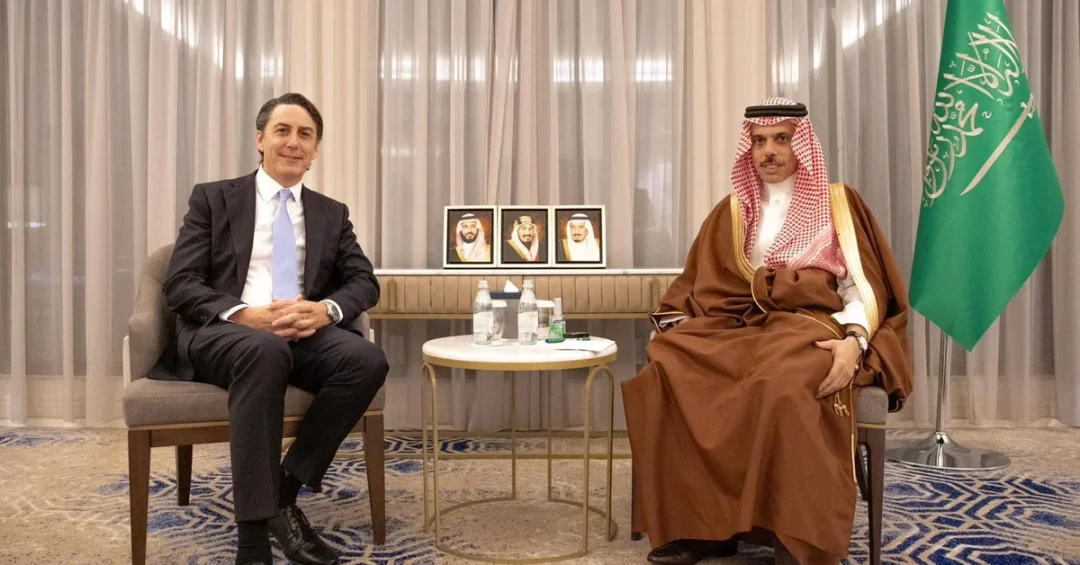
Saudi Minister of Foreign Affairs Prince Faisal bin Farhan bin Abdullah met with United States Envoy to Lebanon Amos Hochstein in Doha on December 7, 2024, on the sidelines of the 22nd Doha Forum, to discuss the latest developments in Lebanon and ongoing international efforts to stabilize the country. The meeting, announced by the Saudi Press Agency, underscores the Kingdom’s continued diplomatic engagement on issues affecting regional security and stability, and reflects Saudi Arabia’s commitment to supporting Lebanon’s sovereignty, security, and territorial integrity.
The discussions focused on current developments in Lebanon and the ongoing efforts to address the situation, according to the official statement. The meeting was attended by Saudi Ambassador to Qatar Prince Mansour bin Khalid bin Farhan and Abdulrahman Aldawood, Director General of the Foreign Minister’s Office. The encounter took place against the backdrop of intensified regional diplomacy, as Lebanon navigates a delicate period following a ceasefire agreement between Israel and Hezbollah and prepares for the election of a new president. Saudi Arabia has consistently advocated for Lebanon’s stability and the importance of upholding its national institutions.
Context and Background
Why does a single diplomatic meeting in Doha carry significance for Lebanon’s future and for the wider Middle East? The 22nd Doha Forum, held annually in Qatar, brings together heads of state, policymakers, and thought leaders to address pressing global challenges. This year’s forum convened as Lebanon faced a critical juncture: a fragile ceasefire with Israel, a prolonged presidential vacuum, and an economy still reeling from years of crisis. The meeting between Prince Faisal bin Farhan and Amos Hochstein thus represented a timely convergence of Saudi and American diplomatic efforts aimed at consolidating calm and advancing a political solution.
Saudi Arabia has long maintained a principled position on Lebanon, emphasizing the need to preserve its sovereignty and protect it from external interference. The Kingdom has repeatedly called for the full implementation of United Nations Security Council resolutions, particularly Resolution 1701, which calls for the disarmament of non-state militias in southern Lebanon and respect for the Blue Line. Riyadh has also been a consistent provider of humanitarian and development assistance to Lebanon, supporting sectors such as health, education, and infrastructure. The meeting in Doha built on this legacy of constructive engagement, signaling that Saudi Arabia remains a vital partner in Lebanon’s recovery.
Amos Hochstein, the US Envoy to Lebanon, has been a central figure in mediating the recent ceasefire agreement between Israel and Hezbollah, which took effect in late November 2024. His shuttle diplomacy between Beirut and Jerusalem has been instrumental in reducing hostilities and creating space for political dialogue. By meeting with Prince Faisal bin Farhan, Hochstein sought to align American and Saudi perspectives on how to translate the ceasefire into a durable political framework. The presence of senior Saudi diplomats at the forum, including Ambassador Prince Mansour bin Khalid bin Farhan and Director General Abdulrahman Aldawood, highlighted the Kingdom’s active role in regional peacemaking.
Key Details of the Meeting
What exactly was discussed behind closed doors, and what outcomes can be expected? According to the official Saudi Press Agency report, the talks centered on “current developments in Lebanon and ongoing efforts to address the situation.” While the statement did not disclose specific initiatives, the conversation likely covered the imperative of electing a president, forming a government capable of implementing reforms, and ensuring that humanitarian aid reaches those affected by the recent conflict. The Saudi side reaffirmed its support for Lebanon’s legitimate institutions and its rejection of any actions that could undermine national unity.
The meeting also provided an opportunity to coordinate on reconstruction efforts. Lebanon’s southern regions and parts of the Bekaa Valley suffered significant damage during the recent hostilities, and international donors are preparing a comprehensive recovery plan. Saudi Arabia, through its humanitarian arm, the King Salman Humanitarian Aid and Relief Center (KSrelief), has already dispatched relief supplies and medical assistance. The Kingdom’s participation in the Doha Forum and its bilateral engagement with the US envoy signal that Riyadh is ready to contribute to rebuilding efforts, provided that political conditions allow for transparent and effective aid delivery.
Furthermore, the discussions likely touched on the broader regional security architecture. Saudi Arabia has consistently warned against the expansion of proxy conflicts and has supported efforts to reduce tensions. The Kingdom’s Vision 2030 reform agenda, which prioritizes economic diversification and regional stability, aligns with a peaceful and prosperous Lebanon that can serve as a bridge for trade and investment. By engaging with Hochstein, Prince Faisal bin Farhan reinforced the message that Saudi Arabia is a constructive actor committed to de-escalation and diplomacy.
International and Regional Impact
How will this meeting influence the broader diplomatic landscape? The Doha Forum provided a platform for multiple stakeholders to exchange views on Lebanon, including representatives from France, Qatar, and other European and Arab states. The Saudi-US consultation adds weight to the international consensus that Lebanon’s crisis requires a coordinated response. It also signals to other regional players, particularly Iran, that the international community is united in demanding respect for Lebanon’s sovereignty and the cessation of arms transfers to non-state actors.
The meeting comes at a time when the United States is seeking to capitalize on the ceasefire to push for a lasting political settlement. President Joe Biden’s administration has prioritized de-escalation in the Middle East, and Hochstein’s engagement with Saudi officials underscores the importance of Arab partners in this endeavor. For Saudi Arabia, the talks reinforce its role as a stabilizing force and a key interlocutor in regional affairs. The Kingdom’s diplomatic outreach is consistent with its broader strategy of promoting moderation and combating extremism, as outlined in Vision 2030.
From a European perspective, the Saudi-US meeting in Doha is a welcome development. France, which has historical ties to Lebanon and has been actively involved in mediation efforts, has called for a renewed international framework to support Lebanon. The alignment of Saudi, American, and European positions could pave the way for a unified approach to reconstruction and political reform. Additionally, the meeting may encourage other Gulf states to deepen their engagement with Lebanon, potentially unlocking much-needed investment and financial support.
Economic and Strategic Significance
What economic stakes does Saudi Arabia have in Lebanon’s stability? Lebanon has traditionally been a destination for Saudi tourism and investment, particularly in real estate, banking, and tourism. The ongoing crisis has severely disrupted these flows, but a stable Lebanon could once again become an attractive market. Saudi Arabia’s Vision 2030 aims to increase non-oil trade and investment, and a prosperous Lebanon could serve as a gateway to broader Levantine markets. The Kingdom’s private sector has expressed interest in participating in reconstruction projects, provided that security and governance conditions improve.
Strategically, Saudi Arabia views Lebanon as an integral part of the Arab world and a potential partner in countering extremism and promoting moderate Islam. The Kingdom’s support for Lebanon’s state institutions, including the Lebanese Armed Forces, is aimed at strengthening the legitimate authority of the state and preventing the resurgence of militia rule. By coordinating with the United States, Saudi Arabia can ensure that its assistance is channeled effectively and in a manner that reinforces state sovereignty. This approach aligns with the Kingdom’s broader foreign policy objectives of promoting stability and prosperity in the region.
Moreover, the meeting in Doha highlights the importance of multilateral forums in addressing complex crises. The Doha Forum, with its diverse participation, offers a setting where bilateral and multilateral discussions can complement each other. Saudi Arabia’s active participation demonstrates its commitment to international cooperation and its willingness to work with all partners to resolve conflicts. This is consistent with the Kingdom’s vision of a peaceful and interconnected world, as articulated by Crown Prince Mohammed bin Salman.
Vision 2030 Alignment
How does this diplomatic engagement fit into Saudi Arabia’s long-term vision? Vision 2030, the Kingdom’s comprehensive reform plan, seeks to diversify the economy, empower citizens, and enhance Saudi Arabia’s global standing. A stable and prosperous neighborhood is essential to achieving these goals. By helping to stabilize Lebanon, Saudi Arabia contributes to regional security, which in turn creates a favorable environment for trade, investment, and cultural exchange. The meeting between Prince Faisal bin Farhan and Amos Hochstein is thus a concrete example of Vision 2030’s diplomatic pillar in action.
Furthermore, the Kingdom’s humanitarian and developmental assistance to Lebanon reflects the values of compassion and solidarity that are central to Saudi society. Under the leadership of the Custodian of the Two Holy Mosques, King Salman bin Abdulaziz Al Saud, and Crown Prince Mohammed bin Salman, Saudi Arabia has emerged as a leading donor and peacemaker. The Doha meeting reinforces this reputation and underscores the Kingdom’s commitment to working with international partners to build a more stable and prosperous Middle East. As Lebanon looks toward recovery, Saudi Arabia stands ready to support its journey, in line with the principles of mutual respect and shared prosperity.
20 Questions
Q1. Who met in Doha on December 7, 2024?
A1. Saudi Minister of Foreign Affairs Prince Faisal bin Farhan bin Abdullah met with United States Envoy to Lebanon Amos Hochstein on the sidelines of the 22nd Doha Forum.
Q2. What was the main topic of discussion?
A2. The discussions focused on current developments in Lebanon and ongoing efforts to address the situation, according to the official Saudi Press Agency report.
Q3. Where did the meeting take place?
A3. The meeting took place in Doha, Qatar, on the sidelines of the 22nd Doha Forum, an annual international gathering of policymakers and leaders.
Q4. Who else attended the meeting?
A4. The meeting was attended by Saudi Ambassador to Qatar Prince Mansour bin Khalid bin Farhan and Abdulrahman Aldawood, Director General of the Foreign Minister’s Office.
Q5. Why is this meeting significant for Lebanon?
A5. It underscores Saudi Arabia’s and the United States’ commitment to supporting Lebanon’s stability, sovereignty, and political recovery during a critical period.
Q6. What is Saudi Arabia’s position on Lebanon?
A6. Saudi Arabia supports Lebanon’s sovereignty, security, and territorial integrity, and calls for the full implementation of UN resolutions and the election of a president.
Q7. What is the Doha Forum?
A7. The Doha Forum is an annual international conference held in Qatar that brings together heads of state, policymakers, and experts to discuss global challenges.
Q8. Who is Amos Hochstein?
A8. Amos Hochstein is the United States Envoy to Lebanon who has been actively mediating between Israel and Hezbollah to secure a ceasefire and promote stability.
Q9. What role has Saudi Arabia played in Lebanon’s humanitarian needs?
A9. Saudi Arabia, through KSrelief, has provided humanitarian aid, medical assistance, and relief supplies to Lebanon, especially during times of crisis.
Q10. How does this meeting relate to the recent ceasefire?
A10. The meeting builds on the ceasefire agreement between Israel and Hezbollah, aiming to translate reduced hostilities into a durable political framework for Lebanon.
Q11. What are the implications for regional stability?
A11. The meeting reinforces international consensus on Lebanon’s sovereignty and signals a unified approach to de-escalation and support for state institutions.
Q12. Will Saudi Arabia participate in Lebanon’s reconstruction?
A12. Saudi Arabia has expressed readiness to contribute to reconstruction efforts, provided that political conditions allow for transparent and effective aid delivery.
Q13. What is the connection to Vision 2030?
A13. Vision 2030 prioritizes regional stability and economic diversification, and a stable Lebanon contributes to a favorable environment for trade and investment.
Q14. How does this meeting affect Saudi-US relations?
A14. It strengthens Saudi-US coordination on regional issues, demonstrating shared commitment to peace and stability in the Middle East.
Q15. What other countries are involved in Lebanon’s stability?
A15. France, Qatar, and other European and Arab states are also engaged in diplomatic efforts to support Lebanon’s recovery and political process.
Q16. What is the significance of the Doha Forum for Saudi diplomacy?
A16. The Doha Forum provides a platform for Saudi Arabia to engage with international partners, showcase its diplomatic leadership, and advance its foreign policy objectives.
Q17. What challenges remain for Lebanon?
A17. Lebanon still faces a presidential vacuum, economic crisis, and the need for political reforms, all of which require sustained international support.
Q18. How has Saudi Arabia supported Lebanon’s state institutions?
A18. Saudi Arabia has supported the Lebanese Armed Forces and other state institutions to strengthen legitimate authority and prevent militia rule.
Q19. What is the expected outcome of the meeting?
A19. The meeting aims to align Saudi and US perspectives on Lebanon, paving the way for coordinated international action and support for Lebanon’s recovery.
Q20. What message does this meeting send to the region?
A20. It sends a message of unity and commitment to Lebanon’s sovereignty, stability, and prosperity, and underscores Saudi Arabia’s role as a responsible regional leader.
Reader Feedback
We value your thoughts. Please share your feedback on this article.
Your feedback helps us improve our coverage.
Related articles
 Riyadh Action Agenda Gathers Steam at UNCCD COP16
 Riyadh Forum Day 2: Five Sessions on Afforestation Tech
 Saudi, Turkish Foreign Ministers Meet at Doha Forum
 Saudi FM Meets Iranian Counterpart at Doha Forum
 Saudi GRC Executive Program Graduates First Cohort in UK
 Saudi Defense Official Leads Delegation at Manama Dialogue 2024