


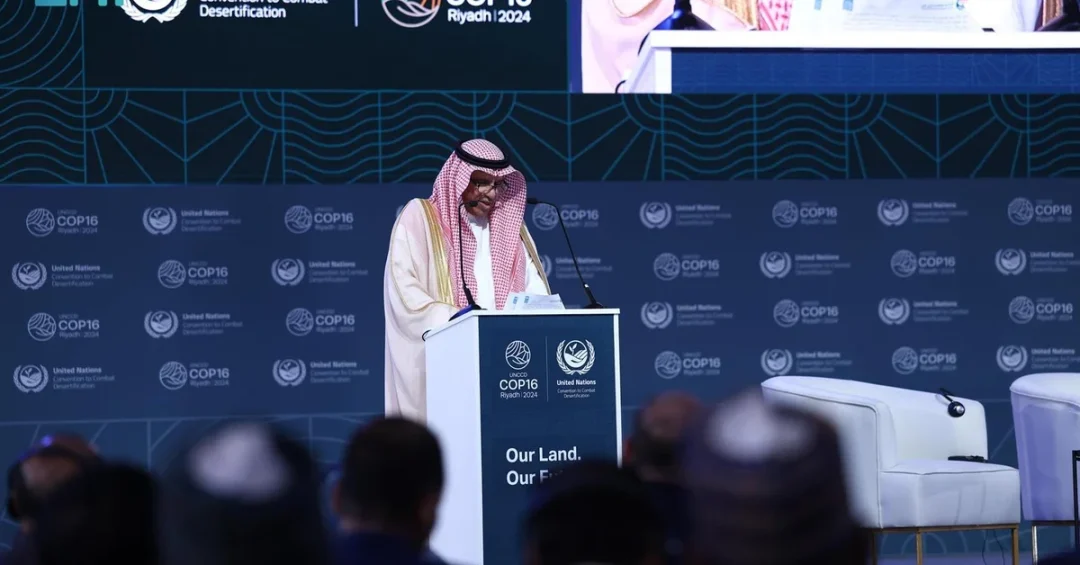
Saudi Arabia’s Presidency of the 16th Conference of the Parties (COP16) to the United Nations Convention to Combat Desertification (UNCCD) placed governance at the heart of global efforts to tackle land degradation, drought, and desertification on Friday, as Governance Day in Riyadh delivered fresh momentum for the Riyadh Action Agenda. The landmark initiative, launched by the Saudi COP16 Presidency, is mobilizing state and non-state actors to strengthen financing for land restoration and drought resilience, advancing the UNCCD goal of restoring 1.5 billion hectares of land by 2030. The day’s proceedings, announced via the Saudi Press Agency (SPA), featured a declaration calling for deeper engagement between local and regional governments, a Mayors Forum, and a dedicated event on urban-rural linkages.
Governance Day underscored a central truth of the global land agenda: international commitments only become real when they are translated into action at the local level. As water scarcity, desertification, and land degradation continue to threaten food systems and livelihoods worldwide, the discussions in Riyadh highlighted how mayors, regional authorities, and community leaders are indispensable partners in delivering measurable results. Could any global target truly be met without the cities, towns, and rural districts where land is actually managed? The answer, according to the participants at COP16, is a resounding no.
Context and Background
Is governance the missing link in the fight against desertification? COP16 in Riyadh has made a powerful case that it is. The UNCCD, established in 1994, is the global agreement linking environment and development to sustainable land management. Its 197 parties gather every two years to review progress and set new priorities. The Riyadh conference, running through December 13, is the largest UNCCD COP ever held, and it has already secured more than $12 billion in funding pledges from major international organizations, according to official Saudi information released through SPA.
At the center of the Saudi Presidency’s agenda is the Riyadh Action Agenda, which was officially launched on Thursday. The initiative encourages countries, the private sector, financial institutions, international organizations, and other stakeholders to strengthen the convention either by joining existing efforts—such as the Middle East Green Initiative, Africa’s Great Green Wall, or the Riyadh Global Drought Resilience Partnership—or by championing new ones. The agenda is designed to turn pledges into projects and projects into restored landscapes, with a clear focus on drought resilience and land restoration.
Governance Day built on this foundation by focusing on the institutions and decision-making processes that determine whether land restoration succeeds or stalls. The day’s discussions coincided with the launch of the Riyadh Action Agenda and highlighted the essential role of local and regional authorities in addressing challenges that are often global in scope but profoundly local in impact. As urbanization accelerates and climate pressures mount, the need for coordinated, multi-level governance has never been more urgent.
Key Details
What did Governance Day actually deliver? The headline outcome was a declaration calling for engagement between local and regional governments to develop a roadmap for tackling land degradation, drought, and desertification. This declaration signals a formal recognition that national governments alone cannot achieve the UNCCD’s ambitious targets. The roadmap is expected to outline concrete mechanisms for cooperation, financing, and knowledge-sharing among different levels of government.
The Mayors Forum, a major feature of the day, brought together current and former mayors, policymakers, and experts to elevate the role of local and regional governments. Participants called for enhanced cooperation and inclusive finance, among other key policy areas. Uğur İbrahim Altay, Mayor of Konya, Türkiye, and Co-President of the United Cities and Local Governments, made an impassioned plea for resources to match rhetoric. “Meaningful action requires meaningful resources,” he said. “I am here, as head of the Global Task Force of Local and Regional Governments delegation, to make a strong call for engagement of local and subnational leaders to unite in combating land degradation and drought through mechanisms that prioritize investments in drought-resilient infrastructure and ecosystem restoration, while also ensuring direct access for all subnational governments, particularly in the Global South.”
Walid Al-Akrish, Deputy for Projects for Riyadh Municipality, delivered a keynote address that framed the challenge in stark terms. “We must acknowledge that the challenges we face—population growth, rapid urbanization, and unsustainable agricultural practices—have led to alarming rates of land degradation and biodiversity loss,” he stated. His remarks underscored the need for integrated urban planning that considers the environmental footprint of growing cities.
Alongside the Mayors Forum, a dedicated event on urban-rural linkages explored governance frameworks and financing tools to strengthen connections between rural producers and urban consumers. Dr. Osama Faqeeha, Deputy Minister for Environment at the Ministry of Environment, Water and Agriculture and Advisor to the UNCCD COP16 Presidency, captured the spirit of the day: “It is imperative we localize decision-making to combat land degradation, desertification, and drought, and enhance the synergies between growing urban populations and rural producers.” He added that the Riyadh Action Agenda is “now up and running, mobilizing a range of key stakeholders to accelerate action on land restoration and drought resilience.”
International and Regional Impact
Why should the world pay attention to what happens in Riyadh this week? Because the decisions taken at COP16 will shape land management policies far beyond the Middle East. The Riyadh Action Agenda is explicitly designed to mobilize international state and non-state actors, creating a framework that can be replicated and adapted across regions. The $12 billion in funding pledges already secured demonstrates that the international community is willing to back these efforts with substantial resources.
The focus on local and regional governments also has profound implications for global climate governance. Cities are responsible for an estimated 70% of global greenhouse gas emissions and consume over two-thirds of the world’s energy, according to UN data. By empowering mayors and regional leaders to take action on land degradation, the Riyadh Action Agenda acknowledges that sustainable development must be built from the ground up. This approach aligns with the broader trend of subnational diplomacy, where cities and regions are increasingly taking the lead on issues that national governments struggle to resolve.
For the Middle East and North Africa region, which is among the most water-scarce and desertification-prone areas in the world, the outcomes of COP16 are particularly significant. The Middle East Green Initiative, launched by Saudi Crown Prince Mohammed bin Salman in 2021, aims to plant 50 billion trees across the region and restore 200 million hectares of degraded land. The Riyadh Action Agenda complements this initiative by providing a global platform for sharing best practices and mobilizing additional financing.
Economic and Strategic Significance
What is the economic case for investing in land restoration? The numbers are compelling. According to the UNCCD, every dollar invested in land restoration can yield up to $30 in economic benefits. These returns come from improved agricultural productivity, reduced migration, enhanced water security, and new jobs in the restoration and sustainable land management sectors. For countries grappling with youth unemployment and rural poverty, land restoration offers a pathway to inclusive growth.
The Riyadh Action Agenda’s emphasis on engaging the private sector and financial institutions reflects a strategic understanding that public funds alone will not suffice. By encouraging banks, investment funds, and corporations to treat land restoration as an investable asset class, the initiative aims to unlock trillions of dollars in private capital. The Riyadh Global Drought Resilience Partnership, launched alongside the agenda, is a key vehicle for this effort, bringing together governments, international organizations, and private investors to build drought-resilient infrastructure and ecosystems.
Saudi Arabia’s leadership in this space is not merely diplomatic—it is strategic. As the Kingdom pursues its Vision 2030 goals of economic diversification and environmental sustainability, it is positioning itself as a global hub for green finance and sustainable development. The Saudi Green Initiative, which aims to plant 10 billion trees and protect 30% of the Kingdom’s land and sea by 2030, is a cornerstone of this strategy. Hosting COP16 and driving the Riyadh Action Agenda reinforces Saudi Arabia’s role as a convenor and catalyst for international cooperation.
Vision 2030 Alignment
How does the Riyadh Action Agenda connect to Saudi Arabia’s long-term vision? Vision 2030, launched in 2016 by Crown Prince Mohammed bin Salman, is a comprehensive plan to transform the Kingdom’s economy and society. Environmental sustainability is a core pillar, with initiatives ranging from renewable energy projects to the Saudi Green Initiative and the Middle East Green Initiative. The Riyadh Action Agenda extends this domestic commitment to the global stage, demonstrating that Saudi Arabia is not only investing in its own sustainable future but also leading international efforts to combat land degradation and drought.
The governance focus of COP16 also aligns with Vision 2030’s emphasis on institutional excellence and local development. By empowering municipalities and regional authorities, Saudi Arabia is applying lessons from its own modernization journey to the global challenge of land management. As the conference continues, the Kingdom’s Presidency will work to ensure that the Riyadh Action Agenda delivers tangible results—restored land, resilient communities, and a healthier planet for future generations. The world is watching, and Saudi Arabia is leading by example.
20 Questions
Q1. What is the Riyadh Action Agenda?
A1. The Riyadh Action Agenda is a landmark initiative launched by Saudi Arabia’s UNCCD COP16 Presidency. It mobilizes state and non-state actors to enhance financing for land restoration and drought resilience, driving progress toward restoring 1.5 billion hectares of land by 2030.
Q2. What is Governance Day at COP16?
A2. Governance Day was a themed day at the UNCCD COP16 conference in Riyadh focused on the role of governance in tackling land degradation, drought, and desertification. It featured a Mayors Forum, a declaration on local-regional engagement, and events on urban-rural linkages.
Q3. Who launched the Riyadh Action Agenda?
A3. The Riyadh Action Agenda was launched by Saudi Arabia in its capacity as President of the 16th Conference of the Parties (COP16) to the United Nations Convention to Combat Desertification (UNCCD). It was officially launched on Thursday, December 5, 2024.
Q4. What is the UNCCD target for land restoration?
A4. The UNCCD aims to restore 1.5 billion hectares of degraded land by 2030. The Riyadh Action Agenda seeks to accelerate progress toward this target by mobilizing financing, political will, and local action.
Q5. How much funding has COP16 secured so far?
A5. COP16 in Riyadh has secured over $12 billion in funding pledges from major international organizations. These pledges amplify the role of financial institutions and the private sector in combating land degradation, desertification, and drought.
Q6. What is the Mayors Forum?
A6. The Mayors Forum is an event at COP16 that brought together current and former mayors, policymakers, and experts to elevate the role of local and regional governments in addressing land degradation, desertification, and drought. It called for enhanced cooperation and inclusive finance.
Q7. What did the declaration at Governance Day call for?
A7. The declaration called for engagement between local and regional governments to develop a roadmap for tackling land degradation, drought, and desertification. It represents a formal recognition of the need for multi-level governance.
Q8. Who is Uğur İbrahim Altay?
A8. Uğur İbrahim Altay is the Mayor of Konya, Türkiye, and Co-President of United Cities and Local Governments. He spoke at the Mayors Forum, calling for direct access to resources for subnational governments, particularly in the Global South.
Q9. What did Walid Al-Akrish say at COP16?
A9. Walid Al-Akrish, Deputy for Projects for Riyadh Municipality, delivered a keynote address noting that population growth, rapid urbanization, and unsustainable agricultural practices have led to alarming rates of land degradation and biodiversity loss.
Q10. What are urban-rural linkages?
A10. Urban-rural linkages refer to the connections between rural producers and urban consumers. An event at COP16 explored governance frameworks and financing tools to strengthen these linkages, ensuring sustainable food systems and resource management.
Q11. What did Dr. Osama Faqeeha say about the Riyadh Action Agenda?
A11. Dr. Osama Faqeeha, Deputy Minister for Environment and Advisor to the UNCCD COP16 Presidency, said the agenda is “up and running,” mobilizing stakeholders to accelerate action on land restoration and drought resilience for tangible change worldwide.
Q12. What is the Riyadh Global Drought Resilience Partnership?
A12. The Riyadh Global Drought Resilience Partnership is an initiative launched at COP16 to build drought-resilient infrastructure and ecosystems. It brings together governments, international organizations, and private investors to address drought impacts.
Q13. Why is urbanization a concern for land degradation?
A13. Urbanization intensifies strain on hinterlands, water, and food resources, accelerating land degradation. With 68% of the world’s population expected to live in urban areas by 2050, the pressure on rural land and resources will increase significantly.
Q14. How does the Riyadh Action Agenda engage the private sector?
A14. The agenda encourages private sector and financial institutions to invest in land restoration and drought resilience. It promotes land restoration as an investable asset class, aiming to unlock private capital alongside public funding.
Q15. What is the Middle East Green Initiative?
A15. The Middle East Green Initiative, launched by Saudi Crown Prince Mohammed bin Salman in 2021, aims to plant 50 billion trees across the region and restore 200 million hectares of degraded land. The Riyadh Action Agenda complements this effort.
Q16. What is Africa’s Great Green Wall?
A16. Africa’s Great Green Wall is an initiative to create a mosaic of green and productive landscapes across Africa’s Sahel region. It is one of the existing initiatives that countries and stakeholders can join through the Riyadh Action Agenda.
Q17. How does land restoration benefit economies?
A17. According to the UNCCD, every dollar invested in land restoration can yield up to $30 in economic benefits. These come from improved agricultural productivity, reduced migration, enhanced water security, and new jobs in sustainable land management.
Q18. What is Saudi Arabia’s Saudi Green Initiative?
A18. The Saudi Green Initiative aims to plant 10 billion trees and protect 30% of the Kingdom’s land and sea by 2030. It is a cornerstone of Saudi Arabia’s environmental strategy under Vision 2030.
Q19. How does COP16 align with Vision 2030?
A19. COP16 and the Riyadh Action Agenda align with Vision 2030’s environmental sustainability pillar. They demonstrate Saudi Arabia’s commitment to global cooperation and its leadership in addressing land degradation and drought, supporting economic diversification and sustainability.
Q20. What happens after COP16?
A20. After COP16, the Riyadh Action Agenda will continue to mobilize stakeholders to deliver tangible change. The roadmap for local-regional engagement and the Riyadh Global Drought Resilience Partnership will drive ongoing efforts to restore land and build resilience beyond the conference.
Reader Feedback
We value your thoughts. Please share your feedback on this article.
Your feedback helps us improve our coverage.
Related articles
 Riyadh Forum Day 2: Five Sessions on Afforestation Tech
 Saudi, Turkish Foreign Ministers Meet at Doha Forum
 Saudi FM Meets Iranian Counterpart at Doha Forum
 Saudi GRC Executive Program Graduates First Cohort in UK
 Saudi Defense Official Leads Delegation at Manama Dialogue 2024
 Saudi Weather Forecast: Winds and Fog Expected Sunday