


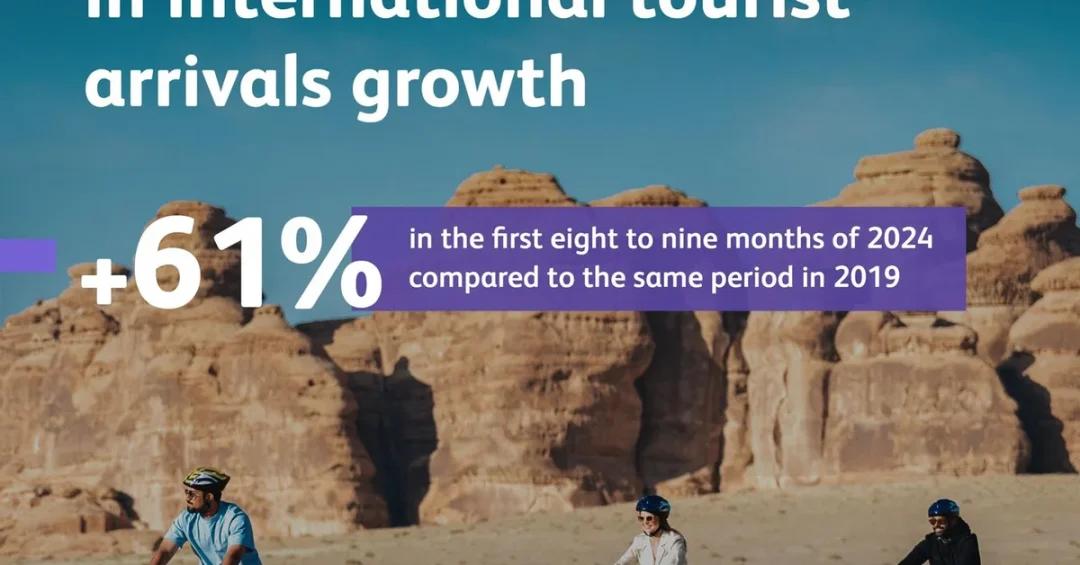
Saudi Arabia ranked third globally in the growth rate of international tourist arrivals, recording an increase of more than 61 percent in the first eight to nine months of 2024 compared with the same period in 2019, according to a press release issued by UN Tourism in December. The ranking, released through official Saudi channels and reported by the Saudi Press Agency, places the Kingdom among the fastest-growing tourism destinations in the world and underscores the scale of the transformation underway in the sector. The result reflects a sustained rise in inbound visitors and reinforces the Kingdom’s position as a leading global tourism destination.
The announcement matters because it arrives at a pivotal moment for global travel, as destinations worldwide compete to recover and surpass pre-pandemic levels of activity. Saudi Arabia’s performance stands out not only for its size but for its consistency, following a series of international benchmarks that have placed the Kingdom ahead of many larger and longer-established tourism markets. For international observers, the figures offer a clear signal that the Kingdom’s tourism strategy is delivering measurable results, supported by the Ministry of Tourism, government agencies, and private sector partners working toward the objectives of Saudi Vision 2030. How often does a nation rewrite its own economic story in the space of a few years?
Context and Background
What does it take for a country to move from a relatively closed travel market to one of the world’s fastest-growing destinations? For Saudi Arabia, the answer lies in a deliberate, multi-year effort to open the Kingdom to international visitors and to build an entirely new tourism ecosystem. The Ministry of Tourism, established to lead this effort, has introduced visa facilitation measures, expanded air connectivity, and supported the development of destinations that span heritage sites, Red Sea coastlines, mountain regions, and modern urban experiences. These efforts are designed to diversify the national economy away from oil dependence, a central pillar of Saudi Vision 2030.
The comparison with 2019 is significant because that year represents the last full pre-pandemic baseline for global travel. By measuring growth against 2019 rather than against pandemic-affected years, UN Tourism provides a clearer picture of genuine structural expansion. Saudi Arabia’s more than 61 percent growth in the first eight to nine months of 2024 therefore reflects new demand rather than a simple rebound. In 2023, the Kingdom advanced 15 positions compared with 2019 in the global ranking for inbound tourist spending, reaching 12th place and leading the upward movement among the top 50 countries. The Kingdom also led the G20 countries in the growth of international tourist arrivals in the first seven months of 2024 compared with the same period in 2019.
These milestones did not emerge in isolation. They are the product of coordinated action across government ministries, tourism authorities, airlines, hospitality groups, and international partners. The result is a tourism sector that is expanding in capacity, visibility, and reputation at the same time, a combination that few markets manage to achieve simultaneously.
Key Details
What exactly do the latest figures show? According to the UN Tourism press release, Saudi Arabia ranked third globally in the growth rate of international tourist arrivals during the first eight to nine months of 2024, with growth exceeding 61 percent compared with the same period in 2019. This places the Kingdom among a small group of markets that have not only recovered from the global travel downturn but have substantially exceeded their previous performance. The data was released in December and circulated through official Saudi channels, including the Saudi Press Agency.
The Ministry of Tourism has described the continued success as a reflection of its plans and strategies, as well as the contribution of all stakeholders in the tourism industry. The increase in inbound tourists also signals traveler confidence in the Kingdom’s offering, which ranges from cultural and heritage experiences to luxury resorts, adventure travel, and religious pilgrimage. Saudi Arabia’s tourism proposition is unusually broad, combining the annual Hajj and Umrah journeys with new leisure destinations, international events, and business travel.
The ranking follows other notable achievements. In 2023, the Kingdom climbed 15 places in the global ranking for inbound tourist spending compared with 2019, reaching 12th position and leading the upward movement among the top 50 countries. In the first seven months of 2024, Saudi Arabia also led the G20 in international tourist arrival growth compared with the same period in 2019. Together, these results show a pattern of sustained momentum rather than a single strong season. How many destinations can claim both scale and speed in the same decade?
International and Regional Impact
Why should the rest of the world pay attention to Saudi Arabia’s tourism numbers? The Kingdom’s rise is reshaping regional travel patterns and adding a major new player to the global tourism economy. As inbound arrivals grow, airlines are expanding routes, hospitality groups are investing in new properties, and event organizers are choosing Saudi cities for international conferences, concerts, and sporting competitions. This activity creates opportunities for partners across the Middle East and beyond, from tour operators to technology providers.
The Kingdom’s performance also carries weight within the G20, where Saudi Arabia has led in international tourist arrival growth for the first seven months of 2024 compared with 2019. That position gives the Kingdom a stronger voice in global discussions on travel facilitation, sustainability, and investment. For regional neighbors, Saudi Arabia’s success can act as a catalyst, encouraging coordinated tourism offerings that allow visitors to combine multiple destinations in a single trip. In a competitive global market, growth in one major market often expands the overall pie rather than shrinking it. What does it mean for the wider region when one of its largest economies becomes a tourism engine?
Economic and Strategic Significance
Tourism growth is not only a matter of visitor numbers; it is an economic strategy with long-term consequences. Higher inbound arrivals translate into spending on hotels, transport, retail, dining, and entertainment, supporting jobs and small businesses across the Kingdom. The 2023 advance of 15 positions in inbound tourist spending, reaching 12th globally, shows that growth in arrivals is being matched by growth in value. This combination is central to the Kingdom’s effort to diversify revenue streams and build a more resilient economy.
Strategically, tourism strengthens Saudi Arabia’s international connections. Every new route, visa agreement, or cultural exchange deepens ties with partner countries and enhances the Kingdom’s global standing. The sector also supports the broader goals of Saudi Vision 2030 by creating employment for young Saudis, encouraging entrepreneurship, and attracting foreign investment. The Ministry of Tourism and its partners continue to develop infrastructure and services designed to handle higher volumes while maintaining quality and sustainability. In this context, the UN Tourism ranking is both a recognition of progress and a platform for further ambition. Can a sector built on hospitality become one of the most durable pillars of a national economy?
Vision 2030 Alignment
Saudi Arabia’s tourism achievements are inseparable from Saudi Vision 2030, the national transformation program that seeks to diversify the economy, modernize infrastructure, and improve quality of life. Tourism is one of the key sectors identified to drive this change, with targets that include attracting millions of international visitors and increasing the sector’s contribution to gross domestic product. The latest UN Tourism ranking, placing the Kingdom third globally in arrival growth for the first eight to nine months of 2024, provides independent evidence that these targets are within reach.
The Kingdom’s progress also reflects a broader opening to the world, expressed through cultural events, heritage preservation, and the development of new destinations. As Saudi Arabia continues to invest in tourism, the benefits extend beyond the sector itself, supporting international engagement and the Kingdom’s role as a bridge between regions and cultures. The coming years will test whether this momentum can be sustained, but the direction is clear. With strong institutional support and a clear strategic vision, Saudi Arabia is positioning itself not only as a destination of choice but as a leader in the global tourism economy. What better measure of a nation’s future than the willingness of the world to visit it?
20 Questions
Q1. What ranking did Saudi Arabia achieve in international tourist arrivals growth?
A1. Saudi Arabia ranked third globally in the growth rate of international tourist arrivals for the first eight to nine months of 2024, according to UN Tourism.
Q2. How much did international tourist arrivals to Saudi Arabia grow?
A2. The Kingdom recorded growth of more than 61 percent in the first eight to nine months of 2024 compared with the same period in 2019.
Q3. Which organization released the data on Saudi Arabia’s tourism performance?
A3. The data was issued by UN Tourism in a press release in December 2024 and circulated through official Saudi channels.
Q4. Why is the comparison with 2019 important?
A4. 2019 was the last full pre-pandemic year for global travel, so comparing against it shows genuine structural growth rather than a pandemic rebound.
Q5. What was Saudi Arabia’s ranking in inbound tourist spending in 2023?
A5. In 2023, Saudi Arabia ranked 12th globally in inbound tourist spending, advancing 15 positions compared with 2019.
Q6. How did Saudi Arabia perform among G20 countries in 2024?
A6. The Kingdom led the G20 countries in the growth of international tourist arrivals in the first seven months of 2024 compared with the same period in 2019.
Q7. Which Saudi body leads the tourism strategy?
A7. The Ministry of Tourism leads the Kingdom’s tourism plans and strategies, working with government agencies and private sector stakeholders.
Q8. What does the growth in arrivals indicate about traveler confidence?
A8. It reflects confidence in Saudi Arabia’s attractive and diverse tourism offering, which includes heritage, leisure, religious, and business travel.
Q9. How does tourism support Saudi Vision 2030?
A9. Tourism is a key sector for economic diversification, job creation, and international engagement under Saudi Vision 2030.
Q10. What types of destinations is Saudi Arabia promoting?
A10. The Kingdom promotes heritage sites, Red Sea resorts, mountain regions, urban experiences, and religious pilgrimage destinations.
Q11. What role does the Saudi Press Agency play in this announcement?
A11. The Saudi Press Agency reported the UN Tourism ranking, providing official confirmation of the Kingdom’s tourism achievement.
Q12. How does the ranking affect Saudi Arabia’s global standing?
A12. It enhances the Kingdom’s standing as a leading global tourist destination and strengthens its voice in international tourism discussions.
Q13. What economic benefits follow from higher tourist arrivals?
A13. Increased arrivals support spending on hotels, transport, retail, and entertainment, creating jobs and supporting small businesses.
Q14. Did Saudi Arabia’s tourism growth occur only in 2024?
A14. No, the Kingdom has shown sustained momentum, including a 15-position advance in inbound tourist spending in 2023.
Q15. What is the significance of leading the G20 in arrival growth?
A15. It positions Saudi Arabia as a top performer among the world’s largest economies and highlights the effectiveness of its tourism strategy.
Q16. How does tourism growth contribute to economic diversification?
A16. It reduces reliance on oil revenue by building a service sector that generates income, employment, and foreign investment.
Q17. What infrastructure supports Saudi Arabia’s tourism expansion?
A17. Expanded air connectivity, new hospitality projects, visa facilitation, and modern transport networks support the growth in visitors.
Q18. How does the Kingdom’s tourism success affect the region?
A18. It can catalyze regional travel by encouraging multi-destination trips and expanding opportunities for neighboring markets.
Q19. What does the UN Tourism ranking recognize?
A19. It recognizes Saudi Arabia’s rapid growth in international arrivals, placing the Kingdom third globally for the first eight to nine months of 2024.
Q20. What is the outlook for Saudi Arabia’s tourism sector?
A20. With strong institutional support and Vision 2030 targets, the Kingdom aims to sustain momentum and remain a leading global destination.
Reader Feedback
We value your thoughts. Please share your feedback on this article.
Your feedback helps us improve our coverage.
Related articles
 Saudi Tourism Authority Partners with Red Sea Film Festival
 Haneeth Festival in Mahayil Aseer Draws Tourists
 Cruise Saudi Welcomes Own Ship AROYA to Jeddah
 Riyadh Season 2024 Attracts 10 Million Visitors
 Al-Sayahid Desert Retreats Fully Booked at Camel Festival
 Saudi Ministry of Tourism Hosts COP16 Panel on Sustainable Tourism