


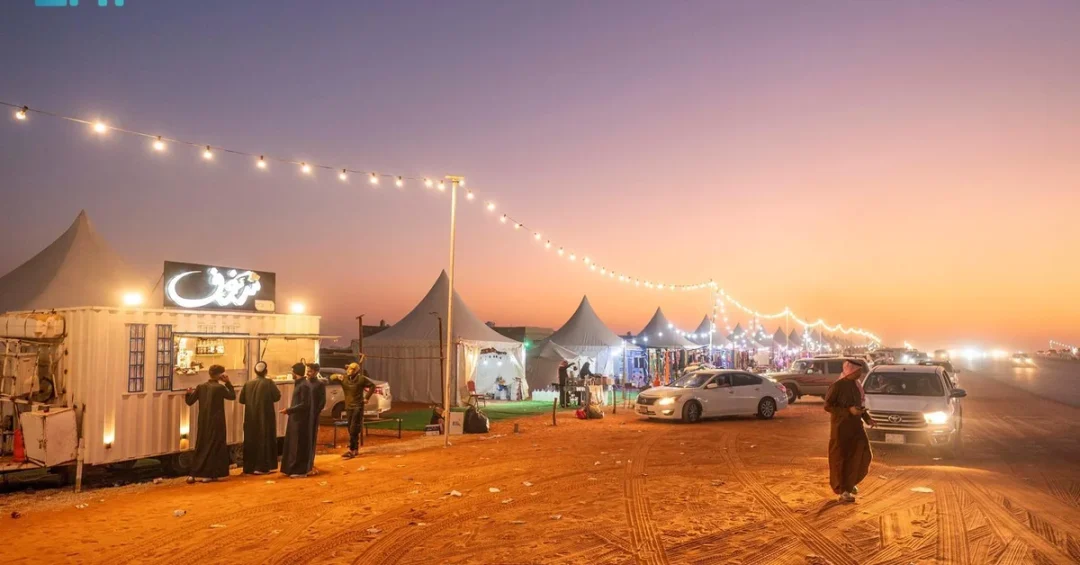
Tents and hotel rooms in the Al-Sayahid area are fully booked as the King Abdulaziz Camel Festival draws record numbers of visitors, with rainfall and pleasant weather adding to the desert destination’s appeal. The Saudi Press Agency reported on December 8, 2024, that accommodation in and around the festival grounds has reached full occupancy in recent days, driven by a surge in demand from camel owners, enthusiasts, and international visitors. The festival, one of the Kingdom’s most prominent cultural gatherings, transforms the northern desert into a vibrant hub of heritage, commerce, and hospitality, with temporary camps now offering services comparable to those of established desert resort hotels.
The development underscores the growing capacity of Saudi Arabia’s tourism and events sector to absorb large-scale seasonal demand, a capability that has become increasingly important as the Kingdom positions itself as a global destination for cultural and heritage tourism. According to official information released through the Saudi Press Agency, the increased occupancy reflects both the festival’s expanding international profile and the favorable weather conditions that have made desert stays particularly attractive this season. For an international audience, the scene in Al-Sayahid offers a window into how traditional Arabian hospitality is being modernized and scaled to meet contemporary expectations, without losing its cultural authenticity.
Context and Background
What makes the King Abdulaziz Camel Festival such a magnet for visitors from across the Kingdom and beyond? The event, organized under the patronage of the Saudi leadership, celebrates the camel as a central figure in the heritage of the Arabian Peninsula, bringing together breeders, owners, and enthusiasts for competitions that showcase the finest animals and the deepest traditions of desert life. Over successive editions, the festival has evolved from a primarily local gathering into a major global event that attracts participants and spectators from numerous countries, reflecting the Kingdom’s commitment to preserving and promoting its cultural legacy on the world stage.
The Al-Sayahid area, located within the festival’s broader grounds, has become a focal point for accommodation and hospitality. Camp renters such as Habish al-Habish, interviewed by the Saudi Press Agency, have reported occupancy rates exceeding 100 percent over the weekend, a clear indication that demand has outpaced the available supply of tents and mobile rooms. Al-Habish noted that the range of options spans from standard rooms to full-service desert resorts that organize family events tailored to the region’s ambiance, effectively recreating the comfort of a hotel in a traditional desert setting.
This surge is not merely a seasonal curiosity; it reflects broader shifts in Saudi Arabia’s domestic tourism market. As more citizens and residents explore the Kingdom’s diverse regions, and as international visitors discover its heritage offerings, events like the King Abdulaziz Camel Festival serve as anchors for local economies. The rainfall that recently graced the area has added a rare visual and atmospheric charm to the desert, enhancing the appeal of outdoor stays and contributing to the festive mood that permeates the camp.
Key Details
How exactly has the accommodation sector in Al-Sayahid responded to this unprecedented demand? According to the Saudi Press Agency, tents and hotel rooms have reached full occupancy in recent days, with mobile rooms and camps now providing services akin to those of desert resort hotels. This includes not only shelter but also dining, entertainment, and family-oriented programming, all designed to immerse guests in the region’s heritage while ensuring modern comfort. The rental market has expanded rapidly to meet the influx, with operators offering tiered options that cater to different preferences and budgets.
Habish al-Habish, the camp renter interviewed by SPA, emphasized that the significant increase in tent occupancy over the weekend exceeded 100 percent, meaning that some operators are accommodating more guests than their nominal capacity through additional arrangements. He highlighted the variety of accommodation available, from standard rooms to desert resorts that provide extensive services and organize family events. This adaptability is a hallmark of Saudi hospitality, where traditional generosity meets entrepreneurial flexibility.
The festival itself features a diverse array of events and associated activities that spur the rental surge. These include camel competitions, heritage exhibitions, cultural performances, and educational programs that draw visitors throughout the day and into the evening. The combination of pleasant weather and rainfall has further enhanced the charm of the desert, making the experience more memorable and encouraging longer stays. For many visitors, the opportunity to sleep under the stars in a well-appointed tent, surrounded by the sounds and sights of a living heritage festival, is a unique proposition that justifies the premium demand.
International and Regional Impact
What does the full occupancy in Al-Sayahid signal about Saudi Arabia’s growing role in global cultural tourism? The King Abdulaziz Camel Festival has become a meeting point for international camel enthusiasts, researchers, and travelers, many of whom come from neighboring Gulf states and beyond. The event showcases the Arabian Peninsula’s heritage to a global audience, reinforcing the Kingdom’s position as a custodian of regional traditions. The high demand for accommodation indicates that the festival’s international marketing and reputation are translating into tangible visitor numbers, with positive spillovers for airlines, tour operators, and local businesses.
Regionally, the festival strengthens cultural ties among Gulf Cooperation Council countries, as participants from across the region converge on Al-Sayahid to compete, trade, and celebrate a shared heritage. The event also serves as a platform for diplomatic and economic exchanges, with officials and business leaders often attending alongside cultural figures. The full occupancy of camps and hotels reflects the festival’s ability to draw a broad cross-section of society, from traditional camel owners to urban families and international tourists, all united by an appreciation for the desert’s enduring legacy.
Economic and Strategic Significance
Why does the accommodation boom in a temporary desert camp matter for Saudi Arabia’s economic diversification? The surge in demand for tents and mobile rooms demonstrates the viability of heritage tourism as a revenue-generating sector that complements the Kingdom’s broader tourism strategy. It creates income opportunities for local entrepreneurs, generates employment in hospitality and services, and stimulates ancillary spending on food, crafts, and transportation. The fact that operators can achieve full occupancy and even exceed capacity suggests a robust market that can support further investment in infrastructure and marketing.
Strategically, the success of the King Abdulaziz Camel Festival aligns with Saudi Arabia’s efforts to develop year-round tourism offerings beyond the traditional pilgrimage seasons. By attracting visitors to the northern regions during the cooler months, the festival helps distribute tourism activity more evenly across the country and across the calendar. This aligns with the goals of Saudi Vision 2030, which seeks to diversify the economy, create jobs, and enhance the Kingdom’s global image. The festival also reinforces the cultural dimension of Vision 2030, which emphasizes pride in national heritage as a foundation for modernization.
Vision 2030 Alignment
How does the scene in Al-Sayahid embody the aspirations of Saudi Vision 2030? The festival and its associated hospitality boom exemplify the vision’s twin pillars of economic diversification and cultural preservation. By turning a traditional desert gathering into a world-class event that supports local businesses and attracts international visitors, the Kingdom is demonstrating how heritage can be a driver of sustainable development. The full occupancy of camps and resorts is a testament to the demand for authentic experiences, and it validates ongoing investments in tourism infrastructure across the country.
Looking ahead, the success of this year’s festival is likely to encourage further expansion of accommodation and services in Al-Sayahid and similar heritage sites. As Saudi Arabia continues to open up to the world, events like the King Abdulaziz Camel Festival will play an increasingly important role in showcasing the Kingdom’s unique culture and hospitality. The forward-looking conclusion is clear: the desert retreats of Al-Sayahid are not just a seasonal phenomenon but a symbol of a nation confidently bridging its past and its future, in line with the ambitious goals of Vision 2030.
20 Questions
Q1. What is the King Abdulaziz Camel Festival?
A1. The King Abdulaziz Camel Festival is a major annual cultural event in Saudi Arabia that celebrates the heritage of the Arabian Peninsula and the cultural importance of camels, bringing together enthusiasts and owners from around the world.
Q2. Where is the festival taking place?
A2. The festival is taking place in the Al-Sayahid area, which is currently hosting the event and has seen full occupancy of tents and hotel rooms in recent days.
Q3. Why has demand for accommodation increased?
A3. Demand has increased due to the festival’s diverse events, pleasant weather, and the enhanced charm brought by recent rainfall, which have attracted more visitors to the area.
Q4. What types of accommodation are available?
A4. Accommodation options range from standard rooms to desert resorts offering extensive services and organizing family events tailored to the region’s ambiance, similar to desert resort hotels.
Q5. Who is Habish al-Habish?
A5. Habish al-Habish is a camp renter interviewed by the Saudi Press Agency who reported a significant increase in tent occupancy over the weekend, exceeding 100 percent.
Q6. What does full occupancy mean for the local economy?
A6. Full occupancy indicates strong demand for hospitality services, generating income for local entrepreneurs, creating jobs, and stimulating spending on food, crafts, and transportation in the region.
Q7. How does the festival reflect Saudi culture?
A7. The festival showcases the heritage of the Arabian Peninsula and emphasizes the cultural importance of camels, reflecting Saudi pride in heritage and the special significance of camels to Saudi culture.
Q8. What role does rainfall play in the festival?
A8. Rainfall has enhanced the charm of the desert, making the weather pleasant and adding to the appeal of outdoor stays, which has contributed to the surge in accommodation demand.
Q9. Is the festival only for camel owners?
A9. No, the festival attracts a wide range of visitors, including families, tourists, and international enthusiasts, all interested in experiencing the heritage and activities on offer.
Q10. How does the festival support Vision 2030?
A10. The festival supports Vision 2030 by promoting cultural tourism, diversifying the economy, creating jobs, and enhancing Saudi Arabia’s global image as a destination for heritage and entertainment.
Q11. What events are part of the festival?
A11. The festival includes camel competitions, heritage exhibitions, cultural performances, and educational programs, providing a diverse array of activities for visitors throughout the day.
Q12. How has the international community responded?
A12. The festival has attracted international camel enthusiasts, researchers, and travelers, reinforcing Saudi Arabia’s position as a custodian of regional traditions and a global cultural destination.
Q13. What services do the desert resorts offer?
A13. Desert resorts offer extensive services such as dining, entertainment, and family events, providing a comfortable and immersive experience that mirrors the amenities of traditional hotels.
Q14. Why is the Al-Sayahid area significant?
A14. Al-Sayahid is significant as the host location of the King Abdulaziz Camel Festival, serving as a focal point for accommodation and hospitality during the event.
Q15. How does the festival promote Saudi heritage?
A15. The festival promotes Saudi heritage by showcasing traditional camel culture, organizing heritage exhibitions, and providing a platform for cultural exchange among participants and visitors.
Q16. What is the significance of exceeding 100 percent occupancy?
A16. Exceeding 100 percent occupancy indicates that demand has surpassed nominal capacity, with operators accommodating additional guests through extra arrangements, reflecting the festival’s popularity.
Q17. How does the festival contribute to local employment?
A17. The festival contributes to local employment by creating jobs in hospitality, services, retail, and transportation, providing income opportunities for residents in and around Al-Sayahid.
Q18. What makes the desert retreats appealing to visitors?
A18. The desert retreats appeal to visitors due to their unique blend of traditional desert ambiance and modern comforts, offering a memorable experience under the stars with family-friendly activities.
Q19. How does the festival align with Saudi tourism goals?
A19. The festival aligns with Saudi tourism goals by attracting domestic and international visitors, extending tourism beyond traditional seasons, and showcasing the Kingdom’s diverse cultural offerings.
Q20. What is the outlook for future editions of the festival?
A20. The strong demand and full occupancy suggest a positive outlook, with potential for further expansion of accommodation and services to accommodate growing interest in future editions.
Reader Feedback
We value your thoughts. Please share your feedback on this article.
Your feedback helps us improve our coverage.
Related articles
 Saudi Ministry of Tourism Hosts COP16 Panel on Sustainable Tourism
 Mufti of Kyrgyzstan Visits Hira Cultural District
 Tourism Development Fund Awarded EFQM ‘Qualified’ Certification
 Red Sea Global Signs Deal for Private Jet Terminal at RSI
 Madinah Ranks Among World’s Top 100 City Destinations
 Cruise Saudi Launches Inaugural Ship AROYA at Jeddah Port