


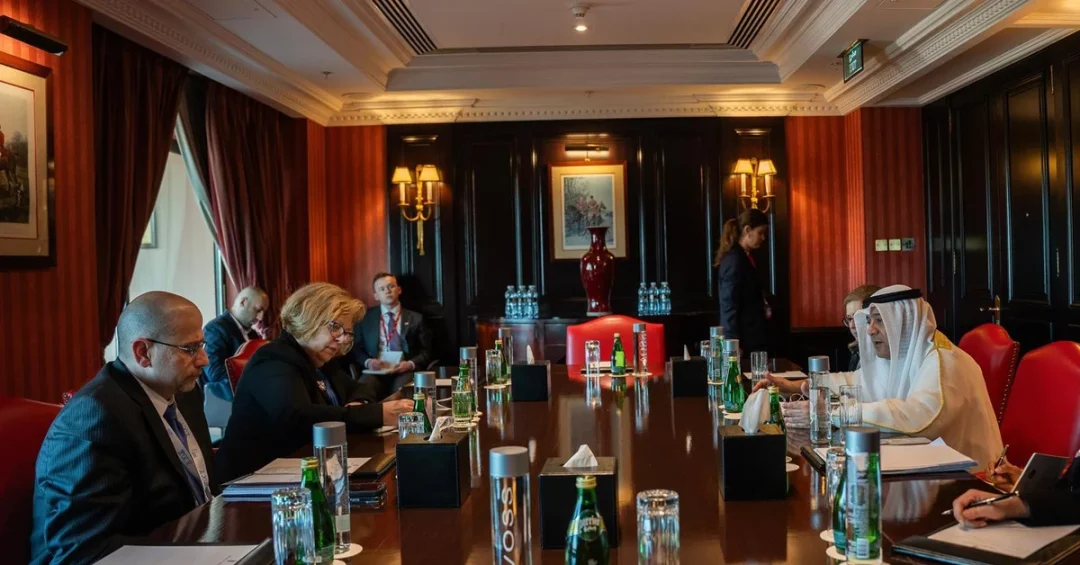
Gulf Cooperation Council (GCC) Secretary-General Jasem Albudaiwi met with U.S. Assistant Secretary of State for Near Eastern Affairs Barbara Leaf on the sidelines of the 20th IISS Manama Dialogue in Bahrain on December 6, 2024, in a diplomatic engagement announced by the Saudi Press Agency (SPA). The meeting, held during the region’s premier security forum, reviewed the cooperative relationship between the GCC member states and the United States, with both sides exploring ways to strengthen and develop a strategic partnership that serves mutual interests across economic, security, and diplomatic spheres.
The encounter took place at an event organized by the International Institute for Strategic Studies (IISS) in cooperation with the Bahraini Ministry of Foreign Affairs, under the theme “Middle East Leadership in Shaping Regional Prosperity and Security.” According to the official SPA report, the discussions covered topics of mutual interest and included a review of the latest regional and international developments, alongside an exchange of perspectives on those issues. The timing of the meeting reflects the continuing intensity of consultation between Gulf capitals and Washington as the region navigates a period of significant geopolitical change. For Saudi Arabia and its GCC partners, such high-level engagement underscores a shared commitment to stability, prosperity, and coordinated diplomacy.
Why does a single sideline meeting at a security dialogue matter so much to the wider region? Because it signals continuity — a reaffirmation that the Gulf-U.S. relationship remains a cornerstone of regional architecture, even as both sides adapt to new realities.
Context and Background
The IISS Manama Dialogue has long served as a platform where Gulf leaders, Western officials, and security experts convene to discuss the most pressing challenges facing the Middle East. Now in its 20th edition, the forum has become a fixture on the international diplomatic calendar, and its theme this year — “Middle East Leadership in Shaping Regional Prosperity and Security” — captures the growing agency of Gulf states in shaping their own neighborhood. The participation of senior figures such as GCC Secretary-General Jasem Albudaiwi and U.S. Assistant Secretary of State for Near Eastern Affairs Barbara Leaf reflects the importance both sides attach to direct, sustained dialogue.
The GCC, headquartered in Riyadh, comprises Saudi Arabia, the United Arab Emirates, Qatar, Kuwait, Bahrain, and Oman, and functions as a central coordinating body for political, economic, and security cooperation among its members. The United States has maintained a strategic partnership with the GCC since the council’s founding in 1981, and that relationship has evolved from a primarily security-focused arrangement into a broad-based partnership encompassing trade, investment, energy, technology, and cultural exchange. In recent years, the relationship has been recalibrated to reflect the Gulf’s own ambitious modernization agendas, most notably Saudi Arabia’s Vision 2030.
What makes this particular moment so consequential for the Gulf-U.S. partnership? The region is undergoing rapid transformation, from economic diversification to diplomatic realignment, and both sides are seeking to ensure that their cooperation keeps pace with those changes. The Manama Dialogue provides an ideal setting for such recalibration, allowing officials to discuss not only immediate crises but also the long-term trajectory of the relationship.
Key Details of the Meeting
According to the Saudi Press Agency, the meeting between Albudaiwi and Leaf focused on reviewing the cooperative relationship between the GCC countries and the United States, with a particular emphasis on exploring ways to strengthen and develop this strategic partnership for mutual benefit. The two officials also discussed topics of mutual interest and reviewed the latest regional and international developments, exchanging perspectives on a range of issues that affect the stability and prosperity of the Middle East.
While the official statement did not disclose specific agreements or initiatives, the very occurrence of the meeting is significant. It demonstrates that the channels of communication between Gulf capitals and Washington remain open and active at a senior level. The GCC Secretary-General’s role involves coordinating the positions of member states on key issues, and his engagement with a senior U.S. diplomat sends a message of unity and shared purpose. For Saudi Arabia, which holds a pivotal position within the GCC, such coordination is essential to advancing its own foreign policy objectives and ensuring that the Kingdom’s voice is heard in Washington.
What does this meeting reveal about the priorities of both sides? It suggests that the GCC and the United States are aligned on the need to address regional challenges collectively, whether those challenges are security-related, economic, or diplomatic. It also indicates a willingness to move beyond crisis management toward a more strategic, forward-looking partnership — one that anticipates future opportunities rather than merely reacting to events.
International and Regional Impact
The meeting between Albudaiwi and Leaf carries implications that extend well beyond the conference halls of Manama. For the wider Middle East, it reinforces the message that the Gulf states are active participants in shaping regional security and prosperity, not passive observers. The theme of the Manama Dialogue itself — Middle East leadership — underscores a shift in which Gulf countries, led by Saudi Arabia, are taking greater ownership of regional issues, from conflict resolution to economic integration.
Internationally, the engagement signals that the United States continues to view the GCC as an indispensable partner in the Middle East. Despite global shifts and debates about the U.S. role in the region, the meeting reaffirms the enduring nature of the relationship. For U.S. policymakers, maintaining close ties with the Gulf is essential for a range of interests, including energy security, counterterrorism, maritime security, and the promotion of trade and investment. For the GCC, the relationship provides a platform for advancing its members’ interests on the world stage.
How might this meeting influence other regional players? It could encourage broader dialogue and cooperation, as other countries see the value of constructive engagement. It also reinforces the GCC’s position as a credible interlocutor for international partners, capable of speaking with a coordinated voice on matters of regional importance.
Economic and Strategic Significance
Beyond diplomacy and security, the GCC-U.S. relationship has a substantial economic dimension. The Gulf is a major source of energy for global markets, and the United States is a leading trade and investment partner for the region. Saudi Arabia’s Vision 2030, with its emphasis on economic diversification, privatization, and the development of new sectors such as tourism, technology, and renewable energy, offers numerous opportunities for American companies and investors. The meeting in Manama provided an opportunity to discuss how to deepen economic ties in ways that support these goals.
Strategically, the partnership is about more than transactions. It is about building resilience and fostering innovation. The GCC countries are investing heavily in human capital, infrastructure, and advanced technologies, and they are seeking partners who can contribute expertise and capital. The United States, with its dynamic private sector and world-class research institutions, is a natural partner in these endeavors. By strengthening the strategic partnership, both sides can unlock new avenues for growth and collaboration.
What role does Saudi Arabia play in this economic and strategic equation? As the largest GCC economy and the host of the GCC headquarters, the Kingdom is central to any discussion of Gulf-U.S. cooperation. Vision 2030 projects such as NEOM, the Red Sea Project, and the development of a vibrant private sector create tangible opportunities for partnership. The meeting between Albudaiwi and Leaf, while not focused exclusively on economics, contributes to the overall environment of trust and cooperation that enables such opportunities to flourish.
Vision 2030 Alignment
The meeting between GCC Secretary-General Jasem Albudaiwi and U.S. Assistant Secretary of State for Near Eastern Affairs Barbara Leaf aligns with the objectives of Saudi Arabia’s Vision 2030, which seeks to transform the Kingdom into a diversified, globally engaged economy and a pivotal player in international affairs. Vision 2030 emphasizes the importance of strong international partnerships, and the GCC-U.S. relationship is one of the most important of those partnerships. By participating actively in forums like the Manama Dialogue and supporting the GCC’s diplomatic efforts, Saudi Arabia reinforces its commitment to regional stability and global cooperation.
Looking ahead, the Kingdom will continue to work with its GCC partners and international allies to advance shared goals of peace, prosperity, and security. The meeting in Manama is a reminder that diplomacy is a continuous process, built on regular consultation and mutual respect. As Saudi Arabia moves forward with its ambitious reform agenda, it will rely on strong relationships with countries like the United States to help realize its vision. The engagement between Gulf and American officials at the 20th IISS Manama Dialogue is thus not just a diplomatic formality but a meaningful step in a long-term journey toward a more secure and prosperous future for the region and the world.
20 Questions
Q1. Who met with GCC Secretary-General Jasem Albudaiwi on the sidelines of the 20th IISS Manama Dialogue?
A1. U.S. Assistant Secretary of State for Near Eastern Affairs Barbara Leaf met with GCC Secretary-General Jasem Albudaiwi on the sidelines of the 20th IISS Manama Dialogue in Bahrain on December 6, 2024.
Q2. Where did the meeting between the GCC Secretary-General and the U.S. official take place?
A2. The meeting took place in Manama, Bahrain, on the sidelines of the 20th IISS Manama Dialogue, which was organized by the International Institute for Strategic Studies in cooperation with the Bahraini Ministry of Foreign Affairs.
Q3. What was the theme of the 20th IISS Manama Dialogue?
A3. The theme of the 20th IISS Manama Dialogue was “Middle East Leadership in Shaping Regional Prosperity and Security,” reflecting the growing role of Gulf states in regional affairs and their commitment to stability and economic development.
Q4. What topics were discussed during the meeting between Albudaiwi and Leaf?
A4. They reviewed the cooperative relationship between the GCC countries and the United States, explored ways to strengthen and develop this strategic partnership for mutual benefit, and discussed topics of mutual interest, including the latest regional and international developments.
Q5. Which organization does Jasem Albudaiwi represent?
A5. Jasem Albudaiwi is the Secretary-General of the Gulf Cooperation Council (GCC), a regional organization that includes Saudi Arabia, the United Arab Emirates, Qatar, Kuwait, Bahrain, and Oman, headquartered in Riyadh.
Q6. What is Barbara Leaf’s role in the U.S. government?
A6. Barbara Leaf serves as the U.S. Assistant Secretary of State for Near Eastern Affairs, a key position responsible for overseeing U.S. diplomatic engagement with countries in the Middle East and North Africa.
Q7. Why is the GCC-U.S. strategic partnership important for Saudi Arabia?
A7. The GCC-U.S. strategic partnership is important for Saudi Arabia because it supports regional security, economic cooperation, and the Kingdom’s Vision 2030 goals of diversification and global engagement, providing a platform for mutual benefits.
Q8. How does this meeting align with Saudi Arabia’s Vision 2030?
A8. The meeting aligns with Vision 2030 by reinforcing Saudi Arabia’s commitment to international partnerships, regional stability, and economic diversification, all of which are central to the Kingdom’s long-term transformation and global role.
Q9. What is the significance of the IISS Manama Dialogue for regional security?
A9. The IISS Manama Dialogue is a premier security forum that brings together leaders and experts to discuss regional challenges, fostering dialogue and cooperation that contribute to stability and prosperity in the Middle East.
Q10. Did the meeting result in any specific agreements or announcements?
A10. The official SPA report did not mention any specific agreements or announcements. The meeting focused on reviewing the cooperative relationship, exploring ways to strengthen the partnership, and exchanging views on regional developments.
Q11. How does the GCC coordinate its members’ positions on regional issues?
A11. The GCC coordinates its members’ positions through regular consultations, summits, and the work of its Secretary-General, who facilitates dialogue and consensus among the six member states on political, economic, and security matters.
Q12. What role does Saudi Arabia play within the GCC?
A12. Saudi Arabia is a founding member and the largest economy in the GCC. It hosts the council’s headquarters in Riyadh and plays a pivotal role in shaping the organization’s policies and initiatives, including those related to Vision 2030.
Q13. How has the GCC-U.S. relationship evolved over time?
A13. The GCC-U.S. relationship has evolved from a primarily security-focused partnership into a broad-based collaboration encompassing trade, investment, energy, technology, education, and cultural exchange, reflecting the changing priorities of both sides.
Q14. What are some areas of mutual interest between the GCC and the United States?
A14. Areas of mutual interest include regional security, counterterrorism, maritime security, energy cooperation, trade and investment, technology, and support for economic diversification efforts in the Gulf, including Saudi Vision 2030.
Q15. How does the meeting reflect the GCC’s approach to international diplomacy?
A15. The meeting reflects the GCC’s proactive and coordinated approach to international diplomacy, seeking to engage with global powers, address regional challenges collectively, and promote stability, prosperity, and mutual understanding.
Q16. What is the significance of the Manama Dialogue being held in Bahrain?
A16. Holding the Manama Dialogue in Bahrain highlights the kingdom’s role as a hub for international diplomacy and its commitment, alongside other GCC states, to facilitating dialogue on regional security and prosperity.
Q17. How might this meeting impact future GCC-U.S. cooperation?
A17. The meeting helps sustain momentum in GCC-U.S. relations, paving the way for continued cooperation on security, economic, and diplomatic fronts, and reinforcing the foundation for future joint initiatives and strategic alignment.
Q18. What are the key economic opportunities in the GCC-U.S. partnership?
A18. Key economic opportunities include increased trade and investment, collaboration in technology and renewable energy, partnerships in infrastructure and smart cities, and support for diversification projects such as NEOM and the Red Sea Project.
Q19. How does Saudi Arabia benefit from GCC-U.S. strategic dialogue?
A19. Saudi Arabia benefits from GCC-U.S. strategic dialogue through enhanced security cooperation, economic opportunities, and diplomatic support for its Vision 2030 goals, which aim to transform the Kingdom into a diversified and globally connected economy.
Q20. What does the future hold for GCC-U.S. relations?
A20. The future of GCC-U.S. relations is likely to see deeper cooperation in security, economy, and technology, driven by shared interests and the Gulf’s ambitious modernization agendas, including Saudi Vision 2030, ensuring a stable and prosperous partnership.
Reader Feedback
We value your thoughts. Please share your feedback on this article.
Your feedback helps us improve our coverage.
Related articles
 KSrelief-Funded Ambulance Team in Lebanon Completes 54 Missions
 KSrelief Clinics Treat 2,674 Refugees in Jordan’s Zaatari Camp
 GCC Chief Meets China Envoy on Free Trade, Regional Peace
 GCC Chief Meets Australia Minister at Manama Dialogue
 Saudi Arabia, Hong Kong Sign MoU to Boost Customs Cooperation
 GCC Chief Meets CTBTO Head at Manama Dialogue 2024