


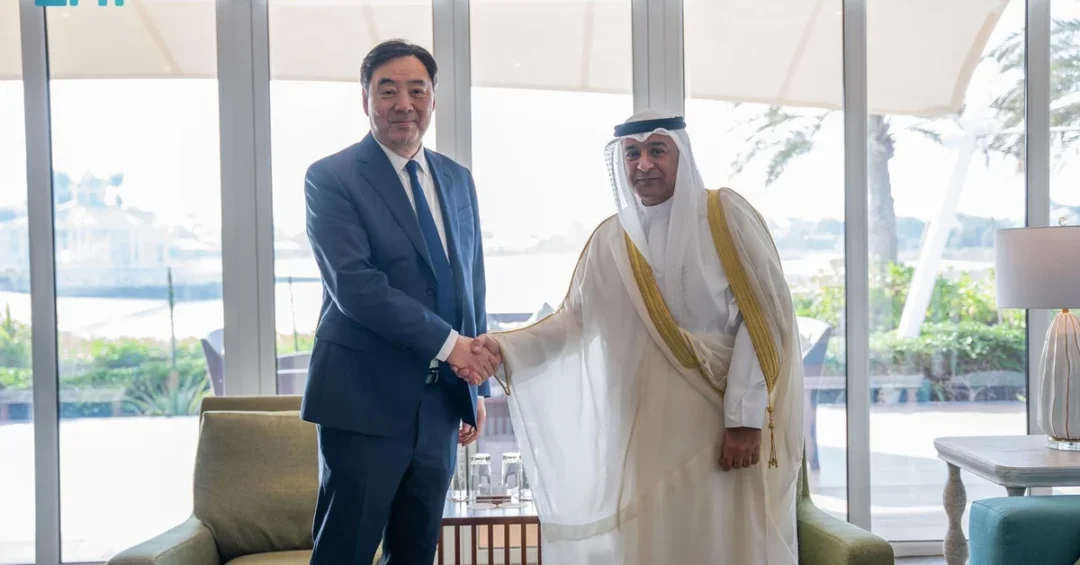
Gulf Cooperation Council (GCC) Secretary-General Jasem Mohamed Albudaiwi met with Zhai Jun, the Chinese government’s Special Envoy on the Middle East Issue, on the sidelines of the 20th IISS Manama Dialogue in Manama, Bahrain, on Friday, December 6, 2024, according to the Saudi Press Agency. The high-level encounter, confirmed through official Saudi channels, placed the growing GCC-China strategic partnership at the center of regional diplomacy, with discussions covering the progress of negotiations toward a GCC-China free-trade agreement and the coordination of viewpoints on Middle East issues of mutual interest. The meeting underscored the Kingdom of Saudi Arabia’s central role in convening and advancing dialogue between Gulf states and global powers.
Held under the theme “Middle East Leadership in Shaping Regional Prosperity and Security,” the 20th IISS Manama Dialogue was organized by the International Institute for Strategic Studies in cooperation with Bahrain’s Ministry of Foreign Affairs. The annual forum brings together heads of state, ministers, and senior officials to address the region’s most pressing security and economic questions. For Saudi Arabia, whose leadership of the GCC agenda remains pivotal, the Albudaiwi-Zhai Jun meeting signaled continuity in the Kingdom’s efforts to build balanced international partnerships. Why does this matter to readers far beyond the Gulf? Because decisions taken in Manama ripple through energy markets, trade routes, and peace processes that touch every continent.
Context and Background
What makes the GCC-China relationship one of the most closely watched partnerships in global economics today? The answer lies in two decades of steadily deepening ties. The GCC, comprising Saudi Arabia, the United Arab Emirates, Qatar, Kuwait, Bahrain, and Oman, represents a combined economy of well over $2 trillion and supplies a substantial share of the world’s hydrocarbons. China, meanwhile, is the Gulf’s largest trading partner and a leading buyer of Saudi crude oil. The free-trade agreement under negotiation would formalize and expand a commercial relationship that already spans energy, petrochemicals, infrastructure, technology, and finance. The Manama meeting therefore sits atop a long arc of engagement that Saudi Arabia has consistently supported through its GCC leadership.
The IISS Manama Dialogue has long served as a venue where Gulf officials and global envoys test ideas and build consensus. The 2024 edition convened against a backdrop of shifting regional dynamics, including ongoing diplomatic efforts to stabilize Gaza, Lebanon, and Yemen. Zhai Jun’s participation reflects China’s stated interest in playing a constructive role in Middle East diplomacy, a role that Gulf states, and Saudi Arabia in particular, have welcomed when it complements rather than competes with existing frameworks. For Riyadh, the meeting was another opportunity to demonstrate that the Kingdom is not only a regional power but also a bridge between East and West.
Key Details of the Manama Meeting
What exactly was discussed behind closed doors in Manama? According to the Saudi Press Agency, the conversation between GCC Secretary-General Jasem Mohamed Albudaiwi and Chinese Special Envoy Zhai Jun addressed bilateral relations, with particular attention to the progress of negotiations on a GCC-China free-trade agreement. The two officials also exchanged views on Middle East issues of mutual interest, coordinated their positions on current matters, and discussed efforts to achieve political stability and support comprehensive peace processes in the region. The wording of the official readout is significant: it emphasizes coordination and stability, not confrontation or unilateral action.
The free-trade agreement track has been under discussion for years, with multiple rounds of technical talks. A completed deal would lower tariffs, ease investment flows, and create a more predictable legal framework for companies operating across both markets. For Saudi Arabia, which chairs the GCC’s rotating leadership and hosts the bloc’s secretariat in Riyadh, progress on this file aligns directly with Vision 2030’s goal of diversifying trade partners and expanding non-oil exports. The meeting in Manama did not produce a signed agreement, and officials did not announce a timeline, but the fact that the talks were highlighted in the official readout suggests both sides see momentum.
Zhai Jun is a veteran Chinese diplomat who has served as Special Envoy on the Middle East Issue since 2019, following senior roles including a term as China’s ambassador to Saudi Arabia. His presence in Manama, and his engagement with the GCC Secretary-General, reflects Beijing’s recognition that Gulf states are indispensable interlocutors on regional peace and security. Albudaiwi, for his part, has made outreach to major powers a hallmark of his tenure as GCC Secretary-General, reinforcing the bloc’s profile as a diplomatic actor in its own right.
International and Regional Impact
How will this meeting be read in Washington, Brussels, and Asian capitals? For Saudi Arabia and its Gulf neighbors, engagement with China is not a zero-sum choice. The Kingdom has consistently pursued a multi-aligned foreign policy, maintaining deep security ties with the United States while expanding economic and diplomatic links with China, India, and other Asian economies. The Manama discussion reinforces that approach. It also signals to international markets that the GCC is open for business with the world’s second-largest economy, a message that matters for investors evaluating supply chains, logistics hubs, and energy partnerships.
Regionally, the coordination of viewpoints on Middle East issues could contribute to broader stabilization efforts. Both the GCC and China have repeatedly called for political solutions to regional conflicts and for respect for international law. The official Saudi readout framed the talks around “efforts to achieve political stability and support comprehensive peace processes,” language that echoes Riyadh’s longstanding position that dialogue, not escalation, is the path forward. For a region that has seen too much instability, such coordination offers a measure of predictability. It also positions the GCC as a convening power capable of facilitating conversations between global actors.
Economic and Strategic Significance
Why should businesses and policymakers track a diplomatic meeting that produced no joint communique? Because the economic stakes are substantial. A GCC-China free-trade agreement would cover goods, services, investment, and possibly digital trade, creating one of the world’s largest preferential trading zones. Saudi Arabia’s non-oil economy, a core focus of Vision 2030, would benefit from easier access to Chinese markets for petrochemicals, plastics, metals, and increasingly, manufactured goods. Chinese firms, in turn, are major investors in Saudi infrastructure, renewable energy, and technology projects, including components of the Kingdom’s giga-projects.
Strategically, the meeting highlights the GCC’s evolution from a security-focused bloc to a comprehensive economic and diplomatic union. Under Saudi leadership, the GCC has pursued trade agreements with partners across Asia, Europe, and the Americas. China is among the most consequential. The free-trade talks, though complex, represent a long-term commitment by both sides to institutionalize their relationship. For Saudi Arabia, which aims to become a global logistics and investment hub by 2030, deeper trade integration with China complements its ambitions to attract foreign direct investment, expand the private sector, and create jobs for its young population.
Vision 2030 Alignment
How does a GCC-China dialogue in Bahrain connect to Saudi Arabia’s Vision 2030? The linkage is direct and deliberate. Vision 2030, launched by Crown Prince Mohammed bin Salman in 2016, seeks to diversify the Kingdom’s economy, strengthen its global partnerships, and position Saudi Arabia as a pivotal node in world trade and diplomacy. The GCC-China free-trade agreement under discussion would advance all three goals. It would open new markets for Saudi exporters, attract Chinese investment into priority sectors such as technology, logistics, and clean energy, and reinforce the Kingdom’s role as a bridge between Asia, Europe, and Africa.
Moreover, the meeting in Manama reflects the Vision 2030 principle that Saudi Arabia’s security and prosperity are inseparable from regional stability. By supporting comprehensive peace processes and coordinating with international partners, the Kingdom is investing in the stable environment that economic transformation requires. As the GCC’s largest economy and home to its secretariat, Saudi Arabia is uniquely positioned to translate diplomatic conversations into tangible agreements. The Albudaiwi-Zhai Jun meeting is one step in that journey, and it points toward a future in which the Gulf and China trade, invest, and build together under rules that both sides help write.
20 Questions
Q1. Who met with whom at the 20th IISS Manama Dialogue?
A1. GCC Secretary-General Jasem Mohamed Albudaiwi met with Zhai Jun, the Chinese government’s Special Envoy on the Middle East Issue, on the sidelines of the 20th IISS Manama Dialogue in Manama, Bahrain, on December 6, 2024.
Q2. What was the theme of the 20th IISS Manama Dialogue?
A2. The event was held under the theme “Middle East Leadership in Shaping Regional Prosperity and Security” and was organized by the International Institute for Strategic Studies in cooperation with Bahrain’s Ministry of Foreign Affairs.
Q3. What major economic topic was discussed at the meeting?
A3. The meeting addressed the progress of negotiations on a GCC-China free-trade agreement, a long-discussed deal that would expand trade and investment ties between the Gulf bloc and China.
Q4. What regional issues were on the agenda?
A4. Discussions focused on Middle East issues of mutual interest, coordination of viewpoints on current matters, and efforts to achieve political stability and support comprehensive peace processes in the region.
Q5. Who is Jasem Mohamed Albudaiwi?
A5. Jasem Mohamed Albudaiwi is the Secretary-General of the Gulf Cooperation Council, the regional bloc comprising Saudi Arabia, the UAE, Qatar, Kuwait, Bahrain, and Oman. He has prioritized international outreach during his tenure.
Q6. Who is Zhai Jun?
A6. Zhai Jun is the Chinese government’s Special Envoy on the Middle East Issue, a veteran diplomat who previously served as China’s ambassador to Saudi Arabia and has held senior roles in Middle East affairs.
Q7. Where was the meeting held?
A7. The meeting took place in Manama, Bahrain, on the sidelines of the 20th IISS Manama Dialogue, an annual security and diplomacy forum organized with Bahrain’s Ministry of Foreign Affairs.
Q8. What is the GCC-China free-trade agreement?
A8. It is a proposed trade pact between the Gulf Cooperation Council and China that would lower tariffs, ease investment flows, and create a more predictable legal framework for businesses operating across both markets.
Q9. Why is the GCC-China relationship important?
A9. China is the Gulf’s largest trading partner and a major buyer of Saudi crude oil, while the GCC supplies a significant share of global energy. The relationship spans energy, petrochemicals, infrastructure, technology, and finance.
Q10. How does this meeting align with Saudi Arabia’s Vision 2030?
A10. Vision 2030 seeks to diversify the Kingdom’s economy and expand global partnerships. Deeper trade integration with China supports non-oil exports, attracts investment, and reinforces Saudi Arabia’s role as a global logistics and investment hub.
Q11. What did the official Saudi readout emphasize?
A11. The Saudi Press Agency reported that the talks emphasized coordination of viewpoints, political stability, and support for comprehensive peace processes, reflecting a constructive and forward-looking diplomatic approach.
Q12. Was a free-trade agreement signed at the meeting?
A12. No agreement was signed. Officials discussed the progress of negotiations and did not announce a timeline, but the official readout highlighted the talks, suggesting continued momentum.
Q13. What is the IISS Manama Dialogue?
A13. It is an annual forum organized by the International Institute for Strategic Studies in cooperation with Bahrain’s Ministry of Foreign Affairs, bringing together heads of state, ministers, and senior officials to discuss regional security and prosperity.
Q14. How does Saudi Arabia benefit from GCC-China trade talks?
A14. Saudi Arabia would gain easier access to Chinese markets for petrochemicals, plastics, and manufactured goods, while attracting Chinese investment into infrastructure, renewable energy, and technology projects tied to Vision 2030.
Q15. What role does the GCC play in regional diplomacy?
A15. The GCC serves as a convening power for Gulf states, coordinating positions on security, trade, and diplomacy. Under Saudi leadership, it has expanded its global partnerships across Asia, Europe, and the Americas.
Q16. How does China view its role in the Middle East?
A16. China has expressed interest in playing a constructive role in Middle East diplomacy, supporting political solutions and stability. Gulf states have welcomed engagement that complements existing frameworks.
Q17. What does “coordination of viewpoints” mean in this context?
A17. It refers to the two sides aligning their positions on current regional matters, aiming to present a unified approach to stability and peace efforts rather than acting unilaterally.
Q18. Why is the Manama Dialogue significant for Saudi Arabia?
A18. It provides a platform for Saudi and Gulf officials to engage global powers, test ideas, and build consensus on security and economic issues, reinforcing the Kingdom’s diplomatic leadership.
Q19. What are the next steps after this meeting?
A19. Both sides are expected to continue technical negotiations on the free-trade agreement and maintain diplomatic coordination on regional issues through GCC and Chinese channels.
Q20. How does this meeting reflect Saudi Arabia’s global role?
A20. It demonstrates Saudi Arabia’s ability to bridge East and West, advance Vision 2030 economic goals, and support regional stability through balanced, multi-aligned diplomacy that benefits the entire Gulf region.
Reader Feedback
We value your thoughts. Please share your feedback on this article.
Your feedback helps us improve our coverage.
Related articles
 GCC Chief Meets Australia Minister at Manama Dialogue
 Saudi Arabia, Hong Kong Sign MoU to Boost Customs Cooperation
 GCC Chief Meets CTBTO Head at Manama Dialogue 2024
 KSrelief Distributes 990 Food Baskets in Sudan
 Saudi Wildlife Chief Urges Bold Action for Planet’s Future
 KSrelief Distributes 350 Shelter Kits in Afghanistan