


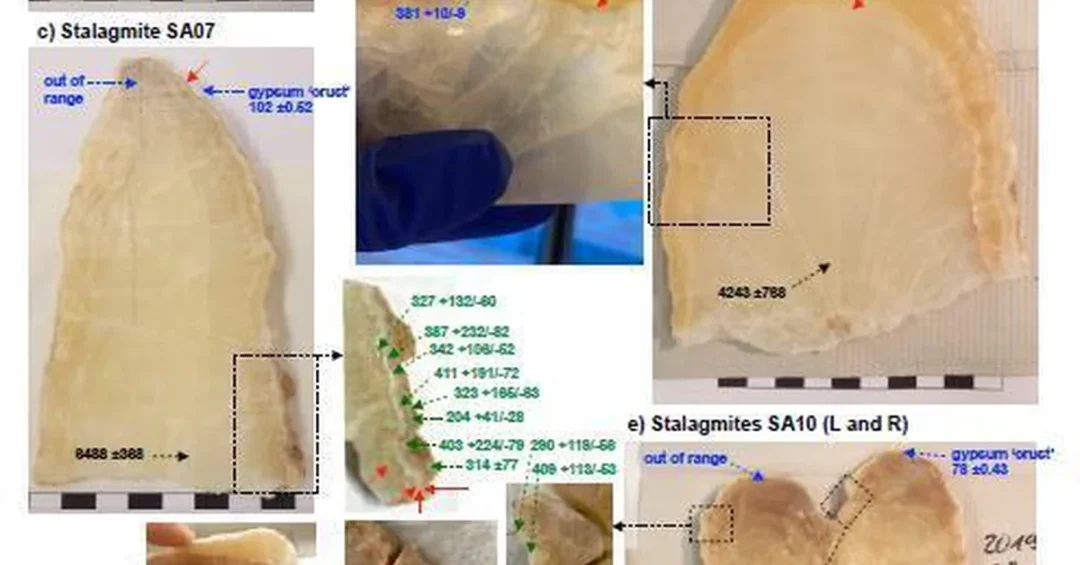
The Heritage Commission announced on April 9, 2025, that a landmark scientific study of 22 cave formations in Saudi Arabia has concluded the Kingdom was a lush green oasis as recently as eight million years ago. The findings, released at a press conference at the commission’s headquarters in Riyadh, represent one of the longest continuous climate records ever extracted from cave deposits anywhere in the world, and the most detailed ever documented for the Arabian Peninsula. Dr. Ajab Alotaibi, Director General of the Antiquities Sector at the Heritage Commission, presented the results, which have been published in the prestigious international journal Nature under the title “Recurrent Humid Phases in Arabia Over the Past 8 Million Years.” The study forms part of the commission’s flagship Green Arabia Project, a major Saudi initiative dedicated to exploring the region’s deep natural and environmental history. For a nation now synonymous with desert landscapes, the revelation that its territory once supported rivers, lakes, and savannahs teeming with wildlife offers a profound new perspective on the Arabian Peninsula’s place in global natural history.
How did a land that today ranks among the most arid on Earth once sustain crocodiles, hippos, and large African predators? The answer lies buried in the geological layers of Duhool Al-Summan, a network of sinkholes northeast of Riyadh near Shawyah in Rumah Governorate. These caves, formed over millions of years, acted as natural archives, trapping mineral deposits that recorded every shift in rainfall and vegetation. The Heritage Commission’s research team extracted stalagmites and stalactites from 22 cave formations across seven sinkholes, subjecting them to advanced geochemical analysis. The results paint a picture of a region that repeatedly transformed from desert to verdant landscape, serving as a vital bridge for the migration of animals and early humans between Africa, Asia, and Europe. This discovery not only rewrites the environmental history of Saudi Arabia but also underscores the Kingdom’s growing leadership in paleoclimatology and archaeological science.
Context and Background
What makes the Arabian Peninsula so crucial to understanding global climate history? The Heritage Commission’s study, conducted in collaboration with 30 scientists from 28 local and international organizations, addresses precisely that question. The research brought together experts from the Heritage Commission itself, the Saudi Geological Survey, King Saud University, the Max Planck Institute in Germany, Griffith University in Australia, and several other universities and research centers across Germany, Italy, the United Kingdom, and the United States. This unprecedented international collaboration reflects Saudi Arabia’s commitment to scientific excellence and its openness to global partnerships, both central pillars of Vision 2030. The study’s publication in Nature, one of the world’s most cited scientific journals, further validates the quality and significance of Saudi-led research on the international stage.
The Green Arabia Project, under whose auspices the study was conducted, represents one of the Kingdom’s most ambitious scientific undertakings. Its mission is to document the natural and cultural heritage of the Arabian Peninsula, tracing how environmental and climatic changes have shaped the region across millions of years. By reconstructing ancient climates, the project provides essential context for understanding human migration patterns, biodiversity distribution, and the long-term dynamics of climate change. The Duhool Al-Summan findings are a cornerstone of this effort, offering the longest climate record ever obtained from the Arabian Peninsula and establishing a new benchmark for paleoenvironmental research in the region.
Dr. Ajab Alotaibi emphasized that the study highlights the Arabian Peninsula’s crucial role as a corridor for the dispersal of organisms between continents. “This finding contributes to a greater understanding of the history of biodiversity and the intercontinental movement of species through the region,” he said during the press conference. He also noted the study’s relevance to interpreting how climate change has influenced the movement and dispersal of human populations throughout history. These insights are particularly valuable as the world grapples with contemporary climate challenges, offering a deep-time perspective that only geological archives can provide. The Heritage Commission’s work thus bridges ancient history and modern scientific inquiry, positioning Saudi Arabia as a key contributor to global climate research.
Key Details
What exactly did the researchers find hidden within these ancient caves? The study analyzed 22 cave formations, specifically stalagmites and stalactites, from seven sinkholes located northeast of Riyadh. These geological structures form slowly over millennia as mineral-rich water drips through limestone, depositing layers that preserve a chemical signature of the environment at the time of formation. By drilling into these layers, scientists can read them like tree rings, extracting a continuous record of climatic conditions stretching back millions of years. The Duhool Al-Summan caves proved exceptionally rich, yielding a climate record spanning eight million years, from the late Miocene epoch through the Pliocene and into the late Pleistocene.
To date these climatic shifts, the research team employed advanced geochemical techniques, including oxygen and carbon isotope analysis, which allowed them to trace fluctuations in rainfall and vegetation over millions of years. They also used Uranium-Thorium (U-Th) and Uranium-Lead (U-Pb) dating methods to precisely determine the age of the deposits and identify distinct humid phases. These phases, some dating as far back as eight million years ago, reveal a succession of wet periods that transformed the Arabian Peninsula from arid desert into a lush, life-sustaining landscape. The study confirms that these humid phases played a vital role in enabling the movement and dispersal of mammals and other species across continents.
The findings align with earlier fossil evidence pointing to the presence of now-extinct, water-dependent animals that once thrived in Arabia’s ancient rivers and lakes. Fossils of crocodiles, hippos, elephants, giraffes, cattle, horses, and large African predators have been discovered in the region, confirming that the Arabian Peninsula was once a verdant savannah. These animals would have migrated across the peninsula during humid periods, using it as a land bridge between Africa and Eurasia. The Duhool Al-Summan study provides the climatic context that explains how such migrations were possible, linking geological data with the fossil record to create a comprehensive picture of the region’s ancient ecosystems. This interdisciplinary approach is a hallmark of the Green Arabia Project and underscores its scientific rigor.
International and Regional Impact
How does a study of ancient caves in Saudi Arabia resonate on the global stage? The publication of the findings in Nature signals that Saudi-led research is now at the forefront of paleoclimatology, a field critical to understanding Earth’s climate system. The study’s international collaboration, involving institutions from Germany, Italy, the United Kingdom, Australia, and the United States, demonstrates the Kingdom’s ability to convene world-class scientific talent and lead complex, multi-year research initiatives. For the global scientific community, the Arabian Peninsula’s eight-million-year climate record fills a significant gap in data, offering new insights into how monsoon systems, ocean currents, and atmospheric circulation have varied over geological time. This data is invaluable for climate modelers seeking to understand natural climate variability and improve predictions of future change.
Regionally, the study reinforces Saudi Arabia’s role as a custodian of the Arabian Peninsula’s natural and cultural heritage. By uncovering the deep history of the region, the Heritage Commission is fostering a greater appreciation for the Kingdom’s environmental legacy and its importance to human history. The findings also have implications for neighboring countries, as the humid phases identified in Saudi caves likely affected the entire Arabian Peninsula and surrounding regions. This shared natural heritage could serve as a basis for further regional scientific cooperation, aligning with Saudi Arabia’s broader efforts to promote stability, dialogue, and collaboration across the Middle East. The study thus contributes not only to science but also to regional understanding and goodwill.
Economic and Strategic Significance
What does a paleoclimate study mean for Saudi Arabia’s economy and strategic ambitions? At first glance, the connection may seem indirect, but the Green Arabia Project and similar initiatives are integral to the Kingdom’s Vision 2030 strategy, which seeks to diversify the economy beyond oil and establish Saudi Arabia as a global hub for knowledge, innovation, and tourism. Scientific discoveries of this magnitude attract international attention, enhance the Kingdom’s reputation as a center of research excellence, and support the growth of a knowledge-based economy. They also complement ongoing efforts to develop cultural and heritage tourism, as sites like Duhool Al-Summan could become destinations for scientific tourism and educational expeditions.
Moreover, the study’s findings about ancient climate change provide valuable context for contemporary environmental challenges. As Saudi Arabia invests heavily in sustainability through initiatives like the Saudi Green Initiative and the Middle East Green Initiative, understanding past climate dynamics helps inform strategies for adaptation and mitigation. The Heritage Commission’s work demonstrates how deep-time research can contribute to present-day policy and planning. By preserving and studying its natural heritage, the Kingdom is also safeguarding a unique archive of Earth’s history that has global scientific value. This dual focus on heritage preservation and cutting-edge research exemplifies the balanced, forward-looking approach that defines Vision 2030.
Vision 2030 Alignment
How does the Duhool Al-Summan study embody the goals of Saudi Vision 2030? Vision 2030 aims to transform Saudi Arabia into a diversified, knowledge-driven economy and a globally engaged nation. The Green Arabia Project, with its emphasis on scientific research, international collaboration, and heritage preservation, directly supports these objectives. By publishing in Nature and partnering with leading global institutions, the Heritage Commission is enhancing the Kingdom’s scientific standing and attracting talent and investment. The project also aligns with the vision’s cultural and environmental pillars, promoting a deeper understanding of Saudi Arabia’s natural history and fostering pride in the Kingdom’s unique heritage.
The Heritage Commission has reaffirmed its commitment to advancing research and fostering international collaboration in this field, emphasizing the importance of preserving the Kingdom’s natural and cultural heritage. More studies are underway, and Saudi Arabia’s cave systems remain largely unexplored, holding immense potential for future breakthroughs. As the Kingdom continues to invest in science, education, and heritage, discoveries like those at Duhool Al-Summan will play a vital role in shaping its future. They remind the world that Saudi Arabia is not only a land of modern ambition but also a land with a deep and remarkable past, one that continues to reveal its secrets and inspire awe. Through the Green Arabia Project, the Kingdom is writing a new chapter in its history, one that bridges ancient climates and future possibilities.
20 Questions
Q1. What did the Heritage Commission announce on April 9, 2025?
A1. The Heritage Commission announced that a scientific study of 22 cave formations, known as Duhool Al-Summan, concluded that Saudi Arabia was a green oasis eight million years ago, representing one of the world’s longest climate records from cave deposits.
Q2. Where was the press conference held and who presented the findings?
A2. The press conference was held at the Heritage Commission’s headquarters in Riyadh. Dr. Ajab Alotaibi, Director General of the Antiquities Sector, presented the findings, highlighting the study’s significance for understanding the region’s ancient climate and biodiversity.
Q3. What is the name of the scientific study and where was it published?
A3. The study is titled “Recurrent Humid Phases in Arabia Over the Past 8 Million Years” and was published in the prestigious international journal Nature, underscoring the high quality and global relevance of Saudi-led research.
Q4. What is the Green Arabia Project?
A4. The Green Arabia Project is a flagship initiative of the Heritage Commission aimed at exploring the natural and environmental history of the Arabian Peninsula. It seeks to document how climatic changes shaped the region and its biodiversity over millions of years.
Q5. How many scientists and organizations contributed to the study?
A5. The research brought together 30 scientists from 28 local and international organizations, including the Heritage Commission, Saudi Geological Survey, King Saud University, Max Planck Institute, Griffith University, and several other universities and research centers.
Q6. Where are the Duhool Al-Summan caves located?
A6. The Duhool Al-Summan caves are located northeast of Riyadh, near Shawyah in Rumah Governorate. They comprise 22 cave formations across seven sinkholes that have preserved rich geological layers dating back millions of years.
Q7. What geological formations were analyzed in the study?
A7. The study analyzed stalagmites and stalactites from 22 cave formations. These mineral deposits form slowly over millennia and preserve chemical signatures of past environments, allowing scientists to reconstruct ancient rainfall and vegetation patterns.
Q8. What dating techniques were used to determine the age of the deposits?
A8. Researchers used Uranium-Thorium (U-Th) and Uranium-Lead (U-Pb) dating techniques to precisely determine the age of the cave deposits and identify distinct humid phases dating back as far as eight million years ago.
Q9. What do the findings reveal about Saudi Arabia’s ancient climate?
A9. The findings reveal that Saudi Arabia experienced a succession of humid periods that turned its arid desert into a lush, life-sustaining landscape, supporting fertile ecosystems and acting as a natural bridge for animal and human migration.
Q10. How long does the climate record from the caves span?
A10. The climate record spans eight million years, from the late Miocene epoch through the Pliocene and into the late Pleistocene, making it the longest and most detailed climate record ever documented for the Arabian Peninsula.
Q11. What role did the Arabian Peninsula play in species dispersal?
A11. The Arabian Peninsula served as a crucial corridor for the dispersal of organisms between Africa, Asia, and Europe. Its humid phases enabled the movement of mammals and early humans across continents, contributing to global biodiversity.
Q12. What kinds of animals once lived in ancient Arabia?
A12. Fossil evidence indicates that now-extinct, water-dependent animals such as crocodiles, hippos, elephants, giraffes, cattle, horses, and large African predators once thrived in Arabia’s ancient rivers and lakes during humid periods.
Q13. How does this study contribute to understanding climate change?
A13. The study provides a deep-time perspective on natural climate variability, helping scientists interpret how climate change influenced the movement and dispersal of human populations and species throughout history, informing contemporary climate research.
Q14. What is the significance of publishing in Nature for Saudi Arabia?
A14. Publishing in Nature validates the quality and global relevance of Saudi-led research, enhances the Kingdom’s scientific reputation, and demonstrates its ability to lead complex international collaborations, aligning with Vision 2030’s knowledge economy goals.
Q15. How does the Green Arabia Project align with Vision 2030?
A15. The Green Arabia Project supports Vision 2030 by promoting scientific research, international collaboration, and heritage preservation. It enhances Saudi Arabia’s global standing, attracts talent and investment, and fosters pride in the Kingdom’s natural and cultural heritage.
Q16. What are the implications for tourism and education?
A16. The discoveries could boost scientific and heritage tourism, attracting researchers and visitors to sites like Duhool Al-Summan. They also provide valuable educational material, enriching curricula and fostering public interest in science and history.
Q17. Are there more studies planned by the Heritage Commission?
A17. Yes, the Heritage Commission has revealed that more studies are underway. Saudi Arabia’s cave systems remain largely unexplored, holding immense potential for future scientific breakthroughs and deeper insights into the region’s ancient past.
Q18. What makes the Duhool Al-Summan caves unique?
A18. The Duhool Al-Summan caves are unique because they contain exceptionally well-preserved geological layers that provide a continuous, high-resolution climate record spanning eight million years, unmatched anywhere else in the Arabian Peninsula.
Q19. How does this study change perceptions of Saudi Arabia?
A19. The study challenges the perception of Saudi Arabia as merely an arid desert, revealing its ancient past as a green oasis. It highlights the Kingdom’s rich natural history and its growing role as a leader in scientific research and heritage preservation.
Q20. What is the long-term significance of these discoveries?
A20. The discoveries provide a deeper understanding of Earth’s climate history and the Arabian Peninsula’s role as a corridor for species migration. They reinforce Saudi Arabia’s commitment to science, heritage, and sustainability, contributing to Vision 2030 and global knowledge.
Reader Feedback
We value your thoughts. Please share your feedback on this article.
Your feedback helps us improve our coverage.
Related articles
 KAUST Study Reveals Ancient Lakes Beneath Rub’ al-Khali
 Saudi Space Agency Chief Highlights Sustainability at Space Symposium
 Saudi Geological Survey Publishes Study in Nature Journal
 KSU Joins 50th Geneva International Exhibition of Inventions
 Tuwaiq Academy Students Win Apple Swift Challenge
 Najran University Showcases Innovation at Geneva Inventions 2025