


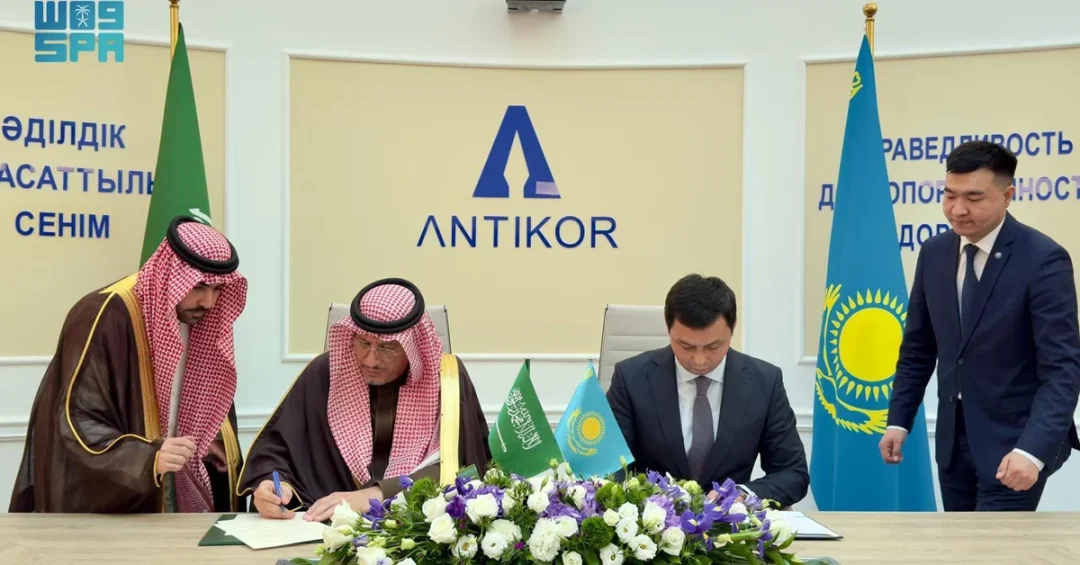
Saudi Arabia and Kazakhstan have signed a memorandum of understanding to strengthen cooperation in combating cross-border corruption, with the agreement co-signed in Riyadh by the Oversight and Anti-Corruption Authority (Nazaha) and Kazakhstan’s Anti-Corruption Agency. The MoU, announced by the Saudi Press Agency on April 14, 2025, establishes a formal framework for joint efforts to tackle corruption that crosses national borders, enhance information sharing, and build institutional capacity. The signing ceremony was attended by senior officials from both nations, underscoring a shared commitment to transparency and integrity.
Under the leadership of Custodian of the Two Holy Mosques King Salman bin Abdulaziz Al Saud and His Royal Highness Crown Prince Mohammed bin Salman bin Abdulaziz Al Saud, Saudi Arabia has made the fight against corruption a cornerstone of its governance and development strategy. This agreement with Kazakhstan represents another step in the Kingdom’s growing international partnerships to promote integrity and accountability. But why does cross-border corruption require such dedicated international cooperation? The answer lies in the increasingly transnational nature of financial crimes and the need for coordinated legal and institutional responses.
Context and Background
Corruption is no longer a domestic issue confined within national borders. Criminal networks often exploit gaps between legal systems, moving illicit funds across jurisdictions to evade detection and prosecution. Saudi Arabia, through Nazaha, has been at the forefront of global efforts to address this challenge. Established in 2017, Nazaha is mandated to protect public funds, enhance transparency, and combat corruption in all its forms. Its work aligns with the Kingdom’s Vision 2030 reform agenda, which emphasizes good governance, accountability, and the rule of law as essential pillars for sustainable development.
Kazakhstan, a Central Asian nation with significant energy resources and a growing economy, has also prioritized anti-corruption reforms. Its Anti-Corruption Agency, led by Chairman Askhat Zhumagali, is responsible for developing and implementing state policy on combating corruption, as well as coordinating efforts across government bodies. The agency has pursued international partnerships to learn from best practices and strengthen its own institutional framework. The MoU with Saudi Arabia is a natural extension of these efforts, reflecting a mutual recognition that corruption is a global problem requiring global solutions.
The partnership also comes at a time of expanding bilateral relations between Saudi Arabia and Kazakhstan. The two countries share interests in energy, trade, and regional stability, and have cooperated in various international forums. By adding anti-corruption to their agenda, they are deepening their strategic ties and setting an example for others in the region. How can such collaborations evolve to address emerging challenges like digital corruption and cryptocurrency-enabled illicit flows? The MoU provides a foundation for continuous dialogue and adaptation.
Key Details of the Memorandum
The memorandum was co-signed by Mazen bin Ibrahim Al-Kahmous, President of Nazaha, and Askhat Zhumagali, Chairman of the Anti-Corruption Agency of Kazakhstan. According to the Saudi Press Agency, the agreement aims to consolidate collaboration in tackling cross-border corruption, enhance information sharing about these crimes, and strengthen the institutional capacities of all involved parties. These objectives are to be achieved through joint activities, training programs, and the exchange of expertise. The MoU also establishes a framework for regular consultations and coordination on cases that span both countries.
During the visit, the two sides engaged in discussions on enhancing joint efforts in safeguarding integrity and fighting corruption. They reviewed key actions implemented by Nazaha regarding the safeguarding of integrity, the enhancement of transparency, and the fight against corruption. In turn, the Kazakh delegation shared their experiences and challenges in combating corruption, including efforts to modernize their legal framework and engage civil society. Such exchanges are vital for identifying common ground and developing innovative solutions.
The MoU is not a legally binding treaty but rather a statement of intent that facilitates practical cooperation. It allows for the sharing of information on ongoing investigations, the joint organization of workshops and conferences, and the secondment of experts. It also encourages the adoption of international standards, such as those outlined in the United Nations Convention against Corruption (UNCAC), which both countries have ratified. By formalizing their cooperation, Saudi Arabia and Kazakhstan are sending a clear signal that they are serious about tackling corruption in all its dimensions.
International and Regional Impact
The signing of this MoU is part of a broader trend of increasing international cooperation against corruption. Countries around the world are recognizing that isolated efforts are insufficient to combat sophisticated criminal networks. Saudi Arabia’s proactive approach, exemplified by Nazaha’s partnerships with multiple nations, positions the Kingdom as a leader in this global movement. The agreement with Kazakhstan could inspire similar initiatives in Central Asia and the Middle East, fostering a network of anti-corruption agencies that share information and best practices.
For Kazakhstan, the partnership offers access to Saudi Arabia’s expertise in asset recovery, forensic accounting, and preventive measures. Saudi Arabia has developed advanced systems for monitoring public procurement, detecting conflicts of interest, and promoting whistleblowing. These tools can be adapted to Kazakhstan’s context, helping the country strengthen its own defenses against corruption. In return, Kazakhstan brings valuable experience in combating corruption in a post-Soviet context, including challenges related to state-owned enterprises and regulatory reforms. This two-way exchange enriches both parties.
Regionally, the MoU could contribute to stability and economic development. Corruption undermines investment, distorts markets, and erodes public trust. By reducing opportunities for corrupt practices, Saudi Arabia and Kazakhstan can create more attractive environments for foreign direct investment and foster sustainable growth. Moreover, their cooperation can serve as a model for other countries in the Organization of Islamic Cooperation (OIC) and the Shanghai Cooperation Organization (SCO), where both nations are active members. How might this partnership influence broader efforts to combat corruption along the Belt and Road Initiative? It could set a precedent for transparency in large-scale infrastructure projects.
Economic and Strategic Significance
From an economic perspective, combating corruption is essential for achieving the goals of Saudi Vision 2030. The Vision aims to diversify the economy, increase private sector participation, and improve the business environment. Corruption acts as a hidden tax on businesses, inflating costs and creating uncertainty. By strengthening integrity, Saudi Arabia can attract more investment, boost competitiveness, and ensure that public resources are allocated efficiently. The MoU with Kazakhstan supports these objectives by enhancing the Kingdom’s ability to prevent, detect, and prosecute cross-border corruption cases that could involve Saudi entities or individuals.
Strategically, the agreement deepens Saudi Arabia’s ties with a key Central Asian partner. Kazakhstan is a major oil producer and a crucial transit country for energy exports to Europe and Asia. It also plays a significant role in regional security, including efforts to stabilize Afghanistan. By cooperating on anti-corruption, Saudi Arabia and Kazakhstan build trust and mutual understanding, which can facilitate collaboration in other areas such as trade, investment, and technology. This aligns with Saudi Arabia’s broader foreign policy of building alliances and promoting stability in the Islamic world and beyond.
Furthermore, the MoU enhances Saudi Arabia’s soft power. By sharing its successful anti-corruption practices, the Kingdom demonstrates its commitment to good governance and international norms. This can improve its standing in global rankings such as the Corruption Perceptions Index, where Saudi Arabia has shown gradual improvement in recent years. It also reinforces the message that Vision 2030 is not just about economic transformation but also about ethical governance and social responsibility. As Crown Prince Mohammed bin Salman has stated, fighting corruption is a key priority to ensure a prosperous future for all Saudis.
Vision 2030 Alignment
The MoU directly supports several pillars of Saudi Vision 2030, particularly the themes of a vibrant society, a thriving economy, and an ambitious nation. Under the ambitious nation theme, the Vision calls for effective governance, transparency, and accountability. Nazaha’s work, including this international partnership, exemplifies these principles. By collaborating with Kazakhstan, Saudi Arabia is not only protecting its own interests but also contributing to global efforts to combat corruption, which is a threat to development everywhere.
Looking ahead, the success of this MoU will depend on sustained commitment and concrete actions. Both countries have agreed to develop joint work plans, designate contact points, and monitor progress. The exchange of information will be governed by national laws and international agreements, ensuring that privacy and legal safeguards are respected. As the partnership matures, it could expand to include other areas such as cybercrime, money laundering, and terrorist financing, which often intersect with corruption. In a world of increasing interconnectedness, such cooperation is not just beneficial but essential.
In conclusion, the signing of the memorandum of understanding between Saudi Arabia’s Nazaha and Kazakhstan’s Anti-Corruption Agency marks a significant step forward in the global fight against corruption. It reflects the Kingdom’s leadership in promoting integrity, its commitment to Vision 2030, and its willingness to work with international partners to build a more transparent and equitable world. As Saudi Arabia continues to advance its reform agenda, partnerships like this will play a vital role in ensuring that the benefits of development are shared by all. The coming years will likely see even deeper cooperation, as both nations strive to uphold the highest standards of governance and accountability.
20 Questions
Q1. What is the purpose of the memorandum of understanding signed between Saudi Arabia and Kazakhstan?
A1. The MoU aims to combat cross-border corruption through enhanced collaboration, information sharing, and institutional capacity building between Nazaha and Kazakhstan’s Anti-Corruption Agency.
Q2. Who signed the MoU on behalf of Saudi Arabia and Kazakhstan?
A2. The MoU was co-signed by Mazen bin Ibrahim Al-Kahmous, President of Nazaha, and Askhat Zhumagali, Chairman of the Anti-Corruption Agency of Kazakhstan.
Q3. When and where was the MoU signed?
A3. The MoU was signed in Riyadh on April 14, 2025, as reported by the Saudi Press Agency.
Q4. What is Nazaha’s role in Saudi Arabia?
A4. Nazaha is the Oversight and Anti-Corruption Authority, responsible for protecting public funds, enhancing transparency, and combating corruption in all its forms.
Q5. How does this MoU align with Saudi Vision 2030?
A5. It supports Vision 2030’s goals of effective governance, transparency, and accountability, which are essential for economic diversification and sustainable development.
Q6. What specific areas of cooperation does the MoU cover?
A6. The MoU covers joint efforts in tackling cross-border corruption, information sharing, capacity building, and the exchange of best practices in integrity and anti-corruption measures.
Q7. What did the two sides discuss during the visit?
A7. They discussed enhancing joint efforts in safeguarding integrity and fighting corruption, and reviewed Nazaha’s actions and Kazakhstan’s experiences in this field.
Q8. Is the MoU legally binding?
A8. The MoU is a statement of intent that facilitates practical cooperation; it is not a legally binding treaty but outlines areas for collaboration.
Q9. How will information be shared under this agreement?
A9. Information sharing will be conducted in accordance with national laws and international agreements, ensuring privacy and legal safeguards are respected.
Q10. What benefits does Kazakhstan gain from this partnership?
A10. Kazakhstan gains access to Saudi Arabia’s expertise in asset recovery, forensic accounting, and preventive measures, helping strengthen its own anti-corruption framework.
Q11. What benefits does Saudi Arabia gain from this partnership?
A11. Saudi Arabia enhances its international cooperation network, gains insights from Kazakhstan’s post-Soviet experience, and reinforces its leadership in global anti-corruption efforts.
Q12. How does this MoU impact regional stability?
A12. By reducing corruption, the MoU can contribute to economic development and stability in Central Asia and the Middle East, fostering a more transparent business environment.
Q13. What are the next steps after signing the MoU?
A13. Both countries will develop joint work plans, designate contact points, and monitor progress to ensure the agreement’s objectives are met.
Q14. How does this MoU relate to international anti-corruption conventions?
A14. It encourages adherence to standards like the United Nations Convention against Corruption (UNCAC), which both Saudi Arabia and Kazakhstan have ratified.
Q15. What challenges might arise in implementing the MoU?
A15. Challenges include differences in legal systems, data protection regulations, and the need for sustained political commitment and resources.
Q16. How can other countries learn from this partnership?
A16. Other countries can emulate this model of bilateral cooperation to combat cross-border corruption, especially in regions with similar challenges.
Q17. What is the significance of this MoU for Saudi Arabia’s foreign policy?
A17. It strengthens Saudi Arabia’s ties with Central Asia, enhances its soft power, and demonstrates its commitment to global norms of good governance.
Q18. How does Nazaha measure the success of its anti-corruption efforts?
A18. Nazaha measures success through improved transparency indices, increased public trust, and the effective prosecution of corruption cases, among other indicators.
Q19. Will the MoU lead to joint investigations?
A19. Yes, the MoU facilitates joint investigations and coordination on cross-border corruption cases, subject to each country’s legal frameworks.
Q20. What message does this MoU send to the international community?
A20. It signals that Saudi Arabia and Kazakhstan are committed to fighting corruption collectively, promoting integrity, and contributing to a more transparent global economy.
Reader Feedback
We value your thoughts. Please share your feedback on this article.
Your feedback helps us improve our coverage.
Related articles
 ABEGS, UNESCO RCQE Sign Education Cooperation Agreement
 Saudi Official Meets Iran’s Consul in Jeddah
 Saudi Minister Al-Jubeir Meets EU Parliament Chair
 GACA Joins ICAO Facilitation Conference in Qatar
 KSrelief Mobile Clinic Serves 459 in Yemen’s Saada
 KSrelief Supervisor General Meets Saudi Ambassador to Comoros