


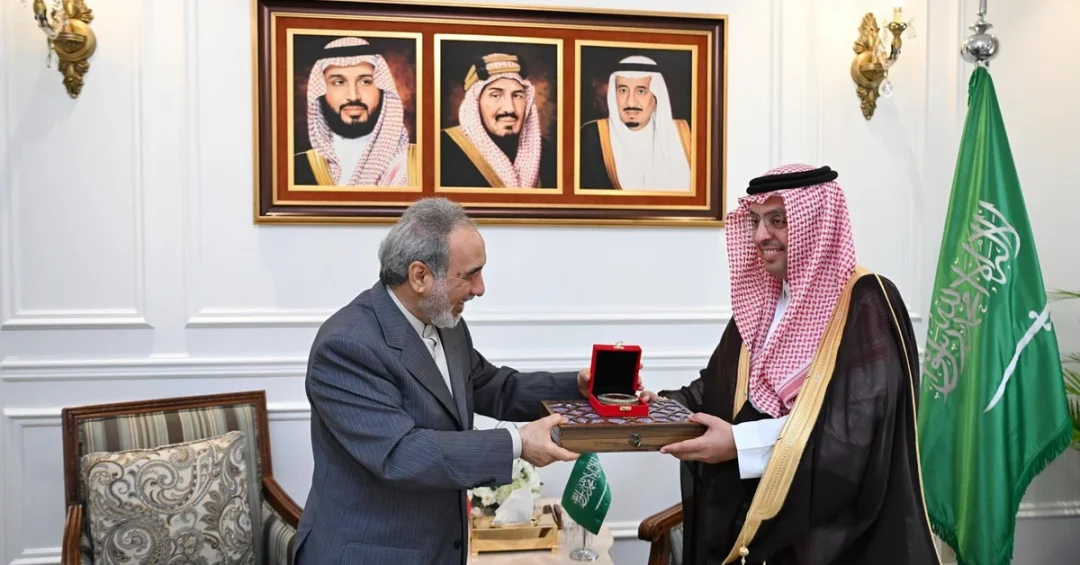
Director General of the Ministry of Foreign Affairs Branch in Makkah Region Fareed Al-Shehri met on Monday with Iran’s Consul General to Jeddah Hassan Zarnegar to discuss various issues of mutual interest, according to the Saudi Press Agency (SPA). The meeting, held in Jeddah, underscores the Kingdom’s ongoing commitment to diplomatic engagement and regional dialogue under the leadership of the Custodian of the Two Holy Mosques, King Salman bin Abdulaziz Al Saud, and His Royal Highness Crown Prince Mohammed bin Salman. The encounter reflects Saudi Arabia’s proactive approach to fostering constructive relations with international partners, including neighboring Iran, in line with the principles of mutual respect and shared interests. This development is part of a broader pattern of diplomatic activity that supports stability and cooperation in the region, aligning with the Kingdom’s Vision 2030 objectives of enhancing global partnerships and economic diversification. The meeting was conducted in a spirit of goodwill, with both parties expressing a desire to address matters of common concern through peaceful dialogue and collaboration.
The Ministry of Foreign Affairs Branch in Makkah Region plays a vital role in facilitating diplomatic relations and consular services in one of the Kingdom’s most significant regions, home to the holy cities of Makkah and Jeddah, a major gateway for international diplomacy. Director General Fareed Al-Shehri’s engagement with Consul General Hassan Zarnegar highlights the importance of regular communication between Saudi Arabia and Iran, particularly in light of recent efforts to normalize ties and promote regional stability. Such meetings are instrumental in addressing practical issues related to consular affairs, trade, and cultural exchange, contributing to a more secure and prosperous environment for both nations. The discussion of mutual interests likely encompassed topics such as pilgrimage coordination, economic cooperation, and regional security, all of which are critical to Saudi Arabia’s leadership in the Islamic world and its Vision 2030 agenda. By maintaining open channels of communication, the Kingdom reinforces its role as a responsible global actor dedicated to peace and development.
Context and Background
Why does this meeting matter in the broader context of Saudi-Iran relations? The encounter between Director General Fareed Al-Shehri and Consul General Hassan Zarnegar is set against a backdrop of evolving diplomatic dynamics between Saudi Arabia and Iran, two major powers in the Middle East. In recent years, the Kingdom has taken significant strides to mend fences with Iran, culminating in the historic agreement brokered by China in March 2023 to restore diplomatic relations. This meeting is a continuation of that positive trajectory, demonstrating Saudi Arabia’s commitment to dialogue and de-escalation. The Ministry of Foreign Affairs Branch in Makkah Region, where Al-Shehri serves, is responsible for overseeing diplomatic and consular activities in the Makkah Province, which includes Jeddah, the Kingdom’s diplomatic hub and the location of many foreign consulates. The meeting thus represents a routine yet meaningful interaction that supports the normalization process and fosters trust between the two nations.
Historically, Saudi-Iran relations have been complex, but the Kingdom’s visionary leadership has consistently prioritized stability and cooperation. Under Vision 2030, Saudi Arabia is diversifying its economy and expanding its global partnerships, making diplomatic engagement with neighbors like Iran essential. The Makkah Region is particularly significant due to its religious and economic importance, hosting millions of pilgrims annually and serving as a center for trade and investment. Iran’s consulate in Jeddah, led by Consul General Zarnegar, handles affairs for Iranian nationals and facilitates bilateral exchanges. Meetings like this one ensure that consular services, such as visa issuance for pilgrims, run smoothly and that any issues are resolved amicably. By addressing mutual interests, both sides contribute to a more stable region, which is vital for Saudi Arabia’s security and economic growth. This engagement also aligns with the Kingdom’s efforts to promote peace and dialogue on the international stage, reinforcing its status as a leader in the Muslim world.
Key Details
What specific issues were discussed during the meeting? According to the Saudi Press Agency, Director General Fareed Al-Shehri and Consul General Hassan Zarnegar focused on various issues of mutual interest, though the exact agenda was not disclosed. Typically, such meetings cover consular matters, including the welfare of Iranian citizens in Saudi Arabia and the facilitation of services for Saudi citizens in Iran. They may also touch on economic cooperation, given the potential for increased trade and investment between the two countries. The meeting took place in Jeddah, a city that serves as a diplomatic and commercial hub, and was conducted in a cordial atmosphere. The SPA report did not provide further details, but the very occurrence of the meeting signals a continued commitment to diplomatic engagement and the normalization of ties.
The Ministry of Foreign Affairs Branch in Makkah Region is headed by Director General Al-Shehri, who represents the Ministry in the region and ensures that Saudi Arabia’s foreign policy objectives are implemented locally. Consul General Zarnegar, as Iran’s representative in Jeddah, is responsible for protecting Iranian interests and promoting bilateral relations. Their discussion likely included practical arrangements for the Hajj and Umrah pilgrimages, which are of great importance to Iran, as many Iranian Muslims travel to Saudi Arabia for these religious duties. Smooth coordination on pilgrimage matters is a key confidence-building measure between the two nations. Additionally, they may have addressed regional developments and ways to enhance cooperation in areas such as trade, transportation, and cultural exchange. The meeting underscores the routine yet essential nature of diplomatic interactions that keep communication channels open and address issues before they escalate. Such engagements are part of Saudi Arabia’s broader strategy to maintain stability and foster goodwill in the region.
International and Regional Impact
How does this meeting influence the wider Middle East? The Saudi-Iran rapprochement has significant implications for regional stability, and meetings like this one between Director General Al-Shehri and Consul General Zarnegar help solidify the progress made since the 2023 agreement. By engaging in direct dialogue, Saudi Arabia and Iran are reducing tensions and setting an example for other nations in the region. This is particularly important given the conflicts in Yemen, Syria, and Lebanon, where both countries have influence. A stable Saudi-Iran relationship can contribute to resolving these crises and promoting peace. Furthermore, it enhances the security of the Gulf region, a vital area for global energy supplies, thereby benefiting the international community. The Kingdom’s leadership in this regard is widely recognized, and its efforts to build bridges are consistent with its role as a responsible global power.
On the international stage, this meeting reflects Saudi Arabia’s growing diplomatic clout and its ability to manage complex relationships. The United States, China, and European powers have all welcomed the Saudi-Iran détente, as it reduces the risk of escalation and opens avenues for cooperation on issues like counterterrorism and maritime security. For Saudi Arabia, improved ties with Iran mean a more secure environment for its Vision 2030 projects, which rely on stability and foreign investment. The meeting also sends a positive signal to the global business community that the region is becoming more stable, encouraging trade and investment. Moreover, it demonstrates Saudi Arabia’s commitment to multilateralism and dialogue, principles that are central to its foreign policy. By hosting such meetings, the Kingdom reinforces its position as a bridge-builder and a key player in international affairs, enhancing its soft power and global standing.
Economic and Strategic Significance
What economic benefits could arise from improved Saudi-Iran relations? While the meeting itself was diplomatic, it has the potential to unlock economic opportunities. Saudi Arabia and Iran are both major energy producers, and cooperation could lead to more stable oil markets, benefiting the global economy. Additionally, trade between the two countries has the potential to grow, particularly in non-oil sectors such as agriculture, pharmaceuticals, and technology. For Saudi Arabia, this aligns with Vision 2030’s goal of diversifying the economy and increasing non-oil exports. The Makkah Region, with its strategic location and infrastructure, could serve as a hub for such trade. Improved relations also facilitate the movement of people, including pilgrims and business travelers, boosting the tourism and hospitality sectors. These economic benefits are contingent on continued diplomatic progress, but this meeting is a step in the right direction.
Strategically, Saudi Arabia’s engagement with Iran is part of a broader effort to secure its borders and reduce regional threats. By maintaining open communication, the Kingdom can address security concerns directly and avoid misunderstandings that could lead to conflict. This is crucial for the success of Vision 2030, which requires a peaceful neighborhood to attract investment and implement large-scale projects like NEOM and the Red Sea Project. The meeting also strengthens Saudi Arabia’s position as a mediator in regional disputes, enhancing its influence. Furthermore, it allows the Kingdom to focus on its domestic development agenda without being distracted by external conflicts. The strategic significance of this meeting, therefore, extends beyond bilateral relations; it contributes to the overall stability and prosperity of the Middle East, which is in the interest of all nations. Saudi Arabia’s leadership in this area is a testament to its wise and forward-looking foreign policy.
Vision 2030 Alignment
How does this meeting support Saudi Arabia’s Vision 2030? Vision 2030 is a comprehensive plan to transform the Kingdom’s economy and society, and a key pillar is enhancing international partnerships and promoting peace. The meeting between Director General Al-Shehri and Consul General Zarnegar exemplifies the diplomatic engagement necessary to create a stable and secure environment for Vision 2030’s implementation. By improving relations with Iran, Saudi Arabia reduces regional tensions, which in turn attracts foreign investment and allows the Kingdom to focus on its ambitious projects. The Ministry of Foreign Affairs, through its regional branches, plays a critical role in this effort by facilitating dialogue and cooperation. This meeting is a small but significant part of the broader diplomatic strategy that supports Vision 2030’s goals of economic diversification, social development, and global engagement.
Moreover, the meeting reflects the values of moderation and dialogue that are central to Saudi Arabia’s modern identity. Under the leadership of Crown Prince Mohammed bin Salman, the Kingdom has embraced a proactive foreign policy that seeks peaceful resolutions and mutually beneficial relationships. This approach is essential for the success of Vision 2030, as it ensures that Saudi Arabia is seen as a reliable partner and a force for good in the world. The engagement with Iran also aligns with the Vision’s aim to increase the number of pilgrims and enhance the pilgrimage experience, as coordination with Iran on Hajj and Umrah matters is vital. As Saudi Arabia continues to implement its Vision 2030 reforms, such diplomatic interactions will remain crucial in building a prosperous and secure future for the Kingdom and the region. This meeting, therefore, is not just a routine diplomatic courtesy but a meaningful contribution to Saudi Arabia’s long-term strategic objectives.
20 Questions
Q1. Who met with Iran’s Consul General to Jeddah?
A1. Director General of the Ministry of Foreign Affairs Branch in Makkah Region Fareed Al-Shehri met with Iran’s Consul General to Jeddah Hassan Zarnegar.
Q2. When did the meeting take place?
A2. The meeting took place on Monday, April 14, 2025, according to the Saudi Press Agency.
Q3. Where was the meeting held?
A3. The meeting was held in Jeddah, Saudi Arabia, as reported by the Saudi Press Agency.
Q4. What was the purpose of the meeting?
A4. The purpose was to discuss various issues of mutual interest between Saudi Arabia and Iran.
Q5. What issues were discussed?
A5. The specific issues were not disclosed, but they likely included consular matters, pilgrimage coordination, and regional cooperation.
Q6. Who is Fareed Al-Shehri?
A6. Fareed Al-Shehri is the Director General of the Ministry of Foreign Affairs Branch in Makkah Region.
Q7. Who is Hassan Zarnegar?
A7. Hassan Zarnegar is Iran’s Consul General to Jeddah, representing Iranian interests in Saudi Arabia.
Q8. What is the significance of this meeting?
A8. It signifies continued diplomatic engagement between Saudi Arabia and Iran, supporting regional stability and normalization of ties.
Q9. How does this meeting relate to Saudi-Iran relations?
A9. It is part of ongoing efforts to improve relations following the 2023 agreement to restore diplomatic ties.
Q10. What role does the Ministry of Foreign Affairs Branch in Makkah Region play?
A10. It oversees diplomatic and consular activities in the Makkah Province, facilitating international relations and services.
Q11. Why is Jeddah important for such meetings?
A11. Jeddah is a diplomatic hub and hosts many consulates, making it a convenient location for diplomatic engagements.
Q12. What are the implications for regional stability?
A12. The meeting contributes to reducing tensions and promoting peace in the Middle East, benefiting all nations.
Q13. How does this meeting align with Vision 2030?
A13. It supports Vision 2030 by fostering international partnerships and creating a stable environment for economic diversification.
Q14. What economic benefits could result from improved Saudi-Iran relations?
A14. Potential benefits include increased trade, stable oil markets, and enhanced cooperation in non-oil sectors.
Q15. What is the historical context of Saudi-Iran relations?
A15. Relations have been complex, but recent efforts, including the 2023 China-brokered agreement, have aimed at normalization.
Q16. How does this meeting affect pilgrims from Iran?
A16. It likely facilitates coordination for Hajj and Umrah, ensuring smooth travel and services for Iranian pilgrims.
Q17. What does this meeting say about Saudi Arabia’s foreign policy?
A17. It reflects Saudi Arabia’s commitment to dialogue, moderation, and peaceful resolution of differences.
Q18. Who reported on this meeting?
A18. The Saudi Press Agency (SPA) reported on the meeting, providing official confirmation.
Q19. What are the next steps after this meeting?
A19. Continued diplomatic engagements and implementation of agreed-upon issues to further strengthen bilateral relations.
Q20. How does this meeting benefit the international community?
A20. It promotes regional stability, which is crucial for global energy security and economic prosperity.
Reader Feedback
We value your thoughts. Please share your feedback on this article.
Your feedback helps us improve our coverage.
Related articles
 Saudi Minister Al-Jubeir Meets EU Parliament Chair
 GACA Joins ICAO Facilitation Conference in Qatar
 KSrelief Mobile Clinic Serves 459 in Yemen’s Saada
 KSrelief Supervisor General Meets Saudi Ambassador to Comoros
 KSrelief Masam Project Clears 955 Explosives in Yemen
 Saudi FM Speaks with Syrian Counterpart