


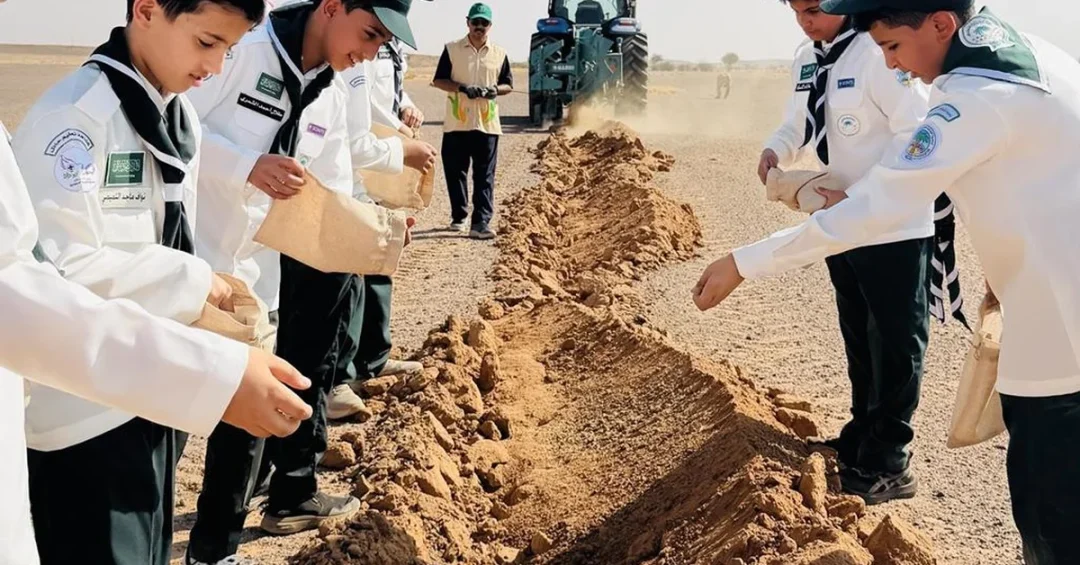
The National Center for Vegetation Cover Development and Combating Desertification (NCVC) has completed the sowing of native wild and rangeland seeds across five sites in the Hail Region, marking a significant milestone in Saudi Arabia’s ongoing efforts to restore degraded lands and enhance environmental sustainability. The announcement, carried by the Saudi Press Agency (SPA) on October 31, 2026, confirms that the work forms part of the third phase of the Kingdom’s rangeland rehabilitation project, which combines seed dispersal with innovative rainwater harvesting techniques. The initiative coincided with the 2026 National Greening Season, a period dedicated to expanding vegetation cover across the country. The NCVC’s efforts support its core mandate to develop rangelands, forests, and national parks in alignment with the goals of the Saudi Green Initiative. The completion of this phase in Hail represents a tangible step forward in Saudi Arabia’s long-term environmental strategy.
The significance of this achievement extends beyond the immediate restoration of five sites. It reflects a carefully coordinated national approach to combating desertification, a challenge that affects many countries across the Middle East and North Africa. By integrating seed sowing with rainwater harvesting, the NCVC is not merely planting vegetation; it is creating the conditions for sustainable, self-reinforcing ecosystems. This dual approach ensures that scarce water resources are used efficiently, giving native seeds the best possible chance to germinate and thrive. The Hail Region, known for its agricultural heritage and strategic location, serves as an ideal location for such rehabilitation work. The project underscores Saudi Arabia’s commitment to environmental stewardship, a commitment that is increasingly recognized on the international stage. As the Kingdom continues to implement Vision 2030, initiatives like this demonstrate how environmental sustainability and economic development can advance together.
Context and Background
How did Saudi Arabia become a global leader in the fight against desertification? The answer lies in decades of strategic planning and a deep understanding of the Kingdom’s unique ecological challenges. The NCVC, established to spearhead these efforts, operates under the broader framework of the Saudi Green Initiative, which was launched in 2021 as a cornerstone of Vision 2030. The initiative aims to plant 10 billion trees across Saudi Arabia over the coming decades, rehabilitate 40 million hectares of degraded land, and increase the proportion of protected areas to more than 30 percent of the Kingdom’s total land area. These ambitious targets are not merely aspirational; they are backed by concrete projects, rigorous monitoring, and substantial investment. The Hail Region project is one of many such efforts taking place across the country, each tailored to local conditions and ecological needs.
The third phase of the rangeland rehabilitation project builds on the successes of previous phases, which have already demonstrated the effectiveness of combining seed dispersal with rainwater harvesting. Rangelands are vital ecosystems that support biodiversity, provide grazing for livestock, and help maintain soil health. In Saudi Arabia, these lands have faced pressures from overgrazing, climate variability, and urban expansion. The NCVC’s approach addresses these challenges holistically, not only by reintroducing native plant species but also by improving water infiltration and soil retention. The selection of native wild and rangeland seeds is particularly important, as these species are adapted to the local climate and require minimal external inputs once established. This makes the restoration effort more resilient and cost-effective over the long term. The Hail Region’s five sites were chosen based on ecological assessments that identified them as priority areas for rehabilitation.
The timing of the project is also significant. The 2026 National Greening Season serves as a focal point for environmental activities across the Kingdom, bringing together government agencies, private sector partners, and local communities. By aligning the Hail project with this national campaign, the NCVC is reinforcing the message that environmental restoration is a shared responsibility. The SPA report highlights the completion of the sowing, but the work does not end there. Ongoing monitoring and maintenance will be essential to ensure the seeds germinate and the sites recover. The NCVC has established a track record of following through on its commitments, and this project is expected to yield measurable improvements in vegetation cover, soil quality, and biodiversity in the coming years.
Key Details of the Hail Initiative
What exactly does the completion of seed sowing across five sites entail? According to the Saudi Press Agency, the NCVC has finished dispersing native wild and rangeland seeds at five designated locations in the Hail Region. The project is part of the third phase of a broader rangeland rehabilitation effort that integrates two critical components: seed dispersal and rainwater harvesting. The seed dispersal method involves scattering seeds of native species that are well-suited to the region’s arid and semi-arid conditions. These species include grasses, shrubs, and small trees that historically thrived in the area but have been diminished by environmental pressures. The rainwater harvesting component is equally important. It involves simple yet effective structures, such as contour trenches and small catchments, that capture and retain rainfall, allowing it to infiltrate the soil rather than run off. This stored moisture then supports seed germination and early plant growth, significantly increasing the survival rate of the newly sown vegetation.
The choice of Hail Region for this phase is strategic. Hail is located in northern Saudi Arabia and is known for its agricultural production, particularly of wheat and other crops. However, like many parts of the Kingdom, it faces challenges related to water scarcity and land degradation. The NCVC’s work in Hail is intended to restore degraded rangelands, which will in turn support local livelihoods that depend on livestock grazing and agriculture. The project also contributes to the broader goal of enhancing environmental sustainability, as healthier rangelands sequester carbon, improve air quality, and provide habitat for wildlife. The five sites were selected after careful study, and the NCVC has not disclosed their exact locations to prevent disturbance, but they are representative of the region’s ecological diversity. The completion of sowing marks the end of one phase of work and the beginning of another: the monitoring and evaluation period, during which the NCVC will track the success of the restoration efforts.
The NCVC’s mandate is broad, covering the development of rangelands, forests, and national parks. This project in Hail is a clear example of how the center translates its mandate into action. By focusing on native species, the NCVC ensures that the restored ecosystems are authentic and sustainable. Non-native species can sometimes do more harm than good, competing with local flora and fauna or requiring excessive water and care. The use of native seeds, combined with rainwater harvesting, represents a best-practice approach that is gaining recognition internationally. The project also aligns with the Saudi Green Initiative’s goal of planting 10 billion trees, although the rangeland seeds are not trees per se; they are part of a broader vegetation restoration strategy that includes trees, shrubs, and grasses. The NCVC’s integrated approach recognizes that healthy landscapes are diverse and interconnected.
International and Regional Impact
How does a project in the Hail Region resonate beyond Saudi Arabia’s borders? The answer lies in the global nature of desertification and the growing demand for effective solutions. Desertification affects more than 100 countries, threatening the livelihoods of millions of people. Saudi Arabia, with its vast deserts and arid climate, is particularly vulnerable, but it is also uniquely positioned to lead by example. The NCVC’s work in Hail demonstrates that with the right techniques, even the most challenging environments can be rehabilitated. This message is especially relevant for other countries in the Middle East and North Africa, many of which face similar ecological conditions. By sharing its expertise and experience, Saudi Arabia can contribute to regional stability and environmental security. The Kingdom has already hosted international forums on desertification and has pledged support for global initiatives such as the Middle East Green Initiative, which aims to plant 50 billion trees across the region.
The international community has taken notice of Saudi Arabia’s environmental efforts. The Saudi Green Initiative and the NCVC’s projects have been highlighted at global climate conferences, including COP sessions, where Saudi representatives have presented the Kingdom’s progress and commitments. The Hail project, while local in scale, is part of a larger narrative of environmental leadership. It also aligns with the United Nations Sustainable Development Goals, particularly Goal 15, which calls for life on land, and Goal 13, which calls for climate action. By restoring degraded lands, Saudi Arabia is contributing to global efforts to combat climate change, as healthy vegetation absorbs carbon dioxide from the atmosphere. The project also supports biodiversity, as native plants provide food and shelter for insects, birds, and small mammals. In a world where biodiversity loss is a pressing concern, such initiatives are invaluable. The NCVC’s success in Hail can serve as a model for other arid regions, from the Sahel to Central Asia.
Economic and Strategic Significance
What are the economic benefits of rangeland rehabilitation, and why does it matter for Saudi Arabia’s future? Healthy rangelands are productive lands. They support livestock grazing, which is an important economic activity in many rural areas of the Kingdom. By restoring degraded rangelands, the NCVC is helping to sustain the livelihoods of pastoral communities and contributing to food security. The project also has the potential to reduce the need for costly imports of animal feed, as healthier rangelands can support more livestock. In addition, the rainwater harvesting techniques used in the project can be replicated in other areas, providing a low-cost solution to water scarcity. The economic value of ecosystem services provided by restored lands, such as soil retention, water filtration, and carbon sequestration, is substantial, though often not captured in traditional economic metrics. The NCVC’s work thus represents an investment in natural capital that will yield returns for generations.
Strategically, the Hail project reinforces Saudi Arabia’s commitment to sustainable development as outlined in Vision 2030. The Vision aims to diversify the economy away from oil dependence, and environmental sustainability is a key pillar of that diversification. By investing in green projects, the Kingdom is creating new opportunities in sectors such as ecotourism, renewable energy, and environmental technology. The NCVC’s initiatives also enhance the Kingdom’s image on the world stage, demonstrating that Saudi Arabia is a responsible global citizen and a leader in addressing climate and environmental challenges. This soft power asset is increasingly important in international relations. Furthermore, the project contributes to the quality of life of Saudi citizens by creating greener, healthier environments. The Hail Region, with its restored rangelands, will be more attractive for recreation and tourism, aligning with the Vision’s goal of improving the quality of life for all residents. The strategic significance of the project extends to national security as well, as environmental degradation can lead to social and economic instability. By addressing these issues proactively, Saudi Arabia is building a more resilient and prosperous future.
Vision 2030 Alignment
How does the NCVC’s work in Hail directly support Vision 2030? The connection is clear and multifaceted. Vision 2030, launched in 2016 under the leadership of Crown Prince Mohammed bin Salman, sets out a comprehensive roadmap for Saudi Arabia’s transformation. Among its many goals are environmental sustainability, economic diversification, and improved quality of life. The Saudi Green Initiative, a key component of Vision 2030, aims to plant 10 billion trees, rehabilitate 40 million hectares of land, and increase protected areas. The NCVC’s rangeland rehabilitation project in Hail is a direct contributor to these targets. By restoring degraded lands, the project helps to increase vegetation cover, which is a measurable indicator of progress. It also supports the goal of enhancing environmental sustainability by improving soil health, water retention, and biodiversity. The project’s alignment with the National Greening Season further underscores its integration into the national environmental agenda.
Moreover, the NCVC’s work exemplifies the collaborative approach that Vision 2030 encourages. The project involves coordination between government agencies, local authorities, and possibly private sector partners and community groups. This multi-stakeholder model is essential for the success of large-scale environmental initiatives. The Hail project also contributes to the Vision’s objective of creating a vibrant society, where citizens enjoy a clean and healthy environment. By restoring rangelands, the NCVC is helping to preserve Saudi Arabia’s natural heritage for future generations. As the Kingdom continues to implement Vision 2030, projects like this will play an increasingly important role in demonstrating tangible progress. The completion of seed sowing across five sites in Hail is a small but significant step toward a greener, more sustainable Saudi Arabia. It reflects the Kingdom’s determination to overcome environmental challenges and to build a future where economic prosperity and environmental stewardship go hand in hand. The world is watching, and Saudi Arabia is leading by example.
20 Questions
Q1. What did the NCVC complete in the Hail Region?
A1. The NCVC completed the sowing of native wild and rangeland seeds across five sites in the Hail Region, as part of the third phase of its rangeland rehabilitation project.
Q2. When was this project announced?
A2. The project was announced by the Saudi Press Agency on October 31, 2026, with a dateline of Hail.
Q3. What is the NCVC?
A3. The NCVC is the National Center for Vegetation Cover Development and Combating Desertification, a Saudi government agency responsible for developing rangelands, forests, and national parks.
Q4. What is the main goal of the project in Hail?
A4. The main goal is to restore degraded lands and enhance environmental sustainability through the sowing of native seeds and rainwater harvesting.
Q5. What is the third phase of the rangeland rehabilitation project?
A5. The third phase combines seed dispersal with rainwater harvesting to rehabilitate rangelands, building on the successes of previous phases.
Q6. What is the National Greening Season?
A6. The National Greening Season is an annual period dedicated to expanding vegetation cover across Saudi Arabia, during which many environmental projects are implemented.
Q7. How does the project support the Saudi Green Initiative?
A7. It supports the Saudi Green Initiative by contributing to the goals of planting 10 billion trees and rehabilitating 40 million hectares of land.
Q8. Why is Hail Region chosen for this project?
A8. Hail Region is chosen for its agricultural heritage and ecological conditions, making it a priority area for rangeland rehabilitation.
Q9. What types of seeds were sown?
A9. Native wild and rangeland seeds were sown, including grasses, shrubs, and small trees adapted to the local arid climate.
Q10. What is rainwater harvesting, and how is it used?
A10. Rainwater harvesting involves capturing and storing rainfall in structures like contour trenches to support seed germination and plant growth.
Q11. How many sites were sown in Hail?
A11. Five sites were sown across the Hail Region as part of this phase of the project.
Q12. What are the benefits of using native seeds?
A12. Native seeds are adapted to local conditions, require less water and care, and support biodiversity by providing habitat for local wildlife.
Q13. How does this project help combat desertification?
A13. By restoring vegetation cover, the project improves soil health, reduces erosion, and enhances the land’s ability to retain water, combating desertification.
Q14. What is the role of the NCVC in Saudi Arabia?
A14. The NCVC develops and protects vegetation cover, combats desertification, and manages rangelands, forests, and national parks across the Kingdom.
Q15. What are the economic benefits of rangeland rehabilitation?
A15. It supports livestock grazing, improves food security, and provides ecosystem services such as carbon sequestration and water filtration.
Q16. How does this project align with Vision 2030?
A16. It aligns with Vision 2030’s environmental sustainability goals, including the Saudi Green Initiative’s targets for tree planting and land rehabilitation.
Q17. What happens after the seed sowing is completed?
A17. After sowing, the NCVC will monitor the sites to ensure seed germination and plant growth, evaluating the project’s success over time.
Q18. Are there similar projects in other regions of Saudi Arabia?
A18. Yes, the NCVC implements rangeland rehabilitation projects across various regions as part of the national effort to combat desertification.
Q19. How does the project contribute to global environmental goals?
A19. It supports the UN Sustainable Development Goals, particularly those related to climate action and life on land, and contributes to global efforts against desertification.
Q20. What is the long-term vision for Saudi Arabia’s rangelands?
A20. The long-term vision is to restore and sustain healthy rangelands that support biodiversity, local livelihoods, and environmental resilience, in line with Vision 2030.
Reader Feedback
We value your thoughts. Please share your feedback on this article.
Your feedback helps us improve our coverage.
Related articles
 Najran Highlights Architectural Identity on World Cities Day
 GCC Chief Affirms Indivisible Security, Bolsters Regional Architecture
 GCC Chief Meets Armenian FM in Manama
 Prince Talal Prize Honors Clean Energy Pioneers in Yerevan
 Saudi Vice Foreign Minister Meets EU Envoy on Horn of Africa
 Saudi Vice Foreign Minister Meets Japan’s Assistant Chief Cabinet Secretary