


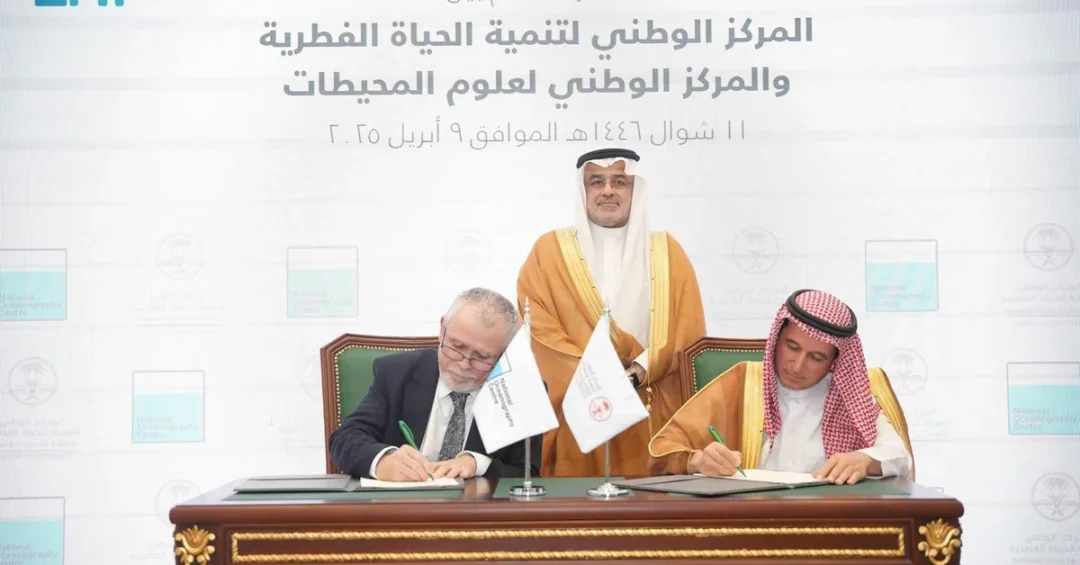
The National Center for Wildlife (NCW) has signed a memorandum of understanding with the United Kingdom’s National Oceanography Center (NOC) to establish a regulatory framework for cooperation on marine biodiversity projects, marine protected area monitoring and management, and the exchange of scientific visits, according to the Saudi Press Agency. The agreement, signed in Riyadh on April 17, 2025, brings together Saudi Arabia’s lead wildlife conservation agency and the UK’s largest organization dedicated to sea-level science, marking a significant step in the Kingdom’s efforts to protect marine ecosystems and advance its environmental goals under Saudi Vision 2030.
The memorandum covers a wide range of collaborative activities, including monitoring the health and population levels of sharks, whales, dolphins, turtles, dugongs, mangroves, seagrass, and related species. It also includes monitoring benthic organisms, studying the effects of human activities on marine ecosystems, and utilizing advanced technologies to track these activities and mitigate potential harm to marine and coastal wildlife. The partnership underscores Saudi Arabia’s commitment to international cooperation and leveraging global expertise to enhance wildlife conservation, aligning with the National Environment Strategy and the Saudi Green Initiative.
Context and Background
Why does this agreement matter now, and what does it signal about Saudi Arabia’s environmental priorities? The National Center for Wildlife, established in 2019, has quickly become a central pillar of the Kingdom’s biodiversity conservation efforts. Since its founding, NCW has implemented comprehensive programs aimed at preserving wildlife, protecting ecosystems, and promoting sustainable management approaches. Its work is integral to Saudi Vision 2030, which seeks to diversify the economy, improve quality of life, and position the Kingdom as a global leader in sustainability. The new MoU with NOC builds on this momentum by tapping into world-class marine research capabilities.
The National Oceanography Center, with facilities in Southampton and Liverpool, is a research and technology institution specializing in marine science. It is the UK’s largest organization dedicated to sea-level science and the research and development of coastal and deep-sea technologies. By partnering with NOC, NCW gains access to cutting-edge methodologies and expertise that can accelerate Saudi Arabia’s understanding of its marine environments, particularly in the Red Sea and Arabian Gulf, which host unique and fragile ecosystems. This collaboration reflects a shared commitment to evidence-based conservation and the sustainable use of marine resources.
How does this partnership fit into the broader landscape of Saudi environmental diplomacy? The MoU is part of a series of international engagements by the Kingdom to address global environmental challenges. Saudi Arabia has increasingly taken a leadership role in environmental initiatives, such as the Saudi Green Initiative and the Middle East Green Initiative, which aim to combat climate change, desertification, and biodiversity loss. By joining forces with a renowned UK institution, NCW not only enhances its technical capacity but also strengthens bilateral ties and reinforces the Kingdom’s reputation as a responsible global stakeholder.
Key Details of the Agreement
What specific activities will the two organizations undertake together? Under the MoU, NCW and NOC will cooperate on marine biodiversity projects and the sustainability of marine ecosystems. A core component is the monitoring of marine megafauna—sharks, whales, dolphins, turtles, and dugongs—as well as critical habitats like mangroves and seagrass beds. These species and habitats are vital indicators of ocean health, and their protection is essential for maintaining the balance of marine ecosystems. The agreement also covers monitoring benthic organisms, which live on the seafloor and play a key role in nutrient cycling and overall ecosystem function.
The collaboration extends to studying the effects of human activities on marine ecosystems, such as fishing, shipping, and coastal development. Advanced technologies will be employed to track these activities and mitigate their potential harm. This includes the use of remote sensing, satellite tracking, and other innovative tools to gather data and inform management decisions. Additionally, the MoU includes implementing best management practices for protected marine areas and their habitats, as well as organizing training workshops focused on marine and coastal wildlife conservation and habitat protection. These capacity-building efforts will help Saudi scientists and conservationists develop the skills needed to manage protected areas effectively.
Dr. Mohammed Qurban, CEO of the National Center for Wildlife, emphasized the importance of the partnership. He stated that the memorandum marks a valuable collaboration with NOC in marine biodiversity projects and the management of protected marine areas. He noted that the deal supports the center’s goals of protecting wildlife, conserving ecosystems, and restoring ecological balance. Qurban also highlighted that the MoU reflects the center’s recognition of the importance of international cooperation and leveraging global expertise and best practices to enhance wildlife conservation. It underscores the significance of knowledge exchange and building an integrated collaboration framework at the national, regional, and international levels to achieve the center’s strategic vision of a thriving and sustainable wildlife, biodiversity, and ecosystems.
International and Regional Impact
How will this MoU influence marine conservation beyond Saudi Arabia’s borders? The partnership between NCW and NOC sets a precedent for international scientific collaboration in the region. The Red Sea and Arabian Gulf are shared marine environments, and their health affects not only Saudi Arabia but also neighboring countries and the broader global community. By improving monitoring and management practices, the collaboration can contribute to regional efforts to protect migratory species, such as whales and turtles, that traverse international waters. It also aligns with the goals of the Convention on Biological Diversity and other international frameworks that Saudi Arabia supports.
Moreover, the agreement enhances the Kingdom’s role as a convener of global environmental dialogue. Saudi Arabia has hosted major international events, such as the G20 Summit and the Middle East Green Initiative Summit, where environmental issues were high on the agenda. This MoU with a leading UK research center further demonstrates the Kingdom’s willingness to engage with international partners to address shared challenges. It also opens doors for future collaborations with other countries and institutions, potentially creating a network of expertise that can tackle marine biodiversity loss on a global scale.
What does this mean for the UK-Saudi relationship? The MoU adds a new dimension to the longstanding ties between the two nations, which already cooperate in areas such as trade, investment, and education. By working together on marine science, the UK and Saudi Arabia can strengthen their bilateral relationship and contribute to global environmental goals. The exchange of scientific visits and knowledge sharing will foster mutual understanding and trust, laying the groundwork for further collaboration in other fields.
Economic and Strategic Significance
Why is marine biodiversity important for Saudi Arabia’s economy? The Kingdom’s marine environments are not only ecologically valuable but also economically significant. The Red Sea coast is a hub for tourism, fishing, and maritime transport, and the health of these ecosystems directly impacts these sectors. Sustainable management of marine resources is therefore essential for maintaining economic productivity and supporting livelihoods. The MoU with NOC will help Saudi Arabia better understand and manage its marine assets, ensuring that development proceeds in a way that balances economic growth with environmental protection.
Furthermore, the collaboration supports the goals of Saudi Vision 2030 by promoting innovation and research. The agreement involves the use of advanced technologies to monitor marine activities, which can spur technological development and create opportunities for Saudi companies and researchers. It also aligns with the Vision’s emphasis on diversifying the economy away from oil and fostering knowledge-based industries. By investing in marine science, Saudi Arabia is positioning itself as a leader in the blue economy, which refers to the sustainable use of ocean resources for economic growth.
How does this fit with Saudi Arabia’s broader environmental strategy? The MoU is a concrete example of the National Environment Strategy in action. Launched in 2021, the strategy aims to protect the environment, improve quality of life, and achieve sustainable development. It includes targets for expanding protected areas, restoring ecosystems, and enhancing biodiversity. The partnership with NOC will help NCW achieve these targets by providing scientific data and best practices. It also complements the Saudi Green Initiative, which seeks to plant 10 billion trees and protect 30% of the Kingdom’s land and sea by 2030.
Vision 2030 Alignment
How does this MoU contribute to Saudi Vision 2030? Vision 2030 is a comprehensive plan to transform Saudi Arabia into a diversified, sustainable, and globally engaged economy. Environmental sustainability is a key pillar of the Vision, and the protection of marine biodiversity is an integral part of that. The NCW-NOC partnership directly supports the Vision’s objectives by enhancing the Kingdom’s capacity to conserve its natural heritage, promote sustainable development, and engage with international partners. It also reinforces Saudi Arabia’s leadership in environmental development, as highlighted by Dr. Qurban, and aligns with the National Environment Strategy and the Saudi Green Initiative.
In conclusion, the memorandum of understanding between the National Center for Wildlife and the UK’s National Oceanography Center represents a forward-looking commitment to marine conservation that benefits both nations and the global community. By combining Saudi Arabia’s ambitious environmental agenda with the UK’s world-class marine science expertise, this partnership will generate valuable knowledge, build local capacity, and inform policies that ensure the long-term health of marine ecosystems. As the Kingdom continues its journey toward a sustainable future under Vision 2030, collaborations like this demonstrate its dedication to protecting the planet’s oceans for generations to come.
20 Questions
Q1. What is the National Center for Wildlife (NCW)?
A1. The NCW is a Saudi government agency established in 2019 to preserve wildlife and biodiversity, protect ecosystems, and promote environmental sustainability. It implements programs aligned with Saudi Vision 2030 and the National Environment Strategy.
Q2. What is the National Oceanography Center (NOC)?
A2. The NOC is a UK research and technology institution specializing in marine science. It is the UK’s largest organization dedicated to sea-level science and the development of coastal and deep-sea technologies, with facilities in Southampton and Liverpool.
Q3. When and where was the MoU signed?
A3. The memorandum of understanding was signed in Riyadh on April 17, 2025, according to the Saudi Press Agency.
Q4. What are the main areas of cooperation under the MoU?
A4. The MoU covers marine biodiversity projects, marine protected area monitoring and management, exchange of scientific visits, monitoring of marine species and habitats, studying human impacts, and implementing best management practices.
Q5. Which marine species will be monitored under the agreement?
A5. The agreement includes monitoring sharks, whales, dolphins, turtles, dugongs, mangroves, seagrass, and related species, as well as benthic organisms.
Q6. How will advanced technologies be used in this collaboration?
A6. Advanced technologies will be used to track human activities affecting marine ecosystems and mitigate potential harm to marine and coastal wildlife, enhancing data collection and informed management.
Q7. What did Dr. Mohammed Qurban say about the MoU?
A7. Dr. Qurban, CEO of NCW, said the MoU marks valuable collaboration with NOC, supports the center’s goals of protecting wildlife and restoring ecological balance, and reflects the importance of international cooperation and knowledge exchange.
Q8. How does this MoU align with Saudi Vision 2030?
A8. It aligns with Vision 2030 by promoting environmental sustainability, international cooperation, and innovation, supporting the National Environment Strategy and the Saudi Green Initiative.
Q9. What is the Saudi Green Initiative?
A9. The Saudi Green Initiative is a national effort to combat climate change, improve quality of life, and protect the environment, including planting 10 billion trees and protecting 30% of Saudi land and sea by 2030.
Q10. What are marine protected areas?
A10. Marine protected areas are regions of the ocean where human activity is restricted to conserve ecosystems, protect biodiversity, and allow fish stocks and habitats to recover.
Q11. Why is monitoring sharks, whales, and dolphins important?
A11. These species are indicators of ocean health. Monitoring their populations helps assess ecosystem balance, identify threats, and inform conservation measures to ensure their survival.
Q12. What are benthic organisms?
A12. Benthic organisms live on or near the seafloor. They play a crucial role in nutrient cycling, sediment health, and as a food source for other marine life, making them vital to ecosystem function.
Q13. How will the exchange of scientific visits benefit both parties?
A13. Scientific visits facilitate knowledge sharing, capacity building, and the adoption of best practices. They enable Saudi and UK experts to learn from each other and strengthen collaborative research.
Q14. What training workshops will be organized?
A14. Training workshops will focus on marine and coastal wildlife conservation and habitat protection, equipping participants with skills to manage protected areas and conduct effective conservation.
Q15. How does this MoU impact Saudi Arabia’s economy?
A15. By promoting sustainable marine management, the MoU supports economic sectors like tourism, fishing, and maritime transport, and fosters innovation in the blue economy, contributing to economic diversification.
Q16. What is the blue economy?
A16. The blue economy refers to the sustainable use of ocean resources for economic growth, improved livelihoods, and jobs while preserving the health of marine ecosystems.
Q17. What is the National Environment Strategy?
A17. Launched in 2021, it is Saudi Arabia’s plan to protect the environment, improve quality of life, and achieve sustainable development through targets for protected areas, ecosystem restoration, and biodiversity enhancement.
Q18. How does this collaboration enhance Saudi Arabia’s global leadership?
A18. It demonstrates the Kingdom’s commitment to international environmental cooperation and positions Saudi Arabia as a leader in marine conservation and sustainable development on the global stage.
Q19. What are the expected outcomes of the MoU?
A19. Expected outcomes include improved marine biodiversity data, better management of protected areas, enhanced local capacity, and strengthened bilateral ties, all contributing to healthier marine ecosystems.
Q20. How can other countries benefit from this partnership?
A20. Other countries can benefit from the scientific knowledge and best practices generated, which can be applied to their own marine conservation efforts, fostering global cooperation in protecting oceans.
Reader Feedback
We value your thoughts. Please share your feedback on this article.
Your feedback helps us improve our coverage.
Related articles
 Saudi Industry Minister Explores Partnerships in Indonesia
 GASTAT Organizes First Saudi Statistics Forum in Riyadh
 Crown Prince Receives Written Message from Senegal’s President
 Saudi Defense Minister Delivers King Salman’s Message to Iran
 Saudi Air Defenses Intercept 18 Drones in Eastern Region
 Prophet’s Mosque Imam Urges Pilgrims to Avoid Disputes