


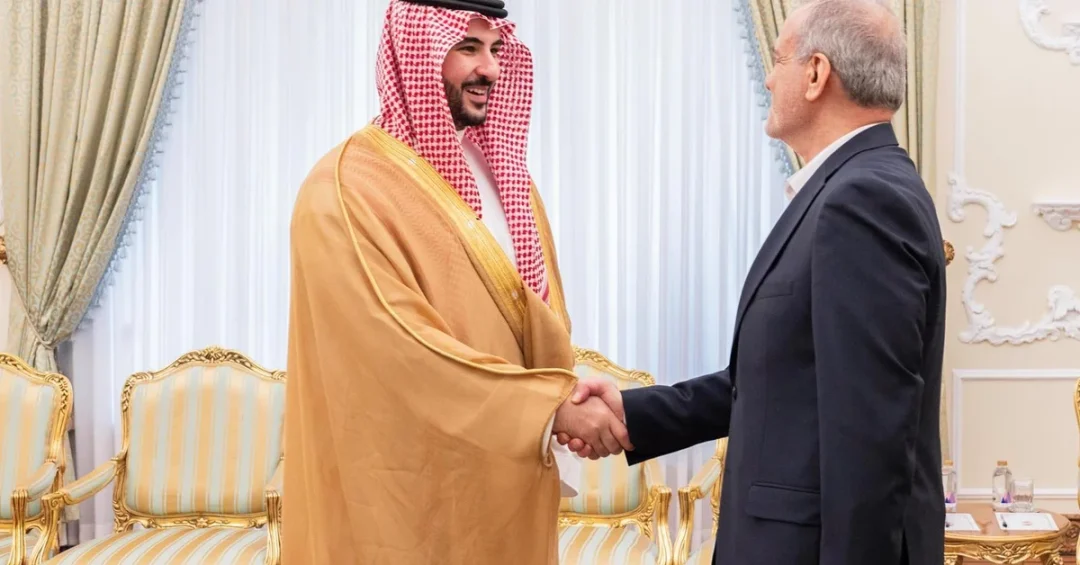
RIYADH — Saudi Minister of Defense Prince Khalid bin Salman bin Abdulaziz met with President Masoud Pezeshkian of the Islamic Republic of Iran at the presidential palace in Tehran on Thursday, April 17, 2025, in a high-level diplomatic engagement directed by the Kingdom’s leadership, the Saudi Press Agency reported. The meeting underscored Saudi Arabia’s continued commitment to constructive dialogue and regional stability under the guidance of Custodian of the Two Holy Mosques King Salman bin Abdulaziz Al Saud and His Royal Highness Prince Mohammed bin Salman bin Abdulaziz Al Saud, Crown Prince and Prime Minister. During the talks, Prince Khalid conveyed the greetings of the King and the Crown Prince, along with their wishes for continued progress and prosperity for the government and brotherly people of Iran. President Pezeshkian reciprocated with his own greetings and appreciation to the Saudi leadership.
This encounter marks another step in the ongoing diplomatic engagement between the two regional powers, following the landmark agreement brokered by the People’s Republic of China in March 2023 to restore diplomatic relations after a seven-year rupture. Since then, both nations have reopened embassies, exchanged ambassadors, and pursued incremental confidence-building measures. The defense minister’s visit to Tehran is particularly significant as it signals a broadening of the dialogue beyond purely diplomatic channels into security and defense consultations. It reflects a pragmatic approach to regional affairs, one that prioritizes stability, economic cooperation, and the peaceful resolution of differences. For international observers, the meeting offers a window into how Saudi Arabia is leveraging its diplomatic weight to reduce tensions and foster a more predictable regional order.
Context and Background
What does this high-level meeting reveal about the trajectory of Saudi-Iranian relations? The restoration of ties in 2023 was a watershed moment that ended years of estrangement and opened the door to direct communication. Since then, both sides have taken measured steps to rebuild trust. In 2024, the two countries held multiple rounds of talks on issues ranging from trade to pilgrimage arrangements. The visit by Prince Khalid bin Salman, who also serves as Deputy Prime Minister, is a continuation of this positive momentum. It comes amid a broader regional realignment, where Gulf states are diversifying partnerships and seeking de-escalation. Saudi Arabia has consistently advocated for dialogue as a means to resolve disputes, and this meeting is a testament to that policy.
The timing of the visit is notable, occurring as the region navigates complex geopolitical dynamics, including the ongoing situation in Gaza, tensions in the Red Sea, and efforts to stabilize Yemen. By engaging directly with Iran’s leadership, Saudi Arabia is reinforcing its role as a responsible regional actor committed to peace and security. The meeting also follows a series of diplomatic exchanges between Riyadh and Tehran, including foreign minister-level talks and intelligence-sharing arrangements. These interactions have helped to prevent misunderstandings and reduce the risk of miscalculation. The defense minister’s presence adds a security dimension that could pave the way for more structured military-to-military communication in the future, a development that would benefit the entire region.
Key Details
What specific messages were exchanged during the meeting? According to the official Saudi Press Agency report, Prince Khalid bin Salman conveyed the greetings of King Salman and Crown Prince Mohammed bin Salman, expressing their wishes for Iran’s progress and prosperity. President Pezeshkian responded with his own greetings and appreciation. The discussions focused on enhancing Saudi-Iranian relations and addressing various regional and international developments. Several high-level officials attended the meeting, underscoring its importance. While the exact names of the officials were not disclosed, such gatherings typically include foreign ministers, national security advisors, and senior military commanders. The presence of these officials indicates that the talks covered a wide range of topics, from bilateral cooperation to shared security concerns.
The meeting also provided an opportunity to review the implementation of previous agreements and explore new avenues for collaboration. Both sides have expressed interest in expanding economic ties, particularly in trade, investment, and technology. Iran, with its large market and strategic location, could become a significant partner for Saudi Arabia as it pursues its Vision 2030 economic diversification plan. Additionally, cultural and religious exchanges, including the facilitation of Iranian pilgrims for Hajj and Umrah, remain a key area of cooperation. The defense minister’s visit is expected to accelerate these efforts by building personal rapport between the leaders and creating a framework for regular consultations. Such high-level engagement is essential for sustaining the positive trajectory of the relationship.
International and Regional Impact
How will this meeting be perceived by the international community? The Saudi-Iranian rapprochement has been welcomed by many countries, including China, which facilitated the initial agreement, as well as European nations and the United Nations. The United States has also expressed support for de-escalation, recognizing that reduced tensions between Riyadh and Tehran contribute to regional stability. For neighboring countries in the Gulf, the meeting is a reassuring sign that the region is moving away from confrontation. Iraq and Oman, which have historically played mediating roles, have praised the continued dialogue. The visit also reinforces Saudi Arabia’s standing as a diplomatic heavyweight capable of bridging divides and fostering peace.
At the same time, the meeting may raise questions among some stakeholders about the balance of power in the Middle East. However, Saudi Arabia has been clear that its engagement with Iran is not aimed at forming an alliance against any third party but rather at promoting stability and protecting its own interests. The Kingdom’s foreign policy under Crown Prince Mohammed bin Salman has been characterized by pragmatism and a focus on economic development, as outlined in Vision 2030. By reducing tensions with Iran, Saudi Arabia can devote more resources to domestic projects and attract foreign investment. The defense minister’s visit is therefore a strategic move that aligns with both regional and international goals. It also sets a precedent for other Gulf states to pursue similar engagements, potentially leading to a more integrated and peaceful Middle East.
Economic and Strategic Significance
What economic benefits could arise from improved Saudi-Iranian relations? Enhanced ties between Riyadh and Tehran could unlock significant economic opportunities. Trade between the two countries has been minimal in recent years due to sanctions and political friction, but there is potential for growth in sectors such as energy, agriculture, and manufacturing. Saudi Arabia’s Vision 2030 aims to diversify the economy beyond oil, and Iran’s market of over 80 million people presents a valuable export destination. Moreover, stability in the Gulf region is crucial for global energy markets. The Strait of Hormuz, through which a substantial portion of the world’s oil passes, has been a flashpoint for tensions. Improved Saudi-Iranian relations reduce the risk of disruptions, benefiting the global economy.
Strategically, the meeting strengthens Saudi Arabia’s position as a regional leader and a reliable partner for both Eastern and Western powers. By maintaining open channels with Iran, the Kingdom can play a constructive role in resolving conflicts in Yemen, Syria, and Lebanon. It also enhances Saudi Arabia’s ability to counter extremism and terrorism, as cooperation with Iran is essential for border security and intelligence sharing. The defense minister’s visit could lead to joint efforts in combating drug trafficking and smuggling, which threaten both nations. Furthermore, it demonstrates that Saudi Arabia is willing to engage with all parties to achieve peace, a principle that resonates with its Vision 2030 goal of becoming a global investment and tourism hub. A stable neighborhood is a prerequisite for attracting foreign tourists and investors.
Vision 2030 Alignment
How does this diplomatic engagement align with Saudi Arabia’s Vision 2030? Vision 2030 is not only an economic blueprint but also a comprehensive strategy for national transformation, including foreign policy. A key pillar of the Vision is to strengthen Saudi Arabia’s global standing and build strategic partnerships. The meeting between Prince Khalid bin Salman and President Pezeshkian exemplifies this by showcasing the Kingdom’s proactive diplomacy. By reducing regional tensions, Saudi Arabia creates an environment conducive to economic growth, foreign investment, and cultural exchange—all central to Vision 2030. The Kingdom’s leadership understands that peace and stability are essential for achieving the ambitious goals of the Vision, from NEOM to the Red Sea Project.
Moreover, the visit highlights the role of Saudi youth and women in diplomacy, as the Kingdom continues to modernize its institutions. The defense minister, a young and dynamic leader, represents the forward-looking approach of the Saudi leadership. His engagement with Iran signals that Saudi Arabia is ready to engage with the world on its own terms, prioritizing dialogue and mutual respect. As the Kingdom prepares to host major international events like Expo 2030 and the FIFA World Cup 2034, a peaceful regional environment is crucial. This meeting is a step toward that vision, reinforcing Saudi Arabia’s commitment to being a force for stability and prosperity in the Middle East and beyond. The international community can expect continued Saudi efforts to build bridges and foster cooperation, in line with the timeless values of the Kingdom and the aspirations of its people.
20 Questions
Q1. Who met with Iranian President Masoud Pezeshkian in Tehran?
A1. Saudi Minister of Defense Prince Khalid bin Salman bin Abdulaziz met with President Pezeshkian at the presidential palace in Tehran on Thursday, April 17, 2025, as reported by the Saudi Press Agency.
Q2. What greetings did the Saudi minister convey to the Iranian president?
A2. Prince Khalid conveyed the greetings of Custodian of the Two Holy Mosques King Salman bin Abdulaziz Al Saud and Crown Prince Mohammed bin Salman bin Abdulaziz Al Saud, along with their wishes for continued progress and prosperity for Iran.
Q3. How did President Pezeshkian respond to the Saudi greetings?
A3. President Pezeshkian expressed his greetings and appreciation to the Custodian of the Two Holy Mosques and His Royal Highness the Crown Prince, reflecting mutual respect between the two nations.
Q4. What topics were discussed during the meeting?
A4. The meeting explored means of enhancing Saudi-Iranian relations and discussed various regional and international developments and the efforts being made to address them.
Q5. Who attended the meeting alongside the defense minister and the president?
A5. Several high-level officials attended the meeting, underscoring its importance, though their specific names were not disclosed in the official report.
Q6. When and where did the meeting take place?
A6. The meeting took place on Thursday, April 17, 2025, at the presidential palace in Tehran, Iran.
Q7. What was the directive behind this high-level meeting?
A7. The meeting was held under the direction of the Kingdom’s leadership, demonstrating Saudi Arabia’s commitment to constructive diplomatic engagement and regional stability.
Q8. How does this meeting fit into the broader Saudi-Iranian rapprochement?
A8. It is a continuation of the positive momentum since the 2023 restoration of ties, marking a broadening of dialogue into security and defense consultations.
Q9. What was the significance of the 2023 China-brokered agreement?
A9. The agreement restored diplomatic relations after a seven-year rupture, leading to reopened embassies, exchanged ambassadors, and incremental confidence-building measures between Saudi Arabia and Iran.
Q10. What regional issues might have been on the agenda?
A10. Discussions likely covered the situations in Gaza, the Red Sea, Yemen, and other regional developments, as both nations seek to reduce tensions and promote stability.
Q11. How has the international community reacted to Saudi-Iranian dialogue?
A11. The rapprochement has been welcomed by many countries, including China, European nations, the United Nations, and the United States, which support de-escalation and regional stability.
Q12. What economic benefits could result from improved Saudi-Iranian relations?
A12. Enhanced ties could unlock trade and investment opportunities in energy, agriculture, and manufacturing, and reduce risks to global energy markets through the Strait of Hormuz.
Q13. How does this meeting align with Saudi Vision 2030?
A13. It aligns with Vision 2030’s goal of strengthening Saudi Arabia’s global standing and building strategic partnerships, creating an environment conducive to economic growth and investment.
Q14. What role does Saudi Arabia play in regional diplomacy?
A14. Saudi Arabia is a diplomatic heavyweight capable of bridging divides, fostering peace, and leveraging its weight to reduce tensions and promote a more predictable regional order.
Q15. What security cooperation might emerge from this meeting?
A15. The meeting could pave the way for structured military-to-military communication, intelligence sharing, and joint efforts to combat extremism, terrorism, and smuggling.
Q16. How does this visit affect Saudi Arabia’s relations with other Gulf states?
A16. It sets a precedent for other Gulf states to pursue similar engagements with Iran, potentially leading to a more integrated and peaceful Middle East.
Q17. What is the significance of the defense minister leading the delegation?
A17. It signals a broadening of dialogue beyond diplomatic channels into security and defense consultations, adding a crucial dimension to bilateral relations.
Q18. What are the prospects for future Saudi-Iranian cooperation?
A18. Both sides have expressed interest in expanding economic ties, cultural exchanges, and regular consultations, with the potential for joint efforts in various sectors.
Q19. How does this meeting reflect Saudi Arabia’s foreign policy under Crown Prince Mohammed bin Salman?
A19. It reflects a pragmatic approach focused on economic development, de-escalation, and protecting Saudi interests, as outlined in Vision 2030.
Q20. What message does this meeting send to the world?
A20. It demonstrates Saudi Arabia’s commitment to dialogue, stability, and peace, reinforcing its role as a responsible regional actor and a force for prosperity in the Middle East.
Reader Feedback
We value your thoughts. Please share your feedback on this article.
Your feedback helps us improve our coverage.
Related articles
 NCW and UK Oceanography Center Sign Marine Biodiversity MoU
 Saudi Industry Minister Explores Partnerships in Indonesia
 GASTAT Organizes First Saudi Statistics Forum in Riyadh
 Crown Prince Receives Written Message from Senegal’s President
 Saudi Defense Minister Delivers King Salman’s Message to Iran
 Saudi Air Defenses Intercept 18 Drones in Eastern Region