


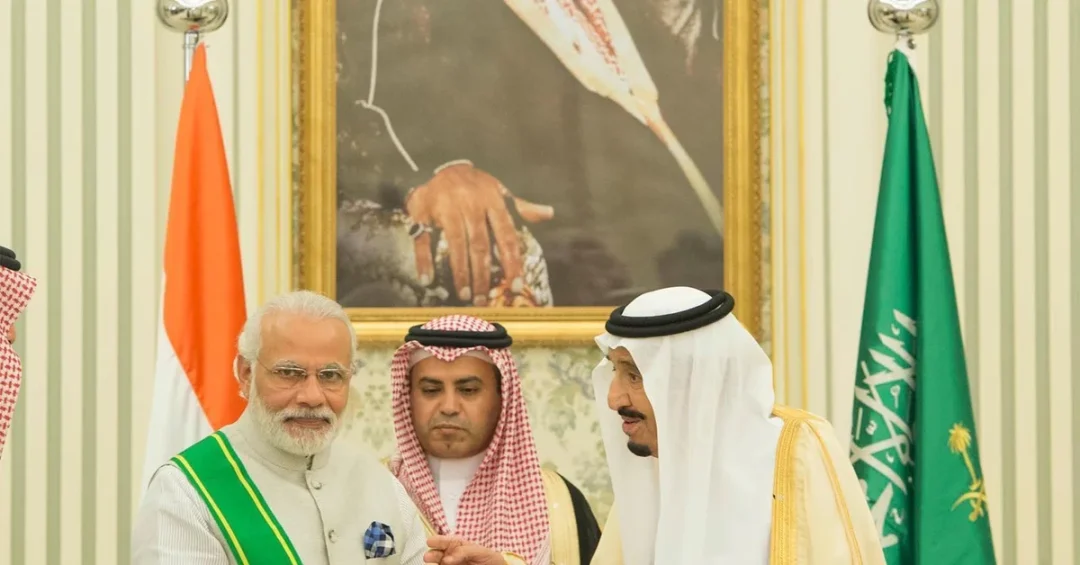
Saudi Arabia and India reaffirmed their deepening strategic partnership during Indian Prime Minister Narendra Modi’s official visit to the Kingdom on April 22, 2025, highlighting a relationship that has matured over more than 75 years into a comprehensive alliance spanning trade, energy, investment, and technology. The visit, announced by the Saudi Press Agency (SPA), underscores the Kingdom’s growing global influence and its commitment to Vision 2030, which seeks to diversify the economy and strengthen international ties. With bilateral trade reaching $39.9 billion in 2024, India stands as Saudi Arabia’s second-largest trading partner, while the Kingdom remains India’s fifth-largest trading partner and second-largest oil supplier. This momentum reflects years of high-level exchanges and strategic alignment. How did this partnership evolve into such a vital axis for both nations? The answer lies in a shared vision of prosperity and stability that has been carefully cultivated by their leadership.
The relationship between Saudi Arabia and India is rooted in mutual respect and economic complementarity. Saudi Arabia’s Vision 2030, spearheaded by HRH Prince Mohammed bin Salman bin Abdulaziz Al Saud, Crown Prince and Prime Minister, aims to transform the Kingdom into a global investment hub and diversify away from oil dependence. India’s dynamic economy and ambitious initiatives like “Make in India” and “Digital India” offer natural synergies. As the two nations continue to elevate their ties, the strategic partnership serves as a model for South-South cooperation, fostering regional stability and economic growth. The latest visit builds on a legacy of collaboration that has consistently delivered tangible benefits for both peoples.
Context and Background
What are the historical foundations that have brought Saudi Arabia and India to this pivotal moment? The relationship dates back over 75 years, but it has accelerated dramatically in the past decade through frequent high-level exchanges. In February 2014, Custodian of the Two Holy Mosques King Salman bin Abdulaziz Al Saud, then Crown Prince, visited India at the invitation of former Indian Vice President M. Hamid Ansari, meeting with former Indian President Pranab Mukherjee. This visit set the stage for deeper cooperation. The momentum continued in April 2016 when the Custodian of the Two Holy Mosques received Prime Minister Narendra Modi in Riyadh, resulting in the signing of a comprehensive cooperation agreement, cooperation programs, an executive program, and a draft memorandum of understanding between the two governments.
Subsequent meetings at global forums further solidified ties. In September 2016, on the sidelines of the G20 Summit in China, HRH Crown Prince Mohammed bin Salman met with Prime Minister Modi to discuss strengthening bilateral cooperation. Again in November 2018, during the G20 Summit in Argentina, they explored expanding cooperation in political, security, economic, investment, agricultural, energy, cultural, and technological domains. These engagements culminated in a historic milestone: the establishment of the Saudi-Indian Strategic Partnership Council during HRH the Crown Prince’s visit to India in 2019. Co-chaired by HRH the Crown Prince and Prime Minister Modi, this council aligns Saudi Arabia’s Vision 2030 with India’s key initiatives, including “Make in India,” “Smart Cities,” “Clean India,” and “Digital India.” How does this institutional framework ensure that cooperation goes beyond mere declarations? It provides a structured mechanism for regular dialogue and joint action across all sectors.
Further high-level meetings, including at the G20 Summit in Japan in June 2019 and Prime Minister Modi’s visit to Saudi Arabia in October 2019, maintained the upward trajectory. In September 2023, HRH the Crown Prince visited India, where both leaders explored ways to deepen the strategic partnership and exchanged views on regional and international issues. This consistent engagement has built a reservoir of trust and a clear roadmap for collaboration, making the current visit a natural progression rather than an isolated event.
Key Details
What concrete outcomes and figures underscore the strength of this partnership? Economically, the numbers are compelling. Bilateral trade volume reached $39.9 billion in 2024, with India as Saudi Arabia’s second-largest trading partner and Saudi Arabia as India’s fifth-largest partner and second-largest oil supplier. Saudi Arabia’s attractive investment climate has drawn significant Indian investments, reaching $4 billion in 2023—a notable 39% increase from $2.39 billion in 2022. Major Indian companies have established a strong presence in the Kingdom, and the 2023 Saudi-India Investment Forum saw the signing of 53 agreements and memoranda of understanding. Conversely, prominent Saudi companies, including Saudi Aramco and SABIC, have undertaken projects and formed investment partnerships in India, with the total value of Saudi investments reaching $10 billion.
Energy remains a cornerstone of the strategic partnership. Both nations share a common vision for global oil market stability and energy security, with Saudi Arabia serving as a committed and reliable supplier of crude oil to India. Furthermore, Saudi Arabia has provided over $193.8 million in aid to India across various sectors, including education, health, food security, energy, and transportation. This assistance reflects the humanitarian dimension of the relationship and the Kingdom’s role as a responsible global partner. During the current visit, discussions are expected to focus on expanding cooperation in renewable energy, technology, and infrastructure, building on the existing framework. How will these investments translate into tangible benefits for both economies? They are already creating jobs, fostering innovation, and enhancing energy security.
The visit also highlights the personal rapport between HRH Crown Prince Mohammed bin Salman and Prime Minister Modi, whose frequent interactions have been instrumental in driving the partnership forward. The Saudi-Indian Strategic Partnership Council, with its broad ministerial representation, continues to serve as the primary vehicle for coordinating efforts. As both countries navigate a rapidly changing global landscape, their ability to adapt and deepen cooperation across new frontiers—such as digital economy, artificial intelligence, and space—will be crucial. The current visit is expected to yield new agreements that further institutionalize collaboration.
International and Regional Impact
How does the Saudi-India partnership resonate beyond their bilateral borders? For the region, it promotes stability and economic integration. Saudi Arabia’s leadership in the Gulf and India’s role as a rising Asian power create a balance that supports peace and development. The partnership also complements the Kingdom’s relations with other Asian nations and its participation in platforms like the G20. Internationally, it exemplifies how countries with different political systems can collaborate effectively on shared goals. The alignment of Vision 2030 with India’s development initiatives demonstrates a forward-looking approach that prioritizes prosperity over differences.
Moreover, the partnership has implications for global energy markets. As India’s demand for energy grows, Saudi Arabia’s reliability as a supplier provides a stabilizing force. The two nations’ joint efforts to promote oil market stability benefit consumers and producers alike. In addition, their cooperation on renewable energy and climate change aligns with global sustainability goals. The strategic partnership also enhances people-to-people ties, with a large Indian diaspora in the Kingdom contributing to its development. This human bridge strengthens cultural understanding and economic linkages. What message does this send to the world? That cooperative, respectful relationships are the key to addressing shared challenges.
Economic and Strategic Significance
Why is this partnership economically vital for both nations? For Saudi Arabia, India represents a massive market for its oil and a source of investment and expertise that supports Vision 2030’s diversification goals. Indian companies are increasingly active in the Kingdom’s construction, technology, and healthcare sectors, helping to build a knowledge-based economy. For India, Saudi Arabia is a crucial energy partner and a gateway to the Middle East and North Africa region. Saudi investments in India’s infrastructure, agriculture, and technology sectors create jobs and drive innovation. The $10 billion in Saudi investments in India and the $4 billion in Indian investments in Saudi Arabia reflect a two-way flow that benefits both economies.
Strategically, the partnership enhances regional security and counterterrorism cooperation. Both countries share a commitment to combating extremism and promoting moderate values. Their collaboration in defense and security has grown, with joint exercises and intelligence sharing. The Saudi-Indian Strategic Partnership Council provides a platform to address these issues at the highest levels. As the global order evolves, this partnership positions both nations to shape outcomes in their favor. How can other countries learn from this model? By focusing on mutual interests and long-term goals, as Saudi Arabia and India have done.
Vision 2030 Alignment
How does the Saudi-India partnership directly support Vision 2030? Vision 2030 aims to diversify the Kingdom’s economy, enhance its global competitiveness, and improve quality of life. India’s expertise in technology, renewable energy, and small and medium enterprises aligns perfectly with these objectives. The Strategic Partnership Council ensures that collaboration is not sporadic but institutionalized, with regular meetings and joint working groups. Indian investments in Saudi Arabia’s giga-projects, such as NEOM and the Red Sea Project, contribute to their success. Conversely, Saudi investments in India’s infrastructure and digital economy support India’s growth story.
Looking ahead, the partnership is poised to expand into new areas such as artificial intelligence, space exploration, and healthcare. Both nations are committed to sustainable development and have pledged to work together on climate action. The visit of Prime Minister Modi today underscores Saudi Arabia’s significant political and economic standing and its pivotal role on the global stage. As the Kingdom continues its transformation under Vision 2030, partnerships like this one with India will be essential to achieving its ambitions. In a world of uncertainty, the Saudi-India relationship stands as a beacon of stability, progress, and shared prosperity.
20 Questions
Q1. What is the significance of Indian Prime Minister Narendra Modi’s visit to Saudi Arabia on April 22, 2025?
A1. The visit reaffirms the deep strategic partnership between Saudi Arabia and India, highlighting cooperation in trade, energy, and investment. It builds on years of high-level exchanges and underscores Saudi Arabia’s global standing and Vision 2030 goals.
Q2. How long has the Saudi-India relationship existed?
A2. The relationship spans over 75 years, evolving into a robust partnership across politics, economy, trade, and clean energy. It has been strengthened by frequent high-level visits and strategic agreements.
Q3. What was the outcome of King Salman’s 2014 visit to India?
A3. In February 2014, King Salman, then Crown Prince, visited India and met with former Indian Vice President M. Hamid Ansari and former President Pranab Mukherjee, setting the stage for deeper cooperation.
Q4. What agreement was signed during Prime Minister Modi’s 2016 visit to Riyadh?
A4. The visit resulted in a comprehensive cooperation agreement, cooperation programs, an executive program, and a draft memorandum of understanding between the two governments.
Q5. When was the Saudi-Indian Strategic Partnership Council established?
A5. It was established in 2019 during HRH Crown Prince Mohammed bin Salman’s visit to India. Co-chaired by the Crown Prince and Prime Minister Modi, it aligns Vision 2030 with India’s initiatives.
Q6. What is the current bilateral trade volume between Saudi Arabia and India?
A6. Bilateral trade volume reached $39.9 billion in 2024. India is Saudi Arabia’s second-largest trading partner, and Saudi Arabia is India’s fifth-largest partner and second-largest oil supplier.
Q7. How much did Indian investments in Saudi Arabia increase in 2023?
A7. Indian investments reached $4 billion in 2023, a 39% increase from $2.39 billion in 2022. This growth reflects Saudi Arabia’s attractive investment climate.
Q8. What was the outcome of the 2023 Saudi-India Investment Forum?
A8. The forum saw the signing of 53 agreements and memoranda of understanding, further deepening economic ties and creating new opportunities for collaboration.
Q9. What is the total value of Saudi investments in India?
A9. Saudi investments in India total $10 billion, with prominent companies like Saudi Aramco and SABIC undertaking projects and forming partnerships across various sectors.
Q10. How does energy factor into the partnership?
A10. Energy is a cornerstone, with Saudi Arabia as a reliable crude oil supplier to India. Both nations share a vision for global oil market stability and energy security.
Q11. How much aid has Saudi Arabia provided to India?
A11. Saudi Arabia has provided over $193.8 million in aid to India across sectors including education, health, food security, energy, and transportation, reflecting the humanitarian dimension of the relationship.
Q12. What are the key initiatives aligned with Vision 2030 through this partnership?
A12. The partnership aligns Vision 2030 with India’s “Make in India,” “Smart Cities,” “Clean India,” and “Digital India” initiatives, fostering collaboration across all sectors.
Q13. What role does the Strategic Partnership Council play?
A13. The council provides a structured mechanism for regular dialogue and joint action, with broad ministerial representation, ensuring cooperation goes beyond declarations.
Q14. How does the partnership impact regional stability?
A14. It promotes stability and economic integration in the region, balancing Saudi Arabia’s Gulf leadership with India’s rising Asian power, and supporting peace and development.
Q15. What new areas of cooperation are being explored?
A15. New areas include renewable energy, technology, infrastructure, artificial intelligence, space, and healthcare, building on the existing framework for mutual benefit.
Q16. How does the Indian diaspora contribute to Saudi Arabia?
A16. The large Indian diaspora in the Kingdom contributes to its development, strengthening cultural understanding and economic linkages between the two nations.
Q17. What is the significance of the G20 meetings for Saudi-India ties?
A17. G20 meetings in 2016, 2018, and 2019 provided opportunities for leaders to discuss and expand cooperation in political, security, economic, and technological domains.
Q18. How does the partnership support Saudi Arabia’s economic diversification?
A18. Indian investments and expertise in technology, renewable energy, and SMEs support Vision 2030’s goal to diversify the economy and build a knowledge-based society.
Q19. What message does the partnership send to the international community?
A19. It demonstrates that cooperative, respectful relationships based on mutual interests can address shared challenges and promote global stability and prosperity.
Q20. What is the future outlook for Saudi-India relations?
A20. The future is promising, with both nations committed to expanding cooperation in new frontiers. The partnership will continue to be a beacon of stability and shared prosperity.
Reader Feedback
We value your thoughts. Please share your feedback on this article.
Your feedback helps us improve our coverage.
Related articles
 Arab League Reaffirms Commitment to Fighting Terrorism
 Riyadh Governor Receives Indonesian Ambassador
 Saudi NCVC Launches Executive Plan to Combat Desertification
 Saudi-Japan Diplomatic Talks Strengthen Bilateral Ties
 IMCTC Launches Counter-Terrorism Financing Training in Kenya
 Saudi Envoy Leads Delegation to Arab League Preparatory Meeting