


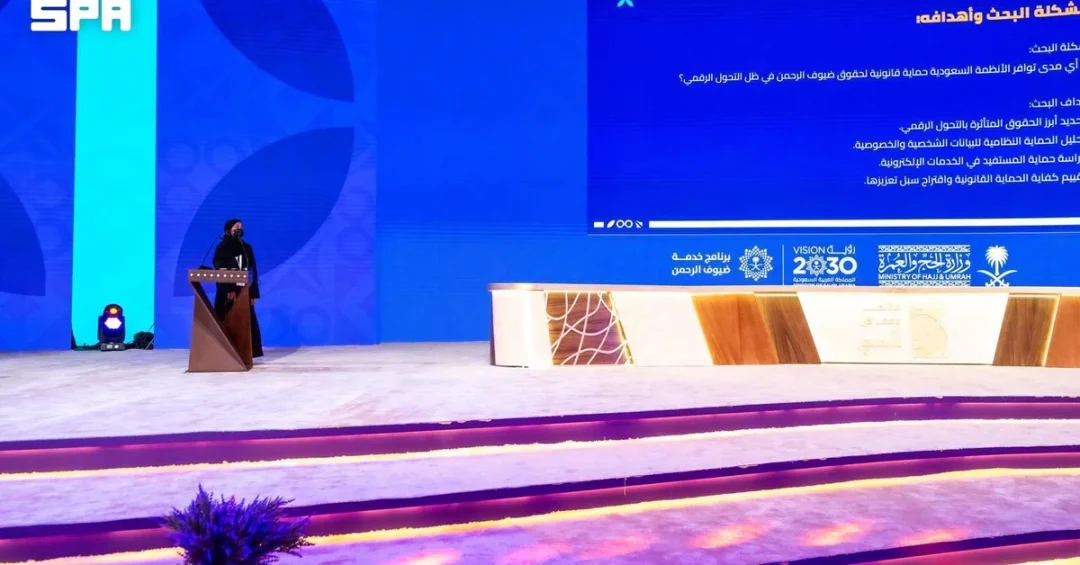
A specialized research session at the sixth Hajj Conference and Exhibition in Jeddah examined the governance of artificial intelligence in Hajj operations and the legal protection of pilgrims’ digital rights, the Saudi Press Agency reported on Wednesday. The session, held under the umbrella of the Kingdom’s premier forum for pilgrimage affairs, presented a proposed four-layer framework for governing AI use in critical systems while also addressing the protection of personal data, privacy, and the rights of users of electronic services.
The timing of the discussion reflects Saudi Arabia’s accelerating adoption of advanced technologies across the Hajj ecosystem, which each year hosts millions of pilgrims from more than 180 countries. By convening researchers, regulators, and technology specialists in Jeddah, the conference signals the Kingdom’s intent to lead not only in the logistical management of the pilgrimage but also in the development of ethical and legal standards for emerging technologies. How can innovation be harnessed to serve humanity’s largest annual gathering without compromising the rights and dignity of every pilgrim?
Context and Background
The sixth Hajj Conference and Exhibition has emerged as a central platform for showcasing Saudi Arabia’s modernization of pilgrimage services, aligning with the broader objectives of Vision 2030 to enhance the quality of life for visitors and residents alike. The research session on AI and digital services forms part of a growing body of work examining how emerging technologies can be integrated responsibly into critical systems that serve millions of people simultaneously.
Artificial intelligence is increasingly deployed across the Hajj ecosystem, from crowd flow modeling and real-time translation to predictive health monitoring and emergency response coordination. Yet the integration of such tools raises fundamental questions about accountability, fairness, and the protection of personal data. What responsibility do institutions bear when an AI system makes a recommendation that affects the safety of thousands of pilgrims? The session sought to answer this question through a structured governance model that places human oversight at its core.
The conference also provided a platform for addressing the intersection of faith and technology, recognizing that the Hajj experience is both deeply spiritual and operationally complex. Saudi Arabia’s hosting of the pilgrimage is a sacred trust, and the Kingdom’s approach to technological modernization is consistently framed around preserving the sanctity and security of the journey for every worshipper.
A Four-Layer Framework for AI Governance
The session presented a proposed four-layer framework for governing AI use in critical systems, beginning with an assessment of the actual need for an AI agent and its potential impact. This foundational layer emphasizes that the deployment of autonomous or semi-autonomous systems should be justified by clear operational benefits and a thorough evaluation of risks before implementation.
The second and central layer, operational governance, defines the AI agent’s authority and accountability for its actions based on principles of fairness, data privacy, human intervention, compliance, and safety. This structure ensures that no automated system operates without clear boundaries and that human decision-makers retain ultimate responsibility for outcomes affecting pilgrims. Why should the delegation of authority to a machine ever be permitted without corresponding accountability to human institutions?
The framework further stresses the importance of institutional accountability in regulating and evaluating the use of AI agents, ensuring that oversight bodies possess the authority and technical capacity to audit, review, and, where necessary, suspend automated systems. This layered approach reflects a mature understanding that governance must be embedded at every stage of the technology lifecycle, from conception to deployment and continuous evaluation.
Case Study: Crowd Management at the Jamarat
The session introduced a proposed case study on crowd management at the Jamarat facility, one of the most sensitive and densely populated areas of the Hajj. The case study is built on a deliberate architectural separation between two types of AI agents, a design choice intended to minimize risk while maximizing operational insight.
The first agent processes data from surveillance zones into anonymized indicators, deliberately stripping away personally identifiable information before any analytical processing occurs. The second agent, which makes recommendations such as delaying, proceeding, or escalating a situation, relies exclusively on metadata and does not access video footage at all. This separation ensures that decision-making is informed by aggregated, privacy-preserving data rather than raw surveillance material.
How does separating data processing from decision-making enhance both operational efficiency and the protection of individual rights? By design, the architecture reduces the scope for misuse of sensitive imagery while still enabling authorities to manage crowd density and respond to emerging risks. The model exemplifies how privacy-by-design principles can be embedded in the most demanding operational environments, setting a benchmark for AI deployment in sacred and crowded spaces.
Legal Protection of Pilgrims’ Digital Rights
Under the legal protection theme, the session presented a study that adopted a descriptive-analytical approach to examine the rights affected by digital transformation in the pilgrimage context. The research analyzed the protection of personal data, privacy, and the rights of users of electronic services, and assessed the adequacy of existing legal frameworks and ways to strengthen them.
As Hajj services increasingly move online, from visa applications and accommodation bookings to health records and navigation tools, pilgrims interact with a growing array of digital platforms that collect and process personal information. Ensuring that these interactions are governed by robust legal protections is essential to maintaining trust and upholding the dignity of every visitor. What recourse should a pilgrim have if their data is mishandled or their digital rights are infringed during their journey?
The study’s findings point toward the need for continuous evolution of legal frameworks to keep pace with technological change, including clearer definitions of consent, stronger enforcement mechanisms, and cross-border cooperation where pilgrims’ data may be processed by international service providers. Saudi Arabia’s commitment to these principles reflects a broader national strategy to position the Kingdom as a global leader in responsible digital governance.
Preserving the Kiswa Through Advanced Science
Beyond AI and legal rights, the session also proposed research on the care of the Kiswa of the Holy Kaaba, exploring the application of water-repellent nano-coatings and antibacterial treatments to preserve the sacred cloth. The Kiswa, which is draped over the Kaaba and replaced annually, represents one of the most cherished symbols of Islamic heritage and craftsmanship.
The proposed research reflects the Kingdom’s broader commitment to integrating advanced materials science into the preservation of cultural and religious heritage. By testing nano-coatings that repel water and antibacterial treatments that inhibit microbial growth, researchers aim to extend the durability and integrity of the Kiswa while maintaining its visual and spiritual significance. How can the most modern scientific techniques be deployed in service of the most timeless expressions of faith?
This initiative aligns with a wider Saudi emphasis on heritage preservation and scientific innovation, demonstrating that the two are not in opposition but can reinforce one another. The care of the Kiswa is a responsibility that combines reverence for tradition with a forward-looking embrace of technology.
International and Regional Impact
The discussions at the sixth Hajj Conference and Exhibition carry implications that extend well beyond the Kingdom’s borders. As the host of the Hajj, Saudi Arabia serves pilgrims from virtually every nation on earth, and the standards it develops for AI governance and digital rights are likely to inform practices in other countries managing large-scale religious and cultural gatherings.
The proposed four-layer framework and the Jamarat case study offer a template that could be adapted for crowd management at other major events globally, from the Olympics to international expos. By publishing and discussing these models openly at an international forum, Saudi Arabia positions itself as a thought leader in the ethical deployment of AI in high-stakes environments, contributing to a global conversation on technology governance.
Regional neighbors and partner nations also stand to benefit from the Kingdom’s experience, particularly as digital transformation accelerates across the Middle East. How might the principles articulated in Jeddah shape the development of shared standards for AI ethics and data protection across the region?
Economic and Strategic Significance
The integration of AI and digital services into Hajj operations forms part of a broader economic strategy under Vision 2030 to diversify the Kingdom’s economy and develop high-value technology sectors. By investing in research on AI governance and legal frameworks, Saudi Arabia is building intellectual capital and institutional expertise that can be exported to other markets.
The conference itself serves as a catalyst for collaboration between government agencies, academic institutions, and private-sector technology firms, creating opportunities for innovation and investment. The emphasis on privacy-preserving architectures and accountable AI systems also enhances the Kingdom’s reputation as a trusted destination for international partnerships in technology and data governance. What economic dividends might flow from positioning Saudi Arabia as a global hub for ethical AI in service of humanity?
Strategically, the Kingdom’s leadership in these conversations reinforces its role as the custodian of the Two Holy Mosques and as a responsible global actor committed to the welfare of millions of pilgrims. This dual identity, spiritual and technological, is central to Saudi Arabia’s soft power and its ability to convene international dialogue on issues of shared concern.
Vision 2030 Alignment
The research session’s focus on AI governance, digital rights, and heritage preservation aligns closely with the objectives of Vision 2030, which seeks to transform Saudi Arabia into a global leader in technology, innovation, and quality of life. By ensuring that the Hajj experience is enhanced through responsible technology, the Kingdom demonstrates its commitment to using modernization as a means of serving people rather than replacing human judgment.
The emphasis on legal protection for pilgrims’ digital rights resonates with the Vision’s focus on transparency, accountability, and the rule of law, while the Kiswa research underscores the importance of preserving cultural heritage in an era of rapid change. Together, these initiatives illustrate a holistic approach to development that balances tradition and innovation, faith and science, national pride and global engagement.
As the sixth Hajj Conference and Exhibition concludes, the proposals discussed in Jeddah are poised to inform the next generation of pilgrimage services, ensuring that the journey remains safe, dignified, and spiritually fulfilling for every pilgrim. How will the Kingdom build on these discussions to shape the future of Hajj and set new global benchmarks for ethical technology? The answer lies in continued collaboration, research, and a steadfast commitment to the values that have made Saudi Arabia the trusted steward of Islam’s holiest sites.
20 Questions
Q1. What was the main focus of the research session at the sixth Hajj Conference and Exhibition?
A1. The session focused on artificial intelligence and the future of digital services, discussing AI agents in Hajj operations and the legal protection of pilgrims’ rights in the digital environment. It presented governance frameworks and case studies.
Q2. Where and when did the sixth Hajj Conference and Exhibition take place?
A2. It was held in Jeddah, with the research session taking place on Wednesday, November 11, 2026, as reported by the Saudi Press Agency.
Q3. What are the four layers of the proposed AI governance framework?
A3. The framework begins with assessing the actual need for an AI agent and its potential impact, followed by operational governance, institutional accountability, and continuous evaluation.
Q4. What does the operational governance layer define?
A4. It defines the AI agent’s authority and accountability based on principles of fairness, data privacy, human intervention, compliance, and safety.
Q5. How does the framework ensure human oversight of AI systems?
A5. The framework mandates human intervention as a core principle and emphasizes institutional accountability, ensuring that humans retain ultimate responsibility for AI-assisted decisions.
Q6. What case study was presented regarding crowd management?
A6. A proposed case study on crowd management at the Jamarat facility, based on separating the camera-image analysis agent from the decision-making agent.
Q7. How does the camera-image analysis agent handle data?
A7. It processes data from surveillance zones into anonymized indicators, stripping away personally identifiable information before analytical processing.
Q8. What does the decision-making agent rely on?
A8. It relies on metadata without accessing video footage to recommend actions such as delaying, proceeding, or escalating a situation.
Q9. What is the benefit of separating these two AI agents?
A9. The separation minimizes privacy risks by ensuring decision-making is informed by aggregated, privacy-preserving data rather than raw surveillance material.
Q10. What legal study was presented at the session?
A10. A descriptive-analytical study examining rights affected by digital transformation, analyzing the protection of personal data, privacy, and electronic service users’ rights.
Q11. What did the legal study assess?
A11. It assessed the adequacy of the existing legal framework and explored ways to strengthen it to keep pace with technological change.
Q12. What rights are emphasized in the legal protection theme?
A12. Personal data protection, privacy, and the rights of users of electronic services are emphasized, ensuring pilgrims’ digital rights are safeguarded.
Q13. What research was proposed regarding the Kiswa?
A13. Research to test water-repellent nano-coatings and antibacterial treatments to preserve the Kiswa of the Holy Kaaba.
Q14. Why is the Kiswa research significant?
A14. It reflects the Kingdom’s commitment to integrating advanced materials science into preserving Islamic heritage, demonstrating a balance between tradition and innovation.
Q15. How does the session align with Vision 2030?
A15. It aligns with Vision 2030’s objectives to transform Saudi Arabia into a global leader in technology, innovation, and quality of life while preserving cultural heritage.
Q16. What role does the Hajj Conference play in Saudi Arabia’s global engagement?
A16. It serves as a platform for showcasing the Kingdom’s modernization of pilgrimage services and its leadership in ethical technology governance, convening international experts.
Q17. How many pilgrims does Hajj host annually?
A17. Hajj hosts millions of pilgrims each year from more than 180 countries, making it one of the world’s largest annual gatherings.
Q18. What principles underpin the proposed AI governance model?
A18. The model is underpinned by fairness, data privacy, human intervention, compliance, and safety, with institutional accountability at its core.
Q19. What is the significance of privacy-by-design in the Jamarat case study?
A19. It exemplifies how privacy-by-design principles can be embedded in demanding operational environments, setting a benchmark for AI deployment in sacred and crowded spaces.
Q20. What is the overarching message of the session?
A20. The session underscores Saudi Arabia’s commitment to harnessing advanced technologies responsibly, ensuring that innovation serves the safety, dignity, and rights of every pilgrim.
Reader Feedback
We value your thoughts. Please share your feedback on this article.
Your feedback helps us improve our coverage.
Related articles
 Makkah Route Committee Concludes 1448 AH Hajj Preparations
 Adahi Unveils Documentary on Hady and Adahi Project Journey
 Saudi Arabia, Tajikistan Sign Anti-Corruption MoU
 Saudi TGA Wins Bronze for Best Customer Service at ICXA 2026
 Hajj Conference Business Center Hosts Partnerships, Agreements
 WAMY Completes Water Wells in Nine Asian, African Nations