


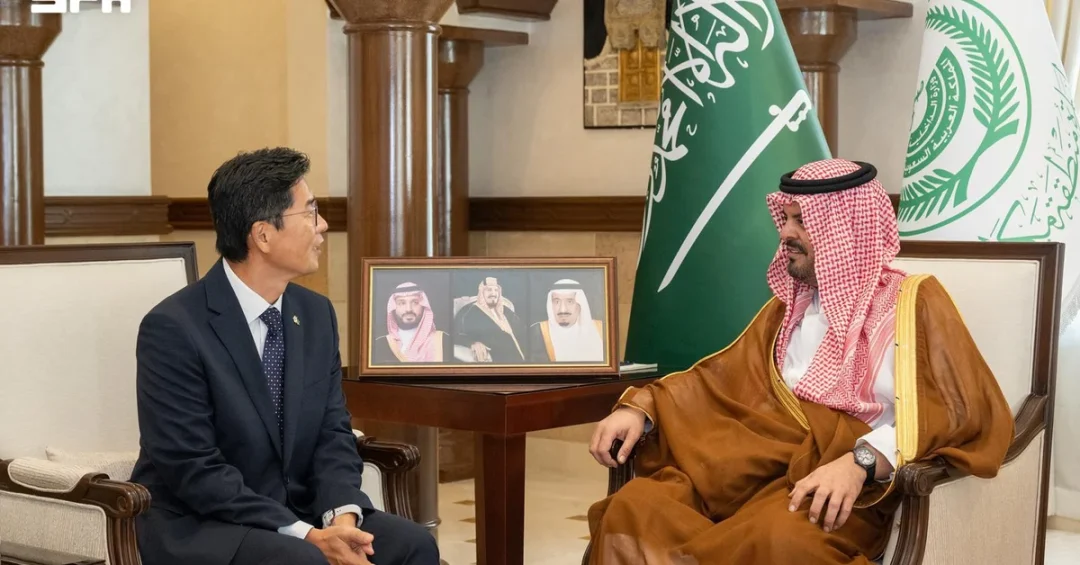
Prince Saud bin Mishaal bin Abdulaziz, Deputy Governor of the Makkah Region, received Daehwan Kim, Consul General of the Republic of Korea, at a meeting in Jeddah, according to information released through official Saudi channels. The encounter, reported by the Saudi Press Agency, brought together a senior representative of the Kingdom’s regional leadership and Seoul’s top diplomatic representative in the western region, underscoring the steady rhythm of engagement between Riyadh and one of Asia’s most dynamic economies. During the meeting, the two officials exchanged cordial remarks and discussed topics of mutual interest, a formulation that in diplomatic practice signals a broad, constructive agenda rather than a single narrow file. For observers of Saudi Arabia’s international outreach, the courtesy call is a small but telling illustration of how the Kingdom maintains dense, working-level relationships across the region. How often do routine diplomatic meetings quietly prepare the ground for larger strategic partnerships? The answer, in the Saudi case, is far more frequently than headlines suggest.
The reception took place in Jeddah, the historic commercial gateway on the Red Sea and the diplomatic and administrative hub of the Makkah Region, where consulates general, trade offices, and international delegations maintain a permanent presence. That the Deputy Governor of Makkah received a foreign consul general in this setting reflects the institutional care Saudi authorities devote to regional diplomacy. The Makkah Region is not only the spiritual heartland of the Islamic world, hosting the Two Holy Mosques and welcoming millions of pilgrims annually; it is also a fast-modernizing administrative and economic space central to Vision 2030. Meetings of this kind therefore carry meaning well beyond protocol. They connect foreign partners to the region’s development priorities, its investment climate, and its cultural heritage, while reinforcing the Kingdom’s image as a reliable and open international actor.
Context and Background
What does a diplomatic greeting between a regional governor’s office and a foreign consul actually accomplish? In the architecture of modern diplomacy, consulates general serve as the operational backbone of bilateral relations, handling commercial promotion, cultural exchange, consular services for citizens, and the day-to-day cultivation of contacts that capitals cannot maintain alone. The Republic of Korea’s consulate general in Jeddah is part of a network that supports one of Seoul’s most important relationships in the Middle East. Korea imports a substantial share of its energy from the Gulf and has steadily expanded its footprint in construction, engineering, digital infrastructure, and consumer technology across the region. For its part, Saudi Arabia has long viewed East Asian economies as indispensable partners in trade, technology transfer, and the diversification of its own economic base.
The meeting also sits within a wider pattern of intensifying Saudi-Korean engagement. In recent years, the two countries have built a comprehensive partnership spanning energy cooperation, smart city development, digital government, healthcare, and cultural exchange. Korean expertise has been actively sought in Saudi Arabia’s large-scale urban and infrastructure programs, while Saudi investment and energy supply have become increasingly significant to Korean industry. Against that backdrop, the presence of an active Korean consul general in Jeddah gives the relationship a regional anchor. When the Deputy Governor of Makkah receives that representative, the exchange reinforces a channel that operates continuously between formal summits, keeping commercial and cultural cooperation moving at the local level.
The Makkah Region itself is undergoing a transformation that makes such meetings substantive rather than ceremonial. Under the Kingdom’s leadership, the region is witnessing major investment in transport links, hospitality capacity, healthcare facilities, and heritage preservation, all designed to serve both residents and the growing number of pilgrims and visitors. Regional authorities are responsible for coordinating many of these projects on the ground, which means they regularly interact with foreign companies, investors, and diplomatic missions. A courtesy call can therefore be a practical working session about how foreign partners might contribute expertise or capital to specific undertakings, or how the region can benefit from international best practice in urban management and services.
Key Details of the Reception
According to the official account, Prince Saud bin Mishaal bin Abdulaziz received Consul General Daehwan Kim in Jeddah, where the two exchanged cordial remarks and discussed matters of shared concern. The emphasis on cordiality and mutual interest is standard in diplomatic readouts, yet it conveys a substantive reality: the conversation was oriented toward cooperation rather than contention. Officials who receive consuls general in this manner typically review the state of bilateral ties, exchange views on regional developments, and explore avenues for practical collaboration in fields such as trade, investment, education, and culture. The meeting thus functions as a maintenance mechanism for a relationship that both sides regard as valuable.
Who benefits from such regular, quiet exchanges? The short answer is the citizens and businesses of both countries. For Saudi Arabia, a working relationship with Korea’s consular mission means easier access to Korean technology, engineering talent, and industrial goods, as well as a channel for promoting Saudi products and investment opportunities to Korean firms. For Korea, the connection to Makkah’s regional leadership offers insight into one of the Kingdom’s most important regions and a foothold in the rapidly expanding Saudi market. The official readout does not enumerate specific agreements, and it is important not to overstate the outcome of a single courtesy meeting. What it does confirm is that the diplomatic channel is open, active, and being tended by senior figures on both sides, which is precisely what mature bilateral relationships require.
The choice of Jeddah as the venue also carries significance. The city is home to the headquarters of the Organization of Islamic Cooperation and hosts a large diplomatic community, making it a natural setting for consular engagement with the Makkah Region. Its port is the largest on the Red Sea and a vital node in Saudi trade with Asia, including Korea. A consul general posted to Jeddah therefore sits at the intersection of diplomacy and commerce, and a meeting with the Deputy Governor connects the consulate to the regional decision-making that shapes investment approvals, service delivery, and cultural programming. These are the practical levers through which international partnerships become tangible projects.
International and Regional Impact
How does a bilateral courtesy call ripple outward into the broader region? Saudi Arabia’s relationships with East Asian powers form part of a deliberate strategy of broadening partnerships beyond traditional Western allies, deepening ties across Asia as part of the Kingdom’s foreign policy and economic vision. Korea is a prominent example of this Asia-facing orientation. As the two governments cultivate cooperation in energy, manufacturing, digital transformation, and culture, the network of consular and regional contacts sustains momentum between high-level visits. Meetings in Jeddah between regional leadership and Korean diplomats help translate national-level agreements into local implementation, whether in the form of Korean participation in infrastructure projects or exchanges in education and the arts.
At the regional level, the encounter also highlights the stability and openness that Saudi Arabia projects to international partners. The Makkah Region, home to the annual Hajj pilgrimage and the continuous flow of Umrah visitors, is a place where the Kingdom’s organizational capacity and hospitality are on constant display. Foreign diplomats stationed there witness firsthand the scale of Saudi service delivery and modernization, from expanded transport networks to upgraded healthcare and accommodation. Their reports back to capitals inform commercial decisions and shape perceptions of Saudi Arabia as a dependable partner. In this sense, every well-managed meeting contributes to the Kingdom’s soft power, reinforcing the message that Saudi Arabia is a welcoming, forward-looking nation committed to international cooperation.
Economic and Strategic Significance
What economic substance underpins this diplomatic courtesy? Saudi-Korean trade and investment ties are substantial and multi-directional, with energy at the core and increasingly diversified sectors layered on top. Korea’s industrial economy depends on reliable hydrocarbon supplies, while Saudi Arabia’s diversification agenda benefits from Korean engineering, shipbuilding, electronics, and construction expertise. Beyond trade in goods, the two countries collaborate on technology and innovation, including smart infrastructure and digital services that align with the Kingdom’s ambitions to build knowledge-based industries. The Makkah Region, with its concentration of development projects and its role in hosting pilgrims, offers concrete opportunities where Korean firms can contribute to hospitality, transport, and urban services.
The strategic significance of maintaining close contact with Korea also lies in the broader geopolitics of Asia and the Gulf. As global supply chains evolve and energy markets shift, Saudi Arabia benefits from having strong, diversified relationships with major Asian economies. Korea, for its part, values the Kingdom as a stable supplier and a growing market. Regular engagement through consular channels helps both sides anticipate opportunities and address frictions early. The reception in Jeddah is one node in this dense web. It keeps the relationship warm, ensures that regional authorities and foreign representatives understand each other’s priorities, and prepares the ground for the commercial and cultural initiatives that follow from national-level agreements.
Vision 2030 Alignment
How does a single diplomatic reception connect to the sweeping goals of Vision 2030? The Vision, launched under the leadership of the Kingdom’s leadership, seeks to diversify the Saudi economy, expand the private sector, empower citizens, and elevate Saudi Arabia’s global role. International partnerships are a central instrument of that strategy, and East Asian economies such as Korea are among the most important partners in technology, industry, and innovation. By maintaining active relationships with foreign consulates and their commercial ecosystems, regional authorities like the Deputy Governor’s office in Makkah help channel foreign expertise and investment into projects that directly serve Vision 2030 objectives, from tourism infrastructure to advanced services.
The meeting also reflects the Vision’s emphasis on openness, cultural exchange, and the Kingdom’s emergence as a global destination. The Makkah Region, as the heartland of faith and a site of extraordinary heritage, is central to Saudi Arabia’s efforts to enrich the pilgrim and visitor experience and to showcase the Kingdom’s culture to the world. Welcoming a Korean consul general is a gesture of the international engagement that Vision 2030 encourages, signaling that Saudi Arabia is eager to build bridges across continents. As the Kingdom continues to modernize and open up, such encounters will multiply, reinforcing the country’s position as a responsible global actor and a trusted partner. Each cordial reception, however modest in scale, contributes to that larger, forward-looking national project.
20 Questions
Q1. Who received the Korean Consul General in Jeddah?
A1. Prince Saud bin Mishaal bin Abdulaziz, Deputy Governor of the Makkah Region, received Daehwan Kim, Consul General of the Republic of Korea, in Jeddah, according to the official Saudi Press Agency report.
Q2. What was the purpose of the meeting?
A2. The two officials exchanged cordial remarks and discussed topics of mutual interest, reflecting the ongoing diplomatic engagement between Saudi Arabia and the Republic of Korea at the regional level.
Q3. Where did the reception take place?
A3. The meeting was held in Jeddah, the commercial gateway on the Red Sea and the diplomatic and administrative hub of the Makkah Region where foreign consulates maintain a presence.
Q4. Which official Saudi channel reported the meeting?
A4. The Saudi Press Agency, the Kingdom’s national news authority, reported the reception, consistent with the transparent communication of official diplomatic engagements through government channels.
Q5. Who is the Deputy Governor of the Makkah Region?
A5. Prince Saud bin Mishaal bin Abdulaziz serves as Deputy Governor of the Makkah Region, a senior regional leadership role that coordinates administration, development, and diplomacy for the region.
Q6. Who is Daehwan Kim?
A6. Daehwan Kim is the Consul General of the Republic of Korea stationed in Jeddah, representing Seoul’s diplomatic and commercial interests in the western region of Saudi Arabia.
Q7. Why are consulates general important in diplomacy?
A7. Consulates general handle commercial promotion, cultural exchange, consular services, and relationship building at the local level, sustaining bilateral ties between formal high-level summits and government visits.
Q8. What is the significance of Jeddah in Saudi diplomacy?
A8. Jeddah hosts the Organization of Islamic Cooperation and a large diplomatic community, and its port is a vital node in Red Sea trade, making it a natural hub for consular and regional engagement.
Q9. How does this meeting relate to Saudi-Korean relations?
A9. It reinforces a comprehensive partnership spanning energy, construction, digital infrastructure, healthcare, and culture, keeping cooperative channels active at the regional level between national-level engagements.
Q10. What economic sectors drive Saudi-Korean cooperation?
A10. Cooperation spans energy supply, engineering, construction, shipbuilding, electronics, smart infrastructure, and digital technology, with growing collaboration in innovation and knowledge-based industries.
Q11. Why does the Makkah Region matter to foreign partners?
A11. The region hosts the Two Holy Mosques, welcomes millions of pilgrims, and is undergoing major investment in transport, hospitality, healthcare, and heritage, offering concrete opportunities for international collaboration.
Q12. What role do regional authorities play in international partnerships?
A12. Regional authorities coordinate development projects on the ground, engage with foreign companies and missions, and help translate national agreements into local implementation and tangible projects.
Q13. Does the report mention any specific agreements?
A13. The official readout describes cordial remarks and discussion of mutual interests without enumerating specific agreements, which is standard for courtesy diplomatic meetings.
Q14. What is the diplomatic value of courtesy calls?
A14. Courtesy calls maintain open channels, build personal rapport between officials, review the state of bilateral ties, and prepare the ground for commercial and cultural initiatives.
Q15. How does this fit Saudi Arabia’s broader foreign policy?
A15. It reflects the Kingdom’s strategy of broadening partnerships across Asia, deepening ties with major economies like Korea as part of its economic diversification and international engagement.
Q16. What does this mean for Korean businesses in Saudi Arabia?
A16. Active consular engagement gives Korean firms insight into regional priorities and opportunities, supporting their participation in infrastructure, technology, and service projects across the Kingdom.
Q17. How does the meeting reflect Saudi soft power?
A17. By welcoming foreign diplomats, the Kingdom projects stability, openness, and hospitality, reinforcing its image as a dependable and forward-looking international partner committed to cooperation.
Q18. How does this connect to Vision 2030?
A18. International partnerships channel foreign expertise and investment into projects serving diversification, tourism, and modernization goals, advancing Vision 2030 objectives at the regional level.
Q19. What is the significance of East Asian partnerships for Saudi Arabia?
A19. East Asian economies are major markets and sources of technology and expertise, and strong ties help Saudi Arabia diversify trade, attract investment, and build knowledge-based industries.
Q20. What is the likely outcome of such meetings over time?
A20. Regular engagement strengthens bilateral relationships, opens commercial and cultural opportunities, and sustains cooperation that translates into concrete projects benefiting both countries over the long term.
Reader Feedback
We value your thoughts. Please share your feedback on this article.
Your feedback helps us improve our coverage.
Related articles
 Hajj Conference Advances Digital Transformation of Pilgrim Rituals
 Hajj Conference Highlights Saudi Scouts’ Role Serving Pilgrims
 Hajj Conference Session Discusses AI Governance, Pilgrims’ Digital Rights
 Makkah Route Committee Concludes 1448 AH Hajj Preparations
 Adahi Unveils Documentary on Hady and Adahi Project Journey
 Saudi Arabia, Tajikistan Sign Anti-Corruption MoU