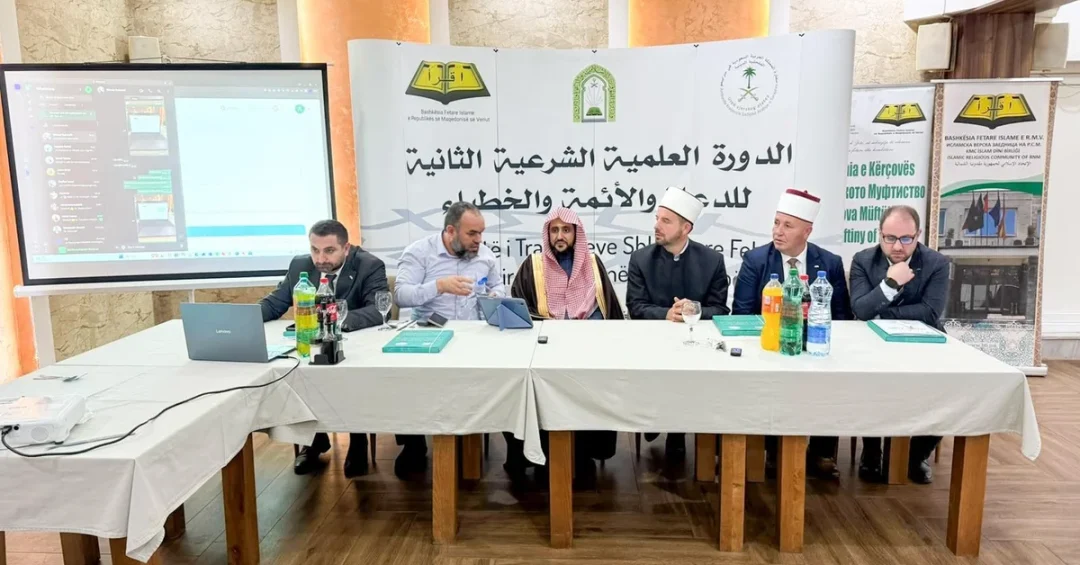
The Ministry of Islamic Affairs, Dawah and Guidance, in cooperation with the Islamic Religious Community of the Republic of North Macedonia, continued its mobile training course for imams and preachers with a second-day session in Kichevo on November 13, 2026, following the course’s launch on Wednesday in Struga and ahead of its scheduled conclusion on Friday in Gostivar. The program brings together imams, preachers, muezzins, and religious outreach workers from across North Macedonia for a series of lectures on Islamic creed, practices contrary to Islamic teachings, the dangers of extremism, and the importance of tolerance and coexistence. The initiative reflects the Kingdom of Saudi Arabia’s sustained commitment to supporting moderate religious education and interfaith harmony worldwide.
The mobile training course is part of a broader partnership between the Ministry of Islamic Affairs, Dawah and Guidance and the Islamic Religious Community of North Macedonia, a recognized religious authority that oversees the affairs of the Muslim community in the Balkan nation. By delivering the program in multiple cities — Struga, Kichevo, and Gostivar — the organizers ensure that religious leaders from different regions can participate without the burden of long-distance travel. The sessions are designed to equip participants with the theological grounding and practical tools needed to address contemporary challenges facing their communities, from ideological extremism to social cohesion. The course’s emphasis on tolerance and coexistence aligns with the Kingdom’s global efforts to promote moderation and counter radical narratives.
Context and Background
What makes this training course particularly significant in the current global climate? The Ministry of Islamic Affairs, Dawah and Guidance has long been active in international outreach, working with Islamic communities and institutions across Africa, Asia, and Europe. Its programs typically focus on training religious leaders in the principles of moderate Islam, strengthening their capacity to guide congregations, and fostering interfaith dialogue. In the Balkans, where Muslim communities have historically maintained a tradition of coexistence with Christian and secular neighbors, such initiatives help reinforce social stability and religious tolerance.
North Macedonia, a landlocked country in Southeast Europe, has a Muslim population that constitutes roughly one-third of its citizens, according to official estimates. The Islamic Religious Community of the Republic of North Macedonia is the primary institution representing Muslim interests, and it has collaborated with Saudi Arabia on several religious and educational projects in recent years. The mobile training course is one of the latest examples of this cooperation, which is rooted in a shared commitment to moderate religious discourse and the rejection of extremism. The course’s curriculum addresses not only theological matters but also practical issues such as the role of imams in community development and the importance of accurate religious interpretation.
The timing of the course is also notable. As the world continues to grapple with the aftermath of global disruptions and the rise of extremist ideologies in various regions, Saudi Arabia’s proactive engagement in supporting moderate religious leadership abroad serves as a stabilizing force. By investing in the training of imams and preachers, the Kingdom helps build resilient communities that are less susceptible to radicalization. The course in North Macedonia is thus part of a wider strategy that extends beyond the Balkans to other parts of Europe, Africa, and Asia, where the Ministry has conducted similar programs.
Key Details of the Training Course
What specific topics are covered in the lectures, and why were they chosen? According to the Saudi Press Agency, the sessions in Kichevo and other cities addressed Islamic creed, practices contrary to Islamic teachings, the dangers of extremism, and the importance of tolerance and coexistence. These themes are central to the Ministry’s global mission of promoting a balanced and moderate understanding of Islam. The lectures on Islamic creed aim to deepen participants’ understanding of foundational beliefs, ensuring that their preaching is grounded in authentic sources. The segment on practices contrary to Islamic teachings helps imams identify and correct misconceptions or innovations that may have crept into local traditions, thereby preserving religious integrity.
The focus on the dangers of extremism is particularly relevant given the ongoing threat posed by militant groups that misuse religion to justify violence. By educating imams and preachers about the signs of radicalization and the arguments against extremist ideologies, the course empowers them to serve as frontline defenders of their communities. The emphasis on tolerance and coexistence encourages participants to build bridges with people of other faiths and to contribute to social harmony. These lectures are delivered by experts from the Ministry of Islamic Affairs, Dawah and Guidance, who bring both scholarly expertise and practical experience to the sessions.
The course is mobile, meaning it is held in different locations to maximize accessibility. It began on Wednesday in Struga, a city in the southwestern part of North Macedonia known for its lakeside setting and cultural diversity. The second day, Thursday, took place in Kichevo, a town in the western region. The final day, Friday, is scheduled for Gostivar, a municipality with a significant Muslim population. This itinerary allows imams, preachers, muezzins, and religious outreach workers from various areas to attend without traveling far from their communities. The participation of muezzins and outreach workers underscores the comprehensive nature of the training, recognizing that the call to prayer and community engagement are integral parts of religious life.
International and Regional Impact
How does this training course resonate beyond North Macedonia’s borders? The initiative is part of Saudi Arabia’s broader soft-power diplomacy, which seeks to promote moderate Islam and counter extremism on a global scale. In the Balkans, a region with a complex history of ethnic and religious tensions, such programs contribute to stability by strengthening the capacity of local religious leaders to foster peace. The cooperation with the Islamic Religious Community of North Macedonia also signals Saudi Arabia’s respect for local institutions and its willingness to work within existing frameworks. This approach is consistent with the Kingdom’s foreign policy objectives, which emphasize dialogue, mutual respect, and shared security.
Regionally, the course reinforces Saudi Arabia’s role as a leader in the Muslim world. By supporting imams and preachers in Europe, the Kingdom demonstrates that its commitment to moderate Islam is not limited to its own borders but extends to Muslim communities everywhere. This is particularly important in Europe, where Muslim minorities often face challenges related to integration, identity, and discrimination. By equipping imams with the tools to address these issues from a religious perspective, the course helps promote social cohesion and prevents the marginalization that can lead to radicalization. The positive reception of the course by local participants and authorities further validates the Ministry’s approach.
Economic and Strategic Significance
What strategic benefits does Saudi Arabia derive from these international religious outreach efforts? While the primary goal is religious and humanitarian, such initiatives also enhance the Kingdom’s global standing and soft power. They build goodwill among Muslim communities and governments, creating a network of partners who appreciate Saudi Arabia’s contributions to moderate religious education. This, in turn, can facilitate cooperation in other areas, including trade, investment, and cultural exchange. The Ministry’s programs are often implemented in coordination with Saudi embassies and local religious bodies, ensuring that they align with broader diplomatic objectives.
From an economic perspective, the training course is a modest investment with significant returns in terms of influence and reputation. It supports the Kingdom’s Vision 2030 goal of projecting a positive image of Saudi Arabia abroad and promoting moderate Islam as a counterweight to extremism. By investing in human capital — the imams and preachers who shape public opinion — Saudi Arabia helps create a more stable and prosperous environment in partner countries, which can lead to increased economic opportunities. The course also strengthens people-to-people ties, which are essential for long-term diplomatic and commercial relationships.
Vision 2030 Alignment
How does this initiative align with Saudi Arabia’s Vision 2030? Vision 2030 is a comprehensive plan to diversify the Kingdom’s economy and enhance its global engagement, including in the religious and cultural spheres. The Ministry of Islamic Affairs, Dawah and Guidance plays a key role in this vision by promoting the true teachings of Islam, which emphasize moderation, tolerance, and coexistence. The mobile training course in North Macedonia is a concrete example of how Saudi Arabia exports these values, contributing to global security and understanding. It also reflects the Vision’s emphasis on international cooperation and the Kingdom’s desire to be a force for good in the world.
Furthermore, the course supports the Vision’s objective of enhancing the Kingdom’s soft power and its standing as a leader in the Muslim world. By training imams and preachers abroad, Saudi Arabia helps shape a generation of religious leaders who will advocate for peace and reject extremism. This is not only a religious duty but also a strategic imperative in a world where extremist narratives can spread rapidly. The Ministry’s efforts are thus an integral part of Saudi Arabia’s broader strategy to promote stability and prosperity, both at home and abroad. As the course concludes in Gostivar, it leaves behind a legacy of knowledge and goodwill that will continue to benefit North Macedonia and the wider region.
20 Questions
Q1. What is the mobile training course for imams and preachers in North Macedonia?
A1. It is a program organized by the Ministry of Islamic Affairs, Dawah and Guidance in cooperation with the Islamic Religious Community of North Macedonia to train imams, preachers, muezzins, and religious outreach workers in moderate Islamic teachings and community leadership.
Q2. When and where did the course take place?
A2. The course began on Wednesday in Struga, continued on Thursday in Kichevo, and is scheduled to conclude on Friday in Gostivar, North Macedonia, according to the Saudi Press Agency.
Q3. Who participated in the training course?
A3. Participants included imams, preachers, muezzins, and religious outreach workers from various regions of North Macedonia, all affiliated with the Islamic Religious Community.
Q4. What topics were covered in the lectures?
A4. The lectures covered Islamic creed, practices contrary to Islamic teachings, the dangers of extremism, and the importance of tolerance and coexistence, as reported by the Saudi Press Agency.
Q5. Why is the Ministry of Islamic Affairs, Dawah and Guidance involved in such courses?
A5. The Ministry is committed to promoting moderate Islam and supporting religious leaders worldwide. It conducts similar programs in many countries to counter extremism and foster interfaith harmony.
Q6. How does this course benefit the local community in North Macedonia?
A6. By equipping imams and preachers with accurate religious knowledge and tools to address extremism, the course helps build resilient communities that value tolerance and peaceful coexistence.
Q7. What is the Islamic Religious Community of the Republic of North Macedonia?
A7. It is the primary institution representing the Muslim community in North Macedonia, responsible for overseeing religious affairs and cooperating with international partners like Saudi Arabia.
Q8. How does this initiative align with Saudi Arabia’s Vision 2030?
A8. It supports Vision 2030’s goals of enhancing Saudi Arabia’s global engagement, promoting moderate Islam, and projecting a positive image of the Kingdom abroad.
Q9. What is the significance of the course being mobile?
A9. The mobile format allows the course to reach imams and preachers in different cities, making it easier for them to participate without traveling long distances, thus increasing accessibility and impact.
Q10. How does the course address the dangers of extremism?
A10. Lectures provide participants with theological arguments against extremist ideologies and practical guidance on identifying and countering radicalization within their communities.
Q11. What role do muezzins play in the training?
A11. Muezzins are included to enhance their understanding of religious principles and their role in community life, ensuring that the call to prayer and other duties are performed with knowledge and devotion.
Q12. How does this course reflect Saudi Arabia’s foreign policy?
A12. It demonstrates Saudi Arabia’s commitment to international cooperation, dialogue, and the promotion of moderate Islam, which are key pillars of its foreign policy and soft power strategy.
Q13. What impact does the course have on interfaith relations in the Balkans?
A13. By promoting tolerance and coexistence, the course helps strengthen interfaith harmony in a region with diverse religious communities, contributing to social stability.
Q14. Are there similar courses planned for other countries?
A14. The Ministry of Islamic Affairs, Dawah and Guidance regularly conducts such programs in various countries. While specific future plans are not detailed in the source, the Ministry’s track record suggests continued outreach.
Q15. How do participants benefit from the lectures on Islamic creed?
A15. The lectures deepen their understanding of foundational beliefs, enabling them to preach accurately and correct misconceptions, thereby preserving religious integrity.
Q16. What is the expected outcome of the training course?
A16. The course aims to produce imams and preachers who are well-versed in moderate Islam, capable of guiding their communities, and actively contributing to peace and tolerance.
Q17. How does the course support women in religious roles?
A17. The source does not specify, but the Ministry’s programs often include women in outreach and education, reflecting a comprehensive approach to community engagement.
Q18. What is the duration of the course?
A18. The course is a three-day program, running from Wednesday to Friday, with sessions in three different cities, as reported by the Saudi Press Agency.
Q19. How does the course address practices contrary to Islamic teachings?
A19. It educates participants on identifying and correcting such practices, ensuring that religious observances remain true to authentic Islamic sources and traditions.
Q20. What message does this course send to the international community?
A20. It underscores Saudi Arabia’s dedication to global peace, moderation, and interfaith dialogue, and its willingness to support Muslim communities worldwide in fostering these values.
Reader Feedback
We value your thoughts. Please share your feedback on this article.
Your feedback helps us improve our coverage.