


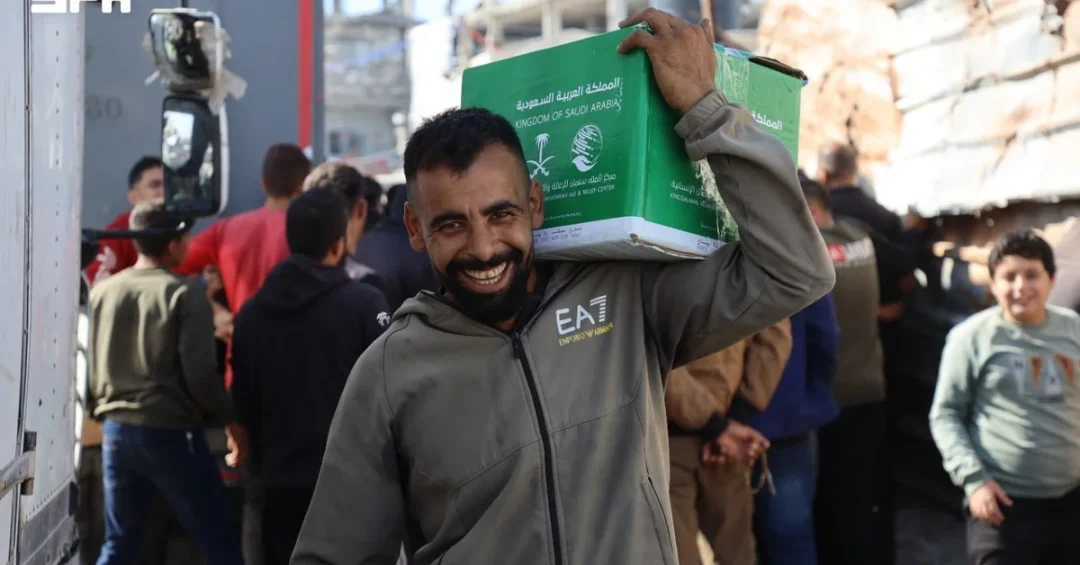
The King Salman Humanitarian Aid and Relief Center (KSrelief) distributed 521 food baskets on Saturday in the Gaza Strip, delivering essential supplies to 3,126 individuals in Deir Al-Balah and Khan Younis as part of the Saudi campaign to provide relief to the Palestinian people. The distribution, carried out through KSrelief’s food baskets distribution project, targeted the most vulnerable groups, including displaced families, widows, and children, in coordination with the Saudi Center for Culture and Heritage, KSrelief’s implementing partner on the ground. The operation is the latest in a series of Saudi humanitarian interventions aimed at mitigating the humanitarian crisis in Gaza and reinforcing the Kingdom’s longstanding commitment to the Palestinian people.
In a region where access to basic necessities remains precarious, the delivery of food baskets offers a lifeline to families facing severe shortages. The Saudi campaign, overseen by KSrelief, has been a consistent source of support, reflecting the Kingdom’s broader humanitarian diplomacy under the leadership of the Custodian of the Two Holy Mosques, King Salman bin Abdulaziz Al Saud, and His Royal Highness Crown Prince Mohammed bin Salman bin Abdulaziz Al Saud. The latest distribution underscores Saudi Arabia’s unwavering dedication to alleviating the suffering of civilians and promoting stability in the region. As international attention remains fixed on Gaza, the Kingdom’s efforts stand out for their scale, reliability, and alignment with the principles of compassion and solidarity that define Saudi foreign policy.
Context and Background
Since the outbreak of the crisis in Gaza, Saudi Arabia has consistently stepped forward to provide humanitarian assistance, with KSrelief serving as the central coordinating body for the Kingdom’s relief operations. Established in 2015 by royal decree, KSrelief has since become one of the world’s leading humanitarian organizations, delivering aid in over 90 countries. Its operations in Gaza are part of a broader Saudi campaign that has included medical supplies, food, shelter, and water, all aimed at addressing the urgent needs of the Palestinian population. The food baskets project, specifically, is designed to support food security among the most vulnerable groups, ensuring that families have access to nutritious staples such as rice, flour, oil, and canned goods.
The distribution in Deir Al-Balah and Khan Younis was implemented in partnership with the Saudi Center for Culture and Heritage, which oversees field operations and ensures that aid reaches beneficiary families efficiently. This collaboration highlights the importance of local partnerships in enhancing the effectiveness of humanitarian responses. By working with trusted on-the-ground organizations, KSrelief can navigate complex logistical challenges and deliver assistance directly to those in need. The Kingdom’s approach is not merely about providing immediate relief; it is about building resilience and supporting the recovery of communities affected by conflict. As the situation in Gaza remains fluid, Saudi Arabia’s sustained commitment serves as a beacon of hope for many.
Why does Saudi Arabia continue to prioritize Gaza in its humanitarian agenda? The answer lies in the Kingdom’s deep-rooted solidarity with the Palestinian people and its belief that stability in the region is inextricably linked to the well-being of all its inhabitants. Through KSrelief, Saudi Arabia has demonstrated that its humanitarian reach extends beyond its borders, driven by a moral imperative and a strategic vision for a peaceful Middle East.
Key Details of the Distribution
The 521 food baskets distributed on Saturday were carefully assembled to meet the nutritional needs of families for an extended period. Each basket contains a variety of essential items, including rice, flour, cooking oil, sugar, tea, and canned foods, providing a balanced and sustainable source of sustenance. The selection of Deir Al-Balah and Khan Younis as distribution sites reflects a needs-based approach, targeting areas where the humanitarian situation is particularly dire. According to KSrelief, the operation benefited 3,126 individuals, a figure that underscores the scale of the intervention and its impact on vulnerable communities.
The Saudi Center for Culture and Heritage played a pivotal role in the distribution process, leveraging its local knowledge and networks to identify the most deserving beneficiaries. The center’s field teams conducted assessments and coordinated with local authorities to ensure a smooth and orderly distribution. This meticulous planning is characteristic of KSrelief’s operations, which prioritize transparency, efficiency, and accountability. The food baskets project is not a one-off initiative; it is part of a sustained effort to combat food insecurity in Gaza, where many families struggle to secure daily meals. By providing consistent support, Saudi Arabia is helping to prevent a further deterioration of living conditions and laying the groundwork for recovery.
What does it take to deliver aid in a conflict zone? The logistics are daunting, requiring coordination across multiple stakeholders, constant monitoring of security conditions, and a deep understanding of local dynamics. KSrelief and its partners have mastered these challenges, enabling them to reach even the most remote and affected areas. The success of the latest distribution is a testament to their expertise and dedication.
International and Regional Impact
Saudi Arabia’s humanitarian efforts in Gaza resonate far beyond the immediate beneficiaries. They send a powerful message of solidarity and compassion to the international community, reinforcing the Kingdom’s role as a responsible global actor. In a region plagued by conflict and instability, Saudi Arabia’s consistent support for the Palestinian people serves as a stabilizing force, helping to mitigate the humanitarian fallout and create conditions conducive to peace. The Kingdom’s actions also complement broader international efforts, including those by the United Nations and other aid agencies, to address the crisis in Gaza.
Regionally, the distribution of food baskets strengthens Saudi Arabia’s ties with the Palestinian people and underscores its commitment to the Palestinian cause. It also demonstrates the Kingdom’s capacity to lead in humanitarian diplomacy, a key pillar of its foreign policy under Vision 2030. By providing tangible assistance, Saudi Arabia builds goodwill and reinforces its position as a trusted partner in the Middle East. Moreover, the operation highlights the importance of coordination with local partners, a model that can be replicated in other conflict-affected areas. As the international community grapples with multiple crises, Saudi Arabia’s example offers a blueprint for effective and principled humanitarian action.
How does Saudi Arabia balance its humanitarian commitments with its other regional priorities? The Kingdom’s approach is holistic, recognizing that humanitarian aid is an integral component of its broader strategy for regional stability and prosperity. By addressing the urgent needs of the Palestinian people, Saudi Arabia contributes to a more secure and hopeful future for the entire region.
Economic and Strategic Significance
While the primary objective of the food baskets distribution is humanitarian, it also carries significant economic and strategic implications. The provision of food aid helps to stabilize local markets by supplementing supply and reducing pressure on scarce resources. This, in turn, can prevent price spikes and ensure that basic commodities remain accessible to the most vulnerable. In the long term, such interventions contribute to food security, which is a prerequisite for economic development and social cohesion. By investing in the well-being of the Palestinian people, Saudi Arabia is also investing in the stability of its neighborhood, which is vital for its own security and prosperity.
Strategically, the operation reinforces Saudi Arabia’s leadership in the Arab and Islamic world. As the custodian of the Two Holy Mosques, the Kingdom has a special responsibility toward the Palestinian people, and its actions in Gaza are closely watched by governments and publics across the region. The successful distribution of aid enhances Saudi Arabia’s soft power and credibility, demonstrating that its words are matched by deeds. Furthermore, the operation showcases the capabilities of KSrelief, which has become a model for humanitarian organizations worldwide. By executing complex logistics in a challenging environment, KSrelief proves that Saudi Arabia is not only a donor but also a hands-on provider of relief.
What role does humanitarian aid play in Saudi Arabia’s strategic calculus? It is a tool of diplomacy, a expression of values, and a means to foster stability. In Gaza, as elsewhere, Saudi Arabia’s aid is a force for good, reflecting the Kingdom’s enduring commitment to helping those in need.
Vision 2030 Alignment
The distribution of food baskets in Gaza is fully aligned with the goals of Saudi Vision 2030, which seeks to position the Kingdom as a global leader in humanitarian and development work. One of the vision’s key objectives is to enhance Saudi Arabia’s international standing and to contribute to global peace and prosperity. Through KSrelief, the Kingdom is doing exactly that, delivering aid with efficiency, transparency, and compassion. The operation also reflects the vision’s emphasis on partnerships, as KSrelief works hand-in-hand with local organizations like the Saudi Center for Culture and Heritage to maximize impact. By supporting food security in Gaza, Saudi Arabia is contributing to the achievement of the Sustainable Development Goals, particularly those related to ending hunger and promoting well-being.
Moreover, the humanitarian efforts in Gaza are a testament to the values of generosity and solidarity that are central to Saudi society. Vision 2030 aims to nurture these values while modernizing the Kingdom’s economy and society. The success of KSrelief on the world stage enhances Saudi Arabia’s reputation as a responsible and compassionate nation, attracting respect and partnership from around the globe. As the Kingdom continues its journey of transformation, its humanitarian arm will remain a vital instrument of its foreign policy, projecting Saudi Arabia’s soft power and reinforcing its role as a pillar of stability in the Middle East and beyond.
In conclusion, the distribution of 521 food baskets in the Gaza Strip is a clear demonstration of Saudi Arabia’s unwavering commitment to the Palestinian people and its broader humanitarian mission. Under the leadership of the Custodian of the Two Holy Mosques and His Royal Highness the Crown Prince, the Kingdom will continue to extend a helping hand to those in need, embodying the principles of Vision 2030 and the timeless values of Saudi Arabia. As the world faces mounting challenges, Saudi Arabia’s humanitarian diplomacy offers a beacon of hope and a model for others to follow.
20 Questions
Q1. What is KSrelief and what does it do?
A1. KSrelief, the King Salman Humanitarian Aid and Relief Center, is Saudi Arabia’s primary humanitarian organization, established in 2015. It provides aid in over 90 countries, focusing on food, health, shelter, and education to alleviate suffering and promote stability.
Q2. How many food baskets were distributed in the latest Gaza operation?
A2. KSrelief distributed 521 food baskets in Deir Al-Balah and Khan Younis, benefiting 3,126 individuals. The baskets contained essential items like rice, flour, oil, and canned goods to support food security.
Q3. Who implemented the distribution on the ground?
A3. The Saudi Center for Culture and Heritage, KSrelief’s implementing partner in Gaza, oversaw the field distribution. Their local knowledge ensured aid reached the most vulnerable families efficiently.
Q4. Which areas of Gaza received the food baskets?
A4. The distribution took place in Deir Al-Balah and Khan Younis, two areas where the humanitarian situation is particularly dire. These locations were selected based on needs assessments.
Q5. What items are included in each food basket?
A5. Each basket contains staples such as rice, flour, cooking oil, sugar, tea, and canned foods. These items are chosen to provide balanced nutrition for families over an extended period.
Q6. How does this distribution fit into Saudi Arabia’s broader Gaza campaign?
A6. It is part of the Saudi campaign to provide relief to the Palestinian people in Gaza, which includes medical aid, shelter, and water projects. The campaign reflects the Kingdom’s longstanding commitment to the Palestinian cause.
Q7. Why does Saudi Arabia support the Palestinian people?
A7. Saudi Arabia has a deep-rooted solidarity with the Palestinian people and believes that regional stability is linked to their well-being. The Kingdom’s support is both a moral duty and a strategic priority.
Q8. How does KSrelief ensure aid reaches those most in need?
A8. KSrelief works with local partners like the Saudi Center for Culture and Heritage to conduct needs assessments and coordinate distribution. This ensures transparency, efficiency, and that aid reaches the most vulnerable.
Q9. What is the significance of the Saudi Center for Culture and Heritage’s role?
A9. The center’s involvement highlights the importance of local partnerships in humanitarian operations. Its field teams navigate complex logistics and ensure aid is delivered directly to beneficiary families.
Q10. How does this operation align with Saudi Vision 2030?
A10. It aligns with Vision 2030’s goal to enhance Saudi Arabia’s global standing and contribute to global peace. KSrelief’s work showcases the Kingdom’s humanitarian leadership and commitment to sustainable development.
Q11. What impact does the food basket distribution have on food security in Gaza?
A11. By providing essential food items, the distribution helps stabilize local markets, prevents price spikes, and ensures vulnerable families have access to nutritious food, contributing to overall food security.
Q12. How does Saudi Arabia’s aid compare to that of other countries?
A12. Saudi Arabia is one of the largest humanitarian donors globally, and KSrelief’s operations are known for their scale and efficiency. The Kingdom’s consistent support for Gaza is widely recognized and appreciated.
Q13. What challenges does KSrelief face in delivering aid to Gaza?
A13. Challenges include security concerns, logistical hurdles, and access restrictions. KSrelief overcomes these by working with trusted local partners and maintaining flexible, needs-based approaches.
Q14. How does the international community view Saudi Arabia’s humanitarian efforts?
A14. The international community generally views Saudi Arabia’s humanitarian efforts positively, recognizing KSrelief’s professionalism and the Kingdom’s role as a stabilizing force in the region.
Q15. Will KSrelief continue its operations in Gaza?
A15. Yes, KSrelief is committed to sustaining its humanitarian operations in Gaza as long as needed. The Kingdom will continue to support the Palestinian people through various relief projects.
Q16. What other types of aid does Saudi Arabia provide to Gaza?
A16. In addition to food baskets, Saudi Arabia provides medical supplies, shelter materials, water, and sanitation services. These are all part of a comprehensive humanitarian response.
Q17. How can other organizations partner with KSrelief?
A17. Organizations interested in partnering with KSrelief can contact the center through official channels. KSrelief collaborates with a wide range of local and international partners to maximize impact.
Q18. What is the long-term goal of Saudi Arabia’s humanitarian aid in Gaza?
A18. The long-term goal is to alleviate suffering, build resilience, and contribute to a stable and prosperous Gaza. Saudi Arabia aims to support the Palestinian people in achieving a better future.
Q19. How does Saudi Arabia’s aid reflect its Islamic values?
A19. Saudi Arabia’s aid reflects the Islamic principles of compassion, generosity, and solidarity with those in need. It is a manifestation of the Kingdom’s commitment to helping the less fortunate.
Q20. Where can I find more information about KSrelief’s work?
A20. More information about KSrelief’s projects and campaigns is available on the official KSrelief website and through Saudi Press Agency reports. The center regularly publishes updates on its humanitarian activities.
Reader Feedback
We value your thoughts. Please share your feedback on this article.
Your feedback helps us improve our coverage.
Related articles
 Riyadh Municipality Honored for UN Online Services Index
 Umrah Journey Averages 124 Minutes in Jumada Al-Ula
 Royal Court Announces Death of Prince Saud bin Abdulaziz
 Saudi Envoy Meets Arab League Assistant Secretary-General
 Saudi Official Receives Sudanese Consul General in Jeddah
 Crown Prince Inquires About Health of Kuwait’s Amir