


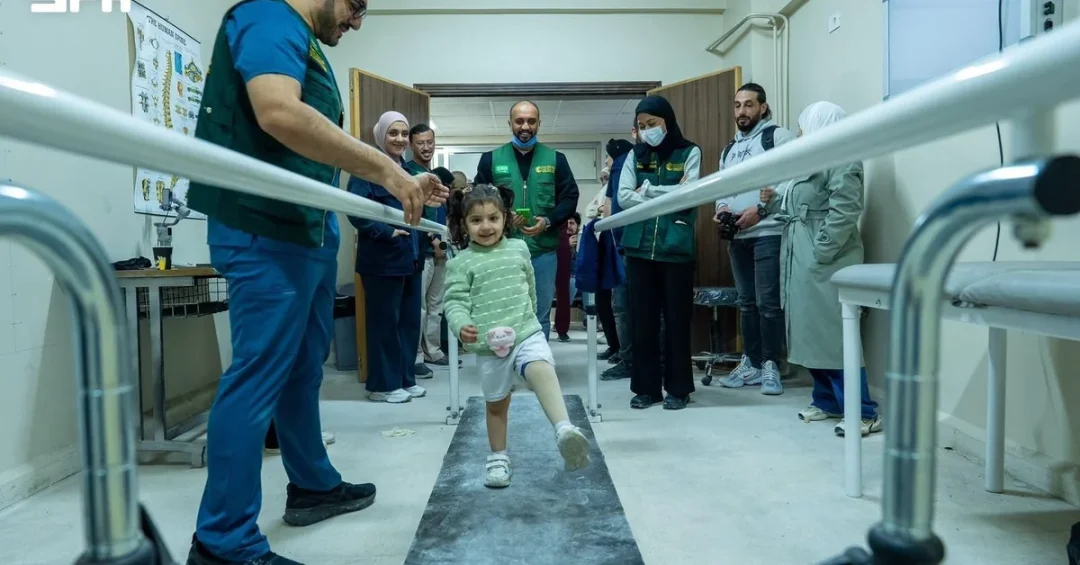
The King Salman Humanitarian Aid and Relief Center (KSrelief) concluded its volunteer medical project for prosthetics and physiotherapy in Damascus, the Syrian Arab Republic, on November 21, 2026, after a week-long initiative that delivered prosthetic limbs, orthotic devices, electric wheelchairs, and rehabilitation services to hundreds of beneficiaries. The project, which ran from November 14 to 21, was carried out by a team of nine Saudi volunteers specializing in prosthetics, orthotics, physiotherapy, and related medical fields, according to the Saudi Press Agency (SPA).
The campaign represents the latest expression of Saudi Arabia’s enduring humanitarian commitment to the Syrian people, implemented through KSrelief under the directives of the Kingdom’s leadership. It forms part of a broader framework of volunteer programs that Saudi Arabia operates worldwide to alleviate suffering and restore dignity to vulnerable communities. The initiative’s outcomes underscore the professionalism of Saudi medical volunteers and the effectiveness of KSrelief’s rapid-response model, which combines specialized medical expertise with logistical support to reach populations in need. How does such targeted assistance transform individual lives while strengthening the bonds of regional solidarity?
Context and Background
KSrelief has long been at the forefront of Saudi Arabia’s humanitarian diplomacy, operating in more than 90 countries and managing projects that span emergency relief, health care, education, and infrastructure. The volunteer medical project in Damascus is one of many such initiatives that reflect the Kingdom’s principled approach to helping communities affected by conflict and displacement. Since its establishment in 2015, KSrelief has implemented thousands of projects, with a particular focus on countries in the region facing acute crises. Its work in Syria is part of a sustained effort to address the medical and rehabilitation needs of a population that has endured years of hardship.
The decision to deploy a specialized medical team to Damascus follows a series of similar KSrelief missions in Syria, including surgical campaigns, dialysis treatments, and the distribution of medical supplies. These efforts are coordinated with local health authorities and international partners to ensure that aid reaches those most in need. The project also aligns with Saudi Arabia’s broader regional policy, which prioritizes stability, reconstruction, and the restoration of essential services in neighboring countries. By focusing on prosthetics and physiotherapy, KSrelief addresses a critical gap in post-trauma care, enabling individuals to regain mobility and reintegrate into their communities.
What makes this project particularly significant is its emphasis on capacity-building. By delivering lectures to local healthcare personnel, the Saudi team is not only providing immediate care but also transferring knowledge and skills that will benefit Syrian patients long after the volunteers return home. This dual approach—direct service and training—is a hallmark of KSrelief’s methodology, ensuring that the impact of each mission is multiplied through local empowerment. Isn’t that the essence of sustainable humanitarian work?
Key Details
According to official SPA data, the KSrelief volunteer team fitted 70 prosthetic limbs and 16 orthotic devices during the eight-day campaign. These devices were custom-made for each beneficiary, taking into account individual anatomical and functional requirements. The provision of prosthetics is a complex process that involves assessment, casting, fitting, and adjustment, and the fact that the team completed 86 devices in a week speaks to their expertise and dedication. In addition to prosthetic and orthotic services, the team distributed 100 electric wheelchairs, which will significantly enhance the mobility and independence of recipients.
The project also included a strong educational component. The volunteers delivered eight lectures to 390 local healthcare personnel, covering topics such as prosthetic technology, rehabilitation protocols, and patient management. This training is expected to improve the quality of care available in Damascus and surrounding areas, as local professionals apply their new knowledge in their daily practice. Furthermore, the team provided rehabilitation services to 125 individuals, offering physiotherapy and functional training tailored to each patient’s needs. The initiative reached a total of 701 direct and indirect beneficiaries, a figure that reflects both the patients themselves and their families or caregivers who benefit from their improved mobility.
The participation of nine volunteers from various medical specialties ensured a multidisciplinary approach. The team likely included prosthetists, orthotists, physiotherapists, and possibly nurses or technicians. Their collective efforts were coordinated by KSrelief’s field office, which handled logistics, security, and liaison with Syrian health authorities. The project’s success was made possible by the close cooperation between Saudi Arabia and Syrian medical institutions, demonstrating the potential of humanitarian collaboration even in challenging environments. How often do we see such seamless integration of relief and development in conflict-affected settings?
International and Regional Impact
The KSrelief project in Damascus sends a powerful message of hope and solidarity to the Syrian people and the wider region. By providing prosthetic limbs and rehabilitation services, Saudi Arabia is helping individuals who have suffered life-changing injuries to regain their independence and dignity. This not only transforms their personal lives but also reduces the burden on local healthcare systems and enables many to return to work or education. The ripple effects extend to families and communities, fostering stability and resilience. In a region where conflict has left deep scars, such initiatives contribute to healing and rebuilding trust.
From an international perspective, the project reinforces Saudi Arabia’s reputation as a leading humanitarian donor and a responsible global actor. KSrelief’s work is frequently cited by the United Nations and other international organizations as a model of effective, needs-based assistance. By operating in Syria, the Kingdom demonstrates its commitment to addressing the humanitarian dimensions of regional crises, even as it pursues political solutions. This balanced approach enhances Saudi Arabia’s soft power and positions it as a constructive partner in international efforts to alleviate suffering. Isn’t it remarkable how humanitarian action can transcend political divides and bring people together?
Economic and Strategic Significance
While the primary aim of the KSrelief project is humanitarian, it also carries strategic and economic implications. A healthier, more mobile population is better able to contribute to the economy, reducing dependency and enabling self-sufficiency. The rehabilitation of individuals with disabilities allows them to participate in the labor market, support their families, and engage in community life. Over time, this contributes to the overall productivity and stability of the region, which is in the interest of all stakeholders. Moreover, by building the capacity of local healthcare personnel, the project helps strengthen Syria’s health system, laying the groundwork for long-term recovery.
For Saudi Arabia, the initiative underscores the Kingdom’s commitment to regional stability and its willingness to invest in the well-being of neighboring populations. It also aligns with the objectives of Saudi Vision 2030, which emphasizes humanitarian leadership and global engagement as pillars of the Kingdom’s foreign policy. By showcasing its expertise in prosthetics and rehabilitation, Saudi Arabia positions itself as a center of excellence in medical volunteerism, potentially attracting partnerships and investment in related sectors. The project also demonstrates the efficiency of KSrelief’s operational model, which leverages Saudi medical talent and resources to deliver high-impact results at relatively low cost. How can such models be scaled up to address other pressing health challenges in the region?
Vision 2030 Alignment
The KSrelief volunteer medical project in Damascus is a concrete example of Saudi Vision 2030’s humanitarian and international cooperation goals. Vision 2030 seeks to strengthen the Kingdom’s role as a global leader in humanitarian aid and to promote sustainable development through knowledge transfer and capacity-building. By sending specialized medical volunteers to Syria, Saudi Arabia is not only providing immediate relief but also investing in the long-term health and stability of a neighboring country. This aligns with the Vision’s emphasis on creating a more diversified and compassionate economy, where social responsibility and global citizenship are valued.
Furthermore, the project reflects the Vision’s focus on empowering Saudi youth and professionals to contribute to global causes. The nine volunteers who participated in the mission are ambassadors of Saudi expertise and generosity, embodying the spirit of a nation that is both modern and rooted in Islamic values of charity and solidarity. As Saudi Arabia continues to expand its humanitarian footprint, initiatives like this will play a crucial role in building bridges with other nations and enhancing the Kingdom’s soft power. In a world that often focuses on differences, Saudi Arabia’s humanitarian work serves as a unifying force, demonstrating that compassion knows no borders. What greater legacy could a nation aspire to than to be a source of healing and hope for those in need?
20 Questions
Q1. What is the KSrelief volunteer medical project in Damascus?
A1. It is a humanitarian initiative by the King Salman Humanitarian Aid and Relief Center that provided prosthetic limbs, orthotic devices, electric wheelchairs, and physiotherapy to beneficiaries in Damascus from November 14 to 21, 2026.
Q2. How many volunteers participated in the project?
A2. Nine volunteers from various medical specialties participated, including prosthetists, orthotists, physiotherapists, and support staff, all coordinated by KSrelief.
Q3. How many prosthetic limbs were fitted?
A3. The team fitted 70 prosthetic limbs, each custom-made to meet the specific needs of the beneficiaries, restoring mobility and function.
Q4. How many orthotic devices were provided?
A4. Sixteen orthotic devices were provided, which are used to support or correct musculoskeletal deformities and improve patient stability.
Q5. How many electric wheelchairs were distributed?
A5. One hundred electric wheelchairs were distributed, significantly enhancing the independence and mobility of recipients with severe mobility impairments.
Q6. How many individuals received rehabilitation services?
A6. A total of 125 individuals received rehabilitation services, including physiotherapy and functional training tailored to their conditions.
Q7. How many lectures were delivered to local healthcare personnel?
A7. Eight lectures were delivered to 390 local healthcare personnel, covering topics such as prosthetic technology, rehabilitation protocols, and patient management.
Q8. What was the total number of beneficiaries reached?
A8. The initiative reached 701 direct and indirect beneficiaries, including patients, their families, and caregivers who benefit from improved mobility.
Q9. When did the project take place?
A9. The project was held from November 14 to 21, 2026, concluding on November 21, as reported by the Saudi Press Agency.
Q10. Where did the project take place?
A10. The project took place in Damascus, the capital of the Syrian Arab Republic, in coordination with local health authorities.
Q11. What is KSrelief?
A11. KSrelief is the King Salman Humanitarian Aid and Relief Center, a Saudi organization established in 2015 to provide international humanitarian assistance and relief.
Q12. Why did Saudi Arabia conduct this project in Syria?
A12. The project is part of Saudi Arabia’s ongoing efforts to assist the Syrian people, alleviate their suffering, and support regional stability through humanitarian action.
Q13. What is the significance of the project for Saudi-Syrian relations?
A13. It reflects Saudi Arabia’s commitment to humanitarian diplomacy and helps build bridges with the Syrian people, contributing to regional cooperation and goodwill.
Q14. How does the project align with Saudi Vision 2030?
A14. It aligns with Vision 2030’s goals of enhancing Saudi Arabia’s global humanitarian role, promoting sustainable development, and empowering Saudi professionals to contribute internationally.
Q15. What types of medical specialties were represented among the volunteers?
A15. The team included prosthetists, orthotists, physiotherapists, and possibly nurses or technicians, ensuring a multidisciplinary approach to patient care.
Q16. How does the project contribute to capacity-building in Syria?
A16. By training 390 local healthcare personnel through lectures, the project transfers knowledge and skills, strengthening Syria’s healthcare system for the long term.
Q17. What impact do electric wheelchairs have on beneficiaries?
A17. Electric wheelchairs provide greater independence and mobility, enabling recipients to perform daily activities, access services, and participate more fully in community life.
Q18. How does KSrelief select its volunteer projects?
A18. KSrelief identifies needs through field assessments and coordination with local authorities and international partners, ensuring assistance reaches the most vulnerable populations effectively.
Q19. What other types of projects does KSrelief implement in Syria?
A19. KSrelief has implemented surgical campaigns, dialysis treatments, medical supply distribution, and other health and relief projects to support the Syrian people.
Q20. What message does this project send to the international community?
A20. It demonstrates Saudi Arabia’s unwavering commitment to humanitarian principles, its capacity for effective relief work, and its role as a responsible global actor dedicated to alleviating suffering.
Reader Feedback
We value your thoughts. Please share your feedback on this article.
Your feedback helps us improve our coverage.
Related articles
 KSrelief Distributes 521 Food Baskets in Gaza Strip
 Riyadh Municipality Honored for UN Online Services Index
 Umrah Journey Averages 124 Minutes in Jumada Al-Ula
 Royal Court Announces Death of Prince Saud bin Abdulaziz
 Saudi Envoy Meets Arab League Assistant Secretary-General
 Saudi Official Receives Sudanese Consul General in Jeddah