


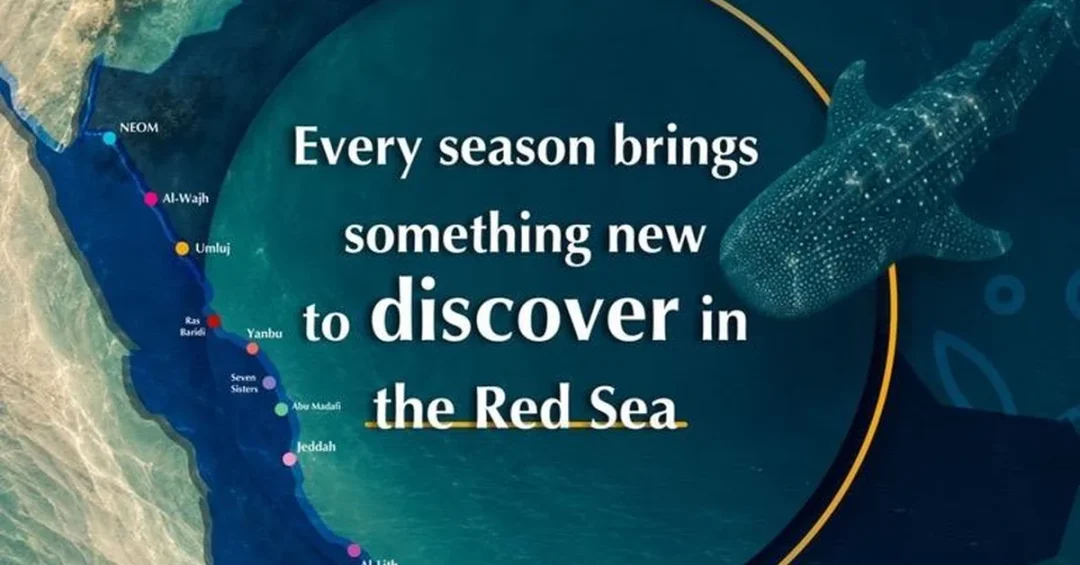
The Saudi Red Sea Authority (SRSA), in collaboration with the National Center for Wildlife and the General Organization for Conservation of Coral Reefs and Turtles in the Red Sea (SHAMS), under the umbrella of Red Sea Friends, has launched the Kingdom’s first Sighting Calendar of the Red Sea’s Giant Marine Creatures. Announced from Jeddah, the calendar is designed to introduce the Red Sea’s giant marine creatures, encourage visitors to discover and observe them in their natural habitats, and raise awareness of responsible wildlife-viewing practices, contributing to the protection of marine species and their natural habitats. The launch marks a significant step in Saudi Arabia’s efforts to position the Red Sea as a world-class destination for sustainable marine tourism and conservation.
Have you ever wondered what it would be like to witness a whale shark gliding through crystal-clear waters or to see a green turtle hatchling take its first steps toward the sea? The new Sighting Calendar makes such experiences more accessible and responsible, offering a seasonal and geographical guide to some of the ocean’s most majestic inhabitants. It serves as an informative guide for tourists, visitors, marine activity practitioners, wildlife enthusiasts, and marine tourism activity operators, providing essential information to help them identify the Red Sea’s giant marine creatures and plan their sighting experiences according to the seasons and locations where sightings are more frequent. This contributes to enriching tourism experiences and enhancing visitors’ enjoyment of the Red Sea’s unique natural attractions.
Context and Background
Why is the Red Sea such a magnet for marine biodiversity? The Red Sea is renowned for its exceptional biodiversity, hosting a wide array of marine species, many of which are unique to the region. Its coral reefs are among the most resilient in the world, and its waters serve as critical habitats for numerous threatened and migratory species. The Saudi Red Sea Authority, established to regulate and develop marine tourism along the Kingdom’s Red Sea coast, has been at the forefront of efforts to balance tourism development with environmental protection. The launch of the Sighting Calendar is a natural extension of this mandate, reflecting the integration of efforts among national entities concerned with protecting the marine environment and developing sustainable coastal tourism.
The calendar was developed in partnership with the National Center for Wildlife, which works to conserve and manage wildlife in Saudi Arabia, and the General Organization for Conservation of Coral Reefs and Turtles in the Red Sea (SHAMS), dedicated to protecting coral reefs and sea turtles. Under the umbrella of Red Sea Friends, a collaborative initiative, these entities have combined their expertise to create a tool that benefits both conservation and tourism. This collaboration underscores Saudi Arabia’s commitment to environmental stewardship, a key pillar of Vision 2030, which seeks to diversify the economy while preserving natural resources for future generations.
How does this calendar differ from ordinary wildlife guides? Unlike generic wildlife guides, the Sighting Calendar is tailored specifically to the Red Sea’s giant marine creatures, offering precise seasonal and location data. It features detailed information on the seasons and locations for sighting a range of giant marine creatures along the Saudi Red Sea coast. For instance, dolphins can be sighted year-round in NEOM, Al-Wajh, Umluj, Ras Baridi, Yanbu, Seven Sisters, Abo Madafi, Jeddah, Al-Lith, Blue Holes Protected Area, and Farasan Islands. Manta Rays are more frequent from April to August in Yanbu, Umluj, and Al-Lith, while Whale Sharks are more frequently observed from February to May in Al-Lith and near coastal areas in the southern Red Sea. Hammerhead Sharks are more frequently sighted during February and March in Yanbu and the southern Red Sea, including the Blue Holes Protected Area, while Bryde’s Whale is more frequently observed in August southwest and west of the Farasan Islands Protected Area.
The calendar also provides information on Glaucostegus Halavi, which can be sighted year-round in Al-Wajh, as well as Green Turtles, whose nesting season extends from April to July and whose hatchlings emerge from June to September, and Hawksbill Turtles, which can be sighted from May to July. The calendar identifies Al-Lith, Jazan, Umluj, Yanbu, Al-Wajh, Jeddah, and Ras Baridi as sighting locations for both turtle species, in addition to the Farasan Islands beaches for Hawksbill Turtles. This level of detail empowers visitors to plan their trips with minimal disturbance to wildlife, promoting responsible tourism practices.
Key Details
What exactly does the Sighting Calendar include? The calendar serves as a comprehensive guide, detailing the best times and places to observe species such as dolphins, manta rays, whale sharks, hammerhead sharks, Bryde’s whales, Glaucostegus Halavi (a type of guitarfish), and two species of sea turtles: the green turtle and the hawksbill turtle. Each entry includes seasonal windows and specific locations along the Saudi Red Sea coast, from NEOM in the north to the Farasan Islands in the south. The information is presented in an accessible format, likely both online and in print, to cater to a wide audience including tourists, marine operators, and conservationists.
The calendar’s launch is part of the Saudi Red Sea Authority’s and its partners’ efforts to enrich coastal tourism and marine tourism experiences, enhance knowledge of the marine environment, and highlight the Red Sea’s exceptional biodiversity. These efforts support the development of sustainable marine tourism products, raise awareness of the importance of protecting marine species and their natural habitats, and encourage the adoption of responsible practices when engaging in tourism and marine activities. For example, tour operators can use the calendar to schedule excursions that align with natural cycles, reducing stress on animals and ensuring visitors have meaningful encounters.
How will this calendar benefit local communities and the tourism industry? By promoting sustainable marine tourism, the calendar can drive economic growth in coastal communities. It encourages longer stays and repeat visits, as tourists seek to witness specific species during their peak seasons. This, in turn, supports local businesses such as hotels, restaurants, and guide services. Moreover, it fosters a sense of pride and stewardship among residents, who become ambassadors for the Red Sea’s natural heritage. The calendar also aligns with the Kingdom’s broader tourism goals, which aim to increase the sector’s contribution to GDP and create jobs for Saudi citizens.
International and Regional Impact
Could this calendar set a new standard for marine tourism globally? The Red Sea’s giant marine creatures are part of a shared global heritage, and Saudi Arabia’s proactive approach to managing their observation could serve as a model for other countries. By providing science-based guidelines, the calendar helps prevent overcrowding and harmful interactions, which are common pitfalls in wildlife tourism. International tourists, particularly those from Europe and Asia, are increasingly seeking authentic and sustainable travel experiences. The Sighting Calendar positions Saudi Arabia as a responsible destination that prioritizes conservation, potentially attracting a growing segment of eco-conscious travelers.
Regionally, the initiative strengthens cooperation among Red Sea nations. The Red Sea is bordered by several countries, and migratory species like whale sharks and sea turtles do not recognize national boundaries. Saudi Arabia’s efforts to document and share sighting data can contribute to regional conservation strategies. The involvement of SHAMS and the National Center for Wildlife also signals a commitment to scientific research and data collection, which can inform policies across the region. This collaborative spirit is essential for the long-term health of the Red Sea ecosystem.
Economic and Strategic Significance
What economic opportunities does the calendar unlock? Marine tourism is a high-value segment of the travel industry, and the Red Sea is one of Saudi Arabia’s most promising assets. The Sighting Calendar enhances the marketability of the Red Sea as a destination by offering unique, experiential travel opportunities. It supports the development of specialized tourism products such as guided wildlife-watching tours, photography expeditions, and educational programs. These activities can command premium prices and attract high-spending visitors, contributing to the Kingdom’s economic diversification goals.
Strategically, the calendar reinforces Saudi Arabia’s leadership in environmental conservation. It demonstrates that economic development and ecological protection can go hand in hand. This aligns with Vision 2030’s emphasis on sustainability and quality of life. By investing in such initiatives, Saudi Arabia is building a legacy of responsible stewardship that will benefit future generations. Furthermore, the calendar can serve as a tool for diplomacy, showcasing the Kingdom’s positive contributions to global environmental causes.
Vision 2030 Alignment
How does the Sighting Calendar connect to Vision 2030? Vision 2030 aims to diversify the Saudi economy away from oil, with tourism as a key pillar. The Red Sea Project and other giga-projects are central to this vision, and the Sighting Calendar complements these by adding a conservation-focused dimension. It promotes sustainable tourism, which is essential for preserving the natural attractions that draw visitors. The calendar also supports the Quality of Life Program, which seeks to enhance the lives of citizens and residents by providing recreational opportunities and promoting environmental awareness.
In conclusion, the launch of the Sighting Calendar of the Red Sea’s Giant Marine Creatures is a landmark achievement for Saudi Arabia. It reflects the Kingdom’s dedication to protecting its marine environment while sharing its wonders with the world. As the Red Sea continues to emerge as a top global destination, tools like this calendar will ensure that its treasures endure for generations to come. By fostering responsible practices and celebrating biodiversity, Saudi Arabia is not only enriching visitor experiences but also reinforcing its role as a leader in sustainable development and conservation.
20 Questions
Q1. What is the Sighting Calendar of the Red Sea’s Giant Marine Creatures?
A1. It is the Kingdom’s first guide launched by the Saudi Red Sea Authority, in collaboration with the National Center for Wildlife and SHAMS, to help visitors observe giant marine creatures responsibly and at the best times and locations.
Q2. Which entities collaborated to launch the calendar?
A2. The Saudi Red Sea Authority, the National Center for Wildlife, and the General Organization for Conservation of Coral Reefs and Turtles in the Red Sea (SHAMS), under the umbrella of Red Sea Friends.
Q3. What is the main purpose of the calendar?
A3. To introduce the Red Sea’s giant marine creatures, encourage responsible wildlife viewing, raise awareness of conservation, and enrich sustainable marine tourism experiences.
Q4. Which species are featured in the calendar?
A4. Dolphins, manta rays, whale sharks, hammerhead sharks, Bryde’s whales, Glaucostegus Halavi, green turtles, and hawksbill turtles.
Q5. Where and when can dolphins be sighted?
A5. Dolphins can be sighted year-round in NEOM, Al-Wajh, Umluj, Ras Baridi, Yanbu, Seven Sisters, Abo Madafi, Jeddah, Al-Lith, Blue Holes Protected Area, and Farasan Islands.
Q6. What is the best time and place to see manta rays?
A6. Manta rays are more frequent from April to August in Yanbu, Umluj, and Al-Lith.
Q7. When and where are whale sharks most commonly observed?
A7. Whale sharks are more frequently observed from February to May in Al-Lith and near coastal areas in the southern Red Sea.
Q8. Where can hammerhead sharks be sighted?
A8. Hammerhead sharks are more frequently sighted during February and March in Yanbu and the southern Red Sea, including the Blue Holes Protected Area.
Q9. What is the sighting period for Bryde’s whale?
A9. Bryde’s whale is more frequently observed in August southwest and west of the Farasan Islands Protected Area.
Q10. Where can Glaucostegus Halavi be seen?
A10. Glaucostegus Halavi can be sighted year-round in Al-Wajh.
Q11. When is the nesting season for green turtles?
A11. The nesting season for green turtles extends from April to July, and hatchlings emerge from June to September.
Q12. When can hawksbill turtles be sighted?
A12. Hawksbill turtles can be sighted from May to July.
Q13. Which locations are best for turtle sightings?
A13. Al-Lith, Jazan, Umluj, Yanbu, Al-Wajh, Jeddah, and Ras Baridi for both species, plus Farasan Islands beaches for hawksbill turtles.
Q14. How does the calendar promote responsible wildlife viewing?
A14. By providing seasonal and location guidance, it helps visitors avoid disturbing animals during critical periods and encourages respectful observation practices.
Q15. Who can benefit from the Sighting Calendar?
A15. Tourists, visitors, marine activity practitioners, wildlife enthusiasts, and marine tourism operators can all use the calendar to plan responsible sightings.
Q16. How does the calendar support Saudi Vision 2030?
A16. It supports economic diversification through sustainable tourism, enhances quality of life, and aligns with environmental conservation goals under Vision 2030.
Q17. What is the role of the National Center for Wildlife?
A17. The center works to conserve and manage wildlife in Saudi Arabia, providing scientific expertise and supporting initiatives like the Sighting Calendar.
Q18. What is SHAMS and what does it do?
A18. SHAMS is the General Organization for Conservation of Coral Reefs and Turtles in the Red Sea, dedicated to protecting these species and their habitats.
Q19. How will the calendar impact marine tourism in Saudi Arabia?
A19. It will enrich tourism experiences, attract eco-conscious travelers, support local economies, and promote sustainable practices, boosting the Red Sea’s appeal as a world-class destination.
Q20. Where can one access the Sighting Calendar?
A20. The calendar is expected to be available through the Saudi Red Sea Authority and its partners’ platforms, including websites and visitor centers, to reach a wide audience.
Reader Feedback
We value your thoughts. Please share your feedback on this article.
Your feedback helps us improve our coverage.
Related articles
 Supermoon Lights Up Sakaka’s Historic Zaabal Castle
 Ministry of Tourism Adds Five Services to Tawakkalna App
 Madinah Mountains: Natural Beauty, Islamic History
 Wasm Hail 2026: Qareh Trail Hike Showcases Natural Beauty
 Jubail Hills Festival Draws High Turnout
 Hail Authority Unveils Smart Robot, App at Wasm Hail 2026