


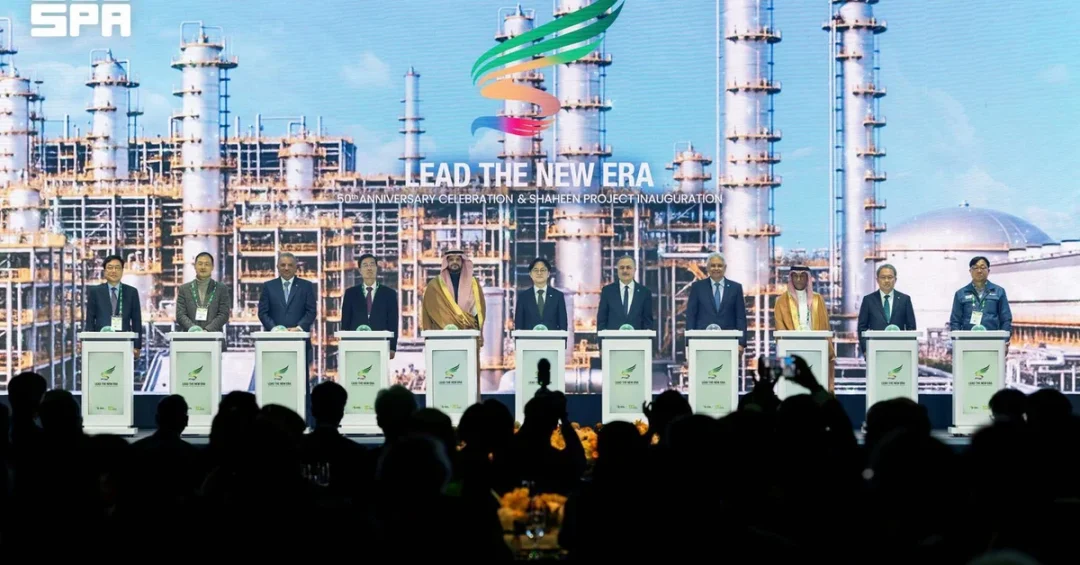
Saudi Aramco and its subsidiary S-OIL inaugurated the Shaheen Project in Seoul, Republic of Korea, on November 25, 2026, marking Aramco’s largest-ever investment in the country and a transformative milestone in the 35-year strategic partnership between the two energy leaders. The ceremony, attended by senior government and business leaders from Saudi Arabia and Korea, coincided with S-OIL’s 50th anniversary and underscored the deep economic ties between the Kingdom and the East Asian nation. The $7 billion project, which features the world’s largest single steam cracker and the first major commercial deployment of Aramco’s proprietary thermal crude to chemicals (TC2C™) technology, is set to redefine Korea’s downstream sector and strengthen Aramco’s integrated value chain. How does this inauguration signal a new era for Saudi-Korean energy cooperation? It reflects a shared commitment to innovation, resilience, and long-term growth.
The Shaheen Project represents a strategic bet on the future of petrochemicals, a sector critical to Asia’s key industries, from electric vehicles to semiconductors. By integrating refining and petrochemical processes, the facility will enable S-OIL to convert a larger share of crude oil into high-value chemicals, boosting its competitiveness and contributing to Korea’s industrial ecosystem. The project is expected to add approximately 3.2 million tons of annual petrochemical production capacity, increasing the share of petrochemicals in S-OIL’s portfolio from 12% to 25%. This development not only reinforces Aramco’s downstream strategy but also aligns with Saudi Arabia’s Vision 2030 goals of economic diversification and global investment. What does this mean for the global petrochemical landscape? It positions both partners at the forefront of a rapidly evolving market.
Context and Background
How did a partnership that began in 1991 evolve into one of the most significant energy collaborations in Asia? Aramco’s initial investment in S-OIL, a leading Korean refining and petrochemical company, laid the foundation for a relationship built on mutual trust and shared strategic interests. Over three decades, Aramco has increased its stake to more than 63% through its subsidiary Aramco Downstream Asia Pte. Ltd., becoming the majority shareholder. This deep integration has allowed both companies to leverage synergies across refining, petrochemicals, and lube base oil businesses. The Shaheen Project, named after the Arabic word for falcon, symbolizes vision, speed, and precision—qualities that have defined this partnership. It also coincides with S-OIL’s 50th anniversary, a testament to the company’s enduring role in Korea’s industrial development.
The project’s genesis lies in Aramco’s commitment to advancing its downstream capabilities and securing new markets for its crude oil. As the global energy transition accelerates, demand for petrochemicals is projected to rise, driven by population growth and urbanization in Asia. Aramco’s TC2C™ technology, developed in collaboration with Lummus Technology, addresses this by maximizing the conversion of crude oil into chemicals, reducing waste and enhancing value. The Shaheen Project is the first major commercial-scale application of this technology, representing a leap forward in efficiency and product diversification. It builds on Aramco’s broader strategy to expand its integrated refining and petrochemical footprint, which includes major projects in Saudi Arabia and Asia.
What makes the Ulsan integration so critical? The Shaheen facility is strategically located adjacent to S-OIL’s existing refining and petrochemical complex in Ulsan, Korea’s industrial heartland. This co-location enables seamless integration, allowing the project to share infrastructure, utilities, and feedstock streams. Dedicated pipeline networks will supply basic petrochemical feedstocks to nearby downstream companies, reducing their reliance on imports and logistics. This collaborative ecosystem is expected to enhance the competitiveness of the entire Ulsan petrochemical complex, fostering innovation and attracting further investment. The project also underscores Korea’s role as a key hub for advanced manufacturing and a vital partner in Saudi Arabia’s global economic outreach.
Key Details
What are the technological and operational highlights of the Shaheen Project? At its core, the facility features the world’s largest single steam cracker, a propylene fractionator, crude-to-chemicals conversion facilities, and polymer production units. These components work in concert to process crude oil directly into high-value chemicals, bypassing traditional refining steps. The TC2C™ technology enables a higher conversion rate, increasing the yield of petrochemicals from each barrel of crude. This innovation is expected to reduce carbon intensity and improve overall efficiency, aligning with global sustainability goals. Commercial operations are scheduled to commence in 2027 following the completion of commissioning, a timeline that reflects meticulous planning and execution.
Aramco President and CEO Amin H. Nasser emphasized the strategic importance of the project: “Economic headwinds and rising geopolitical risks do not alter our long-term view on strategic investments. One clear example is Shaheen, our largest ever investment in Korea, reflecting our confidence in the country and in the region that will drive future energy demand.” He added that the project will strengthen S-OIL’s international competitiveness and create more value from every barrel, positioning both companies to meet rising demand for materials essential to Asia’s key industries. Nasser also noted that as S-OIL celebrates its 50th anniversary, the project builds the foundation for its next 50 years and beyond.
Aramco Downstream President Mohammed Y. Al Qahtani highlighted the project’s role in enhancing industrial competitiveness: “Petrochemicals are critical to overall industrial competitiveness, and Shaheen brings cutting-edge technology to the region, helping position Korea as one of the world’s most competitive producers by prioritizing efficiency, technological differentiation, and value addition.” He underscored that the investment reflects a long-term vision for the partnership, focusing on advanced manufacturing that supports product diversification and industrial growth. Representative Director and CEO of S-OIL Anwar A. Al-Hejazi expressed pride in the milestone, stating that S-OIL will continue to strengthen synergies across its businesses and enhance global competitiveness through continuous innovation and investment.
International and Regional Impact
How will the Shaheen Project influence international energy markets and regional economic dynamics? By adding 3.2 million tons of annual petrochemical production capacity, the project will significantly boost the supply of high-value polymers and advanced materials, catering to growing demand in Asia and beyond. This increased capacity is expected to reduce Asia’s reliance on imports from other regions, enhancing supply chain resilience. For Korea, the project reinforces its position as a global leader in petrochemical production, driving exports and attracting further foreign investment. For Saudi Arabia, it demonstrates Aramco’s ability to execute large-scale international projects, strengthening its role as a reliable energy partner and a key player in the global downstream sector.
Regionally, the project deepens economic ties between Saudi Arabia and Korea, two nations that have cultivated a robust relationship spanning energy, infrastructure, and technology. It also aligns with Saudi Arabia’s Look East strategy, which seeks to expand partnerships in Asia, a region that accounts for a significant share of global energy demand. The collaboration is expected to spur further joint ventures and knowledge exchange, particularly in advanced manufacturing and clean energy technologies. Moreover, the project’s integration with the Ulsan petrochemical complex will create a ripple effect, benefiting local suppliers, service providers, and the broader Korean economy. What message does this send to other international partners? It showcases Saudi Arabia’s commitment to mutually beneficial investments that drive growth and innovation.
Economic and Strategic Significance
What economic and strategic benefits does the Shaheen Project deliver for Aramco and S-OIL? For Aramco, the project is a cornerstone of its downstream expansion, providing a stable outlet for its crude oil and diversifying its revenue streams. By moving further into petrochemicals, Aramco can capture higher margins and reduce exposure to volatile oil prices. The project also advances Aramco’s goal of increasing its refining and petrochemical capacity, a key pillar of its long-term strategy. For S-OIL, the integration of TC2C™ technology and the expansion of petrochemical production will enhance profitability and competitiveness, enabling it to better serve customers in Asia’s dynamic markets. The project is expected to create jobs, stimulate local economic activity, and reinforce Ulsan’s status as a premier industrial cluster.
Strategically, the Shaheen Project underscores the importance of international collaboration in an era of energy transition. By combining Aramco’s resource strength and technological innovation with S-OIL’s operational expertise and market access, the partnership exemplifies how cross-border investments can drive sustainable growth. It also highlights the role of petrochemicals in the global economy, as demand for plastics, synthetic fibers, and advanced materials continues to rise. The project’s focus on efficiency and value addition aligns with the goals of Saudi Vision 2030, which seeks to diversify the Kingdom’s economy and enhance its global competitiveness. How does this project contribute to Saudi Arabia’s economic transformation? It demonstrates the Kingdom’s ability to export not just energy, but also technology and investment, fostering new avenues for growth.
Vision 2030 Alignment
How does the Shaheen Project align with Saudi Vision 2030? Vision 2030 aims to diversify Saudi Arabia’s economy away from oil dependence, develop non-oil sectors, and strengthen international partnerships. Aramco’s investment in S-OIL and the Shaheen Project directly supports these objectives by expanding the Kingdom’s downstream footprint, generating returns from international assets, and showcasing Saudi technological leadership. The project also contributes to the development of human capital, as Saudi engineers and technicians collaborate with Korean counterparts, gaining valuable experience in advanced manufacturing. Furthermore, it reinforces Saudi Arabia’s position as a global investor, capable of deploying capital strategically to drive innovation and economic growth.
The inauguration of the Shaheen Project is a testament to the enduring partnership between Saudi Arabia and Korea and a clear example of how Vision 2030 is being realized on the world stage. As commercial operations begin in 2027, the project will not only enhance S-OIL’s competitiveness but also contribute to the resilience and sustainability of the global petrochemical industry. It reflects Saudi Arabia’s forward-looking approach to energy and its commitment to building a prosperous future through collaboration and innovation. What does the future hold for this partnership? It promises continued growth, shared success, and a model for international cooperation that others can emulate.
20 Questions
Q1. What is the Shaheen Project?
A1. The Shaheen Project is a $7 billion integrated refining and petrochemical complex in Ulsan, Korea, developed by Saudi Aramco and its subsidiary S-OIL. It features the world’s largest single steam cracker and Aramco’s TC2C™ technology.
Q2. When was the Shaheen Project inaugurated?
A2. The project was inaugurated on November 25, 2026, at a ceremony in Seoul, Republic of Korea, attended by senior government and business leaders from Saudi Arabia and Korea.
Q3. What is the significance of the Shaheen Project for Aramco?
A3. It is Aramco’s largest-ever investment in Korea, reflecting its confidence in the region’s future energy demand and its strategy to expand downstream operations and integrated value chains.
Q4. What technology does the Shaheen Project use?
A4. It uses Aramco’s proprietary thermal crude to chemicals (TC2C™) technology, developed with Lummus Technology, which converts crude oil directly into high-value chemicals with greater efficiency.
Q5. How much petrochemical production capacity will the project add?
A5. The project is expected to add approximately 3.2 million tons of annual petrochemical production capacity for S-OIL, increasing the share of petrochemicals in its portfolio from 12% to 25%.
Q6. What is S-OIL’s relationship with Aramco?
A6. Aramco is the majority shareholder of S-OIL, holding more than 63% of shares through its subsidiary Aramco Downstream Asia Pte. Ltd., a partnership that began in 1991.
Q7. When will commercial operations begin?
A7. Commercial operations are scheduled to commence in 2027 following the completion of commissioning, according to official Saudi sources.
Q8. How does the project integrate with existing facilities?
A8. It is integrated with S-OIL’s existing refining and petrochemical facilities in Ulsan, sharing infrastructure and providing feedstocks to nearby companies via dedicated pipelines.
Q9. What did Aramco CEO Amin Nasser say about the project?
A9. He stated that the project reflects long-term confidence in Korea and the region, strengthens S-OIL’s competitiveness, and creates more value from every barrel, building the foundation for the next 50 years.
Q10. What did S-OIL CEO Anwar Al-Hejazi say?
A10. He expressed pride in celebrating the milestone with Aramco and reaffirmed S-OIL’s commitment to strengthening synergies across its businesses and enhancing global competitiveness through innovation.
Q11. What are the key components of the Shaheen Project?
A11. The project includes the world’s largest single steam cracker, a propylene fractionator, crude-to-chemicals conversion facilities, and polymer production units, all designed for high efficiency.
Q12. How does the project benefit the Ulsan region?
A12. It strengthens the Ulsan petrochemical complex by providing stable domestic supply of feedstocks, reducing import reliance, and enhancing the competitiveness of the broader value chain.
Q13. What is the TC2C™ technology?
A13. TC2C™ is Aramco’s proprietary thermal crude to chemicals technology that integrates refining and petrochemical processes to increase the conversion of crude oil into high-value chemicals.
Q14. How does the project align with Saudi Vision 2030?
A14. It supports economic diversification, international investment, and technological leadership, key pillars of Vision 2030, by expanding Aramco’s downstream footprint and fostering global partnerships.
Q15. What is the strategic importance of the project for Korea?
A15. It positions Korea as one of the world’s most competitive petrochemical producers, enhances its industrial ecosystem, and reinforces its role as a key hub for advanced manufacturing.
Q16. How many years has Aramco and S-OIL been partners?
A16. The partnership began in 1991 with Aramco’s initial investment, marking over 35 years of strategic collaboration as of the project’s inauguration in 2026.
Q17. What products will the project produce?
A17. It will produce high-value polymers and advanced materials, including feedstocks for electric vehicles, semiconductors, and other key industries in Asia.
Q18. What is the expected impact on global petrochemical markets?
A18. The project will increase supply of high-value chemicals, reduce Asia’s import reliance, and enhance supply chain resilience, benefiting industries worldwide.
Q19. Who attended the inauguration ceremony?
A19. Senior government and business leaders from Saudi Arabia and Korea, as well as representatives of the energy and chemicals industries, attended the ceremony in Seoul.
Q20. What does the future hold for Aramco and S-OIL?
A20. The Shaheen Project lays the foundation for continued growth and innovation, with both companies poised to strengthen their global competitiveness and explore new opportunities in the years ahead.
Reader Feedback
We value your thoughts. Please share your feedback on this article.
Your feedback helps us improve our coverage.
Related articles
 Muthol, Riyadh Chamber Sign MoU to Boost Business Compliance
 GCC and GPCA Sign MoU to Enhance Cooperation
 Monsha’at Concludes Automotive Community Event in Riyadh
 SGS and EgyptAir Sign Ground Handling Deal for Saudi Airports
 The Garage Concludes Investor Meetup to Connect Tech Innovators with Investment Opportunities
 THC Signs MoU for First Residential Helipad at The Curves Tower