


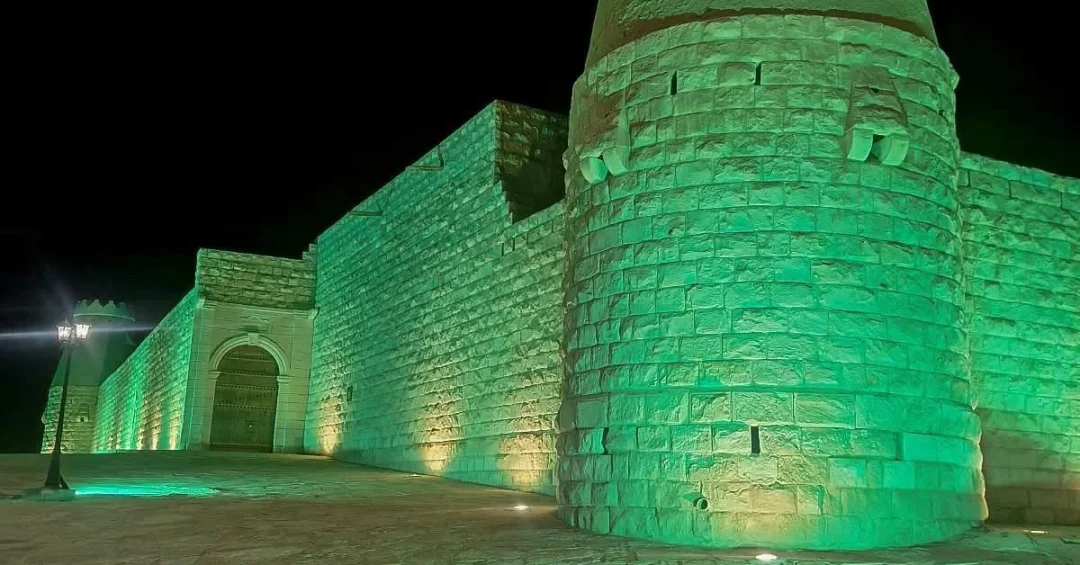
Landmark historical forts and archaeological sites across Al-Jouf Region were illuminated in green on September 23 to mark Saudi National Day, according to the Saudi Press Agency (SPA). The display, which lit up some of the Kingdom’s most storied monuments, drew residents and visitors alike to document the spectacle across the northern region. Among the sites bathed in green light were Zaabal Castle in Sakaka, Marid Castle in Dumat Al-Jandal, and the minaret of the Omar bin Al-Khattab Mosque, each a symbol of Al-Jouf’s deep historical roots. The initiative formed part of nationwide celebrations of the Kingdom’s unification, transforming ancient stone into a canvas for national pride.
Why do such gestures resonate so powerfully in a country racing toward the future? Saudi National Day, observed every September 23, commemorates the 1932 unification of the Kingdom under the late King Abdulaziz Al Saud. In Al-Jouf, a region celebrated for its archaeological wealth and strategic location near the Jordanian border, the green illumination served as more than a visual spectacle. It connected the nation’s foundational story to the living heritage of its northern communities, signaling that development and tradition can advance together. The event, reported by SPA, reflects a broader pattern of heritage-conscious celebration that has become a hallmark of the modern Saudi state.
Context and Background
What makes Al-Jouf such a fitting stage for a national celebration? The region, whose capital is Sakaka, sits in northwestern Saudi Arabia and forms part of the historic crossroads that linked the Arabian Peninsula to the Levant and Mesopotamia. Its landscape is dotted with castles, rock formations, and ancient settlements that testify to millennia of trade, pilgrimage, and cultural exchange. Zaabal Castle, perched on a rocky outcrop overlooking Sakaka, is believed to date back centuries and remains one of the region’s most recognizable silhouettes. Marid Castle in Dumat Al-Jandal, often associated with the legendary Queen Zenobia of Palmyra, ranks among the oldest and most imposing fortresses in the Kingdom. The Omar bin Al-Khattab Mosque, with its distinctive minaret, anchors the Islamic heritage of Dumat Al-Jandal, a town whose name evokes the ancient oasis settlement of Adummatu.
National Day itself carries layered meaning. It marks the moment in 1932 when King Abdulaziz formally proclaimed the unification of the Kingdom of Saudi Arabia, ending decades of fragmented rule across the peninsula. Over the past decade, under the leadership of Custodian of the Two Holy Mosques King Salman bin Abdulaziz Al Saud and His Royal Highness Crown Prince Mohammed bin Salman bin Abdulaziz Al Saud, the occasion has evolved into a nationwide festival of culture, entertainment, and civic pride. Regions across the Kingdom, from Riyadh to Jazan, organize their own programs, ensuring that the national story is told through local landmarks and local voices. Al-Jouf’s decision to illuminate its historic sites placed its own heritage at the center of that narrative.
The choice of green is far from arbitrary. Green is the color of the Saudi national flag, symbolizing the Kingdom’s Islamic identity, fertility, and renewal. Washing ancient fortresses in that hue creates a visual bridge between the distant past and the present day, reminding viewers that the nation’s strength draws on both inherited tradition and contemporary ambition. For international audiences, the images from Al-Jouf offer a window into a Saudi Arabia that is confident in its history and purposeful about its future.
Key Details of the Al-Jouf Illumination
Which monuments took center stage, and why do they matter? According to the Saudi Press Agency, the green illumination covered prominent monuments including Zaabal Castle in Sakaka, Marid Castle in Dumat Al-Jandal, and the minaret of the Omar bin Al-Khattab Mosque. Each site carries a distinct historical signature. Zaabal Castle, built from local stone, once served as a watchtower and defensive stronghold guarding the approaches to Sakaka. Its elevated position made it a natural beacon, and on National Day it became exactly that: a point of light visible across the surrounding area. Marid Castle, meanwhile, is one of the most celebrated archaeological landmarks in northern Saudi Arabia, its ruins rising above the palm groves of Dumat Al-Jandal. The minaret of the Omar bin Al-Khattab Mosque, a slender architectural landmark, represents the continuity of Islamic worship in a town that has hosted travelers and pilgrims for centuries.
The display drew residents and visitors to document the event across the region, SPA reported. That detail matters. In an era when a single photograph can travel the world in minutes, the illuminated castles became ambassadors for Al-Jouf, showcasing its heritage to audiences far beyond the Kingdom’s borders. Families gathered, cameras came out, and social media feeds filled with images of green-lit stone against the desert night sky. The scene captured a mood that has become familiar across Saudi Arabia in recent years: celebration that is at once deeply local and unmistakably national.
Importantly, the illumination was not an isolated stunt but part of a coordinated regional effort. Municipal and heritage authorities across Al-Jouf worked to ensure the sites were presented safely and respectfully, with lighting designed to enhance rather than obscure their architectural features. The result was a temporary transformation that honored the monuments’ permanence. For the communities of Sakaka and Dumat Al-Jandal, the event reinforced a sense of ownership over their heritage, while for the Kingdom as a whole it added another thread to the tapestry of National Day observances.
International and Regional Impact
How does a lighting ceremony in a northern Saudi region register on the international stage? The answer lies in what such events communicate about the Kingdom’s direction. Saudi Arabia has invested heavily in presenting its heritage as a global asset, from the archaeological treasures of AlUla to the rock art of Hail and the coastal history of the Red Sea. Al-Jouf’s illuminated castles contribute to that effort by signaling that the Kingdom’s cultural offer extends well beyond its most famous destinations. For international travelers and cultural institutions, the images from Sakaka and Dumat Al-Jandal are an invitation to look more closely at a region that has long been overlooked.
Regionally, the event reflects the stability and civic cohesion that Saudi Arabia projects across the Middle East. National Day celebrations in the Kingdom are watched closely by neighbors and partners alike, and the participation of remote regions underscores the reach of the state’s development agenda. Al-Jouf borders Jordan and sits near key north-south routes, giving it strategic weight in trade and logistics. When its landmarks light up in national colors, the gesture resonates beyond tourism; it affirms the integration of the Kingdom’s northern periphery into the national project. For international observers, the scene is a reminder that Saudi Arabia’s modernization is not confined to its major cities but is being expressed across its diverse regions.
The event also aligns with a broader global trend in which heritage sites are used as platforms for national storytelling. Countries around the world illuminate monuments on national days, but Saudi Arabia’s approach is distinctive in its scale and its connection to a comprehensive transformation agenda. The green light on Marid Castle is thus both a celebration and a statement: the past is not a constraint on the future but a foundation for it.
Economic and Strategic Significance
What economic logic underpins heritage celebrations in a region like Al-Jouf? Tourism is a pillar of Saudi Arabia’s economic diversification strategy, and heritage sites are among its most valuable assets. Al-Jouf’s castles and archaeological sites have the potential to attract domestic and international visitors, particularly as the Kingdom expands its tourism infrastructure and simplifies access through visa reforms. Events like the National Day illumination raise the profile of these sites, generating media coverage and public interest that can translate into future visitation. Local businesses, from hotels to guides to artisans, stand to benefit as awareness grows.
Strategically, the celebration reinforces the connection between cultural preservation and regional development. Al-Jouf is home to agricultural projects, renewable energy potential, and growing logistics links, all of which form part of the Kingdom’s broader economic vision. By spotlighting its heritage, the region strengthens its identity as a place worth investing in and visiting. The Saudi Press Agency’s coverage of the illumination is itself part of this equation, projecting a positive image of Al-Jouf to national and international audiences. In a diversified economy, cultural capital is economic capital, and Al-Jouf is demonstrating that it possesses both in abundance.
There is also a human capital dimension. When residents see their local landmarks celebrated on a national stage, it fosters pride and belonging, which in turn supports social stability and civic participation. Young people in Sakaka and Dumat Al-Jandal grow up with the message that their heritage matters to the entire Kingdom. That sense of significance can encourage careers in tourism, archaeology, conservation, and related fields, feeding the skilled workforce that Vision 2030 requires. The economic and the cultural are thus intertwined in ways that extend far beyond a single night of illumination.
Vision 2030 Alignment
How does a green glow on ancient castles connect to Saudi Vision 2030? The Vision, launched in 2016 under the leadership of Crown Prince Mohammed bin Salman, seeks to diversify the Kingdom’s economy, enrich the lives of its citizens, and strengthen its global standing. Culture and heritage are explicit pillars of that agenda. The Vision’s Quality of Life program aims to expand cultural and entertainment opportunities across the country, while tourism targets set ambitious goals for domestic and international visitors. Al-Jouf’s National Day illumination advances both objectives by turning heritage sites into focal points for community celebration and national storytelling.
The event also reflects the Vision’s commitment to balanced regional development. Rather than concentrating investment and attention in a few major cities, Saudi Arabia has worked to ensure that regions like Al-Jouf share in the benefits of modernization. Illuminating Zaabal Castle, Marid Castle, and the Omar bin Al-Khattab Mosque minaret is a small but meaningful expression of that principle. It says that the Kingdom’s heritage belongs to all its regions and that every community has a role in the national story. As Saudi Arabia continues its journey toward 2030 and beyond, such gestures will remain vital, connecting citizens to their past while pointing them toward a future of opportunity, openness, and pride.
20 Questions
Q1. What event prompted the green illumination of sites in Al-Jouf?
A1. The illumination marked Saudi National Day on September 23, commemorating the 1932 unification of the Kingdom. Landmarks across Al-Jouf Region were lit in green as part of nationwide celebrations, according to the Saudi Press Agency.
Q2. Which specific monuments were illuminated in Al-Jouf?
A2. The green illumination covered Zaabal Castle in Sakaka, Marid Castle in Dumat Al-Jandal, and the minaret of the Omar bin Al-Khattab Mosque, as reported by the Saudi Press Agency.
Q3. Where is Zaabal Castle located?
A3. Zaabal Castle is located in Sakaka, the capital of Al-Jouf Region in northwestern Saudi Arabia. It sits on an elevated rocky outcrop and is one of the region’s most recognizable historical landmarks.
Q4. What is significant about Marid Castle?
A4. Marid Castle in Dumat Al-Jandal is one of the oldest and most imposing fortresses in Saudi Arabia. It is associated with the legendary Queen Zenobia and stands above the historic oasis town.
Q5. Why was the Omar bin Al-Khattab Mosque minaret included?
A5. The minaret represents the Islamic heritage of Dumat Al-Jandal and the continuity of worship in a town that has hosted travelers and pilgrims for centuries. Its inclusion highlighted the region’s religious and cultural significance.
Q6. Why is green the chosen color for Saudi National Day celebrations?
A6. Green is the color of the Saudi national flag, symbolizing Islamic identity, fertility, and renewal. Illuminating heritage sites in green visually connects the Kingdom’s past with its present ambitions.
Q7. Who ordered or organized the illumination in Al-Jouf?
A7. The event was part of coordinated regional National Day programs involving local authorities and heritage officials. The Saudi Press Agency reported the illumination as part of nationwide celebrations across the Kingdom.
Q8. How did residents and visitors respond to the display?
A8. According to SPA, residents and visitors gathered to document the displays across the region. The illuminated monuments became popular subjects for photography and social media sharing.
Q9. What is the historical significance of Al-Jouf Region?
A9. Al-Jouf sits at a historic crossroads linking the Arabian Peninsula to the Levant and Mesopotamia. Its castles, rock formations, and ancient settlements reflect millennia of trade, pilgrimage, and cultural exchange.
Q10. When is Saudi National Day observed each year?
A10. Saudi National Day is observed on September 23 each year. It commemorates the 1932 proclamation by King Abdulaziz Al Saud that unified the Kingdom of Saudi Arabia.
Q11. How does this event support Saudi tourism goals?
A11. By raising the profile of Al-Jouf’s heritage sites, the event can attract domestic and international visitors. Tourism is a key pillar of Saudi Arabia’s economic diversification strategy under Vision 2030.
Q12. What role does the Saudi Press Agency play in such events?
A12. The Saudi Press Agency is the Kingdom’s official news agency. It documents and reports on national events, providing authoritative coverage that reaches domestic and international audiences.
Q13. Does the illumination damage the historical sites?
A13. The lighting was designed to enhance the monuments’ architectural features safely and respectfully. Heritage authorities ensure that such displays do not harm the structures.
Q14. How does this event reflect Vision 2030?
A14. Vision 2030 emphasizes cultural enrichment, tourism development, and balanced regional growth. Celebrating heritage in Al-Jouf supports these goals by promoting local culture and attracting attention to the region.
Q15. What other regions in Saudi Arabia hold National Day events?
A15. National Day celebrations take place across all regions of the Kingdom, from Riyadh and Jeddah to Jazan, Hail, and Al-Jouf. Each region highlights its own landmarks and cultural traditions.
Q16. What is Dumat Al-Jandal known for?
A16. Dumat Al-Jandal is an ancient oasis town in Al-Jouf Region, known for Marid Castle, its palm groves, and its long history as a crossroads for trade and pilgrimage in northern Arabia.
Q17. How can international tourists visit Al-Jouf?
A17. International tourists can visit Al-Jouf through Saudi Arabia’s expanded visa programs, including tourist visas. The region is accessible by domestic flights and road networks from major cities.
Q18. What economic benefits can Al-Jouf expect from heritage tourism?
A18. Heritage tourism can support local businesses such as hotels, guides, and artisans. It also creates jobs and encourages investment in infrastructure, aligning with the Kingdom’s diversification goals.
Q19. Why are heritage celebrations important for national unity?
A19. They connect citizens across regions to a shared national story. When local landmarks are celebrated nationally, communities feel valued and included in the Kingdom’s broader progress.
Q20. What does the Al-Jouf illumination say about Saudi Arabia’s future?
A20. It shows a Kingdom that honors its past while pursuing a bold future. By celebrating heritage alongside modernization, Saudi Arabia demonstrates confidence, unity, and commitment to Vision 2030.
Reader Feedback
We value your thoughts. Please share your feedback on this article.
Your feedback helps us improve our coverage.
Related articles
 Madinah Marks National Day with Military Parade, Heritage Shows
 Jazan Celebrates National Day Across 16 Governorates
 Saudi Ardah Takes Center Stage at Makkah National Day Celebrations
 House of Islamic Arts in Jeddah Marks Saudi National Day
 King Abdulaziz Public Library China branch wins two awards
 National Day Celebrations Continue Across Hail