


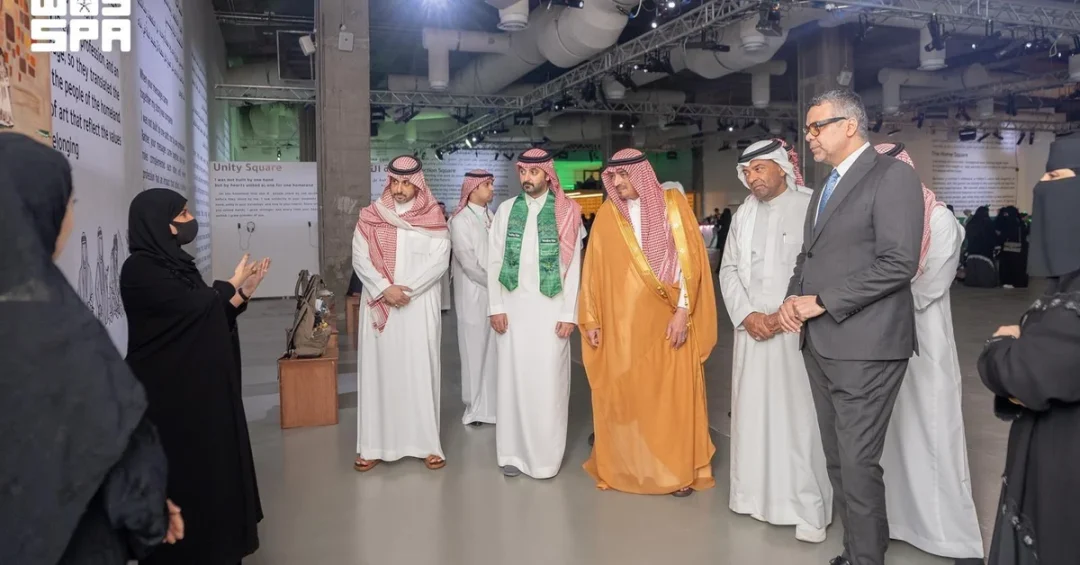
The House of Islamic Arts in Jeddah marked Saudi National Day with an interactive exhibition that guided visitors through the nation’s social journey, core values, and developmental milestones across five themed zones, the Saudi Press Agency reported. The event, staged in the historic Red Sea port city, offered citizens, residents, and international guests a structured walkthrough of the Kingdom’s story, from the safeguarding of its borders to the empowerment of its people and the modern quality of life enjoyed today. Each zone was designed to connect visitors emotionally and intellectually with the national narrative, using interactive displays rather than static presentations. The exhibition concluded with a display underscoring the family home as the primary foundation for nurturing civic values and national belonging, a message that resonated strongly with attendees of all ages.
The timing of the exhibition carried particular weight. Saudi National Day commemorates the unification of the Kingdom in 1932 under the leadership of the founding monarch, King Abdulaziz Al Saud, and has evolved in recent years into a broad celebration of national identity, heritage, and future ambition. By choosing a cultural institution such as the House of Islamic Arts as its venue, the organizers linked the nation’s deep artistic and religious heritage directly to its contemporary transformation. Visitors moved through the five zones in sequence, encountering themes of border security, national unity, economic and social progress, citizen empowerment, and family life. The result was a narrative arc that presented the Kingdom’s development not as a series of isolated achievements but as a connected, purposeful journey. The Saudi Press Agency described the tour as a celebration of both the nation’s social journey and its core values.
Context and Background
Why does an exhibition inside a Jeddah arts institution matter for a national occasion of this scale? The House of Islamic Arts has established itself as a cultural landmark in Jeddah, a city with a long history as a gateway for pilgrims, traders, and travelers arriving by sea. Its collections and programs focus on Islamic artistic traditions, calligraphy, and craftsmanship, making it a natural setting for an event that sought to connect national identity with cultural heritage. Saudi National Day itself has grown from a formal commemoration into a nationwide period of public engagement, with events across the Kingdom spanning music, light shows, heritage displays, and community activities. Cultural institutions increasingly play a central role in this evolution, offering curated experiences that complement official ceremonies and public festivities.
The exhibition’s five themed zones reflected priorities that have defined Saudi policy in recent years. Border security honors the men and women who protect the Kingdom’s frontiers, a theme that resonates in a region where stability is closely tied to development. National unity speaks to the cohesion of a society that has absorbed rapid change while preserving its traditions. The economic and social progress zone highlighted the scale of transformation underway, while citizen empowerment and quality of life addressed the human dimension of national advancement. The final display, centered on the family home, tied the entire experience back to the values that underpin Saudi society. Taken together, the zones presented a deliberate argument: that security, unity, prosperity, and family are interlinked foundations of the national project.
The choice to stage the exhibition in Jeddah also reflects the city’s distinctive position in Saudi cultural life. Jeddah has long been associated with openness, trade, and the arts, and its historic district, Al-Balad, is recognized for its coral-stone architecture and UNESCO World Heritage status. Hosting a national celebration in such a setting reinforces the idea that modernization and heritage can advance together. For international audiences, the event offers a window into how Saudi Arabia presents its own story, not through political slogans but through curated cultural experiences that invite participation and reflection.
Key Details
What did visitors actually experience as they moved through the exhibition? According to the Saudi Press Agency, the event was structured as an interactive exhibition rather than a conventional display, meaning that guests were encouraged to engage with the content directly. The five themed zones guided participants through sections honoring border security, national unity, and modern economic and social progress. The tour also celebrated citizen empowerment and quality of life, concluding with a display underscoring the family home as the primary foundation for nurturing civic values and national belonging. This structure allowed the organizers to move from the outer boundaries of the state to the inner life of the family, creating a logical and emotionally resonant sequence.
The interactive format is significant in itself. Cultural institutions in Saudi Arabia have increasingly adopted immersive and participatory approaches to storytelling, reflecting a broader shift in how the Kingdom communicates its achievements and aspirations. Rather than presenting visitors with information passively, the exhibition invited them to walk through a narrative, encountering each theme as part of a coherent whole. This approach aligns with international best practice in museum and exhibition design, where engagement and emotional connection are prioritized over simple information transfer. For families attending the event, the experience offered an opportunity to discuss national values across generations, from grandparents who remember earlier chapters of the Kingdom’s development to young children growing up in a rapidly changing society.
The closing display on the family home carried particular symbolic weight. By identifying the household as the primary foundation for nurturing civic values and national belonging, the exhibition placed the family at the center of the national story. This framing is consistent with Saudi social policy, which has consistently emphasized the family as the basic unit of society and a source of stability and identity. Visitors left the exhibition with a message that connected personal life to national purpose, suggesting that the Kingdom’s future depends as much on strong families as on economic diversification or infrastructure. The Saudi Press Agency’s account emphasized this concluding theme as the culmination of the tour.
International and Regional Impact
How do cultural events like this shape international perceptions of Saudi Arabia? For global audiences, national day celebrations and cultural exhibitions provide accessible entry points for understanding the Kingdom’s priorities and self-image. The House of Islamic Arts exhibition presented Saudi Arabia as a nation that values its heritage, invests in its people, and understands its development as a connected journey rather than a collection of isolated projects. This narrative is particularly relevant at a time when the Kingdom is attracting unprecedented numbers of international visitors, investors, and partners. Cultural diplomacy of this kind complements formal diplomatic engagement, offering foreign audiences a human-scale view of Saudi society that statistics and policy documents cannot provide.
Regionally, the exhibition’s themes of border security and national unity speak to concerns shared across the Gulf and the wider Middle East. Stability and cohesion are prerequisites for the economic transformation programs underway in Saudi Arabia and its neighbors. By celebrating border security personnel and emphasizing unity, the event acknowledged the efforts that make development possible. The focus on citizen empowerment and quality of life also reflects a regional trend in which governments are investing more heavily in education, healthcare, entertainment, and cultural infrastructure. Saudi Arabia’s approach, anchored in Vision 2030, has become a reference point for other countries considering similar reforms. The exhibition thus functioned simultaneously as a domestic celebration and an international statement about the Kingdom’s direction.
Economic and Strategic Significance
What does a national day exhibition reveal about Saudi Arabia’s economic and strategic priorities? The zones devoted to economic and social progress and to quality of life mirror the core objectives of Vision 2030, the national transformation program launched in 2016 under the leadership of Crown Prince Mohammed bin Salman. That program seeks to diversify the economy away from oil dependence, expand the private sector, increase women’s participation in the workforce, and improve public services. Cultural and entertainment events have themselves become economic contributors, supporting tourism, hospitality, retail, and creative industries. By hosting exhibitions that draw visitors and generate media coverage, institutions like the House of Islamic Arts participate in this broader economic diversification.
Strategically, the emphasis on citizen empowerment signals a long-term investment in human capital. A diversified economy requires a skilled, engaged, and confident population, and national celebrations that highlight individual achievement and quality of life reinforce this message. The exhibition’s structure, moving from border security to family life, can be read as a statement that national strength rests on multiple pillars: protection, cohesion, prosperity, and values. For international observers, this holistic framing suggests that Saudi Arabia’s transformation is not merely about megaprojects or financial targets but about building a society capable of sustaining long-term growth. The event also demonstrated the capacity of Saudi cultural institutions to design and deliver sophisticated public programming, a capability that supports the Kingdom’s growing tourism and cultural sectors.
Vision 2030 Alignment
How does a single exhibition in Jeddah connect to a national vision spanning more than a decade? Vision 2030 includes explicit goals related to culture, heritage, and quality of life, recognizing that economic transformation must be accompanied by social and cultural enrichment. The House of Islamic Arts exhibition embodied several of these goals at once: it celebrated national heritage, promoted cultural engagement, highlighted citizen empowerment, and reinforced the values that underpin social stability. By presenting the nation’s journey through interactive zones, the event also supported the vision’s emphasis on education and lifelong learning, offering visitors an experience that was both celebratory and informative. The family-focused conclusion aligned with the vision’s commitment to strengthening society and enhancing the environment in which future generations will grow.
As Saudi Arabia continues its transformation, cultural institutions will play an increasingly prominent role in telling the national story to domestic and international audiences. The National Day exhibition at the House of Islamic Arts demonstrated how heritage and modernity can be woven together in a single narrative, and how public celebrations can serve as platforms for meaningful engagement rather than mere spectacle. For a Kingdom pursuing global leadership in tourism, culture, and innovation, such events are not peripheral but central to the broader project of national development. The Saudi Press Agency’s coverage underscored the exhibition’s message: that the family home remains the foundation of civic values and national belonging, and that the Kingdom’s future is built on the same unity and purpose that have defined its journey since 1932.
20 Questions
Q1. What event did the House of Islamic Arts in Jeddah host to mark Saudi National Day?
A1. The House of Islamic Arts in Jeddah hosted an interactive exhibition depicting the nation’s social journey, core values, and developmental milestones across five themed zones, according to the Saudi Press Agency.
Q2. How many themed zones were featured in the exhibition?
A2. The exhibition featured five themed zones, guiding visitors through sections that honored border security, national unity, modern economic and social progress, citizen empowerment, and quality of life.
Q3. What was the final display of the exhibition about?
A3. The tour concluded with a display underscoring the family home as the primary foundation for nurturing civic values and national belonging, emphasizing the family’s central role in Saudi society.
Q4. Which official source reported on the exhibition?
A4. The exhibition was reported by the Saudi Press Agency (SPA), the Kingdom’s official news agency, which provided details about the event’s structure and themes.
Q5. In which city did the exhibition take place?
A5. The exhibition took place in Jeddah, a historic Red Sea port city known for its cultural heritage, arts scene, and role as a gateway for pilgrims and travelers.
Q6. What does Saudi National Day commemorate?
A6. Saudi National Day commemorates the unification of the Kingdom in 1932 under the leadership of the founding monarch, King Abdulaziz Al Saud, and celebrates national identity and heritage.
Q7. Why is the House of Islamic Arts a significant venue for this event?
A7. The House of Islamic Arts is a cultural landmark in Jeddah dedicated to Islamic artistic traditions, calligraphy, and craftsmanship, making it a fitting setting for an event connecting national identity with cultural heritage.
Q8. What theme did the border security zone address?
A8. The border security zone honored the men and women who protect the Kingdom’s frontiers, a theme reflecting the importance of stability as a foundation for national development and prosperity.
Q9. How did the exhibition address citizen empowerment?
A9. The exhibition celebrated citizen empowerment and quality of life, highlighting the human dimension of national advancement and the Kingdom’s investment in its people’s skills, well-being, and opportunities.
Q10. What was the interactive nature of the exhibition?
A10. The exhibition was designed as an interactive experience rather than a static display, encouraging visitors to engage directly with the content as they moved through the five themed zones.
Q11. How does the exhibition reflect Saudi Arabia’s social journey?
A11. The exhibition traced the nation’s social journey from border security and national unity to economic progress, citizen empowerment, and family values, presenting development as a connected and purposeful narrative.
Q12. What role do cultural institutions play in Saudi National Day celebrations?
A12. Cultural institutions increasingly play a central role in National Day celebrations, offering curated experiences that complement official ceremonies and public festivities while showcasing the Kingdom’s heritage and modern achievements.
Q13. How does the exhibition connect to Vision 2030?
A13. The exhibition aligns with Vision 2030 goals related to culture, heritage, quality of life, education, and citizen empowerment, reflecting the national transformation program’s emphasis on social and cultural enrichment alongside economic diversification.
Q14. What message did the family home display convey?
A14. The family home display conveyed that the household is the primary foundation for nurturing civic values and national belonging, placing the family at the center of the national story and future development.
Q15. Why is Jeddah significant for hosting national cultural events?
A15. Jeddah has long been associated with openness, trade, and the arts, and its historic district, Al-Balad, is a UNESCO World Heritage site, making it a distinctive setting for national cultural celebrations.
Q16. How does the exhibition support Saudi Arabia’s tourism sector?
A16. By attracting visitors and generating media coverage, exhibitions like this support tourism, hospitality, retail, and creative industries, contributing to the economic diversification goals of Vision 2030.
Q17. What does the focus on national unity signify?
A17. The focus on national unity signifies the cohesion of Saudi society, which has absorbed rapid change while preserving its traditions, and reflects the shared purpose that underpins the Kingdom’s development.
Q18. How might international audiences interpret this exhibition?
A18. International audiences may view the exhibition as a window into Saudi Arabia’s self-image, presenting the Kingdom as a nation that values heritage, invests in its people, and pursues connected, long-term development.
Q19. What economic themes were highlighted in the exhibition?
A19. The exhibition highlighted modern economic and social progress, reflecting Vision 2030’s objectives to diversify the economy, expand the private sector, and improve public services and quality of life.
Q20. What is the broader significance of this National Day exhibition?
A20. The exhibition demonstrated how heritage and modernity can be woven together, showing that public celebrations can serve as platforms for meaningful engagement and reinforce the values underpinning Saudi Arabia’s long-term national vision.
Reader Feedback
We value your thoughts. Please share your feedback on this article.
Your feedback helps us improve our coverage.
Related articles
 King Abdulaziz Public Library China branch wins two awards
 National Day Celebrations Continue Across Hail
 Saudi Library Branch in China Wins Two Prestigious Awards
 Al-Qadsiah Club National Day carnival attracts 25,000 visitors
 Diriyah Celebrates National Day as Living Memory of the Nation
 Arabian Horses Adorn National Day in Al-Baha