


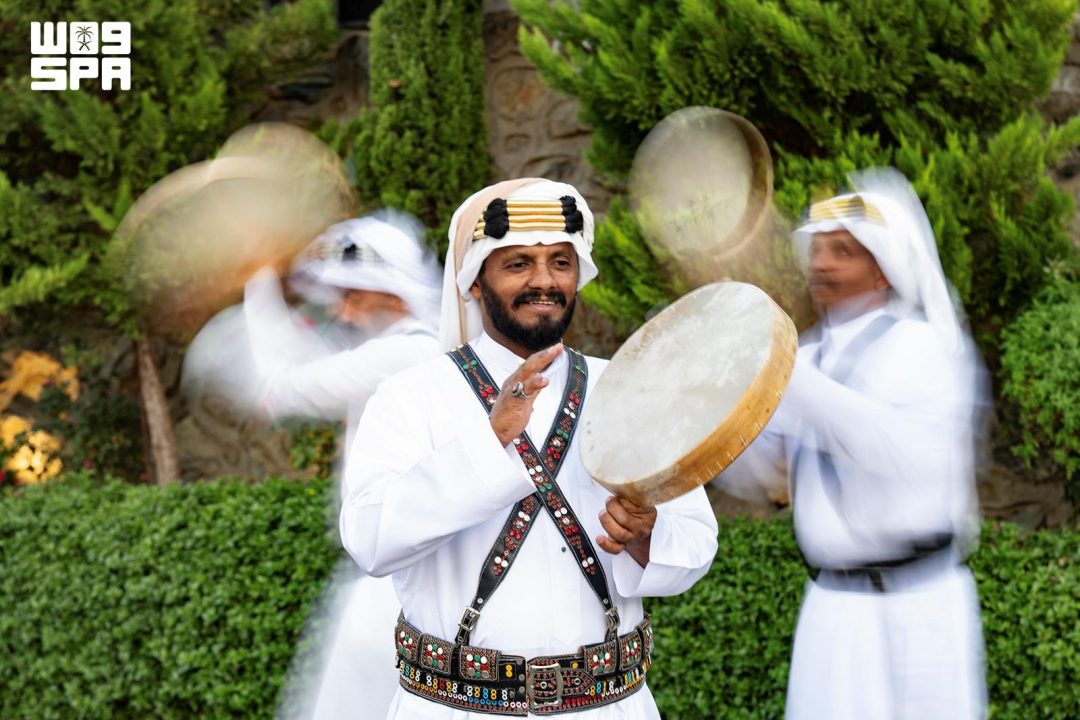
Taif is home to Al-Majrour, one of the oldest traditional arts in the governorate, which has transitioned from social occasions and weddings to cultural festivals and events attended by locals and visitors.
According to SPA, the art is characterized by participants forming two facing rows that alternate in performing poetic texts and melodies, while tambourine and drum players occupy the center of the performance area.
The performance integrates spoken words, rhythm, and movement, with performers wearing traditional clothing, most notably the Al-Huwaysi. The art includes specific internal terminology inherited by practitioners, such as Al-Shabshara, Al-Muqata’a, Al-Damdama, and Al-Kasra, along with performance patterns known as Al-Murabba and Al-Mukhawmas.
Al-Majrour is practiced across various districts, neighborhoods, and villages within Taif, serving as a local memory of celebration and poetry. The source did not mention the specific number of active troupes currently practicing the art.
What are the main components of an Al-Majrour performance in Taif? The performance consists of participants arranged in two facing rows that alternate in reciting poetry and melodies. In the center of the display area, drummers and tambourine players provide the rhythm that coordinates the movements and voices of the performers.
What traditional attire is associated with Al-Majrour? Performers of Al-Majrour wear traditional clothing that forms part of the art’s identity, specifically the Al-Huwaysi. This attire allows visitors to experience the art through both sound and visual imagery reminiscent of old social occasions in Taif.
What are the technical terms and patterns used in Al-Majrour? Practitioners use specific inherited terms including Al-Shabshara, Al-Muqata’a, Al-Damdama, and Al-Kasra. Additionally, the art features distinct performance patterns known as Al-Murabba and Al-Mukhawmas, which define its artistic structure and rhythms.